
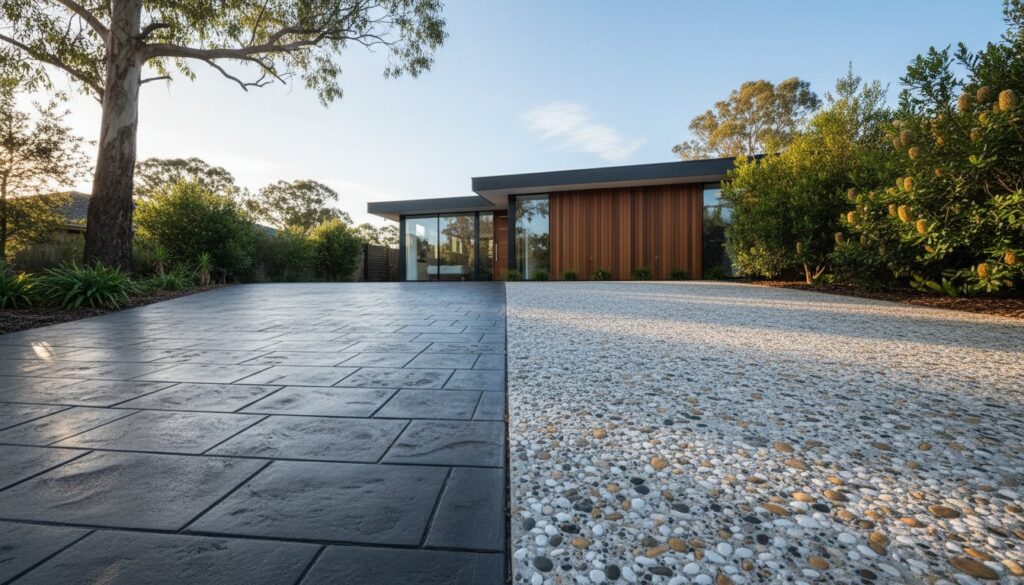
Your driveway is a structural bridge over Sydney’s notoriously reactive clay soil, not just a place to park. Choosing the wrong finish can lead to costly repairs or slippery surfaces that put your family at risk during a wet winter. When weighing up stamped vs exposed aggregate pros and cons, you aren’t just picking a pattern. You are selecting the engineering that protects your home’s first impression and your long-term property value.
The choice is particularly critical because of Sydney’s reactive clay soils. These soils expand and contract with the seasons, putting immense pressure on rigid surfaces. Stamped concrete is a process where we imprint wet concrete with specialized mats to mimic premium materials like European slate, cobblestone, or even timber planks. In contrast, exposed aggregate involves stripping away the top layer of concrete “cream” to reveal a dense, textured bed of natural stones, quartz, or basalt. To better understand the technical foundations of these methods, you can explore What is Decorative Concrete? to see how these artisanal techniques differ from standard grey pours, or explore Decorative Concrete options to see finished examples in professional portfolios.
We know you want a high-end finish that balances elegant aesthetics with the rugged durability needed for the local climate. You deserve a surface that stays safe underfoot and remains cool under the summer sun. This guide breaks down the critical differences between these two popular finishes, from the $95 to $200 per square metre investment levels to the latest 2026 design trends. We will walk you through the 4 to 6 week council permit process and the Australian Standard 100 mm thickness requirements to ensure your project is built to last. Let’s inspire your next outdoor transformation with a finish that is as safe as it is sophisticated.
Key Takeaways
- Understand the stamped vs exposed aggregate pros and cons to determine which finish aligns with your home’s architectural style and Sydney’s unique terrain.
- Compare the slip-resistance levels of both finishes to ensure your driveway or pool surround remains safe for children and vehicles during Sydney’s wet months.
- Learn how to navigate the 2026 council permit landscape and the specific Australian Standards required for a durable, high-end concrete installation.
- Identify which decorative finish offers the best long-term value by evaluating maintenance requirements and resistance to the region’s reactive clay soils.
- Discover how bespoke aggregate blends and intricate stamped patterns can transform your outdoor living space into a seamless extension of your home.
Defining the Decorative Dilemma: Stamped vs. Exposed Aggregate
Sydney’s residential landscape in 2026 demands more than just utility; it requires a fusion of structural resilience and high-end aesthetics. For homeowners across the Greater Sydney basin, the driveway or alfresco area is often the largest visible element of the property. Selecting the right finish is a high-stakes decision that directly impacts curb appeal and long-term property value. When you evaluate the stamped vs exposed aggregate pros and cons, you are balancing the desire for a bespoke look with the technical requirements of your specific site.
The choice is particularly critical because of Sydney’s reactive clay soils. These soils expand and contract with the seasons, putting immense pressure on rigid surfaces. Stamped concrete is a process where we imprint wet concrete with specialized mats to mimic premium materials like European slate, cobblestone, or even timber planks. In contrast, exposed aggregate involves stripping away the top layer of concrete “cream” to reveal a dense, textured bed of natural stones, quartz, or basalt. To better understand the technical foundations of these methods, you can explore What is Decorative Concrete? to see how these artisanal techniques differ from standard grey pours.
The Aesthetic Role of Decorative Concrete in Sydney
Your property’s facade sets the tone for your entire home. Whether you own a heritage Federation cottage in the Inner West or a sleek, contemporary build in the Hills District, the concrete finish should feel like a natural extension of the architecture. We focus on “Inspired” design, which means moving beyond basic functionality to create a seamless transition from your internal living areas to your outdoor spaces. Stamped patterns offer a formal, structured elegance that complements traditional homes, while the earthy, organic textures of exposed aggregate are the current number one choice for modern Sydney landscapes because they blend effortlessly with the Australian environment.
Core Differences at a Glance
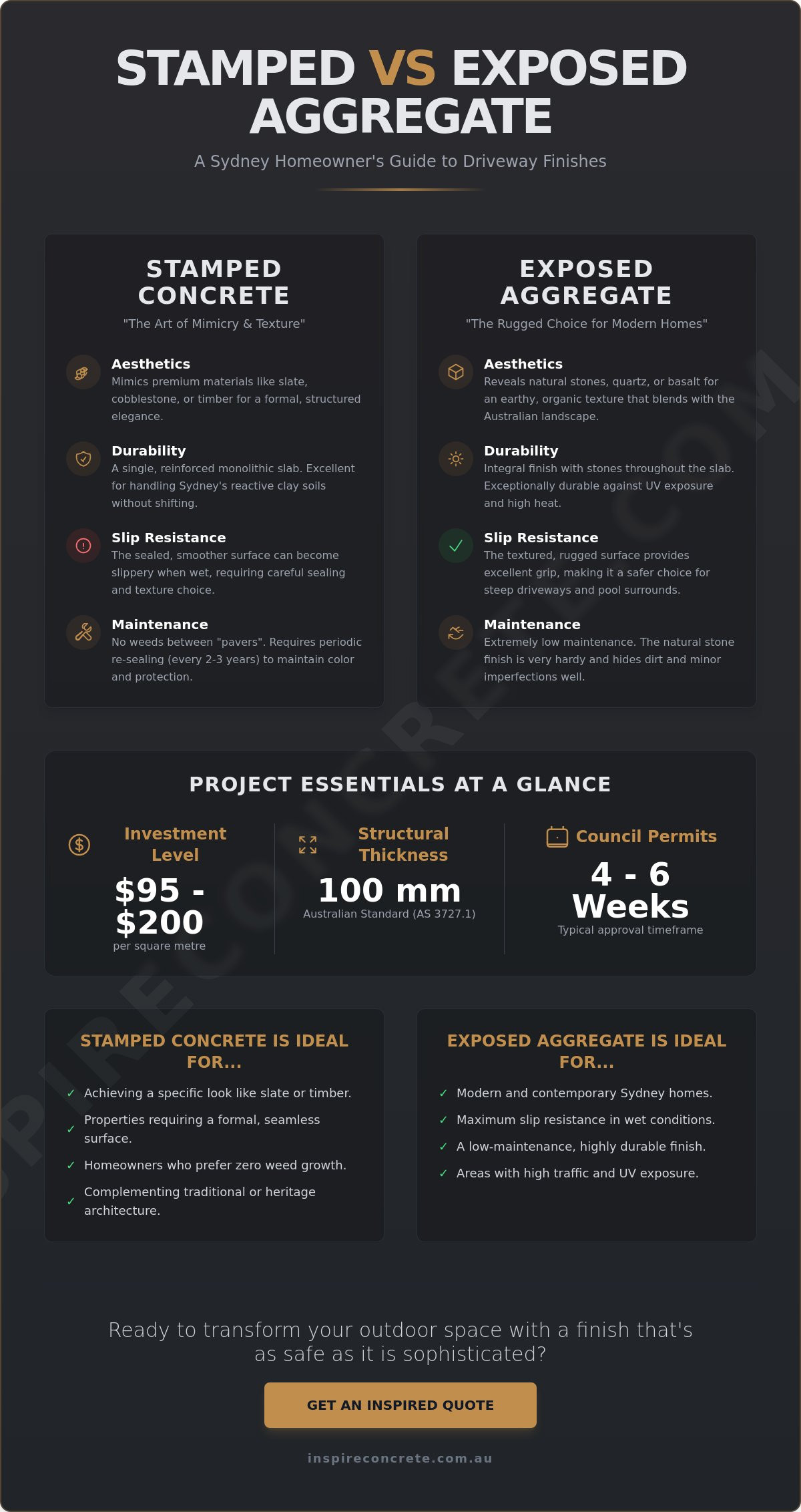
The fundamental differences between these two finishes come down to texture and installation technique. Stamped concrete provides a smoother, patterned surface that excels at mimicry, offering the look of individual pavers without the risk of weeds growing through grout lines. Exposed aggregate is a more rugged, slip-resistant option that utilizes chemical retardants during the pour to achieve its signature finish. While stamped concrete relies on topical dyes and imprints, exposed aggregate is an integral finish where the decorative stones are mixed throughout the entire 100 mm slab thickness required by Australian Standard AS 3727.1-2016. This makes exposed aggregate exceptionally durable against the heavy UV exposure and high-heat conditions common in Western Sydney.
Stamped Concrete: The Art of Mimicry and Texture
Stamped concrete represents the pinnacle of architectural mimicry in modern landscaping. It allows homeowners to achieve the prestigious look of natural materials like European slate, Ashlar stone, or rustic timber without the astronomical costs of sourcing and hand-laying individual units. This technique has evolved significantly over the decades, as explored in The History of Stamped Concrete. Today, we use advanced imprinting mats and high-performance colour hardeners to create surfaces that are virtually indistinguishable from the materials they emulate.
When evaluating stamped vs exposed aggregate pros and cons, the primary advantage of stamping is its structural continuity. Unlike traditional pavers that can shift, sink, or become overrun by weeds, stamped concrete is a single, reinforced slab. This is vital for properties in Sydney’s Western Suburbs, where reactive clay soils often cause individual pavers to dislodge or become uneven over time. By choosing a monolithic pour, you maintain a level, seamless surface that preserves its integrity. We utilize UV-resistant pigments and specialized hardeners to ensure these vibrant patterns don’t fade under the intense Australian sun, keeping your property’s facade looking fresh for years.
Pros: Why Homeowners Love the Stamped Look
The design freedom offered by this method is unparalleled. You can choose bespoke patterns and colour palettes that perfectly align with your home’s existing masonry or cladding. Because the texture is imprinted directly into the wet concrete, the labour costs are significantly lower than those associated with hand-set brick or stone. This efficiency doesn’t sacrifice quality; it simply streamlines the transformation of your property. If you’re planning a complex layout, consulting with professional concreters in Sydney ensures the patterns align perfectly with your home’s structural boundaries.
Cons: Practical Considerations and Limitations
While beautiful, stamped concrete has specific functional trade-offs that require careful consideration. The surface is relatively smooth, which can make it slippery when wet, particularly on the steep driveways common in Sydney’s hilly regions. We often recommend adding anti-slip additives to the sealer to mitigate this risk for families with young children or elderly residents. Additionally, the installation requires expert precision and a meticulous eye for detail. There’s a narrow window of time to imprint the patterns before the concrete sets; if the timing is off, the texture won’t be deep or consistent. Over many years, high-traffic areas may show slight wear in the surface colour, though regular maintenance and resealing every 2 to 3 years typically resolves this issue and restores the original lustre.
Exposed Aggregate: The Rugged Choice for Modern Sydney Homes
Exposed aggregate has secured its position as the premier decorative choice for high-end Sydney residences in 2026. This finish is prized for its organic texture and uncompromising durability, making it the top selection for exposed aggregate driveways across the North Shore and Eastern Suburbs. Unlike other finishes that rely on surface patterns, this method reveals the natural beauty of the stones mixed within the concrete itself. By stripping away the top layer of cement paste, we uncover a dense bed of decorative aggregates that provide both aesthetic depth and a functional, hard-wearing surface.
The versatility of this finish lies in the customisation of the stone mix. You can select from a wide palette of materials, including deep grey basalt, radiant quartz, smooth river pebbles, or even recycled glass for a contemporary shimmer. This allows for a “salt and pepper” look or a bespoke designer blend that complements your home’s architectural palette. When weighing up stamped vs exposed aggregate pros and cons, many homeowners prefer this method because the colour is integral to the slab. It doesn’t just sit on top; it’s part of the structure. For a deeper technical dive into how these materials perform under different conditions, you can review this analysis of Exposed Aggregate vs. Stamped Concrete.
Pros: Durability Meets Natural Beauty
The standout benefit of exposed aggregate is its superior traction. The protruding stones create a natural non-slip profile, which is essential for the steep, inclined driveways common in Sydney’s hilly terrain. It provides exceptional safety for vehicles and pedestrians during our heavy rain events. From a maintenance perspective, the variegated texture is incredibly forgiving. It masks oil drips, tyre marks, and everyday dirt much more effectively than a smooth stamped surface. With a compressive strength designed to exceed 25MPa, these slabs easily handle the weight of multi-car households and heavy SUVs without compromising their structural integrity.
Cons: Maintenance and Comfort Factors
While the texture is a safety asset, it can be a drawback for certain lifestyle needs. The rugged surface is often too abrasive for bare feet, making it less ideal for alfresco areas where children might play or where you plan to walk without shoes. Additionally, the price point typically sits between $95 and $160 per square metre, which is often slightly higher than standard finishes due to the cost of the premium stone blends. To maintain that “just poured” vibrancy, the surface requires a professional high-pressure clean and a fresh coat of sealer every 2 to 3 years. Without this care, the stones can appear dull as road grime builds up in the crevices of the texture.
The Ultimate Comparison: Cost, Safety, and Long-Term Performance
Making a final decision requires a clear-eyed look at the investment and the daily reality of living with your chosen surface. When comparing stamped vs exposed aggregate pros and cons, the financial gap is often narrower than homeowners expect. Exposed aggregate typically ranges from $95 to $160 per square metre, while stamped concrete sits between $100 and $200 per square metre. These prices fluctuate based on the complexity of the pattern or the rarity of the stone mix you select. However, the true value lies in how these surfaces perform under the specific environmental pressures of Greater Sydney.
Safety is the non-negotiable factor for Sydney families. Exposed aggregate naturally achieves high P4 or P5 slip ratings due to the physical texture of the protruding stones. This makes it the superior choice for steep driveways and pool surrounds where water is a constant factor. Stamped concrete, while aesthetically versatile, has a smoother profile that can become hazardous when wet. We address this by incorporating anti-slip glass beads or grit into the final sealing coat, ensuring your elegant alfresco area remains safe for guests and children alike.
Maintenance and Longevity in Sydney Conditions
Sydney’s intense UV levels and the reactive clay soils of the Western Suburbs demand a rigorous approach to maintenance. Both finishes require a high-quality, UV-stable sealant to prevent colour fading and protect against oil penetration. We recommend a professional cycle of concrete cleaning and sealing every 24 to 36 months to maintain the structural integrity of the surface. Many homeowners worry about cracking, but this is rarely a fault of the finish itself. Instead, it’s usually the result of poor subgrade preparation. We ensure every pour meets the Australian Standard AS 3727.1-2016 with a minimum 100 mm thickness and correctly placed expansion joints to manage soil movement.
Choosing Based on Application: Driveway vs. Pool vs. Alfresco
The “barefoot comfort” factor often dictates the final choice for outdoor living areas. Exposed aggregate provides unmatched grip for vehicles on an incline, but the rugged texture can be abrasive for bare feet. This makes it the undisputed king of driveways. For covered alfresco areas and entertaining zones, stamped concrete often wins because it offers a flatter surface that is easier to clean and more comfortable for walking without shoes. If you are struggling to balance these needs, light-coloured finishes are trending in 2026 because they absorb significantly less heat. This is a vital consideration for Western Sydney homes, where surface temperatures on dark concrete can exceed 60 degrees Celsius during a January heatwave. Let us help you transform your property with a finish that balances these technical demands with your personal style.
Navigating Your Decision: Which Concrete Finish Inspires Your Project?
Your choice between these two premium finishes ultimately hinges on how you use your outdoor space. Stamped concrete offers the elegant mimicry of natural stone for your alfresco areas, while exposed aggregate provides the rugged safety required for steep Sydney driveways. By understanding the stamped vs exposed aggregate pros and cons, you can align your property’s aesthetic with the functional demands of your lifestyle. This isn’t just about pouring a slab; it’s about an architectural transformation that enhances your home’s value and your family’s safety.
Success in any decorative project starts with hiring licensed concreters in Sydney who understand the local terrain. We bring a master’s eye to every project, ensuring that the visual beauty you see on the surface is supported by an engineered foundation that won’t fail when the soil shifts. By carefully weighing the stamped vs exposed aggregate pros and cons for your specific site, you ensure a result that looks stunning and performs flawlessly for decades.
The Inspire Concrete Professional Approach
With over 20 years of experience servicing the Western Suburbs and the Blue Mountains, we’ve refined a process that prioritises structural integrity above all else. We don’t just guess at the layout; we offer architectural drafting services to help you visualise how a bespoke aggregate mix or a specific stamp pattern will integrate with your home’s facade. Our team focuses on meticulous subgrade preparation and precise drainage planning to prevent the cracking and pooling that plague inferior installations. We take pride in being partners in your vision, providing the technical certainty that allows your creativity to flourish.
Next Steps for Your Sydney Property Transformation
Before we break ground, it’s helpful to prepare your site for an accurate assessment. Consider the primary use of the area, the typical weight of vehicles that will use the surface, and any existing drainage issues you’ve noticed during heavy rain. For a broader look at how these finishes fit into a total property overhaul, explore our pillar guide on the concrete driveway landscape in 2026. Ready to elevate your property with a finish that balances artistry and engineering? Contact Inspire Concrete for a bespoke consultation and let’s start the journey toward a surface that truly inspires.
Elevate Your Sydney Property with a Bespoke Concrete Finish
Choosing the right decorative surface is the final step in securing your home’s architectural legacy. We’ve explored the stamped vs exposed aggregate pros and cons to help you weigh the elegance of slate patterns against the rugged slip resistance of natural stone. Whether you’re prioritising the barefoot comfort of an alfresco zone or the heavy-duty traction required for a steep Western Sydney driveway, your decision impacts both safety and long-term value. A successful transformation relies on more than just the finish; it requires the structural precision of an expert team that understands the local terrain.
Inspire Concrete brings 20 years of industry experience to every project across the Blue Mountains and Greater Sydney. As licensed and insured expert craftsmen, we specialise in navigating the challenges of reactive clay soils and modern council regulations. We don’t just pour concrete; we build foundations that endure. Transform your property with Sydney’s decorative concrete experts—Request your quote from Inspire Concrete today. Your vision for a seamless, high-end outdoor lifestyle is within reach, and we’re here to bring it to life with technical certainty.
Frequently Asked Questions
Is stamped concrete or exposed aggregate more expensive in Sydney?
Exposed aggregate is generally the more cost-effective option for Sydney homeowners, with verified 2026 prices ranging from $95 to $160 per square metre. Stamped concrete requires a more labour-intensive imprinting process, which typically pushes the investment between $100 and $200 per square metre. Your final quote will depend on the complexity of the pattern or the specific decorative stone mix you select for your property transformation.
Which surface is less slippery when wet for a pool area?
Exposed aggregate is the superior choice for pool surrounds because its physical texture provides a natural P4 or P5 slip rating. The protruding stones offer excellent traction for wet feet and help prevent accidents during family gatherings. While stamped concrete can be finished with anti-slip additives, its smoother profile is inherently more slippery. For maximum safety in splash zones, the rugged grip of aggregate is the most reassuring solution.
How often do I need to reseal my decorative concrete driveway?
You should plan to reseal your decorative driveway every 2 to 3 years to combat the effects of Sydney’s intense UV radiation and heavy rain cycles. This 24 to 36-month maintenance window ensures the protective barrier remains intact, preventing oil stains and colour fading. Regular sealing also keeps the stones in an aggregate mix securely bonded and maintains the vibrant detail of a stamped pattern for the long term.
Can I change the colour of my stamped or exposed aggregate later?
Yes, you can update the look of your property through professional concrete resurfacing if your style preferences change. This process involves applying a high-strength decorative coating over your existing slab to introduce a new colour palette or texture. It is a highly efficient way to modernise a 10 or 15-year-old driveway without the disruption and cost of a total demolition and repour of the structural concrete.
Will exposed aggregate concrete crack in Sydney’s clay soil?
Cracking is prevented by rigorous engineering rather than the choice of decorative finish. When evaluating stamped vs exposed aggregate pros and cons, the structural foundation is the most critical factor. We adhere to Australian Standard AS 3727.1-2016, ensuring a 100 mm minimum thickness and precisely placed expansion joints. These joints allow the slab to move safely with the seasonal expansion and contraction of Sydney’s reactive clay soils.
Is stamped concrete suitable for steep driveways?
Stamped concrete is often less suitable for steep inclines because the imprinting process creates a relatively smooth surface. On Sydney’s hilly terrain, this can lead to vehicle slippage during wet weather. Exposed aggregate is the preferred choice for slopes as the revealed stones provide mechanical grip for tyres. If you choose a stamped finish for a ramp, we must incorporate heavy-duty non-slip grit into the sealer to ensure vehicle safety.
How long does the installation of decorative concrete take?
The onsite installation usually takes 3 to 5 days, though the full project timeline includes a 4 to 6-week lead time for local council permits. Once we pour the slab, the finishing process occurs within the first 24 to 48 hours. You can typically walk on the surface after 24 hours, but you must wait 7 to 28 days for the concrete to reach full compressive strength before driving heavy vehicles on it.
Does decorative concrete increase the resale value of a Sydney home?
A bespoke concrete finish significantly boosts curb appeal and can increase the market value of your home. High-end finishes like stamped or exposed aggregate are viewed by buyers as premium, low-maintenance upgrades compared to standard grey concrete or asphalt. Professional landscaping projects in 2026 often show a strong return on investment, as they signal to prospective buyers that the property has been built and maintained to a sophisticated standard.
