
You’re guiding your SUV up the final climb home, but as the Sydney humidity peaks, your tyres lose their grip on the slick concrete. It’s a heart-stopping moment that many locals face when their driveway isn’t built for the unique terrain of the upper mountains. You likely agree that a home entry should be a seamless transition, not a source of constant anxiety about bumper damage or wet-weather slips.
In our region, the “mountain factor” means standard solutions don’t hold up against steep gradients and heavy rainfall. This guide will show you how to master these challenges using durable, slip-resistant finishes and smart engineering. You’ll discover why an exposed aggregate driveway, favoured by Blue Mountains homeowners, is the gold standard for 2026, offering the P4 slip rating required for safety. We will also preview the architectural drafting secrets that prevent cars from bottoming out and ensure your garage stays dry, regardless of the downpour.
Key Takeaways
- Identify the specific concrete finishes that achieve a P4 slip rating to ensure your vehicle maintains traction during the most intense Blue Mountains rain events.
- Learn how an exposed aggregate driveway blue mountains homeowners invest in combines rugged mechanical grip with a premium aesthetic that adds long-term value to your property.
- Uncover the engineering secrets behind vertical curves and break-over angles to eliminate the risk of your car bottoming out at the kerb or garage entry.
- Discover why adjusting the “slump” of a concrete mix is the non-negotiable technical step for preventing structural failure on steep, high-gravity pours.
- Solve the sealer paradox by choosing the right anti-slip additives to protect your surface without compromising its high-traction safety standards.
Challenges of Steep Driveway Construction in the Blue Mountains
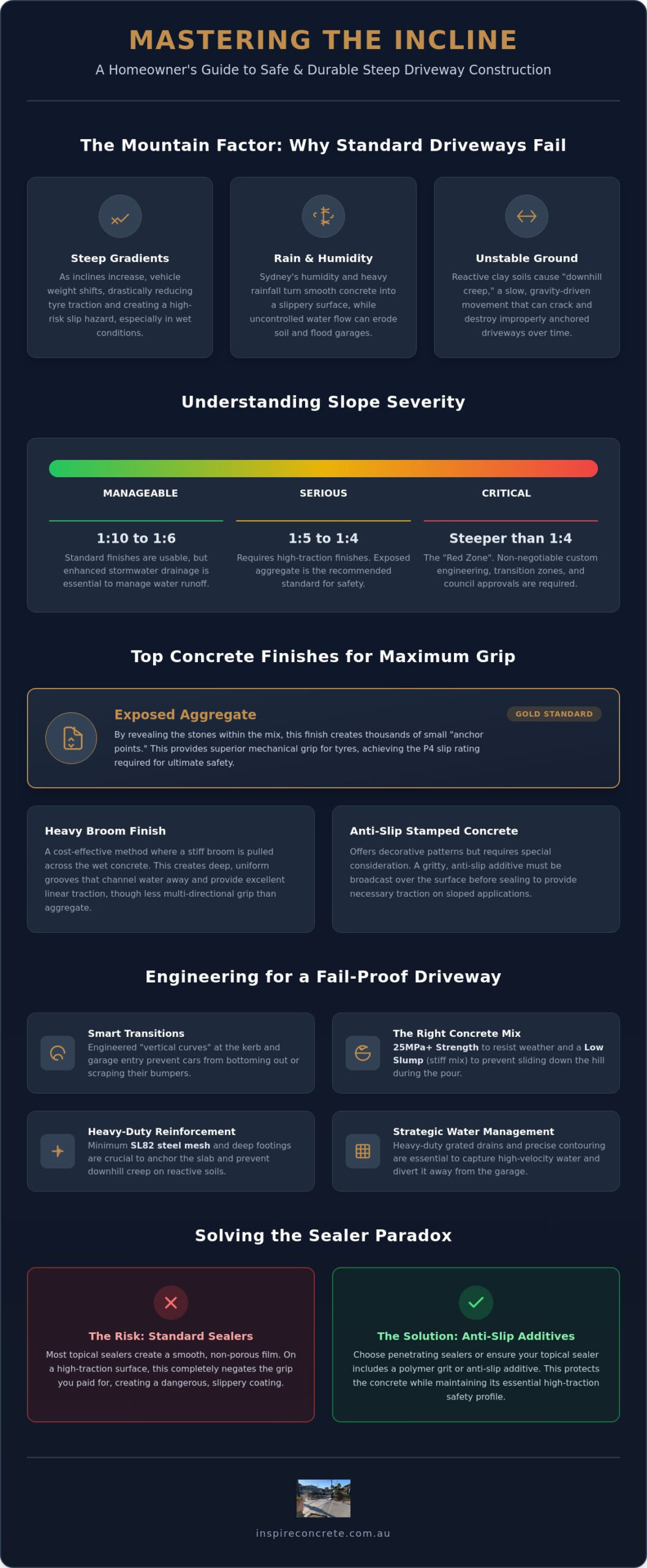
Building a driveway in challenging terrains, such as the steep landscapes found across the Blue Mountains and other hilly Sydney fringe areas, isn’t just about pouring a path; it’s about defying gravity. When you’re dealing with gradients steeper than 1:5, standard plain concrete quickly loses its utility. The physics are simple: as the incline increases, the weight of your vehicle shifts, reducing the downward force on your tyres and making traction difficult to maintain. Without the right texture, a humid Sydney morning can turn a smooth driveway into a high-risk slide for even the most capable SUV.
The technical challenge goes deeper than the surface. Sydney and its surrounding regions are notorious for reactive clay soils that expand and contract with moisture changes. On a sloping block, particularly prevalent in areas like the Blue Mountains, this movement isn’t just vertical. Gravity creates a constant lateral pressure known as downhill “creep.” If your slab isn’t engineered with heavy-duty SL82 reinforcement and deep footings, the entire structure can slowly migrate toward the street, leading to unsightly cracks and structural failure. Managing an exposed aggregate driveway blue mountains project, or any steep Sydney driveway, requires a specialist who understands how to anchor a slab into these volatile soil profiles.
Why Surface Grip is Only Half the Battle
While an Exposed aggregate concrete finish provides the essential mechanical interlock for vehicle tyres, the foundation determines the driveway’s lifespan. You need to consider the difference between static friction (when your car is parked) and kinetic friction (when the wheels are moving). On a hill, the sub-grade must be compacted with surgical precision to prevent the concrete from sagging under its own massive weight.
Beyond the soil, regional weather adds another layer of complexity. Areas like the Blue Mountains experience significant temperature swings and higher rainfall than the immediate Sydney basin. These conditions critically affect how the concrete cures. At Inspire Concrete, we use a minimum 25MPa concrete strength to withstand these more extreme local conditions, including potential frost-thaw cycles. Without this density, moisture trapped in the concrete can freeze and expand, causing the surface to “spall” or flake away over time. A professional pour ensures the mix “slump” is stiff enough to stay on the hill without sliding before it sets.
Local Geography and Slope Severity
Identifying the severity of your slope is the first step in architectural drafting. In Sydney’s steeper suburbs and across regions like the Hills District and Blue Mountains, we categorise slopes to determine the best construction method. A 1:4 gradient is widely considered the “red zone” for standard concreting; at this angle, the risk of vehicle undercarriages scraping and tyres losing grip becomes critical.
- 1:10 to 1:6: Manageable with standard finishes but requires enhanced drainage.
- 1:5 to 1:4: Requires high-traction finishes like an exposed aggregate driveway blue mountains homeowners trust for safety.
- Steeper than 1:4: Requires custom engineering, transition zones, and specific council-approved gradients to ensure the driveway remains a functional asset.
Advanced stormwater management is also non-negotiable. On a steep incline, water gains velocity quickly. Without heavy-duty grated drains and strategic contouring, a summer storm will send a wall of water directly into your garage. We design transitions that redirect this energy, protecting your home’s foundation while maintaining a premium look.
The Top 3 Concrete Finishes for Maximum Traction and Grip
Selecting a finish for a steep incline requires a balance between aesthetic elegance and uncompromising safety. In the challenging terrain of the upper mountains, your choice of texture determines whether your vehicle climbs effortlessly or struggles for purchase during a summer storm. While aesthetics matter, we prioritise the “bite” that a surface provides to your tyres. An exposed aggregate driveway blue mountains project provides the most reliable mechanical grip, but it isn’t the only tool in our arsenal for managing high-gradient transitions.
Exposed Aggregate: The Rugged Professional Choice
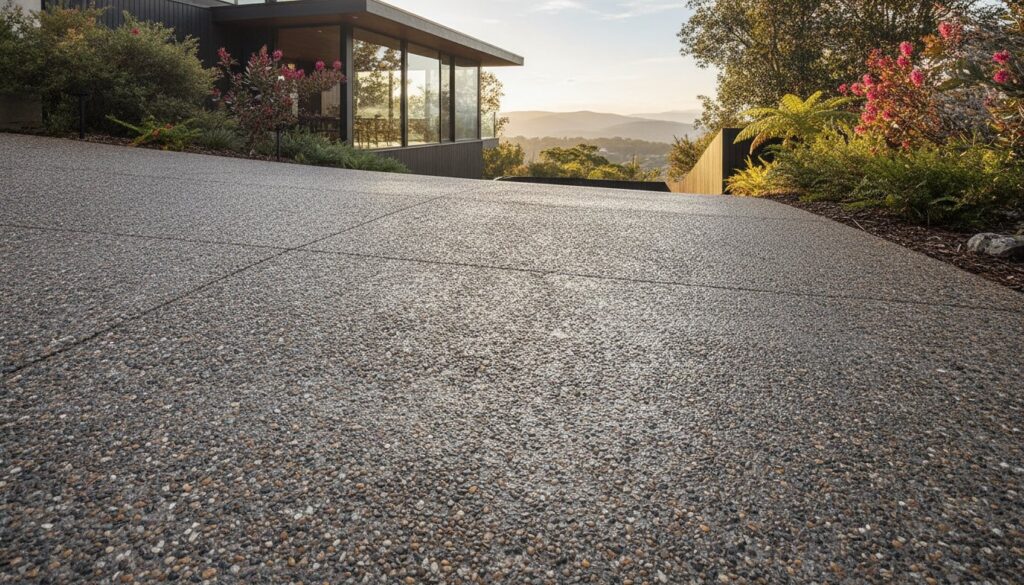
This finish is the gold standard for steep residential sites. By removing the top layer of cement paste to reveal the stone underneath, we create a surface with thousands of tiny “anchor points” for rubber tyres. However, the type of stone you choose is critical. We recommend crushed basalt or blue metal aggregates rather than smooth river pebbles. The jagged, angular edges of crushed stone provide superior mechanical interlock, often exceeding a P4 or P5 slip resistance rating under AS 4586.
We can customise the exposure depth to find the perfect middle ground between high-traction safety and barefoot comfort. For the best results, we typically use a 7 to 14-millimetre aggregate size. This creates enough texture to prevent tyre slip without making the surface difficult to sweep or maintain. For those looking to see how these textures integrate with modern architecture, you can explore our gallery of Exposed Aggregate Driveways Sydney for design inspiration.
Extreme Slopes: Saw-Cutting and Chevron Grooving
When a driveway enters the “red zone” of gradients steeper than 1:4, we often move beyond standard textures into industrial-strength engineering. Saw-cut traction grooves, often arranged in a “chevron” or “cog” pattern, provide a fail-safe for high-torque vehicles. These grooves are precision-cut into the cured concrete, creating deep channels that allow water to escape while giving tyres a physical edge to grip during the ascent.
This method is particularly effective for heavy SUVs and EVs, which deliver high torque to the pavement. If you’re concerned about the long-term durability of your surface under these stresses, a combination of a heavy broom finish for secondary access and saw-cutting for the main climb is a cost-effective strategy. A heavy broom finish involves drawing a stiff-bristled broom across the wet concrete to create deep, parallel ridges. While less premium in appearance than an exposed aggregate driveway blue mountains installation, it’s a hardworking trade finish that stands up to years of heavy use.
Our team can help you select the ideal stone mix to balance these technical requirements with your home’s architectural style; you can request a detailed site consultation to map out your transition zones.
Engineering the Perfect Transition: Preventing Bumper Scrape
The most beautiful driveway is a failure if your car cannot navigate the entry without the sound of grinding metal. While we have addressed how to keep your tyres moving, the geometry of the transition determines if your vehicle’s undercarriage remains intact. In the Blue Mountains, where the road often sits at a vastly different elevation than the garage, a simple “straight line” pour is a recipe for disaster. We utilise architectural drafting to create vertical curves, which are gradual, engineered transitions that allow the car’s suspension to adjust before the full gradient begins. This prevents the “nose” of the car from diving into the pavement or the chassis from high-centering at the peak.
The Secret to Scrap-Free Entry: Transition Zones
The first 3 metres of your driveway are the most critical for safety and vehicle protection. This is where we calculate the “break-over angle,” the maximum peak a vehicle can pass over without the middle of the chassis hitting the ground. By extending the transition slab, we accommodate the longer wheelbase of modern SUVs and the low clearance of performance sedans. When installing an exposed aggregate driveway blue mountains residents often discover that a well-designed cove, the curved section connecting the road to the driveway, is what makes the climb feel effortless. At Inspire Concrete, we draft these custom coves to ensure your entry meets strict Blue Mountains City Council standards for kerb and gutter transitions. We focus on the “layback” geometry, ensuring the transition from the public road reserve to your private property is seamless and compliant.
Strategic Drainage for Sloping Concrete
Gravity turns every steep driveway into a high-speed waterway during a Sydney downpour. To prevent your garage or basement from becoming a catchment basin, we integrate advanced drainage systems directly into the slab’s geometry. This involves more than just a single grate at the bottom of the hill. We engineer cross-falls, which are subtle 2% side-to-side slopes that direct water toward heavy-duty trench drains before it gains enough velocity to cause erosion.
Ensuring compliance with local Sydney water run-off regulations is a core part of our drafting process. We use high-capacity grate drains that can handle the volume of a sudden mountain storm without overflowing. This technical precision ensures your exposed aggregate driveway blue mountains project remains a high-traction asset that protects your home’s foundation. By managing the water’s path and velocity, we eliminate the risk of pooling and ensure that your high-traction surface stays clear and safe, even in the most demanding weather conditions.
Maintaining Safety: Sealing and Cleaning High-Traction Surfaces
Sealing a steep driveway presents a unique challenge known as the Sealer Paradox. While you need to protect your investment from the harsh Blue Mountains elements, applying a standard topical sealer can transform a high-traction surface into a dangerous skating rink. This is particularly critical for an exposed aggregate driveway blue mountains homeowners choose for its safety. If you use a high-gloss acrylic sealer without the correct modifications, you effectively bury the mechanical grip under a smooth, plastic-like film that offers zero purchase for tyres during a Sydney downpour.
On high-gradient sites, we often recommend penetrating sealers over traditional topical coatings. These silane-siloxane treatments soak deep into the concrete’s pores rather than forming a surface film. This preserves the natural texture of the stone while providing invisible protection against moisture and freeze-thaw cycles. If a topical sealer is required for aesthetic reasons, we integrate anti-slip additives like “Shark Grip” or crushed glass beads to meet 2026 safety standards. These micronised polymers create a microscopic sandpaper finish that maintains a P4 or P5 slip rating even when wet.
Choosing the Right Sealer for Grip
The choice between solvent-based and water-based sealers depends on the desired finish and the aggregate type. Solvent-based sealers typically offer a richer “wet look” that highlights the stone’s natural colours, but they require a higher concentration of grit additives to remain safe on slopes. Water-based options are often more breathable, which is vital for managing the moisture levels in Sydney’s reactive soils. For a deeper dive into protecting your investment, see The Ultimate Guide to Concrete Driveways in Sydney.
Cleaning High-Texture Surfaces
Because an exposed aggregate driveway blue mountains features a textured profile, it naturally traps more organic debris than a smooth slab. On steep hills, gravity washes silt and leaf litter into the gaps between the stones. Regular maintenance is essential to prevent these “pores” from filling up, which can reduce the surface’s effective grip over time. If these voids are clogged with dirt, the tyre has less surface area to grab, compromising the engineering of the finish.
When pressure washing, we advise using a wide-fan nozzle rather than a concentrated jet. High-pressure pinpoint streams can actually dislodge the aggregate if the bond has been weakened by age or extreme weather. For stubborn tyre burn marks caused by high-torque vehicles, avoid harsh acidic cleaners that can etch the cement and dull the stones. Instead, use pH-neutral degreasers designed specifically for decorative concrete. If your surface has lost its lustre or feels slick, it may be time for professional concrete cleaning and sealing to restore its high-traction performance. We recommend re-sealing every 24 to 36 months on steep inclines to account for the increased friction and tyre wear.
Why Professional Installation is Non-Negotiable for Sloping Sites
Pouring a slab on a 1:4 gradient is a high-stakes race against gravity. When you’re installing an exposed aggregate driveway blue mountains project, the margin for error disappears the moment the concrete leaves the truck. If the mix is too fluid, the entire mass will slowly “slump” or crawl toward the street before it can be finished. Conversely, if the mix is too stiff and the crew is understaffed, you risk the formation of “cold joints.” These occur when one batch of concrete begins to set before the next is integrated, creating a structural fracture line that will eventually split under the weight of a vehicle.
Our 20 years of industry experience across Sydney’s most difficult terrains has taught us that success on a slope is found in the preparation. We adjust the “slump” of our concrete mix with surgical precision, ensuring it’s stiff enough to hold its position on the incline while remaining workable enough to reveal the decorative aggregate. This technical balance is what separates a premium, high-traction asset from a structural disaster that requires costly demolition and replacement.
The Concreting Process on a Slope
A steep pour requires a significantly larger crew than a flat backyard slab. You need more hands to manage the rapid setting times and ensure the concrete is vibrated correctly. Vibration is essential to remove air pockets that naturally form as concrete is pushed uphill. Without this, you end up with “honeycombing” around your reinforcement mesh, which significantly weakens the driveway’s load-bearing capacity.
In New South Wales, any concreting work valued at over A$5,000 must be performed by a contractor holding a valid license from NSW Fair Trading. This isn’t just a legal requirement; it’s your protection. Professional concreters in Sydney who specialise in structural work understand the reactive nature of local clay soils and how to anchor a slab to prevent the downhill “creep” we discussed earlier. We stand by our craftsmanship, combining this engineering rigour with the aesthetic elegance your home deserves.
Your Next Steps to a Safer Driveway
Transforming a difficult site begins with a comprehensive, site-specific assessment. When you review a professional quote for a steep block, look for more than just a price per square metre. A quality proposal should detail the architectural drafting for transition zones, the specific reinforcement grade, and the engineered drainage solutions required to protect your garage from flooding.
Don’t settle for a contractor who treats a mountain slope like a flat suburban lot. You need a partner who views your driveway as a complex engineering project. If you’re ready to replace your slippery, scraping entry with a high-traction masterpiece, Transform your steep driveway with Inspire Concrete. We’ll help you navigate the council requirements and technical challenges to deliver a result that enhances your lifestyle and property value for decades.
Transform Your Slope into a High-Traction Asset
Mastering a steep driveway requires more than just a textured surface; it’s a synergy of geometric drafting and high-performance materials. You now understand that preventing bumper scrape depends on engineered vertical curves, while long-term safety relies on choosing the right stone and anti-slip sealer additives. An exposed aggregate driveway blue mountains homeowners invest in provides the essential mechanical grip needed to conquer 1:4 gradients without the anxiety of tyre slip or structural creep.
Don’t leave your property’s accessibility to chance with basic utility solutions. At Inspire Concrete, we bring 20+ years of Sydney experience as specialists in difficult sloping sites. Our licensed and fully insured team ensures every pour is managed with the technical precision required for reactive soils and high-gravity environments. We take pride in moving beyond simple utility to create a durable, elegant entry that enhances your lifestyle. Get a Professional Quote for Your Steep Driveway Today and take the first step toward a safer, scrap-free home entry. Your mountain block has incredible potential; let’s build a foundation that matches your vision.
Frequently Asked Questions
What is the most slip-resistant concrete finish for a steep driveway?
Exposed aggregate is the premier choice for high-gradient sites because it provides superior mechanical interlock for vehicle tyres. By revealing the jagged edges of crushed basalt or blue metal stones, we create a surface that achieves a P4 or P5 slip resistance rating. This texture ensures an exposed aggregate driveway blue mountains residents rely on stays safe and high-traction, even during the region’s intense summer downpours.
Can I use stamped concrete on a steep slope?
Stamped concrete is generally discouraged for steep inclines because the stamping process creates a smooth, patterned surface that lacks natural friction. While it offers a refined look, it can become dangerously slick when wet or humid. If you desire a decorative finish on a hill, we recommend exposed aggregate or a heavy broom finish, as these provide the rugged texture necessary for uphill momentum and safety.
How do I stop my car from scraping on a steep driveway entrance?
You prevent bumper scrape by incorporating engineered “vertical curves” into the architectural drafting of your entry. Rather than a sharp, straight transition from the road to the slope, we design gradual curves that accommodate your vehicle’s wheelbase. By calculating the specific break-over angle of your car, we ensure the undercarriage remains clear of the concrete throughout the entire transition from the kerb to the garage.
Is exposed aggregate too rough for kids to walk on?
It isn’t too rough if you select a smaller aggregate size and a controlled exposure depth. We typically utilise 7 to 14-millimetre stones and a light exposure technique to find the perfect balance between high-traction safety and barefoot comfort. This creates a sophisticated, professional finish that provides plenty of grip for cars without being overly abrasive for children playing on the surface.
What is the maximum gradient allowed for a residential driveway in Sydney?
The maximum gradient for a residential driveway is typically 25% (1:4) according to Australian Standard AS/NZS 2890.1:2021, though local Blue Mountains City Council regulations may apply specific limits for crossovers. Any slope exceeding 16% must be constructed with a sealed surface like concrete to prevent erosion. We ensure every exposed aggregate driveway blue mountains project we undertake complies with these safety standards and local drafting requirements.
How much extra does it cost to build a driveway on a steep slope?
Building on a slope requires a higher investment due to the complexity of the engineering, including advanced formwork, heavier reinforcement, and sophisticated drainage systems. The need for a larger crew to manage the pour and precisely adjust the concrete “slump” also contributes to the project’s scope. We provide site-specific assessments to ensure your quote reflects the technical rigour required to build a slab that won’t fail or creep.
How often should I seal a steep concrete driveway to maintain grip?
You should re-seal a steep driveway every 24 to 36 months to protect the concrete and maintain its slip-resistant properties. High-friction areas on slopes wear down sealer films faster than flat surfaces. It’s essential to use a penetrating sealer or a topical coating integrated with anti-slip additives like glass beads. This ensures the surface remains protected from the mountain elements without becoming a slippery hazard.
Do I need council approval to change the slope of my driveway?
You definitely need council approval for any modifications to the vehicle crossing or the section of the driveway within the road reserve. While some internal driveway work may fall under “exempt development” in NSW, changing the gradient significantly often requires a professional assessment to ensure compliance with AS 2890.1 standards. We manage the necessary drafting and compliance checks to ensure your new entry meets all local government regulations.
