
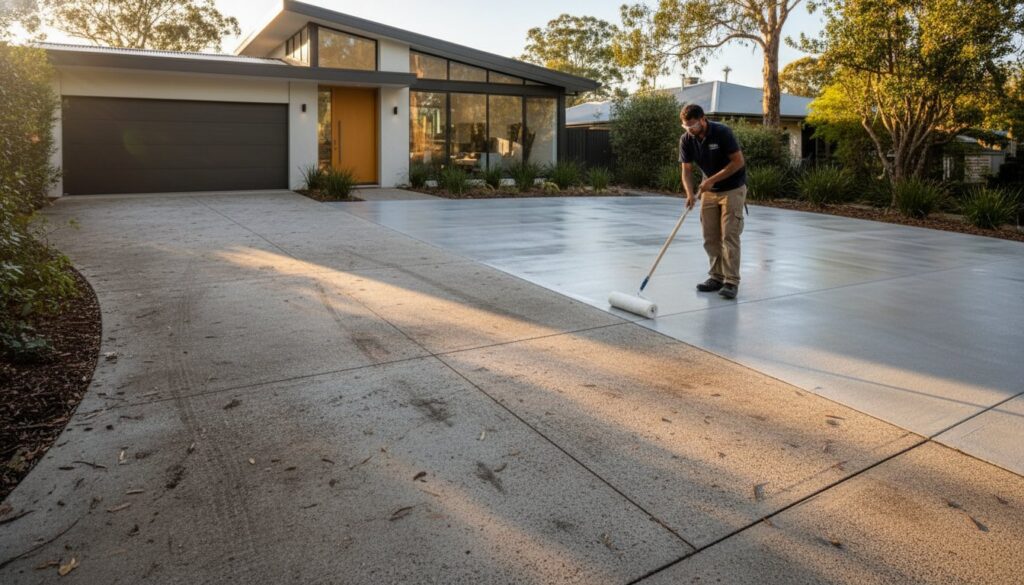
Your weathered driveway isn’t just an eyesore; it’s a structural asset currently being compromised by Sydney’s salt air and intense UV exposure. While many homeowners view surface wear as a purely cosmetic issue, the reality is that untreated concrete acts as a porous sponge for moisture and contaminants. It’s easy to feel defeated by persistent tyre marks, deep oil stains, and the aggressive mould that thrives in our humid coastal pockets. You want your home to reflect the pride of ownership and refined craftsmanship, not look neglected under a layer of environmental grime.
Discover how professional concrete cleaning and sealing can transform your property, restoring that crisp, just-poured aesthetic while preventing the structural decay that leads to expensive replacements. This guide details exactly how to protect your investment from the reactive soils and harsh elements unique to the New South Wales coastline. We’ll examine the 2026 industry rates, where pressure cleaning averages $3 to $5 per square metre, and explain how adhering to AS 3600 standards ensures your restoration provides both elegance and durability. We’ll help you decide if a simple restoration is enough to inspire a total property transformation or if your concrete requires a more technical intervention.
Key Takeaways
- Understand how Sydney’s unique environmental factors like high UV and coastal salt air degrade your surfaces and why timely intervention is essential for structural integrity.
- Learn the professional 4-step concrete cleaning and sealing process that removes stubborn stains and tyre marks without damaging the underlying surface.
- Identify the critical differences between penetrating and topical sealers to choose the finish that best aligns with your property’s aesthetic and functional needs.
- Avoid common DIY pitfalls such as moisture entrapment and uneven streaks by learning the technical risks associated with retail-grade equipment and products.
- Establish a sustainable maintenance schedule to extend the life of your restoration and ensure your concrete remains a high-value asset for years to come.
Why Concrete Cleaning and Sealing is Vital in Sydney’s Climate
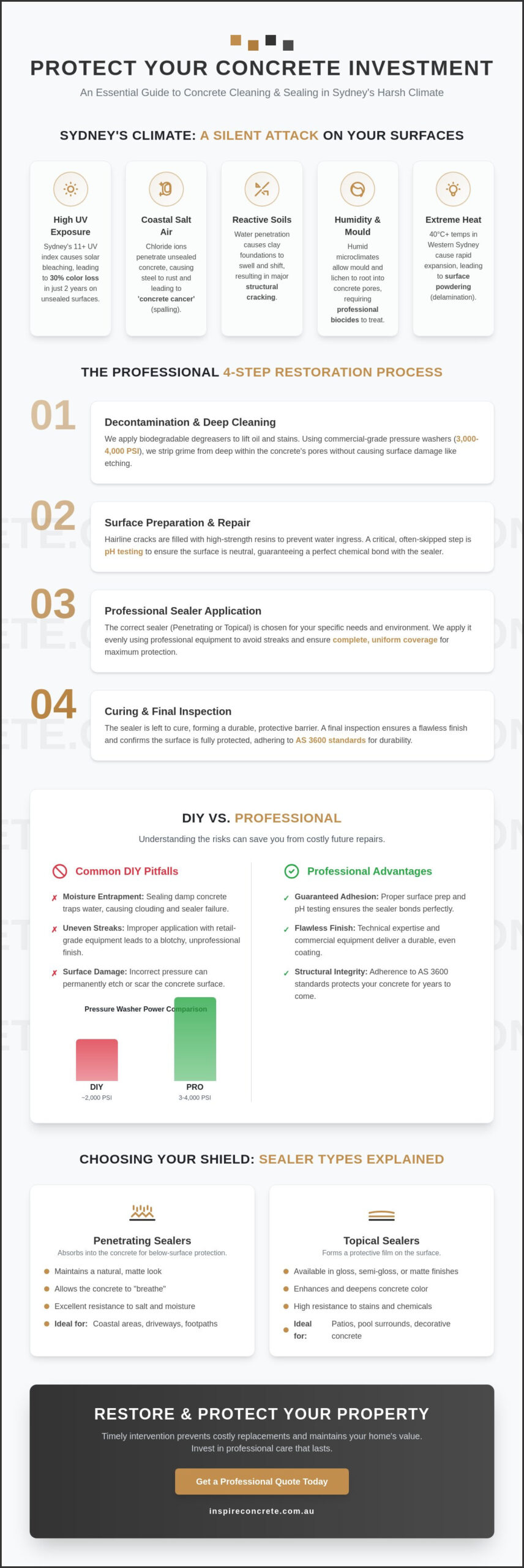
Sydney’s environment is uniquely punishing for structural surfaces. Your concrete isn’t just a static foundation; it’s a breathing material that reacts to the 11+ UV index ratings and the persistent salt spray from the Pacific. Without professional concrete cleaning and sealing, these elements strip the vibrancy from decorative finishes and compromise the slab’s density. We see many properties where unsealed driveways have lost 30% of their colour depth in just two years due to solar bleaching. This isn’t just a cosmetic loss. It represents the slow degradation of the concrete’s top layer, leading to a dusty, porous surface that’s vulnerable to every passing storm.
Beyond the surface, Sydney’s reactive clay foundations pose a hidden risk. When water penetrates an unsealed slab, it seeps into the subgrade, causing the clay to swell and shift. This movement is the primary cause of structural cracking in suburban driveways and paths. Additionally, the humid microclimates in shaded areas like the North Shore provide the perfect breeding ground for Lichen and Gloeocapsa Magma. These aren’t just stains; they are biological organisms that root into the pores of your concrete. Combatting them requires professional-grade biocides that retail pressure washers simply cannot deliver. We don’t just wash away the grime; we treat the concrete to ensure these species don’t return.
Combatting the Western Sydney Heat
In suburbs like Penrith and Parramatta, summer temperatures frequently exceed 40°C. This creates an ‘oven effect’ where the concrete surface reaches much higher temperatures than the air. The resulting rapid expansion and contraction cause micro-fractures and surface powdering, a process known as delamination. Our approach to concrete cleaning and sealing in the West focuses on thermal stability. A high-quality chemical seal reflects a portion of the IR radiation and binds the surface particles together to prevent that worn-out, sandy texture. It’s about maintaining the structural integrity of the slab while ensuring it remains cool enough to walk on.
Protecting Against Coastal Salt and Humidity
Suburbs within five kilometres of the coastline face a different threat: chloride ion attack. Salt air penetrates unsealed concrete and reacts with the internal steel reinforcement. This chemical reaction causes the steel to rust and expand, which exerts internal pressure that eventually results in ‘spalling’ or concrete cancer. We utilize salt-resistant penetrating sealers for Sydney’s east. These create a hydrophobic barrier that prevents humidity from trapping moisture in the pores, stopping internal rot before it starts. This technical precision allows us to inspire confidence in the longevity of your property’s most visible assets.
The Professional 4-Step Concrete Restoration Process
Restoration isn’t a quick spray with a garden hose. It’s a technical sequence designed to preserve structural integrity and achieve a seamless finish. Professional concrete cleaning and sealing requires a meticulous approach to ensure the chemistry of the sealer bonds perfectly with the substrate. We follow a rigorous four-step framework that prioritises the long-term health of your slab over a temporary shine. This process ensures that every pore of the concrete is decontaminated and prepared for a durable, bespoke finish.
Phase 1: Decontamination and Pressure Washing
We start by applying biodegradable degreasers to lift ingrained oil, organic tannins, and tyre rubber. Domestic pressure washers, which typically peak at 2,000 PSI, often lack the power to reach deep into the concrete’s pores. We utilise commercial-grade units with adjustable pressure, usually between 3,000 and 4,000 PSI. This allows us to strip away years of grime without etching the surface or dislodging delicate stones in exposed aggregate finishes. We also treat efflorescence, those stubborn white salt deposits, to ensure they aren’t permanently trapped under the new seal.
Phase 2: Surface Preparation and Repair
Once the surface is clean, we address structural vulnerabilities. We fill hairline cracks with high-strength resins to prevent future water penetration and further cracking. A critical step that many general contractors skip is pH testing. Concrete is naturally alkaline; if the surface remains too acidic from cleaning agents, the sealer will fail to bond. In Sydney’s humid months, where relative humidity often hits 70%, we enforce a strict 24 to 48-hour drying window. We use professional moisture meters to confirm the slab is bone-dry before any application begins. If you’re ready to transform your driveway into a refined architectural statement, this level of technical precision is non-negotiable.
The final application is where engineering meets artistry. We select application tools based on your specific finish. For stamped concrete, we use precision sprayers to avoid puddling in the deep textures, which can lead to ‘blushing’ or unsightly white patches. For exposed aggregate, we ensure the sealer locks the stones into the matrix while making the natural colours pop. This balanced approach prevents the common DIY disaster of uneven streaks and ensures your property maintains its ‘just-poured’ aesthetic for years to come. By treating the project as a partnership in craftsmanship, we deliver a result that enhances both the lifestyle and the value of your Sydney home.
Choosing the Right Sealer: Penetrating vs. Topical Finishes
Your choice between a penetrating or topical sealer isn’t merely an aesthetic one; it determines how your slab interacts with Sydney’s environment over the next decade. Selecting the correct finish requires a technical understanding of both chemistry and design. Professional concrete cleaning and sealing serves as the essential foundation for this choice, ensuring the surface is chemically receptive to the specific bond of your chosen product. Whether you’re looking to highlight the intricate textures of stamped concrete or protect a high-traffic path, the sealer you select acts as the final line of defence for your investment.
When to Use Penetrating (Impregnating) Sealers
Penetrating sealers are the invisible workhorses of the trade. These products dive deep into the concrete’s capillaries to create a hydrophobic barrier from within, rather than sitting on top. They’re the premier choice for exposed aggregate driveways because they protect the internal matrix without altering the rugged, tactile finish of the stones.
A critical advantage of these sealers is breathability. Concrete is naturally porous and holds moisture that needs to escape. If you trap that moisture with a non-breathable film, the resulting hydrostatic pressure can cause the sealer to delaminate or the concrete surface to flake. Penetrating sealers allow moisture vapour to escape safely while preventing liquid water from entering. This is vital around Sydney pool areas where slip resistance is a priority, as these sealers don’t create a slippery surface film that can lead to accidents.
The Appeal of Topical (Acrylic or Polyurethane) Sealers
Topical sealers act as a protective skin, sitting on the surface to provide a high-gloss or matte film. These are ideal for coloured concrete driveways that have suffered from UV fading. By saturating the surface, a topical sealer can restore the original pigment, providing that coveted ‘wet look’ that defines high-end Sydney entries. This aesthetic transformation can inspire a total rethink of your property’s street appeal.
When choosing between solvent-based and water-based topical sealers, consider your household’s needs. Solvent-based options often provide a more vibrant finish but emit high levels of Volatile Organic Compounds (VOCs) during application. For Sydney families with pets and children, we often recommend high-solids water-based sealers. These modern 2026 formulations offer comparable durability with significantly lower odours and environmental impact. While topical sealers require more frequent maintenance, usually every 24 to 36 months, their ability to repel oil and chemical spills is superior to penetrating alternatives.
DIY vs. Professional Concrete Maintenance: Evaluating the Risks
The allure of a weekend DIY project often masks the technical complexity required for a successful restoration. While hardware store shelves are lined with retail-grade products, these formulations typically contain lower solids content, often 50% less than professional-grade alternatives. This means the protective film is thinner, more prone to UV degradation, and likely to fail within 12 months. Choosing professional concrete cleaning and sealing ensures your property benefits from industrial-strength resins that last three to five times longer than retail options. We don’t just apply a product; we engineer a solution that accounts for the specific porosity and age of your slab.
The hidden costs of a DIY approach extend beyond the initial purchase of rollers and trays. Professional equipment hire for high-pressure units capable of 4,000 PSI can quickly erode your budget, especially when paired with the risk of using incorrect chemical concentrations. A professional service provides a comprehensive warranty on both materials and workmanship, offering a level of certainty that no retail product can match. By partnering with a master craftsman, you’re investing in the long-term structural integrity and aesthetic transformation of your home rather than a temporary fix.
The Danger of ‘Clouding’ and Adhesion Failure
One of the most common disasters we’re called to fix is “blushing” or clouding. This occurs when moisture is trapped beneath the sealer, creating unsightly white patches that are nearly impossible to remove without professional stripping agents. In the Sydney basin, where humidity levels frequently fluctuate, guessing the moisture content of your concrete is a high-stakes gamble. We utilise professional moisture meters to ensure the substrate is 100% dry before application. Stripping a failed DIY sealer is a laborious process that often costs double the price of the original application, making it a costly mistake to rectify.
Safety and Slip Resistance Considerations
Safety is a critical factor often overlooked by the inexperienced. Applying a topical sealer without the correct ratio of anti-slip grit can turn a driveway into a dangerous liability, especially during Sydney’s sudden summer downpours. Achieving the perfect balance between a refined finish and a compliant, slip-resistant surface requires precision. We calculate the exact grit-to-sealer ratio based on the slope and intended use of your surface to ensure a safe walking environment for your family and visitors. If you want to avoid these technical pitfalls and ensure a flawless result, it’s time to request a professional consultation for your property.
Protecting Your Investment: Long-Term Maintenance Schedules
A successful project doesn’t end when the sealer dries. Maintaining the structural integrity and aesthetic of your property requires a proactive approach. In Sydney’s reactive climate, we advocate for the “3-year rule.” Industry standards for 2026 suggest that decorative concrete should be professionally inspected and resealed every 24 to 36 months to combat the 11+ UV index that relentlessly breaks down protective polymers. Adhering to this cycle is the most effective way to prevent the need for concrete resurfacing sydney, a more intensive process required when the original surface has been allowed to degrade beyond simple repair. By committing to regular concrete cleaning and sealing, you ensure your driveway remains a high-performing asset rather than a liability.
Consistency is the hallmark of craftsmanship. While the initial application provides a robust barrier, the friction from tyres and the chemical assault from coastal salt air will eventually thin the protective layer. We view maintenance as a partnership between the homeowner and the expert. A well-maintained surface doesn’t just look better; it increases the overall valuation of your property by up to 5% before a sale. It’s about protecting the engineering beneath the artistry.
The 5-Minute Water Bead Test
You don’t need technical equipment to check your sealer’s health. Simply pour a cup of water onto various sections of your driveway, particularly high-traffic areas. If the water beads on the surface, your protection is intact. If the concrete darkens within 60 seconds, it means the slab is absorbing moisture. This “darkening” is a clear signal that the sealer has worn thin, leaving the pores open to salt and oil ingress. When this occurs, it’s time to call a professional concreter sydney for a formal assessment to prevent internal rot or spalling.
Routine Cleaning Without Stripping the Seal
Preserving your seal’s lifespan starts with the right chemistry. Avoid acidic household cleaners or harsh degreasers, as these can chemically strip the protective film you’ve just invested in. For routine maintenance, use a pH-neutral soap and a soft-bristle broom to remove organic debris like leaves and bird droppings. These materials contain tannins that can bake into the sealer under the January sun, causing permanent staining. We recommend a professional ‘soft wash’ once a year. This low-pressure technique removes 95% of surface contaminants without the risk of etching the finish. This steady rhythm of care allows us to inspire a sense of pride in your home’s exterior while ensuring your concrete stays as elegant as the day it was poured.
Secure Your Home’s Aesthetic and Structural Future
Your concrete is more than just a functional surface; it’s a vital component of your property’s value and architectural character. We’ve explored how Sydney’s unique environmental pressures, from the intense Western Sydney heat to corrosive coastal salt spray, demand a technical response that goes beyond a simple wash. By understanding the professional 4-step restoration process and the science behind sealer selection, you’re now equipped to make an informed decision that protects your investment for the long term. Professional concrete cleaning and sealing isn’t just about a temporary shine; it’s about engineering a durable barrier that preserves your home’s integrity.
Entrusting your project to a master craftsman ensures you avoid the common pitfalls of DIY failure and adhesion issues. With over 20 years of Sydney-specific expertise, our team of licensed and insured professionals utilizes premium-grade commercial sealers that outperform retail alternatives. We are committed to delivering a seamless, bespoke finish that reflects the pride you take in your home. Restore your driveway’s glory, get a professional Sydney concrete cleaning and sealing quote today! Let us help you bring your vision to life with a result that truly inspires.
Frequently Asked Questions
How much does professional concrete cleaning and sealing cost in Sydney?
In 2026, pressure cleaning typically costs between $3 and $5 per square metre, while driveway sealing ranges from $10 to $35 per square metre depending on the product chosen. For a standard large driveway up to 100m², you should budget between $300 and $700 for the cleaning phase alone. These industry rates ensure you receive a professional grade application that adheres to Australian Standards like AS 3600 for structural performance and longevity.
How long does the sealing process take from start to finish?
The entire restoration usually spans three days to accommodate the critical drying phase required in our humid climate. We spend day one on deep decontamination and high pressure washing. We then enforce a 24 to 48 hour window to ensure the slab is bone dry, as any trapped moisture can lead to sealer failure. The final application of the concrete cleaning and sealing product takes just a few hours, but you must wait another 24 hours before driving vehicles on the surface.
Can I seal old, cracked concrete, or should I replace it?
Most structurally sound concrete can be restored through professional cleaning and resin based crack repairs. If your slab has hairline fractures or surface wear, sealing will prevent further water ingress and reactive soil movement. However, if cracks are wider than 5mm or the slab has shifted significantly, it may indicate a subgrade failure. In these cases, we assess whether resurfacing or a full replacement is the more durable, long term solution for your property.
How often should I have my driveway cleaned and sealed?
We recommend a professional check up every three years to maintain the protective barrier against Sydney’s high UV levels. While the core structure remains, the top sacrificial layer of sealer naturally thins under tyre friction and coastal salt air. Performing the Water Bead Test annually helps you monitor the surface. Regular maintenance every 24 to 36 months is significantly more cost effective than allowing the concrete to degrade to the point of needing a full resurfacing.
Will sealing make my concrete driveway slippery when it rains?
No, professional application includes the integration of anti slip glass beads or polymer grit to ensure a safe, compliant surface. DIY projects often become slippery because retail sealers are applied too thickly without the correct ratio of traction additives. We calibrate the grit levels based on the slope of your driveway and its proximity to pool areas. This ensures your home remains safe for visitors even during heavy Sydney downpours.
What is the best time of year in Sydney to seal concrete?
The stable weather of autumn and spring, particularly between March and May or September and November, is ideal for sealing in Sydney. During these months, we avoid the 70% humidity peaks of summer and the unpredictable winter rain. Ideal conditions require a surface temperature between 10°C and 28°C. This temperature range allows the sealer to cure slowly and evenly, creating a seamless, bespoke finish without the risk of blushing or bubbling.
Can I change the colour of my concrete during the sealing process?
Yes, we can utilise tinted topical sealers to rejuvenate faded pigments or subtly shift the tone of your concrete. This is a popular choice for homeowners with older coloured concrete driveways that have suffered from colour loss due to sun exposure. While it won’t provide the opaque finish of a full resurfacing, it adds a refined, translucent depth that enhances the existing texture. It’s an elegant way to transform your home’s street appeal through concrete cleaning and sealing.
Do I need to be home while the professional team is working?
You don’t need to be home while our team performs exterior services. As long as we have access to a water source and the work area is clear of vehicles and pets, we can execute the project independently. We provide a detailed project schedule and communicate via digital updates, ensuring you’re informed of every stage from the initial decontamination to the final curing. This allows for a seamless, stress free transformation of your property.
