
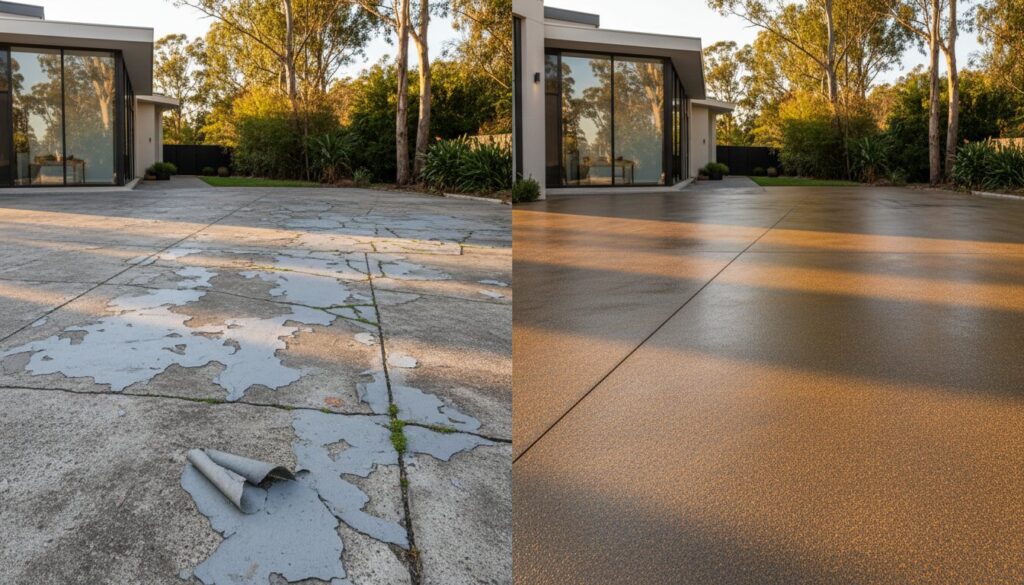
What if the $100 DIY kit from the local hardware store is actually the most expensive mistake you’ll make on your Sydney driveway this year? It’s a common trap for homeowners looking to fix stained, tired paths. You want a bespoke surface that looks like a high-end stencil or exposed aggregate finish, but you’re rightfully worried that a standard concrete resurfacer will simply peel off under the 40 degree Sydney sun or crack when our reactive clay soil shifts.
We understand that you aren’t just looking for a quick coat of paint; you’re looking to protect your home’s structural integrity and aesthetic value. This 2026 guide promises to show you the critical differences between retail buckets and professional polymer systems that achieve a permanent bond. We’ll preview everything from the mandatory $146 City of Sydney permit fees to why premium finishes can reach $165 per square metre. It’s time to inspire a transformation that delivers both rugged durability and refined craftsmanship for your property.
Key Takeaways
- Evaluate the financial and environmental benefits of professional restoration over the disruption and cost of full concrete demolition.
- Identify the critical role of polymer-modified resins in ensuring a concrete resurfacer survives Sydney’s harsh UV exposure and reactive clay soils.
- Navigate the technical requirements for slip resistance to ensure your new decorative finish meets strict Australian Standards for safety and compliance.
- Perform the “Water Drop” and “Hammer” tests to verify if your existing slab is a viable candidate for a high-performance coating.
- Transform your property’s first impression by selecting bespoke finishes that turn a utility surface into an architectural design feature.
Resurface or Replace? Navigating Sydney’s Concrete Restoration Options
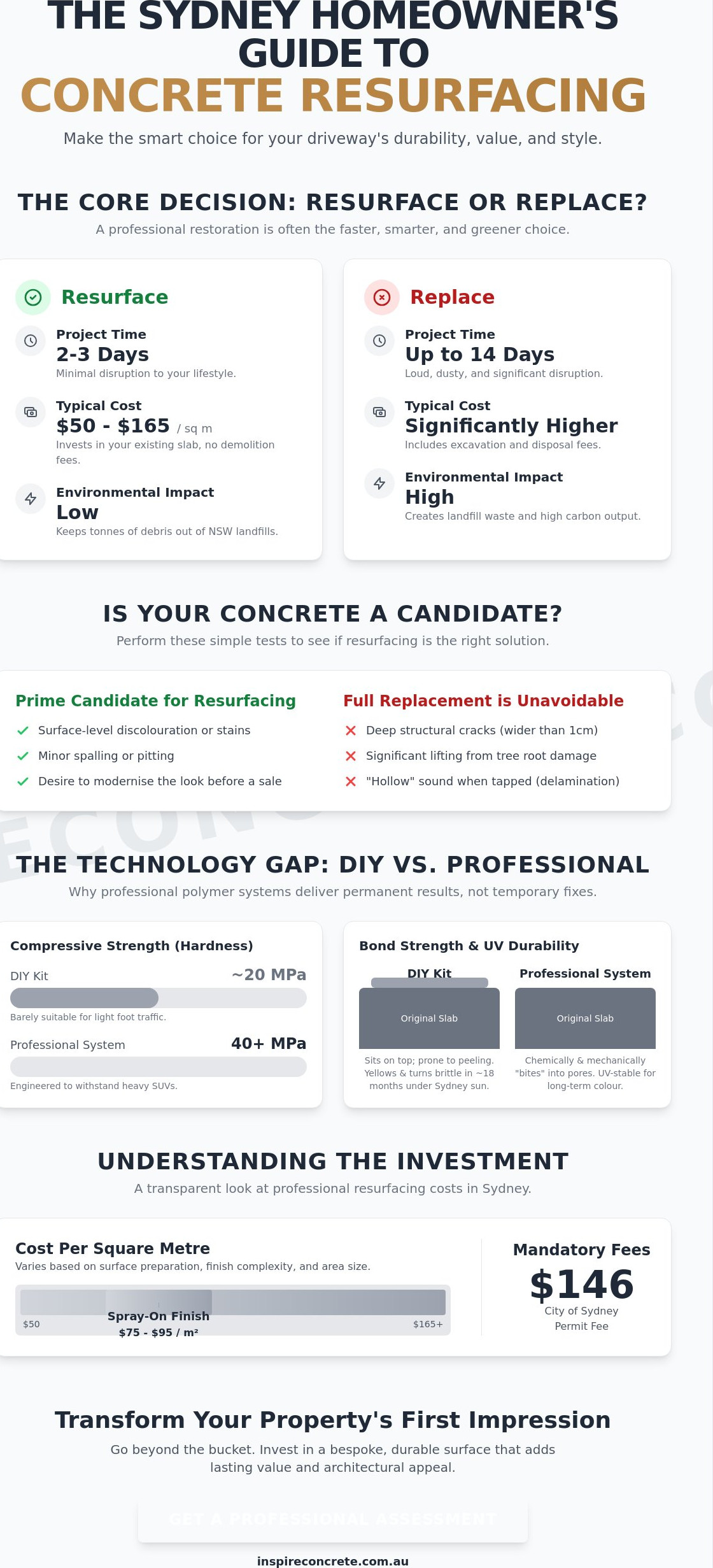
Choosing between a full demolition and a professional restoration is the first step toward reclaiming your property’s curb appeal. Demolishing a standard 50-square-metre driveway is often a loud, dusty, and expensive ordeal that can take up to 14 days to complete. In contrast, a professional concrete resurfacer system allows you to skip the heavy machinery. Most residential projects in Sydney are finished in just 2 to 3 days, providing a surgical strike on “ugly” concrete without the logistical nightmare of a full rebuild.
The financial reality is compelling. While a full replacement involves excavation and disposal fees, professional resurfacing in Australia typically ranges from $50 to $165 per square metre. By opting for polymer cement overlays, you’re investing in a high-performance bond that utilizes your existing slab as a stable foundation. This approach isn’t just budget-conscious; it’s environmentally responsible. Restoring an existing slab keeps tonnes of debris out of New South Wales landfills and significantly reduces the carbon footprint associated with new concrete production.
Sydney’s unique climate also plays a major role in this decision. Our temperate weather allows for year-round application, provided the system is engineered to handle the specific thermal expansion of our region. These professional systems mimic high-end finishes like pebblecrete (exposed aggregate) or sophisticated stencilled patterns, giving you a bespoke look that usually requires a much larger investment in a new pour.
When Resurfacing is the Smarter Investment
If your concrete suffers from surface-level discolouration, minor spalling, or stubborn oil stains that pressure washing won’t touch, it’s a prime candidate for a refresh. We frequently see homeowners use a concrete resurfacer to modernise their facade before a property sale, as a fresh spray-on finish (costing between $75 and $95 per square metre) can dramatically increase perceived value. The speed of application ensures minimal disruption to your Sydney lifestyle, allowing you to park on your driveway again much faster than with new concrete.
When Full Replacement is Unavoidable
There are times when the “Trusted Expert Craftsman” must advise against a simple resurface. If your slab has deep structural cracks wider than a centimetre, it often indicates foundation failure in Sydney’s notorious reactive clay soil. You should also perform a “hollow sound” test by tapping the surface with a hammer. A drummy, hollow ring suggests delamination where the concrete has separated from its sub-base. Finally, if you’re dealing with significant root damage from large trees, a resurfacer won’t stop the lifting; in these cases, a full replacement is the only way to ensure structural integrity.
Understanding Concrete Resurfacer Technology: Professional Polymer Systems
A professional concrete resurfacer is far more than just a thin layer of cement. It’s a sophisticated, polymer-modified cementitious coating engineered to transform existing slabs into high-performance surfaces. These systems rely on liquid polymer resins that replace a portion of the mixing water, creating a material that is both flexible and incredibly adhesive. While a standard bag of cement might sit on top of a slab, these professional resins “bite” into the open pores of the existing concrete. This creates a chemical and mechanical bond that resists the intense shear forces generated by turning vehicle tyres.
The science of bond strength is the primary differentiator between a temporary fix and a permanent solution. A technical paper on bonded concrete emphasizes that the durability of an overlay depends entirely on the interface between the old and new materials. Professional systems are designed to match or exceed the thermal expansion of the base slab, preventing the delamination that plagues cheaper alternatives. In terms of hardness, the gap is wide. Most retail DIY kits struggle to reach a compressive strength of 20MPa, which is barely enough for light foot traffic. Professional-grade systems regularly exceed 40MPa, ensuring the surface doesn’t crush or indent under the weight of heavy SUVs.
Sydney’s UV exposure is another critical factor. Intense solar radiation can cause inferior polymers to turn yellow and become brittle within 18 months. Professional systems utilize UV-stable acrylics and high-performance pigments that maintain their depth of colour even in north-facing driveways. This stability ensures your investment doesn’t just look good on day one, but remains vibrant for the next decade.
The Anatomy of a Professional Resurfacing System
Success begins with a high-performance base coat that acts as a primer, ensuring the decorative layers never peel. We utilize integral pigment technology, where the colour is blended throughout the material rather than just being painted on top. This means if you ever drop a heavy tool, the resulting nick shows the same colour underneath. Finally, a high-solids sealer provides a seamless barrier against Sydney’s coastal salt and road grime.
Hardware Store DIY Kits vs. Professional Grade Systems
Retail “bucket” resurfacers often contain high levels of sand fillers and low polymer density to keep price points down. This recipe is a magnet for hairline cracks. Sydney’s high humidity also makes application tricky for amateurs, as the material can dry too quickly or fail to cure properly. A bespoke professional installation accounts for these environmental variables, providing a workmanship warranty that a hardware store shelf simply cannot match.
Comparing Finishes: Spray-On vs. Hand-Trowelled Resurfacing for Sydney
A professional concrete resurfacer acts as a blank canvas for your property, allowing you to replicate premium materials without the cost of a full demolition. This transformation moves far beyond a simple coat of grey. Today’s systems allow for a sophisticated range of textures and patterns that can turn a cracked path into a design feature. Whether you are aiming for a rugged, textured look or a refined, seamless finish, the choice of application technique determines both the final aesthetic and the surface’s long-term performance.
Safety is a critical consideration for Sydney’s undulating landscape. Every decorative finish must meet AS/NZS 4586 slip resistance standards, particularly for steep driveways in suburbs like Mosman or the Northern Beaches. Textured finishes provide superior traction during Sydney’s sudden summer downpours. In terms of durability, these systems are engineered to withstand the weight of heavy 4WDs and SUVs, which can weigh over 2.5 tonnes. To maintain this structural integrity and visual depth, we recommend a high-quality reseal every 24 months, or every 18 months in areas with extreme UV exposure, to protect the pigments from fading.
Spray-On (Covercrete) and Stencil Finishes
Spray-on applications are the workhorse of residential restoration. By using a specialized hopper gun, we apply a base coat followed by a “flick” or spray texture that creates a multi-toned, slip-resistant surface. This technique is highly effective at hiding minor surface imperfections and tyre marks. Many homeowners choose this method to achieve the sophisticated look of stencil concrete driveways. With stencilling, we can create intricate patterns ranging from classic heritage brick headers to modern geometric tile designs. This finish typically costs between $75 and $150 per square metre, depending on the complexity of the pattern and the number of colours used.
Hand-Trowelled and Smooth Finishes
For those seeking a contemporary, minimalist aesthetic, hand-trowelled finishes offer an elegant solution. This method is often used for alfresco areas and pool surrounds where a seamless “burnished” look is desired. We utilize micro-toppings, which are incredibly thin layers of polymer-modified cement, to create smooth indoor-outdoor transitions. These finishes require the highest level of artisan skill, as every trowel stroke is visible in the final product. While these smooth surfaces are visually stunning, they are often better suited for foot traffic areas rather than heavy-use driveways, as they require more precise maintenance to keep their refined appearance.
The Candidate Test: Is Your Concrete Surface Right for a Resurfacer?
Before committing to a high-end transformation, you must verify that your slab is a willing partner. Not every surface is ready for a concrete resurfacer. Success depends on the slab’s ability to breathe and bond. We begin with the “Water Drop” test. By placing droplets on various sections of the driveway, we check for existing sealers. If the water beads rather than soaking in, a barrier exists that will cause any new coating to fail. Similarly, the “Hammer” test involves tapping the concrete to listen for hollow, drummy sounds. These echoes signal that the top layer has already detached from the sub-base, meaning any resurfacing would be like building on sand.
Moisture is another silent project killer. High moisture vapour transmission from a wet sub-base can cause the new surface to bubble and delaminate within months. We also look at the age of the concrete. “Green” concrete must cure for at least 28 days before we can even consider an overlay. Applying a system too early traps moisture and prevents the polymer from reaching its full 40MPa hardness. This diagnostic phase ensures we aren’t just covering up a problem, but providing a permanent solution.
Sydney Soil and Structural Considerations
Western Sydney is famous for its reactive clay soil, which expands and contracts with our erratic weather patterns. This movement leads to “reflective cracking,” where cracks in the old slab telegraph through to the new concrete resurfacer. To combat this, we respect every expansion joint. You cannot simply resurface over a joint; it must be mirrored in the new finish to allow for natural movement. We also look for spalling caused by rusted reinforcement mesh. If the steel inside is expanding, it’ll blow the new finish off, requiring a more intensive structural repair before the aesthetic work begins.
The Critical Preparation Phase
Preparation is 90% of the job. A high-pressure clean at a minimum of 4000 PSI is the bare baseline to remove surface contaminants. While some contractors still rely on acid etching, we prefer diamond grinding. Grinding opens the concrete’s pores far more effectively, creating a superior mechanical key for the polymer to grip. For existing cracks, we don’t just fill them with grout. We utilize epoxy injection protocols to stitch the slab back together, ensuring the foundation is as rock-solid as the finish. If you’re unsure about your slab’s integrity, book a professional site assessment to avoid costly failures.
Beyond the Bucket: Why Professional Resurfacing Inspires Long-Term Value
A professional concrete resurfacer is more than a simple repair product; it’s a tool for architectural drafting that transforms the entire personality of your home. We treat every project as a bespoke design opportunity, ensuring the final texture and colour palette complement your existing landscape. A renewed driveway acts as the primary engine for your property’s curb appeal, often providing a return on investment that far exceeds the initial application cost. By choosing a high-performance system over a retail fix, you’re securing a surface that handles Sydney’s 40-degree summer peaks without softening or losing its grip.
Long-term value is built on a foundation of consistent maintenance. While a professional system is incredibly durable, even the best concrete driveway resurfacing requires a high-quality re-seal every 3 to 5 years to maintain its lustre and stain resistance. This simple step prevents Sydney’s coastal salt and road oils from penetrating the polymer matrix. When reviewing quotes, ensure your contractor includes the following non-negotiable items:
- Detailed surface preparation (diamond grinding, not just a light wash).
- Provision for the mandatory $146.00 Road Opening Permit fee if working near the kerb.
- Clear inclusion of the $1,030.00 City of Sydney driveway inspection fee.
- A specific slip-resistance rating that complies with AS/NZS 4586.
- An itemised list of the polymer resins and sealants being utilized.
The Value of Local Sydney Expertise
Hiring experienced concreters in Sydney ensures your project navigates the complex web of local council requirements. We manage the technical details of driveway crossovers and kerb heights, ensuring every millimetre of your new surface remains compliant with Australian Standards. We recently transformed a tired property in the Inner West from a stained, “cracked grey” eyesore into a modern slate masterpiece in just 72 hours. This project didn’t just fix a driveway; it inspired a complete lifestyle upgrade for the homeowners.
Your Next Steps to a Transformed Surface
Ready to move beyond the bucket and invest in a permanent solution? The process begins with a comprehensive site inspection where we assess your slab’s structural integrity. Before our team arrives, ensure your site has clear access and that any overhanging foliage is trimmed back from the work area. We’ll handle the drainage considerations and precision application to ensure a seamless result. Transform your property with Sydney’s resurfacing experts at Inspire Concrete and discover the difference that professional craftsmanship makes to your home’s long-term value.
Secure Your Property’s Future with a Bespoke Finish
Your driveway is more than just a place to park; it’s the first impression of your home. You’ve learned that a high-performance concrete resurfacer is not a simple DIY product, but a sophisticated polymer system designed to withstand Sydney’s reactive soils and intense UV exposure. By choosing professional-grade materials over hardware store kits, you ensure a bond that reaches 40MPa hardness and lasts for decades. We’ve seen how proper diagnostics, such as the water drop and hammer tests, prevent the peeling and cracking that plague inferior applications.
With 20+ years of Sydney concreting experience, our licensed and insured artisans specialize in high-performance polymer systems that deliver both durability and elegance. We treat every project as a partnership, ensuring your vision for a seamless, modern surface becomes a reality. Don’t settle for temporary fixes that fail under pressure. Get a Professional Quote for Your Sydney Resurfacing Project today and let our team handle the technical details while you enjoy the transformation. It’s time to inspire a change that enhances your lifestyle and boosts your property value for years to come.
Frequently Asked Questions
How long does a professional concrete resurfacer last?
A professional concrete resurfacer typically lasts between 10 and 15 years when maintained with care. It’s vital to reseal the surface every 24 months to protect the polymer bond from Sydney’s environmental stressors. In areas with extreme UV exposure, we often recommend resealing every 18 months to ensure the decorative pigments don’t lose their depth or vibrancy.
Can you use a concrete resurfacer over painted or sealed surfaces?
No, you cannot apply a resurfacer directly over existing paint, oil stains, or old sealers. These substances act as a bond-breaker that will cause the new layer to peel within months. We utilize diamond grinding to remove 100% of previous coatings, opening the concrete’s pores so the high-performance resins can achieve a permanent mechanical “bite” into the original slab.
Is concrete resurfacing slippery when wet?
Not if it’s applied by a specialist who understands Australian Standards. We ensure every project complies with AS/NZS 4586 for slip resistance by incorporating specialized textures or anti-slip aggregates into the sealing process. This is particularly important for steep Sydney driveways where traction is a non-negotiable safety requirement during our heavy summer downpours.
How thick is a typical layer of concrete resurfacer?
A standard concrete resurfacer application is surprisingly thin, usually ranging from 2mm to 4mm. Despite this slim profile, the polymer-modified cement is engineered to be incredibly dense. These systems regularly achieve a compressive strength of 40MPa, which is significantly harder than the 25MPa concrete typically used for residential driveways and footpaths.
Can I drive my car on the resurfaced driveway immediately?
You should wait at least 48 to 72 hours before driving a vehicle on the new surface. While the material feels dry to the touch within a few hours, the internal polymer matrix requires time to reach its full structural integrity. Parking a 2.5-tonne SUV on the surface too early can cause indentations or compromise the long-term bond strength of the system.
Does concrete resurfacing fix cracks permanently?
Resurfacing is an aesthetic transformation, not a structural cure for a failing foundation. We utilize epoxy injection to stitch minor cracks before applying the finish, but if Sydney’s reactive clay soil causes the slab to shift, “reflective cracking” can occur. If your slab has deep structural failures or hollow sections, a full replacement is the only way to ensure lasting integrity.
What is the best temperature to apply a concrete resurfacer in Sydney?
The ideal application window is between 10 and 30 degrees Celsius. While we work year-round in Sydney, we carefully time our pours to avoid the midday heat of a 40-degree summer day. High temperatures cause the material to dry too quickly, which prevents the polymers from settling correctly and can lead to surface spider-cracks or a weakened bond.
How much does professional concrete resurfacing cost per square metre?
Professional resurfacing costs in Australia typically range from $50 to $165 per square metre. A basic spray-on finish generally costs between $75 and $95 per square metre, while intricate stencilled or stamped patterns start at $100. Premium options like pebblecrete or exposed aggregate finishes represent the higher end of the scale, reaching up to $165 per square metre.
