
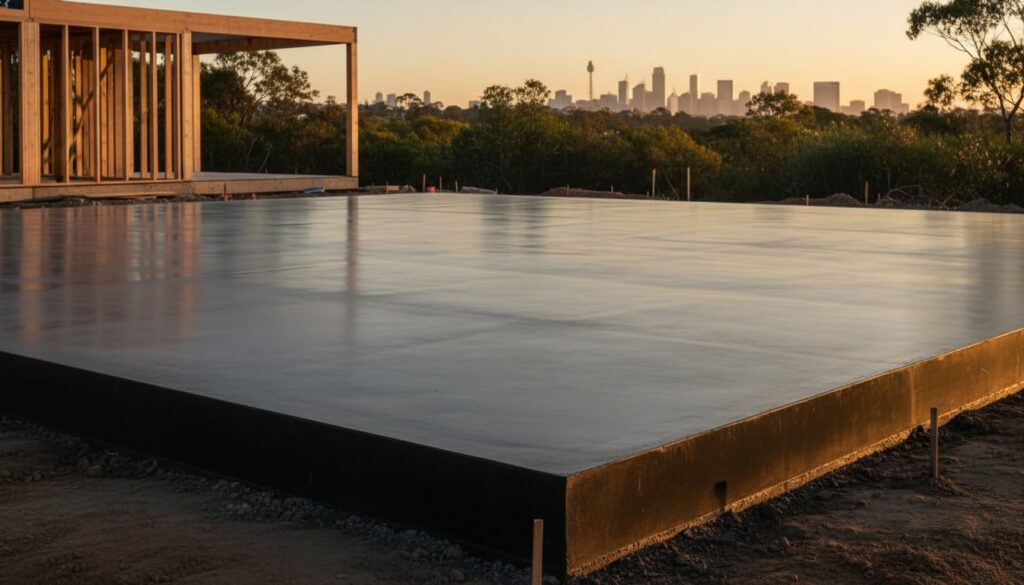
Would you trust a multi-thousand dollar investment to a soil profile that breathes and shifts with every summer storm? In Sydney, a concrete slab is a precision-engineered response to reactive clay, not just a flat surface for your home or shed. You likely feel the weight of responsibility that comes with choosing a foundation, fearing the sight of structural cracks or the sting of hidden excavation costs. We understand that anxiety because we have seen how Sydney’s unique geology challenges even the most seasoned builders.
This guide provides the technical clarity you need to master your project with confidence. You will learn how the current NCC 2022 regulations and the AS 2870:2011 standards protect your property, even as the industry prepares for the May 1, 2027, adoption of the NCC 2025. We break down the current pricing for standard 100mm slabs, which typically range from $75 to $110 per square metre, and explain how site-specific engineering creates long-term value. Let this knowledge inspire your next build, as we preview the essential steps to achieving a seamless, compliant, and durable foundation for 2026 and beyond.
Key Takeaways
- Navigate Sydney’s reactive clay soils with confidence by understanding how site-specific engineering prevents structural movement and cracking.
- Select the ideal concrete slab for your project by comparing different structural types tailored for house foundations, granny flats, and shed bases.
- Master the timing of your project by learning how expert contractors manage the excavation and curing process amidst Sydney’s unique weather conditions.
- Elevate your property’s value by integrating structural precision with the aesthetic potential of bespoke finishes for entertaining areas and pool surrounds.
- Secure your investment by aligning with current Australian Standards and local council regulations to ensure a compliant, long-lasting result.
What is a Concrete Slab? Understanding the Foundation of Your Home
A structural concrete slab is the critical interface where engineering meets the earth. It serves as the silent, unyielding platform that carries the weight of your entire life, from the walls that shelter you to the roof that protects you. In our experience across Sydney, what is a concrete slab? is best understood as a precision-engineered composite. It remains the region’s premier foundation choice because it offers a permanent barrier against subterranean termites and provides the thermal mass needed to stabilize indoor temperatures. Every pour we execute follows the rigorous guidelines of AS 3600:2018, the Australian Standard for concrete structures, ensuring the build meets modern safety and longevity requirements.
The true strength of a foundation lies in its reinforcement. While concrete excels at handling the massive downward pressure of a building, it lacks the inherent flexibility to resist pulling forces. We integrate high-tensile steel mesh and rebar to provide this necessary tensile strength, creating a foundation that can flex without failing. This meticulous balance of materials allows us to transform a raw site into a stable, enduring asset for your property. It’s a process that requires trade mastery to ensure the structural integrity of the home remains uncompromised for generations.
Structural vs. Non-Structural Slabs
Understanding the difference between a load-bearing house slab and a decorative garden path is the first step in project planning. A structural slab is a complex system designed by engineers to support specific live and dead loads, often requiring deeper footings and heavier reinforcement to bridge across varying soil types. Non-structural slabs don’t face these same pressures and are typically thinner, often around 75mm to 100mm. You should never apply a DIY approach to structural foundations; the risk of subsidence or council non-compliance is simply too high. We ensure every structural project is handled with precision to avoid the hidden costs of future repairs.
Key Components: Concrete, Steel, and Vapor Barriers
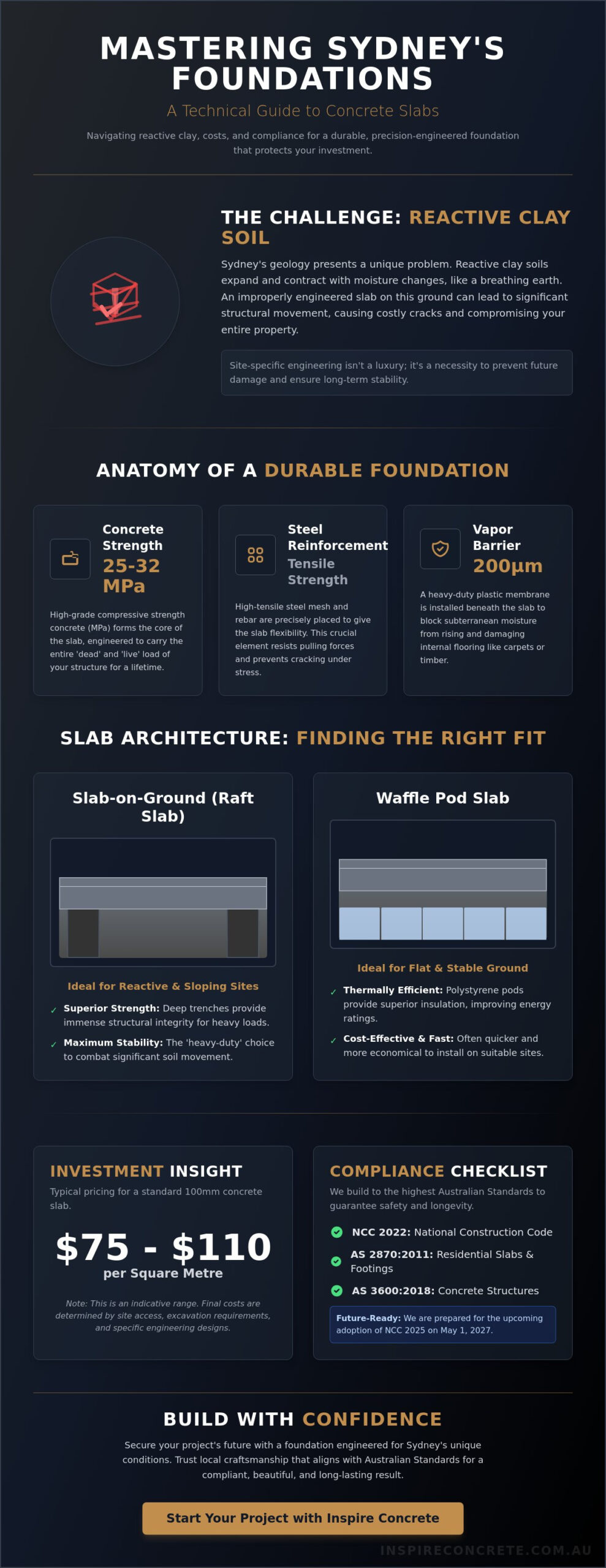
A durable concrete slab relies on a specific technical recipe. We typically utilize concrete with an MPa rating of 25 to 32, ensuring it has the compressive strength to last a lifetime. Because Sydney’s humidity can be relentless, we install a heavy-duty 200-micron vapor barrier to block moisture from migrating through the concrete and damaging your internal floorboards or carpets. We also use plastic chairs to suspend the steel reinforcement at a precise height during the pour. This ensures the mesh is perfectly positioned in the top third of the slab to handle stress, a detail that defines the difference between a standard job and an Inspire Concrete masterpiece.
Common Types of Concrete Slabs for Sydney Residential Projects
Selecting the right concrete slab architecture isn’t just about pouring liquid stone; it’s about matching engineering to the topography of your land. In Sydney, where terrain shifts from the flat plains of the West to the steep sandstone ridges of the North, your choice directly dictates the Finished Floor Level (FFL) of your property. This measurement is crucial for ensuring seamless transitions between indoor living and outdoor entertaining areas. Whether you’re planning a grand residence or need an Expert Concrete Pathway Installer for a smaller garden project, the foundation sets the tone for the entire site’s aesthetic and structural success.
Slab-on-Ground vs. Waffle Pod Slabs
Traditional raft slabs remain the heavy-duty choice for highly reactive Sydney soils. These involve deep trenches filled with concrete and steel, providing immense structural integrity for heavy loads. Conversely, waffle pod slabs utilize a grid of polystyrene pods to create an internal “waffle” pattern. This method is often faster to install on flat blocks and offers superior insulation properties. According to the Australian government guide to concrete floors, these slabs can significantly improve a home’s thermal performance. While waffle pods are cost-effective for 2026 builds on stable ground, raft slabs are often necessary when the soil report demands a more robust response to ground movement.
Specialised Foundations: Granny Flats and Sheds
Secondary dwellings require a tailored approach to ensure they don’t subside over time. For Granny Flat Builders Sydney, we often specify thickened edges. This engineering detail reinforces the perimeter where the most weight is concentrated, ensuring the structure remains level even on reactive clay. Similarly, when engineering Shed Slabs in Sydney, we account for the specific equipment the floor will carry. A standard 100mm concrete slab might suffice for a garden shed, but a workshop housing heavy machinery requires a bespoke thickness and reinforced MPa rating to prevent point-load cracking.
Suspended Slabs for Sloping Blocks
Sydney’s iconic hillsides demand more than a simple ground-bearing pour. Suspended concrete slabs allow you to build out over steep terrain, utilizing steel permanent formwork systems like Bondek. This method creates a rock-solid floor that can be integrated with high-end Concrete Patio Sydney designs. It transforms unusable slopes into elegant, functional spaces. As of March 2026, decorative concrete options for these alfresco areas range from $100 to $170 per square metre, reflecting the craftsmanship required for high-end finishes. If you want to transform your backyard into an elegant retreat, we can help you design a bespoke entertaining area that stands the test of time.
Engineering for Sydney Soils: Navigating Reactive Clay and Site Conditions
Sydney’s geology isn’t a static foundation; it’s a dynamic environment that demands respect. The region is famous for its “reactive clay,” a soil type that swells significantly when wet and shrinks as it dries. This constant cyclic movement exerts immense pressure on a concrete slab, and failing to account for it is the primary cause of structural cracking. Engaging a geotechnical engineer to conduct a soil test is the non-negotiable first step for any House Slab in the Sydney basin. This report provides a site classification under AS 2870:2011, ranging from Class A (stable sand or rock) to Class E (extremely reactive). Many sites in the Western Suburbs fall into Class H or P, requiring bespoke engineering to ensure the home remains level for decades.
To overcome these shifting conditions, we often utilize piering. These are deep, concrete-filled holes bored through the reactive topsoil until they reach stable “founding” material, such as Hawkesbury sandstone or stiff siltstone. By anchoring the foundation to these deeper layers, we bypass the movement of the surface clay. This level of trade mastery transforms a potentially problematic block into a secure building site, providing the certainty every homeowner deserves.
Managing Ground Movement and Cracking
Precision engineering includes planning for the inevitable. We use control joints, often called saw cuts, to create strategic weak points in the surface. These joints “tell” the concrete where to crack safely, ensuring any movement remains invisible and doesn’t compromise the aesthetic finish. Proper drainage is equally vital. If water pools on one side of a concrete slab, the clay underneath swells unevenly, leading to differential settlement. We design site-specific drainage solutions to keep moisture levels consistent around the entire perimeter, protecting the structural integrity of the pour.
Council and Regulatory Requirements
Navigating the local regulatory landscape is a critical part of our project management. Whether your build moves through a Development Application (DA) or a Complying Development Certificate (CDC), compliance with the National Construction Code is mandatory. We provide the necessary Form 15 Compliance Certificates for structural pours, giving you and your council peace of mind. We also pay close attention to Tree Root Protection Zones. Large trees can draw massive amounts of moisture from the soil, causing localized shrinkage that can destabilize a foundation. Our team coordinates with arborists and engineers to ensure your slab design respects the local canopy while maintaining its own durability.
The Professional Concrete Pour: From Excavation to Curing
A professional concrete slab installation is a high-stakes, choreographed event that requires absolute precision. While DIY guides often suggest mixing bags in a wheelbarrow, a residential foundation in Sydney involves complex logistics and heavy machinery. Timing is our most critical variable. In the peak of a Sydney summer, where temperatures frequently climb above 30 degrees, managing the “set” of the concrete becomes a race against the clock. We utilize specific retardants and chilled water mixes to ensure the chemical reaction doesn’t happen too quickly, which would otherwise lead to surface scaling or structural weakness. This level of control is what separates a trade-certified pour from a standard contractor’s job.
Preparation: Excavation and Formwork
Before a single drop of concrete hits the ground, we establish the site’s “datum” height. This is the zero-point that determines your finished floor level. We clear the site and install formwork that is perfectly level and braced to withstand the immense lateral pressure of wet concrete. During this stage, we coordinate the placement of internal plumbing and electrical “rough-ins.” Every pipe must be positioned with millimetre accuracy because once the pour begins, there’s no turning back. We ensure the steel reinforcement is suspended on chairs, maintaining the structural integrity required by Australian Standards.
The Pour: Pumping and Levelling
In the tight suburban streets of the Inner West or the hills of the Northern Beaches, access is often the biggest hurdle. We frequently deploy concrete pump trucks to bridge the gap between the street and the backyard. For difficult access sites, pumping costs typically range from $500 to $1,500 per job. Once the concrete is on the ground, we use mechanical vibrators to remove trapped air pockets, ensuring a dense, honeycomb-free structure. Our team then performs screeding and bull-floating to create a perfectly flat surface, ready for the final finish.
Curing: The Most Underestimated Step
Many homeowners confuse “drying” with “curing,” but they are entirely different processes. Curing is a chemical hydration process that allows the concrete to develop its internal crystalline structure. In Sydney’s dry winds, we often use misting or specialized curing compounds to keep the moisture locked in. Concrete reaches its design strength at 28 days. Rushing this stage can lead to “dusting” or surface cracks that ruin a bespoke finish. For those looking beyond structural foundations, you can explore decorative textures in The Ultimate Sydney Guide to Pool Surrounds, where we detail how different finishes impact safety and style.
The final aesthetic of your concrete slab depends on the trowelling technique. A “broom finish” provides essential slip resistance for driveways and paths, while a “steel trowel” finish creates a glass-smooth, dense surface ideal for internal garage floors or sheds. We take pride in delivering a result that balances rugged durability with a refined, professional look. If you are ready to start your build, we invite you to contact us today to discuss how we can bring your vision to life with a foundation that stands the test of time.
Inspire Your Project: Why Local Craftsmanship Matters for Your Slab
With over 20 years of dedicated service across the Sydney Metro and Western Suburbs, we have mastered the art of the perfect foundation. A concrete slab is the most permanent decision you will make for your property, and it’s why we refuse to cut corners. While some contractors offer cut-price services, these often result in structural failures that cost significantly more than the original price to repair. We balance rugged engineering with a design-led aesthetic, ensuring your foundation is as beautiful as it is strong. As licensed professionals, we take the guesswork out of the process by managing everything from architectural drafting to final site inspections with a meticulous eye for detail.
Our role as a trusted partner means we look beyond the immediate pour. We understand how the local climate and reactive soil profiles discussed in previous sections can jeopardize a poorly planned project. By choosing an expert craftsman, you gain the certainty that your build complies with every Australian Standard while also meeting your specific aesthetic goals. We don’t just pour concrete; we create the structural backbone for your future memories. This commitment to excellence ensures that every project we touch becomes a long-term asset for the homeowner, backed by decades of local trade intelligence.
Bespoke Solutions for Modern Lifestyles
Your project deserves more than just a utility surface. We specialize in transforming a standard concrete slab into a bespoke feature, such as a seamless alfresco area or a refined pool surround. This transformation requires a deep understanding of how different materials react to Sydney’s intense weather patterns and coastal conditions. We coordinate closely with your entire build team to ensure that plumbing, electrical, and structural elements align perfectly before the first truck arrives. Our commitment to using premium-grade materials ensures your entertaining space remains elegant and durable, regardless of the season.
The Inspire Process: From Quote to Completion
Transparency is the backbone of our partnership. Our quoting process is built on absolute honesty, protecting you from the hidden costs that often plague excavation and site preparation in Sydney’s rocky terrain. We maintain a professional conduct that is rare in the trade industry, keeping the site clean and the communication lines open at every stage. Our team guides you from the initial spark of an idea to a final, rock-solid result. We invite you to Contact Inspire Concrete for a bespoke slab quote today and see how we can bring your vision to life with precision and passion.
Build Your Future on a Foundation of Excellence
Your journey toward a durable, crack-free home starts with understanding that a concrete slab is more than just a flat surface; it’s a permanent commitment to your property’s future. By prioritizing site-specific engineering and navigating the complexities of Sydney’s reactive clay soils, you’ve already taken the most important step in protecting your investment. You now understand that structural integrity depends on the precise balance of high-MPa concrete, correct steel reinforcement placement, and a meticulous curing process that respects the local climate.
We bring over 20 years of experience as licensed Sydney concreters to every project, specializing in the reactive clay soil engineering that this region demands. Our team provides comprehensive project management from the initial excavation to the final, elegant finish. We don’t just pour foundations; we provide the technical certainty and refined craftsmanship required to bring your vision to life. This partnership ensures your build remains compliant, seamless, and structurally sound for generations.
Start your foundation with Sydney’s expert house slab builders and ensure your project stands as a testament to quality for decades to come. Let’s build something that inspires confidence together.
Frequently Asked Questions
How much does a concrete slab cost per square metre in Sydney?
A standard 100mm concrete slab in Sydney typically costs between $75 and $110 per square metre as of March 2026. Plain concrete options are generally more affordable, ranging from $60 to $85, while reinforced or coloured slabs range from $65 to $90 per square metre. You should also factor in additional costs for site preparation and excavation, which usually add $20 to $35 per square metre to the total project investment.
How thick should a concrete slab be for a standard house or shed?
Most residential house and shed foundations require a standard thickness of 100mm to ensure long-term structural integrity. While a 75mm slab might suffice for a small garden shed, heavy-duty applications like garages or workshops housing machinery often require 150mm to 200mm. We always align the thickness with the specific soil classification and engineer’s requirements for your Sydney property to prevent future subsidence.
Do I need council approval for a concrete slab in my backyard?
You don’t always need formal council approval if the project falls under “exempt development” criteria in New South Wales. Generally, small slabs under 20 square metres that don’t impact drainage or tree protection zones are exempt from a full Development Application. However, structural foundations for granny flats or larger secondary dwellings always require a Complying Development Certificate (CDC) or council approval to ensure they meet the National Construction Code 2022 standards.
How long does it take for a concrete slab to dry before I can build on it?
You should wait at least 7 to 14 days before starting light construction on a new concrete slab, even though the surface feels hard within 48 hours. Concrete reaches its full design strength at 28 days through a chemical hydration process. Rushing the build can lead to structural stress, so we advise keeping the surface moist during the first week to ensure the curing process is successful and the foundation remains durable.
Why is my concrete slab cracking and is it a structural issue?
Most hairline cracks are non-structural shrinkage cracks that occur when the concrete dries too quickly during the initial set. However, cracks wider than 2mm or those that show vertical displacement often indicate a structural issue related to Sydney’s reactive clay soil. We use strategic control joints to guide this movement, but if you notice significant gaps, it’s vital to have a professional assess the reinforcement and subgrade stability.
What is the difference between MPa 25 and MPa 32 concrete?
The difference lies in the compressive strength; MPa 25 is the standard for residential paths, while MPa 32 is a denser, stronger mix used for heavy-duty driveways and structural foundations. In Sydney’s coastal areas, we prefer MPa 32 because its increased density provides better protection against salt-air corrosion of the internal steel reinforcement. Choosing the right MPa rating ensures your slab withstands specific load pressures and environmental stressors over its lifetime.
Can I pour a concrete slab over existing pavers or old concrete?
We strongly recommend against pouring a new structural slab over old pavers because the existing surface doesn’t provide a stable, uniform base. This “double-layering” often leads to reflective cracking as the old surface shifts independently of the new pour. For a professional result, we excavate the old materials and prepare a fresh subgrade; however, if you only need an aesthetic upgrade, a concrete resurfacing service is a viable alternative for sound surfaces.
Does a concrete slab need steel mesh reinforcement?
Yes, every structural slab requires steel mesh or rebar to provide tensile strength and prevent the concrete from pulling apart. While concrete is excellent at handling weight, it’s brittle and will snap under the tension caused by Sydney’s shifting clay soils. Reinforcement mesh, which typically costs between $5 and $15 per square metre, acts as the skeleton of the foundation, ensuring it remains a single, cohesive unit despite ground movement.

11 Responses