
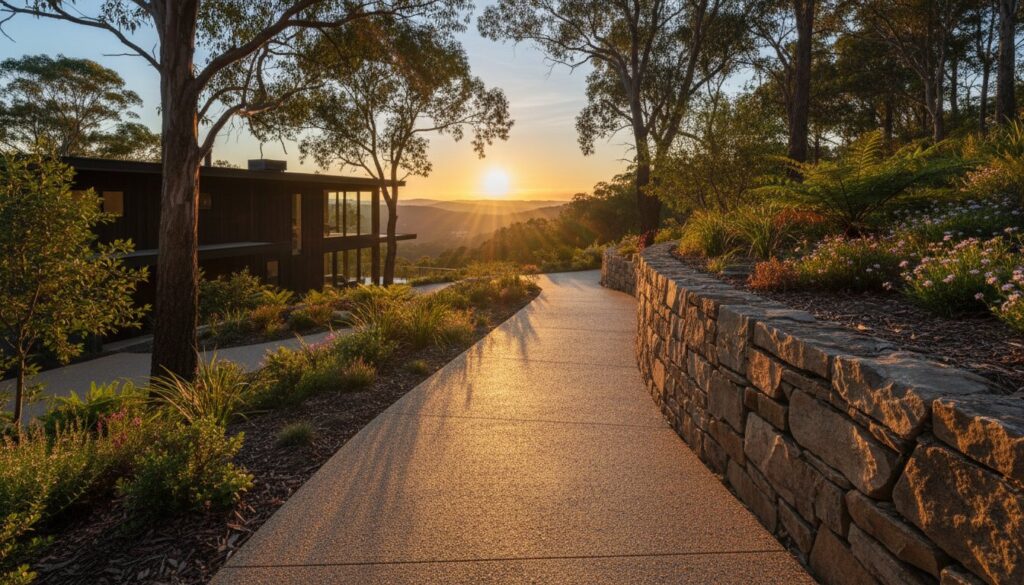
The geology of your property dictates your budget far more than the length of your walkway. While a flat suburban lot offers predictable pricing, the sandstone and steep gradients of our local ridges require a more sophisticated approach to engineering. Understanding the concrete pathway cost blue mountains homeowners face in 2026 means looking beyond simple square metre rates and accounting for the unique Mountain Factor. You’re likely aware that building on a slope or dealing with rocky terrain isn’t the same as pouring a slab on level ground, and those variables change the financial landscape of your project.
We’ve designed this guide to give you total certainty, mapping out everything from the $147 Development Application fee for smaller projects to the $150 per m² labour rates typical of high-quality Sydney craftsmanship. You’ll discover how to navigate Blue Mountains City Council regulations, choose slip-resistant finishes like exposed aggregate that enhance your home’s aesthetic, and ensure your new path stands the test of time against frost and erosion. We’ll preview the specific costs for standard finishes, which range from $75 to $150 per m², and explain how to minimize excavation expenses through smart planning and expert site management.
Key Takeaways
- Master the logistical variables behind the concrete pathway cost blue mountains to ensure your budget reflects the reality of mountain terrain.
- Identify how to mitigate the hidden costs of sandstone excavation and steep gradients through strategic site planning and engineering.
- Select decorative finishes that meet AS 4586 slip-resistance standards while providing the durability needed for frost-prone areas.
- Streamline your project timeline by understanding BMCC permit requirements and the specific 25MPa strength regulations for the region.
- Transform your property’s accessibility and aesthetic appeal with a bespoke, professionally engineered path that adds tangible long-term value.
Concrete Pathway Cost in the Blue Mountains: 2026 Price Ranges
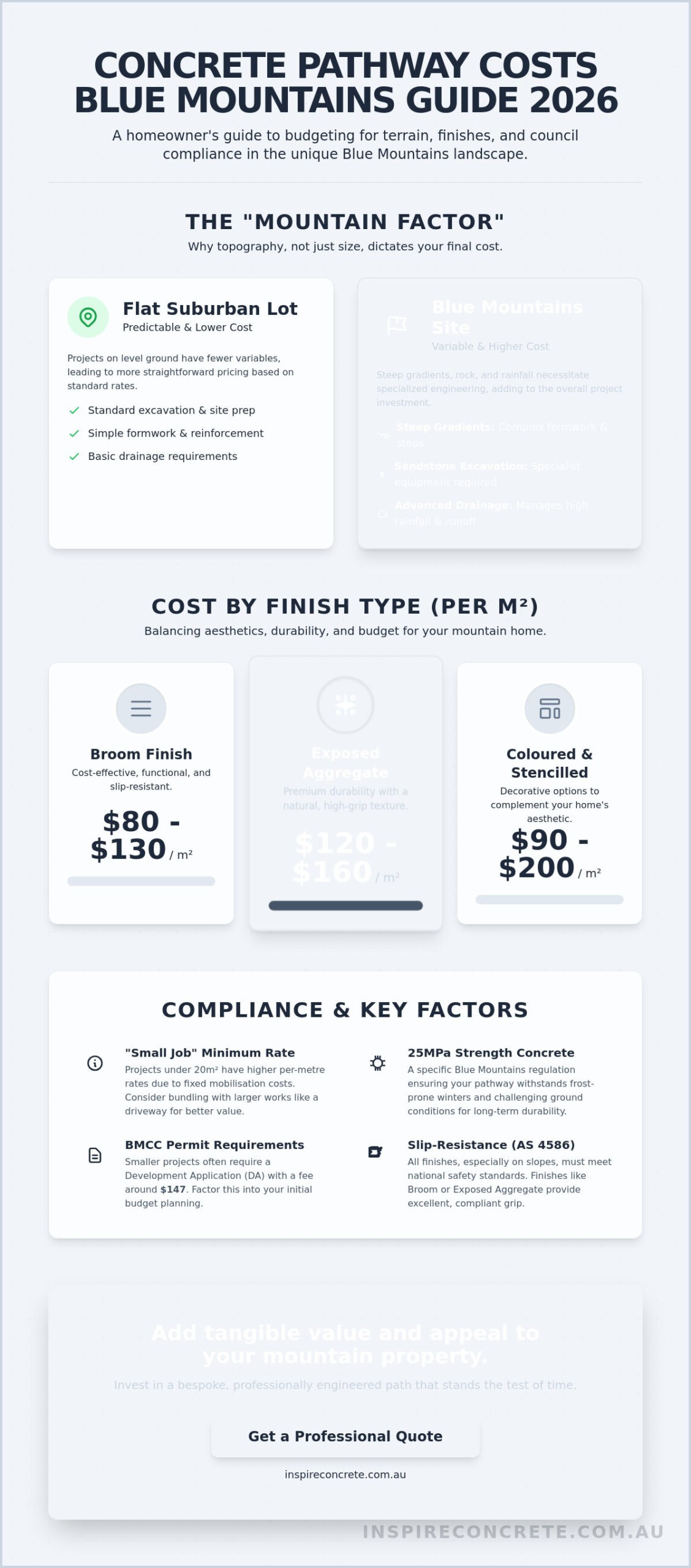
Estimating your concrete pathway cost blue mountains requires more than a simple online calculator. While standard Sydney rates provide a baseline, the logistical challenges of our local ridges often demand a more nuanced budget. You’ll find that a “per square metre” figure is only the starting point; the total project cost incorporates the specific engineering required to manage the unique mountain terrain. In 2026, the average cost for reinforced concrete in the Blue Mountains typically ranges between $80 and $150 per square metre for labour and materials. This range accounts for the structural integrity needed to withstand frost-prone winters and the varying accessibility of mountain properties.
The Rock dictates the price. When we talk about “Sydney prices,” they often fail to account for the sandstone excavation and steep gradients that define our region. A path in Penrith is a different beast than a path in Katoomba. You aren’t just paying for the pour; you’re investing in the site preparation that ensures your path doesn’t shift or crack as the ground moves. We treat every project as a bespoke engineering challenge, balancing the rugged demands of the landscape with a refined finish that enhances your home’s value.
Cost by Finish Type
Your choice of finish serves as both a functional surface and a design statement. A plain broom finish is the most cost-effective entry point, usually priced between $80 and $130 per m². It offers a reliable, slip-resistant surface that meets council requirements for residential footway crossings. For those seeking a more refined aesthetic, coloured and stencilled concrete options range from $90 to $200 per m². These finishes allow you to transform a simple path into a feature that complements your home’s architecture. Exposed aggregate remains the premium choice for mountain landscapes, costing between $120 and $160 per m². This finish provides exceptional durability and a natural look that blends with the environment. When selecting these options, understanding concrete properties like compressive strength and curing times helps you appreciate the craftsmanship involved in a high-end installation.
The “Small Job” Minimum
Small pathway projects often carry a higher square metre rate than larger slabs. This occurs because fixed costs like mobilisation, formwork setup, and concrete pump hire fees remain constant regardless of the job’s size. If you’re planning a project under 20 square metres, expect the unit rate to sit at the higher end of the spectrum. You can achieve better value by bundling your pathway work with a larger project, such as a new concrete driveway. This approach spreads the overhead costs across a larger area, reducing the overall price per metre and ensuring a consistent finish across your entire property. We focus on maximizing the aesthetic transformation of every project, ensuring your investment delivers both immediate beauty and long-term structural value.
The Mountain Factor: Why Topography Drives Cost
The rugged beauty of the Blue Mountains presents a unique set of engineering challenges that don’t exist on the flat plains of Western Sydney. When calculating the concrete pathway cost blue mountains residents must account for, the gradient of the land is often the most significant variable. Steep slopes require intricate formwork and additional steel reinforcement to prevent sliding or structural failure over time. You aren’t just paying for the volume of the pour; you’re paying for the technical expertise required to anchor a heavy structure to a vertical landscape. Unlike standard residential lots, mountain sites often demand tiered steps or reinforced retaining edges to manage the descent safely.
Sandstone excavation is the hidden cost that can catch many homeowners off guard. Beneath the topsoil of many mountain properties lies solid Sydney sandstone, colloquially known as “The Rock.” Excavating this material requires specialized rock-sawing equipment or hydraulic hammers, which increases machinery hours and labour costs significantly. Our high-rainfall environment also necessitates advanced drainage solutions. Without proper sub-surface drainage and strategic run-off points, water pressure can build up behind the concrete, leading to premature cracking or soil erosion. If you’re managing a complex site with significant drainage needs, it’s wise to partner with an expert craftsman who understands local geology.
Excavation and Site Preparation
Preparing a mountain site involves more than just clearing a path. We often have to remove decades of established bushland or old, failing pavers before the real work begins. The soil in our region can be highly reactive, meaning it expands and contracts with moisture changes. To ensure a stable foundation, we focus on creating a compacted road-base sub-grade that meets the Blue Mountains Council’s official standards for durability. This preparation phase is critical; a path is only as good as the ground it sits on.
Access and Logistics
Logistics in the Upper Mountains, from Wentworth Falls to Mount Victoria, carry unique overheads. Narrow, winding driveways often prevent large concrete trucks from reaching the pour site, making a concrete line pump a mandatory requirement rather than an option. You should also factor in the following logistical costs:
- Concrete Pumping: Often adds a flat fee of $600 to $900 depending on the length of the line required.
- Council Permits: A Road/Footpath Opening Permit from BMCC currently costs $200.00 for any work involving the public road reserve.
- Delivery Surcharges: Many plants apply a distance-based surcharge for deliveries to remote or high-altitude locations.
Managing these moving parts requires precision. We coordinate the timing of the pump, the truck, and the finishing crew to ensure the concrete is placed and finished before the mountain weather shifts. It’s this level of detail that transforms a simple walkway into a lasting asset for your property.
Choosing the Right Finish for Value and Durability
Selecting a finish for your mountain walkway involves more than just matching your home’s exterior. In an environment defined by heavy mist, winter frosts, and steep gradients, the technical performance of the surface is paramount. The concrete pathway cost blue mountains homeowners invest in must account for the high-strength mixes required to survive local conditions. We utilize concrete with a 28-day strength (F’c) of 25MPa as a minimum standard, ensuring the structural integrity of your path during intense frost-thaw cycles. This higher density prevents water from penetrating the surface and freezing, which is the primary cause of surface scaling and internal cracking in high-altitude areas.
Safety remains our highest priority, particularly on the inclines common in Leura or Blackheath. We evaluate every finish against the AS 4586 standard for slip resistance to ensure your property remains accessible year-round. While exposed aggregate driveways and paths are often chosen for their premium aesthetic, they are also the most functional choice for slopes. The textured surface provides natural grip underfoot, even when damp from morning dew or light rain. By choosing a bespoke aggregate mix, you transform a necessary safety feature into a design element that echoes the natural stone textures of the surrounding Escarpment.
Exposed Aggregate vs. Stencilled
Durability varies significantly between finishes when subjected to the damp, shaded conditions of a mountain garden. Stencilled or stamped concrete offers a beautiful, patterned look, but the surface textures can sometimes be more susceptible to wear if not maintained. Exposed aggregate is arguably the most resilient option; the stones are part of the concrete itself, meaning the finish won’t peel or fade over time. It’s particularly effective in areas with high leaf litter and shade, as it hides organic staining better than plain or stencilled surfaces. Maintenance for both involves a professional reseal every few years to keep the colours vibrant and the surface protected from moisture ingress.
Slip Resistance and Safety
The technical “P-rating” of your path determines its safety in wet conditions. For steep pathways, we aim for a P4 or P5 rating, which offers the highest level of slip resistance. For a more budget-conscious project, a plain concrete path with a heavy broom finish provides excellent traction. This technique involves drawing a specialized broom across the wet concrete to create fine ridges that grip footwear. If you’re designing a wheelchair-accessible (DDA) path, we carefully balance these textures with a level surface to ensure ease of movement. Every project we undertake is an opportunity to inspire confidence in your home’s outdoor spaces through meticulous craftsmanship and technical precision.
Council Requirements and BMCC Compliance
Navigating the administrative layer of your project is as critical as the excavation itself. When calculating the concrete pathway cost blue mountains homeowners must factor in the specific fees and regulations set by the Blue Mountains City Council (BMCC). For projects with an estimated cost up to $5,000, the Development Application (DA) fee is currently $147.00. If your vision is more ambitious, spanning between $5,001 and $50,000, the fee increases to $226.00 plus $3.00 for every $1,000 of the project value. Using the council’s building cost calculator ensures your initial estimates align with official requirements, preventing any friction during the approval phase.
Heritage conservation plays a significant role in townships like Leura, Wentworth Falls, and Katoomba. If your property sits within a heritage conservation area, your choice of finish and colour might be subject to specific aesthetic guidelines to maintain the town’s historical character. We also pay meticulous attention to Tree Protection Zones (TPZ). The Blue Mountains is home to significant heritage trees whose root systems can be easily damaged by heavy machinery or lime leaching from fresh concrete. We implement specialized techniques or hand-excavation near these zones to protect the local canopy while delivering a durable path.
Working Near the Verge
Work that extends beyond your property line into the public road reserve requires a Road/Footpath Opening Permit, which carries a $200.00 fee. If you’re installing a new footpath in the public reserve, council charges $580.00 for the first 40 metres. It’s vital to hire a contractor with the correct liability insurance to cover these public-facing works. We manage stormwater runoff with precision, ensuring that water is directed into the local system without causing erosion on neighbouring blocks or public land.
Bushfire Zone Requirements (BAL)
For those living in high Bushfire Attack Level (BAL) zones, concrete is the superior choice over timber or plastic composites. It’s a non-combustible material that doesn’t ignite under ember attack or radiant heat. A wide concrete pathway acts as a strategic fire break by creating a sterile, non-flammable zone that prevents ground fires from reaching your home’s facade. Integrating these paths into your Asset Protection Zone (APZ) provides an extra layer of security for your family. To ensure your project meets all local safety and heritage standards, contact our team for an expert assessment of your site.
Inspiring Your Outdoor Space with Professional Concreting
A bespoke pathway does more than connect your front gate to your porch. It defines the visual and physical rhythm of your outdoor living. In the Blue Mountains, where gardens are often multi-level and expansive, a well-placed path guides the eye and the feet through the natural beauty of your property. We don’t just pour concrete; we create a flow that enhances the architecture of your home and integrates seamlessly with its environment. Choosing the right layout transforms a difficult slope into an accessible feature, turning a utility into a design statement.
Sloping sites require more than just muscle. They require foresight. Expert architectural drafting is essential for ensuring that gradients remain comfortable and that water is managed effectively. Our approach to complex concrete slabs in Sydney and the Mountains is built on this foundation of precision engineering. We analyse the site’s unique contour lines to determine where steps, landings, or reinforced edges are necessary to maintain structural integrity over the decades. When you consider the concrete pathway cost blue mountains homeowners pay, remember that a significant portion of that investment goes into this “invisible” work. It’s the planning and site-specific engineering that prevents future failures and ensures your path remains as elegant as the day it was poured.
The Value of Expert Craftsmanship
Budget contractors often overlook the subtle nuances of mountain geology. DIY attempts frequently result in drainage disasters or surface scaling because the mix wasn’t suited for the local frost or the sub-base wasn’t compacted for sandstone-heavy soil. A failed path is an expensive liability that can detract from your property’s appeal. Conversely, a professionally installed, high-end concrete surface offers an impressive return on investment. It increases the curb appeal and tangible market value of your home by providing a permanent solution to terrain challenges. Our commitment to the Blue Mountains community is grounded in this standard of excellence; we build for the long term, not just for the season.
Ready to Transform Your Landscape?
The first step toward your new outdoor space is a comprehensive site consultation. To get the most out of your quote request, have your property survey or site plan ready, along with a clear idea of your preferred finish. We’ll provide a detailed, itemised quote that breaks down the concrete pathway cost blue mountains projects require, from initial excavation to the final protective seal. Whether you’re looking to install a rugged exposed aggregate path or a sleek coloured walkway, our licensed team is ready to bring your vision to life. Enquire with Inspire Concrete today to start your property’s aesthetic transformation.
Secure Your Property’s Future with Master Craftsmanship
Investing in a high-quality walkway is about more than simple accessibility; it’s about adding permanent value to your home. You now understand how the concrete pathway cost blue mountains homeowners plan for is shaped by the unique interplay of sandstone excavation and steep gradients. By selecting a durable, slip-resistant finish and adhering to BMCC standards, you ensure your project withstands the harsh mountain elements while enhancing your landscape’s aesthetic.
Our team brings over 20 years of local experience to every project. As licensed and insured master craftsmen, we specialise in the sloping and complex sites that define our region. We take pride in transforming challenging terrain into elegant, functional spaces through meticulous engineering and refined finishes. This commitment to quality ensures your vision is brought to life with total certainty and pride.
Ready to start your project? Get an Expert Quote for Your Blue Mountains Pathway and let us bring our signature blend of rugged professionalism to your home. We’re here to help you inspire a new flow for your outdoor living space.
Frequently Asked Questions
How much does a concrete pathway cost per m² in the Blue Mountains?
In 2026, the standard price range sits between $80 and $150 per square metre for most residential projects. This concrete pathway cost blue mountains residents encounter reflects the high-strength 25MPa mixes required for local longevity. Prices vary based on the complexity of your site’s topography and the specific decorative finish you select for the surface.
Do I need council approval for a garden path in Katoomba?
Most internal garden paths on private property don’t require a Development Application (DA) provided they meet exempt development criteria. However, any work involving the public road reserve or heritage-listed sites requires formal approval and a Road/Footpath Opening Permit. We recommend checking the specific heritage overlays for your Katoomba street to ensure full compliance before breaking ground.
Will my concrete path crack during a Blue Mountains winter?
Professional engineering prevents frost-related cracking by utilizing high-strength concrete and strategic expansion joints. We use a 28-day strength of 25MPa to resist the pressure of frost-thaw cycles common in the Upper Mountains. Proper sub-base preparation and professional sealing further protect the structural integrity of your path against the winter elements.
What is the best concrete finish for a steep sloping block?
Exposed aggregate is the gold standard for sloping blocks due to its superior natural slip resistance. The textured surface provides essential grip underfoot; this meets high P-rating safety standards for wet or icy conditions. Alternatively, a heavy broom finish offers a cost-effective solution that maintains excellent traction on steep gradients without sacrificing durability.
How long does it take to install a concrete pathway?
A typical residential pathway installation usually spans three to five days from initial excavation to the final pour. This timeline includes site preparation, formwork setup, and the placement of steel reinforcement. Factors like difficult sandstone excavation or unpredictable mountain weather can extend the schedule; we prioritize a seamless workflow to minimize disruption to your lifestyle.
Can you pour concrete over existing sandstone rock?
You can’t simply pour concrete directly onto raw sandstone without proper site preparation. We typically excavate a portion of the rock to create a level sub-grade and install a compacted road-base layer. This process ensures the pathway has a stable foundation and prevents the slab from shifting or cracking as the ground temperature changes.
Is exposed aggregate more expensive than plain concrete?
Yes, exposed aggregate typically costs between $120 and $160 per square metre, compared to $80 to $130 per square metre for plain concrete. The higher price reflects the premium materials and the additional labour required to wash away the surface paste and reveal the stones. It remains a popular investment because it hides wear better and offers enhanced slip resistance.
What is the minimum width for a wheelchair-accessible pathway?
The Australian Standard for a continuous accessible path of travel is a minimum clear width of 1000mm. For optimal comfort and to allow for passing, we often recommend a width of 1200mm to 1500mm. We carefully manage the gradient and surface texture to ensure the path remains safe and easy to navigate for all users in your home.
