
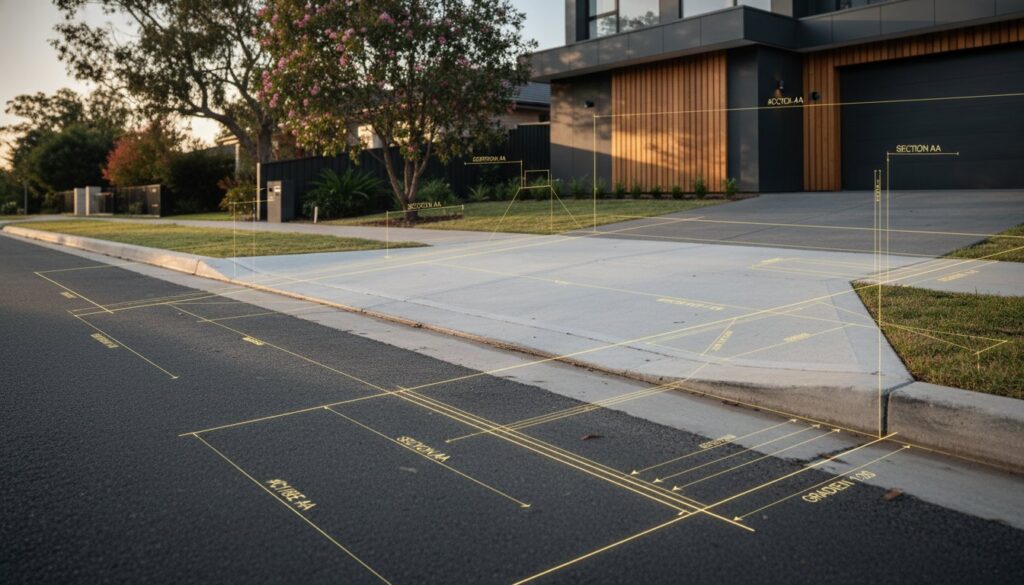
Your front gate isn’t the finish line for your property’s design. It’s the start of a complex legal transition onto public land. Many homeowners are surprised to learn that securing council approval for driveway crossover NSW is a distinct process governed by Section 138 of the Roads Act 1993, which sits entirely outside your standard Development Application. Building without this specific permit risks more than just a fine. It can lead to the heartbreaking reality of being forced to rip out freshly poured concrete because it fails to meet the strict structural and safety standards of the local road reserve.
We understand the frustration of navigating conflicting advice between DA approvals and specific council permits. It’s a common hurdle that shouldn’t stand in the way of your home’s curb appeal. This guide promises to clear the path, providing you with the exact technical specifications and legal steps required for a seamless installation in 2026. We’ll explore the updated AS/NZS 2890.1:2021 standards designed for modern vehicle sizes, break down the current fee structures across major councils, and help you identify a partner who balances engineering precision with high-end aesthetic transformation.
Key Takeaways
- Understand the critical distinction between private property boundaries and the road reserve to avoid unauthorized construction on public land.
- Learn why a standard DA or CDC does not grant permission for a crossover and how to correctly lodge a Section 138 application.
- Discover the precise engineering standards for concrete strength and mesh reinforcement required to meet 2026 NSW council specifications.
- Master the submission steps for council approval for driveway crossover nsw to ensure a seamless transition from planning to physical installation.
- Identify the legal and structural benefits of hiring an insured professional who understands complex council gradients and drainage requirements.
What is a Driveway Crossover and Why is Section 138 Approval Required?
Your property line marks a boundary of ownership, but your vision for your home’s entrance extends beyond that line. The physical transition between your private garage and the public street is a critical piece of infrastructure. Understanding What is a Driveway Crossover is the first step toward a successful build. This structure allows vehicles to move safely across the pedestrian zone without damaging the curb or the road surface. Because this work occurs on the “road reserve,” the land between your fence and the asphalt, you are building on property owned by the local government.
This ownership gap explains why securing council approval for driveway crossover nsw is a non-negotiable legal requirement. Under Section 138 of the Roads Act 1993, any person who wishes to “erect a structure or carry out a work in, on or over a public road” must obtain consent from the appropriate roads authority. This legislation isn’t designed to create red tape; it exists to ensure that your new entrance doesn’t compromise public safety or the integrity of communal assets.
Councils regulate these zones to protect vital underground services like water mains, gas lines, and telecommunications cables that often run beneath the nature strip. They also need to manage stormwater drainage. A poorly designed crossover can act like a dam, causing water to pool on the street or flood into your neighbor’s yard. By securing the correct council approval for driveway crossover nsw, you transform a simple access point into a durable, legal asset for your home while ensuring the sidewalk remains accessible for all pedestrians.
Crossover vs. Driveway: Knowing the Difference
Your driveway is the portion of the path located entirely on your private land. You have significant freedom over its style, whether you choose an exposed aggregate or a stencil finish. However, the crossover is considered public infrastructure. Because it must support the weight of heavy service vehicles like garbage trucks, it requires a greater structural thickness and specific reinforcement. If a pedestrian trips on a non-compliant crossover, the legal liability often rests with the homeowner who installed it, making compliance a critical form of personal protection.
The Role of the Vehicle Access Crossing (VAC)
You’ll frequently see the term “Vehicle Access Crossing” or VAC in Sydney council portals and application forms. It’s the formal industry name for the crossover. A VAC involves several components, including the layback, which is the sloped section of the curb; the apron, the flat area between the curb and the property line; and any internal paths that connect to the street. Because these are high-traffic zones, councils mandate a rigorous inspection schedule. You can’t just pour the concrete; an inspector must often verify the formwork and reinforcement before a single drop of concrete is laid.
Navigating the NSW Approval Hierarchy: DA, CDC, and Section 138
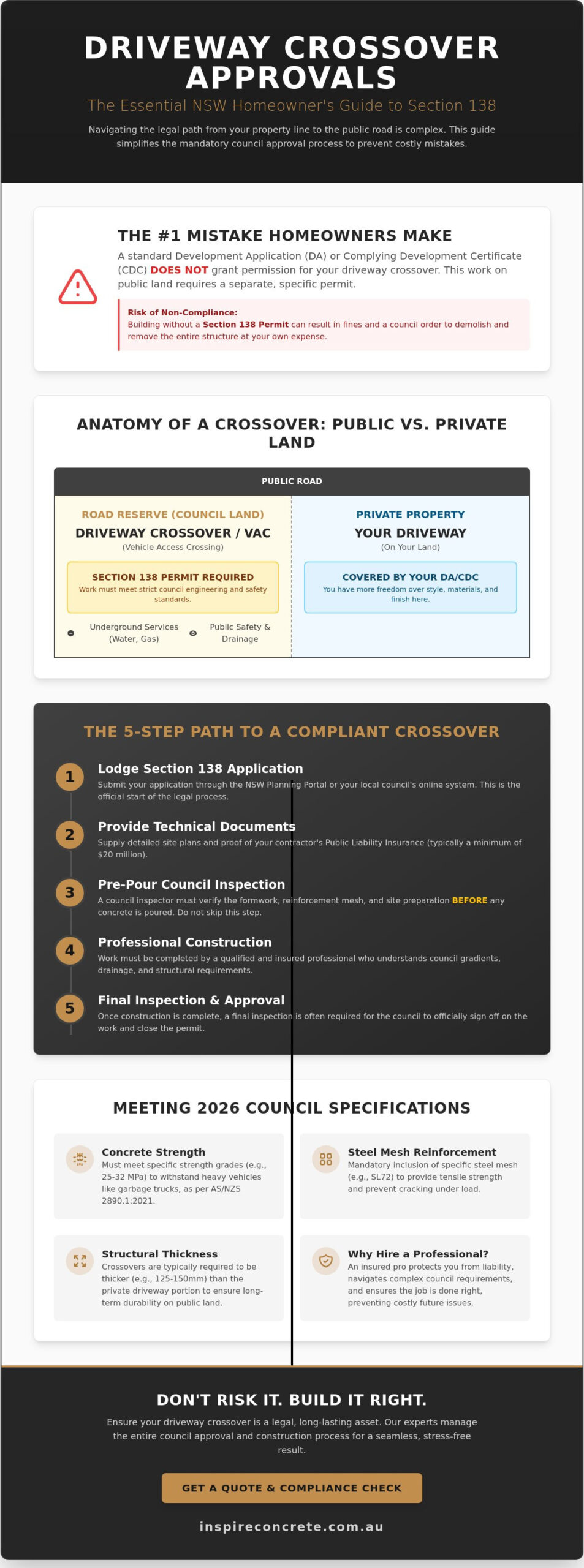
A common misconception stalls many Sydney renovations: the belief that a Development Application (DA) approval grants a total license to build. It doesn’t. Your DA focus is strictly on the private property side of the boundary. The moment your project touches the nature strip, you enter a different jurisdiction. This is where council approval for driveway crossover nsw becomes the primary legal requirement. Without a separate Section 138 permit, your DA is incomplete for street access.
The trap is even tighter for those using a Complying Development Certificate (CDC). Private certifiers can approve your house or granny flat, but they have zero authority over the public road reserve. We’ve seen homeowners complete a beautiful build only to find their Occupation Certificate (OC) withheld because the crossover wasn’t legally sanctioned. You must apply for the Section 138 early. If your home sits on a classified road, such as a major state highway, Council must even consult with Transport for NSW (TfNSW), adding layers of complexity to the timeline.
The Section 138 Permit Process
Securing consent is a structured journey that demands technical accuracy. It begins with an application via the NSW Planning Portal or your local council’s digital desk. You’ll need to provide detailed site plans and demonstrate that your contractor carries at least $20 million in public liability insurance. In several Sydney LGAs, like Blacktown, you must use an “Approved Contractor” who is already registered with the council. The process follows a strict rhythm:
- Pre-approval: Council reviews your levels and drainage plans to ensure they meet local standards.
- Formwork Inspection: An inspector visits the site after the steel is laid but before the concrete pour begins.
- Final Sign-off: A post-construction check to ensure the finish meets safety standards and matches the approved plans.
Consulting with experts who specialize in concrete driveways in Sydney ensures your site levels align with these council requirements from day one.
Avoiding Fines and Rectification Orders
Cutting corners with “unauthorised works” is a costly gamble. For the 2025-2026 financial year, Shellharbour City Council has set an illegal driveway administration fee of $901.00. This penalty is strictly for the paperwork; it doesn’t include the standard application fees or the potential cost of ripping out non-compliant work. Councils also use Section 149 certificates to flag non-compliant crossovers during property sales, which can derail a settlement at the last minute. Ensuring your council approval for driveway crossover nsw is finalized with a “Final Inspection” is the only way to protect your long-term property value and secure your Occupation Certificate.
Standard Drawings and Specifications: What Sydney Councils Demand
Sydney councils don’t leave structural integrity to chance. When seeking council approval for driveway crossover nsw, you must adhere to rigid standard drawings that dictate everything from the thickness of the slab to the grade of the steel. Most LGAs require a minimum concrete strength of 25MPa for residential crossings, though many are shifting toward 32MPa to accommodate the increasing weight of modern SUVs. This aligns with the updated AS/NZS 2890.1:2021 standards, which reflect the larger vehicle fleet currently on Australian roads. Securing council approval for driveway crossover nsw involves more than just a permit; it requires a commitment to engineering excellence.
The reinforcement inside that concrete is equally vital. While your internal driveway might use SL72 mesh, the crossover often demands SL82. This heavier mesh provides the tensile strength necessary to prevent cracking under the pressure of service vehicles. Beyond the material, placement is key. Your crossover must maintain a minimum 1-metre clearance from power poles, street trees, and service pits. Encroaching on these assets is one of the fastest ways to have an application rejected or a finished job condemned.
Kerb Profiles and Laybacks
The point of contact with the street is the kerb profile. Whether your street features roll-top, upright, or mountable kerbs, the existing structure must be modified. This involves creating a “layback,” a specialized cut and replacement of the kerb that allows a vehicle to transition smoothly from the road to the apron. Precision here is non-negotiable. If the layback is too steep, it damages vehicles; if it’s too shallow, it can disrupt the street’s gutter flow and lead to localized flooding.
Integrating Decorative Driveways with Compliant Crossovers
A common frustration for homeowners is the “Plain Concrete” mandate. While you may envision a stunning exposed aggregate driveway for your property, most Sydney councils insist on a plain, broom-finished surface for the portion on the nature strip. This ensures consistency for pedestrian safety and simplifies future utility repairs.
The secret to a high-end result lies in the transition. We utilize expansion joints at the property boundary line to create a clean, intentional break between the public crossover and your private decorative finish. This separation isn’t just aesthetic. It serves a structural purpose, allowing the two slabs to move independently and preventing cracks from migrating from the public zone into your private investment. This meticulous approach ensures your home maintains its premium look without violating the strict “plain concrete only” nature strip mandate.
The Step-by-Step Approval and Construction Process
Securing your property entrance is a sequence of precision milestones. It begins long before the first cubic metre of concrete arrives on site. Your first move should always be a consultation with a professional Sydney concreter who understands the local landscape. They can identify potential red flags in your site levels or proximity to public assets that might lead to a rejection of your council approval for driveway crossover nsw. This early expert insight prevents costly redesigns after your application has already been lodged.
Once your plans are refined, you must lodge your Section 138 application via the NSW Planning Portal or your local council website. If your application meets the 2026 standards, you will receive a “Permit to Construct.” This document is your green light, but it often comes with specific conditions, such as restricted work hours or specific drainage requirements. Precision is the hallmark of a master craftsman. You must follow these conditions to the letter to ensure your security bond is eventually returned. For example, Shellharbour City Council currently charges $600.00 for a standard application, a fee that includes two onsite inspections to verify your progress.
The most critical moment in the timeline is the formwork inspection. A Council Ranger or engineer must visit the site after the excavation is finished and the steel reinforcement is tied, but before any concrete is poured. If you pour without this inspection, council can force you to remove the work at your own expense. Following a successful pre-pour check, the focus shifts to the finish. We prioritize meeting exact levels to ensure a “scrapeless” entry. This meticulous approach protects low-profile vehicles and ensures the transition from the road to your property is both elegant and functional.
Preparing Your Site Plan
A compliant site plan is a technical map of your property’s interface with the street. You must include critical measurements showing the distance from side boundaries, street trees, and power poles. Councils typically demand a 1-metre clearance from all street furniture and service pits. You also need to account for the “1 in 20” slope rule for pedestrian safety across the sidewalk. Before any digging begins, we use Dial Before You Dig (DBYD) to identify hidden water, gas, or fibre optic lines that sit just beneath the nature strip surface.
Managing Inspections and Sign-offs
Timing your inspections is vital for maintaining your project momentum. Most councils require at least 48 hours’ notice for a pre-pour inspection. If the inspector finds an issue, a re-inspection fee applies, which in some LGAs like Shellharbour is $216.32 per visit. After the concrete has cured, a final inspection confirms the work matches the approved council approval for driveway crossover nsw. Once this final sign-off is recorded, your permit is officially closed out, and your Occupation Certificate can proceed without delay. For a seamless transition from planning to a durable result, trust the experts at Inspire Concrete to manage your professional driveway installation.
Why Professional Concreters are Essential for Crossover Compliance
Professionalism is the bridge between a rejected application and a lasting property asset. While a DIY approach might seem cost-effective, the legal risks are immense. Councils across the state require contractors to hold substantial public liability insurance, often $20 million or more. If an uninsured homeowner attempts this work and a pedestrian is injured or a utility line is severed, the financial fallout is life-changing. Choosing a specialist for your council approval for driveway crossover nsw shifts this risk away from your family and onto the shoulders of experts who carry the burden of liability.
The technical demands of a Sydney concrete driveway extension are equally rigorous. Every local government area has its own nuances. Blacktown City Council operates under a specific 2025/26 pricing schedule, while the Northern Beaches Council relies on a detailed Fees and Charges booklet for its specifications. A professional contractor knows these local playbooks. They understand how to design for heavy traffic loads and implement barriers against tree root intrusion, ensuring the slab doesn’t heave or crack after a few seasons. This isn’t just utility; it’s the preservation of long-term value.
The Value of Project Management
We act as your project partner, not just a labor hire service. Inspire Concrete manages the technical drafting and the complex council liaison required for Section 138 consent. This prevents the “Solar Cowboy” trap, where unlicensed operators disappear the moment a council inspector issues a rectification order. By treating the crossover with the same engineering precision as high-end concrete slabs, we transform a mandatory council requirement into a sophisticated entrance that enhances your home’s curb appeal. We ensure the transition is seamless, both legally and physically.
Ready to Start Your Project?
The journey from a basic property boundary to a fully compliant, elegant street frontage is paved with technical milestones. From the initial site plan to the final council sign-off, every detail matters. Don’t leave your property’s compliance to guesswork. Ensure your council approval for driveway crossover nsw is handled with the precision and authority of a master craftsman. Get a compliant quote for your Sydney driveway crossover today and experience the peace of mind that comes with professional execution.
Secure Your Property’s Future with Compliant Craftsmanship
Navigating the transition from your private boundary to the public street requires more than just a pour. It demands a deep understanding of the legal hierarchy and the structural rigour mandated by modern Australian standards. By distinguishing your Section 138 requirements from your standard building certificates, you protect your investment from costly rectification orders and legal liabilities. Mastering the process of council approval for driveway crossover nsw ensures your home’s entrance is as safe as it is sophisticated.
We believe every functional requirement is an opportunity for aesthetic transformation. With over 20 years of Sydney council compliance experience, our team provides end-to-end project management that covers everything from initial technical drafting to the final, high-strength pour. As fully licensed and insured Section 138 specialists, we eliminate the guesswork and handle the council liaison so you don’t have to. You deserve a partner who values precision as much as you value your home’s curb appeal. Request a Professional Crossover Consultation & Quote today. Let’s turn your vision into a durable, compliant reality that welcomes you home for years to come.
Frequently Asked Questions
Do I need a Section 138 approval if I am only repairing an existing driveway?
Yes, any work conducted within the public road reserve requires a Section 138 permit under the Roads Act 1993. Even if you aren’t changing the footprint of the crossing, the council must verify that the structural repair meets current safety standards and does not disturb underground utilities. Secure council approval for driveway crossover nsw before starting any repairs to avoid the risk of fines or being forced to remove non-compliant work.
How much does a driveway crossover permit cost in NSW?
Permit costs vary significantly across different local government areas. For the 2025-2026 financial year, Shellharbour City Council has set a standard application fee of $600.00, which includes two onsite inspections. Other councils, such as Blacktown and Northern Beaches, publish their own specific pricing schedules annually. You should always check your local council’s current fees and charges booklet to confirm the exact costs for your specific location.
Can I use exposed aggregate or stencilled concrete for my crossover?
Most Sydney councils mandate a plain, broom-finished concrete surface for the crossover portion located on the nature strip. While we can install high-end decorative finishes like exposed aggregate on your private property, the public land section must remain plain to ensure pedestrian safety and simplify future utility access. We use professional expansion joints at the boundary line to create a clean, intentional transition between the public crossover and your private driveway design.
What is the standard width for a residential driveway crossover in Sydney?
The standard width for a residential crossover typically ranges from 3 metres to 5 metres depending on your garage configuration and local council policy. These dimensions are governed by the AS/NZS 2890.1:2021 standard, which ensures crossovers are wide enough to accommodate the larger SUVs popular in the current Australian vehicle fleet. Your site plan must also show a minimum 1-metre clearance from street trees, power poles, and service pits.
How long does it take for a council to approve a Section 138 application?
Approval timelines generally fall between 10 and 20 business days, though this fluctuates based on the council’s current application volume. If your home is situated on a classified road, the process may take longer as council must consult with Transport for NSW. Providing a comprehensive site plan with accurate levels and proof of your contractor’s $20 million public liability insurance is the best way to ensure a smooth approval process.
What happens if I build a crossover without council approval?
Constructing a crossover without a permit is considered an illegal work and carries significant financial and legal consequences. In Shellharbour, for instance, the administration fee for an illegal driveway is currently $901.00, which is charged in addition to standard application fees. Council can also issue a rectification order, legally requiring you to demolish and remove the non-compliant concrete at your own expense, and may withhold your Occupation Certificate.
Who is responsible for maintaining the crossover once it is built?
The property owner is responsible for the ongoing maintenance and safety of the driveway crossover. Although the structure is built on public land, it exists solely to provide access to your private property, shifting the maintenance burden to you. If the concrete cracks or becomes a trip hazard, the council can issue a notice requiring you to repair the crossover to their current engineering specifications.
Can I build a second crossover for a circular driveway?
Securing council approval for driveway crossover nsw for a second access point is challenging and often restricted to properties with very wide frontages. Councils generally aim to maximize street parking and minimize pedestrian conflict points by limiting each property to a single crossover. You must provide a compelling justification in your application, and the design must still meet all clearance requirements from street furniture and neighboring boundaries.
