
Could a few square metres of concrete really jeopardise your property’s resale value? For many homeowners, the “simple” backyard project becomes a source of anxiety when the reality of NSW planning laws sets in. Getting council approval for a shed slab sydney is often viewed as a bureaucratic hurdle, yet it is actually the foundation of your property’s long-term structural integrity and legal standing. We understand the frustration of choosing between Exempt and Complying development while fearing a surprise council fine.
This guide provides the clarity you need to move from uncertainty to action with confidence. You will gain a clear framework to determine if your slab requires a formal application or if it meets the 20 square metre exempt threshold for residential zones. We also detail the technical standards for a compliant pour and explain how to navigate the 2026 Planning Portal fees efficiently. From drainage requirements to boundary setbacks, we help you master the engineering and the artistry of a perfect shed foundation.
Key Takeaways
- Determine if your project qualifies as “Exempt Development” by adhering to the 20 square metre floor area and 900mm boundary setback requirements for residential zones.
- Streamline the process of getting council approval for a shed slab sydney by utilizing the fast-track Complying Development pathway for projects that exceed basic limits.
- Safeguard your property’s resale value and insurance coverage by ensuring every concrete foundation meets the latest NSW building regulations and structural standards.
- Navigate the 2026 NSW Planning Portal requirements and mandatory fees with a clear understanding of the digital lodgement process.
- Learn why professional site preparation and expert craftsmanship are essential for preventing slab sinking and ensuring long-term durability.
Understanding NSW Planning Rules for Shed Slabs
The legislative landscape of Urban planning in Australia can feel like a maze, especially when you’re just trying to pour a few square metres of concrete. In NSW, the primary rulebook is the State Environmental Planning Policy (Exempt and Complying Development Codes) 2008, commonly referred to as the “Codes SEPP.” This policy dictates whether you need a formal green light from local authorities or if you can proceed independently. When getting council approval for a shed slab sydney, it’s vital to understand that the law doesn’t view the slab in isolation. It sees the concrete foundation as an integral component of the “outbuilding” it supports. This means the slab must adhere to the same height, setback, and floor area restrictions as the shed itself. Beyond planning codes, the Building Code of Australia (BCA) ensures structural safety, ensuring your project doesn’t just look good but remains safe for decades.
What is Exempt Development?
Certain low-impact residential works fall into the “Exempt Development” category. This is the ideal scenario for homeowners because it requires zero council notification and involves no application fees. If your project meets every specific criterion in the Codes SEPP, you can bypass the paperwork entirely. The benefits are clear. You save thousands in consultant fees and avoid notorious Sydney council wait times. However, “exempt” isn’t a free pass to ignore quality. You’re still legally obligated to meet the state’s development standards. If you build an exempt slab that violates a boundary setback or exceeds the 20m² limit for residential zones, you risk future fines or complications during property sales. Precision matters from day one.
Why Your Slab is the Foundation of Compliance
A slab is more than just a flat surface; it’s a structural element that interacts with your land’s unique constraints. In Sydney’s established suburbs, underground easements for sewer or stormwater are common. A poorly placed slab can inadvertently block access to these utilities, leading to expensive “work-as-executed” orders from Sydney Water. Compliance also means following Australian Standard AS 2870, which governs residential slabs and footings. This standard ensures the concrete can handle the reactive nature of Sydney soils without cracking. At Inspire Concrete, we focus on the engineering behind the aesthetics. We ensure every pour meets these baseline standards, protecting your investment from the ground up. By getting council approval for a shed slab sydney correctly, or ensuring it remains exempt, you’re building long-term value into your home.
The 2026 Criteria for Shed Slabs Without Council Approval
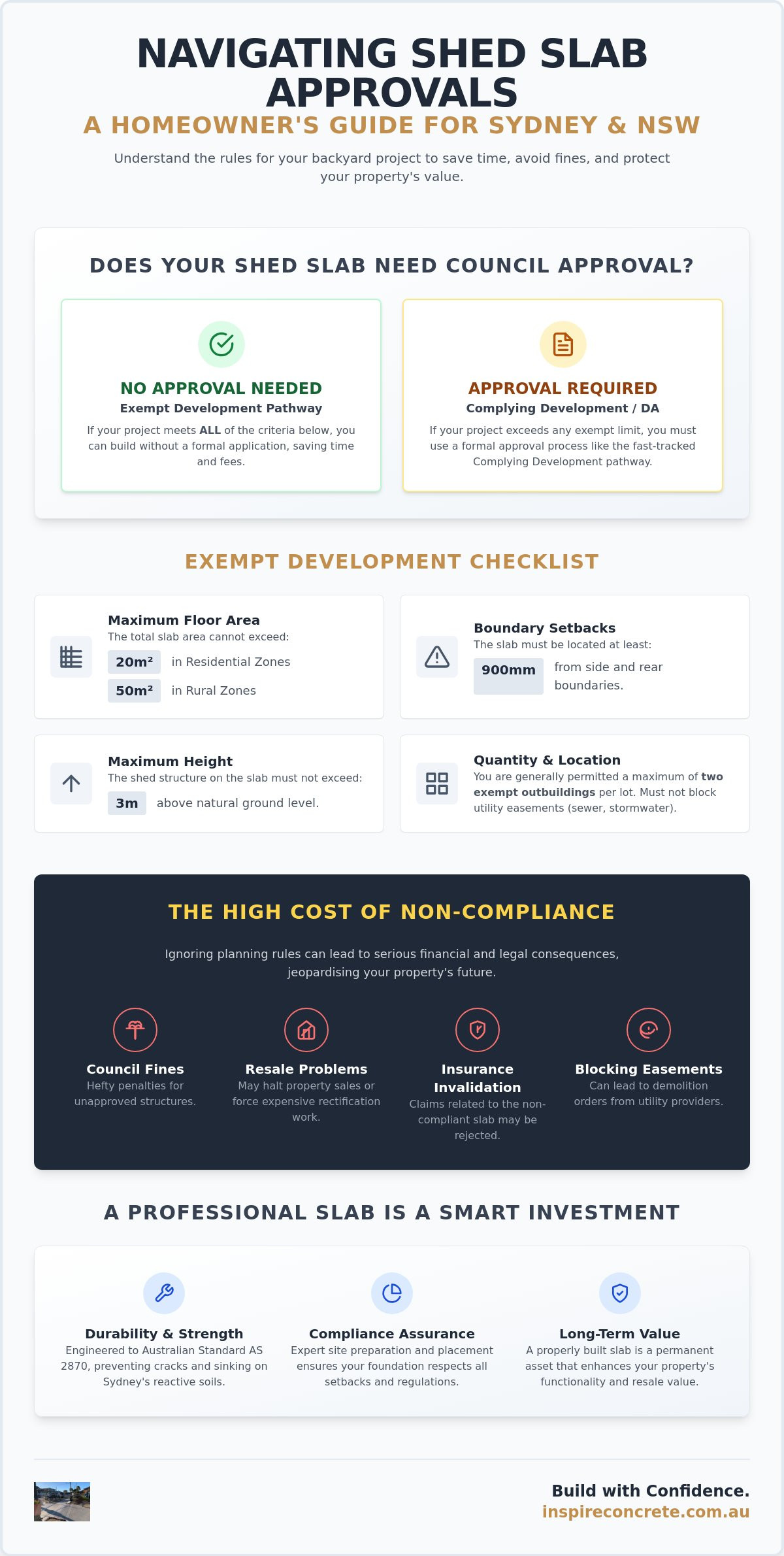
Navigating the specific criteria of the Codes SEPP is the first step toward a successful build. In 2026, residential properties in Sydney can typically bypass the formal application process if the shed and its foundation meet strict “Exempt Development” standards. While many projects qualify for these exemptions, getting council approval for a shed slab sydney is a necessary step if your vision exceeds standard residential limits. The most critical threshold is the maximum floor area. For residential zones, your shed slab must not exceed 20 square metres. In rural zones, this limit expands to 50 square metres, reflecting the increased space available on larger lots.
Height and quantity also play a role in your project’s legal standing. The structure atop your slab cannot exceed 3 metres above the natural ground level. Additionally, NSW planning rules generally permit a maximum of two exempt outbuildings per lot. If you already have a detached garage and a garden shed, adding a third slab might trigger the need for a formal assessment. We also recommend using non-combustible concrete, particularly in bushfire-prone areas like the Blue Mountains or Northern Beaches, as it provides superior protection and ensures your property remains compliant with safety regulations.
Size and Setback Restrictions in Sydney Suburbs
Boundaries are non-negotiable when planning your foundation. To remain exempt, your slab must be located at least 900mm from side and rear boundaries. In Western Sydney, where lots are often more generous, achieving this setback is straightforward. However, for congested inner-city lots in areas like Surry Hills or Newtown, every millimetre counts; you can visit Hill & Blume to ensure your boundary markings are precise. Getting council approval for a shed slab sydney becomes mandatory the moment you encroach on that 900mm buffer. In 2026, the maximum floor area for a residential exempt shed slab remains strictly 20 square metres.
Easements and Underground Services
Sydney’s history is buried beneath your lawn, and ignoring it can be a costly mistake. You cannot pour a concrete slab over a Sydney Water sewer main or within a registered easement without a specific “Build Over” permit. This is where many DIY projects fail. Using the Dial Before You Dig (DBYD) service is an essential first step to identify hidden assets. We integrate these findings into our architectural drafting process, ensuring your slab position doesn’t conflict with critical infrastructure. This meticulous planning prevents the nightmare of council-ordered demolition later. Ensuring your project aligns with these rules is about more than just avoiding fines; it’s about building a legacy of quality on your property. If you’re unsure if your site meets these criteria, consider reaching out to a professional partner like Inspire Concrete to verify your plans before the first truck arrives.
Navigating Approval Pathways: DA vs. Complying Development
When your project moves beyond the 20 square metre exempt limit, you enter the formal planning phase. This transition is where many homeowners feel overwhelmed, yet the process is designed for efficiency if you choose the right path. Getting council approval for a shed slab sydney generally follows one of two routes: a Complying Development Certificate (CDC) or a traditional Development Application (DA). In 2026, the NSW Planning Portal remains the mandatory gateway for both pathways, ensuring all documentation is centralised and tracked from lodgement to final inspection. Understanding which path fits your site is essential for maintaining your project’s momentum.
The Fast-Track: Complying Development Certificates (CDC)
A CDC is essentially a combined planning and construction approval. It’s the preferred choice for straightforward projects that don’t meet exempt criteria but still follow standard building codes. The most significant benefit is the speed. While a DA can languish for months, a CDC is typically processed within 10 to 20 days. This accelerated timeline is possible because the application is assessed against pre-determined state standards rather than a council’s subjective local policy. It provides a level of certainty that is invaluable for residential planning.
You can choose to have your CDC issued by a private certifier or the local council. Most Sydney homeowners opt for a private certifier. While certifier fees generally range from $1,500 to $5,000 depending on complexity, the investment often pays for itself through reduced wait times and more direct communication. Before proceeding, we always verify your land zoning to ensure your property is eligible for this fast-track route. This step prevents the frustration of a rejected application and keeps your build on schedule.
When You Must Lodge a Full DA
Some sites possess unique constraints that make a CDC impossible. If your property is located within a heritage conservation area or on environmentally sensitive land, a full Development Application is unavoidable. Bushfire-prone land also triggers additional scrutiny. In these zones, getting council approval for a shed slab sydney requires specific non-combustible materials and specialized construction techniques to mitigate risk. The council’s role here is to assess how your new structure impacts the local environment and community character.
Another critical factor is your property’s Floor Space Ratio (FSR). Councils use this metric to limit the total built area on a lot. If your new shed slab, combined with your existing home and granny flat, exceeds the FSR limit, you’ll need the DA process to justify the addition. This is where precision in documentation becomes your greatest asset. Inspire Concrete assists by providing the high-quality technical drawings and site plans required for a successful DA lodgement. We ensure the engineering details, such as drainage management and slab thickness, are clearly defined to minimize requests for further information from council planners. This proactive approach transforms a potentially stressful application into a structured step toward your property’s transformation.
The Risks of Non-Compliance and How to Avoid Them
Sydney councils are no longer relying on simple street-side inspections to monitor residential developments. Local authorities increasingly utilise high-resolution aerial photography and satellite data to spot unapproved structures across the suburbs. If you bypass the process of getting council approval for a shed slab sydney, your project is visible from above, often triggering an automated compliance review. This modern monitoring makes “flying under the radar” nearly impossible for homeowners. The consequences of being caught extend far beyond a simple slap on the wrist; they can fundamentally compromise your property’s financial and legal standing.
One of the most significant risks involves the Section 10.7 planning certificate. When you eventually sell your home, this document will likely carry a notation regarding “unauthorised works” if the slab wasn’t approved. This red flag can deter buyers or lead to aggressive price negotiations. Additionally, insurance companies are notorious for scrutinising building approvals during claim assessments. If a storm or flood causes damage and your shed slab is found to be non-compliant, your insurer may have grounds to deny the claim entirely. To rectify these issues after the fact, you’ll need to apply for a Building Information Certificate (BIC). This process is expensive, time-consuming, and offers no guarantee that the council won’t still order the removal of the slab if it fails to meet structural or setback standards.
Fines, Orders, and Legal Headaches
If a council officer identifies a non-compliant slab, the first step is usually a “Notice of Intention to Give an Order.” This is a formal legal warning. It outlines the breach and provides a short window for you to respond or rectify the work. Ignoring this notice can lead to heavy financial penalties and a mandatory order to demolish the structure. We’ve seen homeowners spend more on legal fees and retrospective applications than they would have spent on the initial approval. Doing it right the first time is the only way to protect your investment and maintain peace of mind.
Ensuring Your Slab Meets Australian Standards
Structural integrity is the best defence against compliance issues. A compliant slab must feature proper steel reinforcement (mesh) and a minimum thickness, typically 100mm for standard residential sheds. These technical requirements, detailed in our Essential Guide to Concrete Slabs, ensure the foundation can withstand Sydney’s reactive soil conditions. Proper drainage is equally critical. If your slab causes water run-off into a neighbour’s property, it often triggers a council complaint that brings your entire project under the microscope. By prioritising precision and adhering to Australian Standard AS 2870, you eliminate the risks associated with non-compliance. Secure your property’s future with a compliant, high-end foundation from Inspire Concrete today.
Expert Installation: Why a Professional Slab Matters
The difference between a backyard eyesore and a durable property asset lies in the execution of the foundation. While the administrative side of getting council approval for a shed slab sydney ensures legal compliance, professional installation ensures structural longevity. A slab is only as stable as the ground beneath it. Professional site preparation involves more than just clearing the surface; it requires expert soil assessment and precision compaction to prevent the sinking or cracking that plagues amateur pours. In Sydney’s diverse geological landscape, this technical foresight is the only way to transform a basic utility slab into a high-end, long-term investment that adds genuine value to your home.
Foundational integrity is not just a physical requirement; it’s a legal one. When local authorities review your project, they look for evidence that the structure won’t interfere with local drainage or compromise the land’s stability. By partnering with a team that understands the intersection of engineering and planning, you remove the guesswork from your build. We bring over 20 years of Sydney-specific expertise to every site, ensuring that the physical work mirrors the high standards set out in your planning documents. This commitment to craftsmanship ensures your shed remains a permanent, trouble-free feature of your property for decades to come. Beyond foundations, for comprehensive home improvements, Moreton Bay City Building Services offers expert renovation and extension solutions to transform your living space.
Precision Drafting and Site Management
Technical drawings are the language of council planners. We bridge the gap between your vision and the strict requirements of the Codes SEPP through precision architectural drafting. These documents don’t just secure your approval; they serve as the precise blueprint for our site management team. By choosing a fixed-price contract for your project, you eliminate the financial guesswork and bureaucratic friction often associated with residential construction. We also look beyond the shed itself, ensuring the finish and specialized texture of your new slab harmonise with your existing driveway or alfresco area for a seamless aesthetic transition.
Partnering with Inspire Concrete for Your Sydney Project
Our family-owned approach ensures that every project receives meticulous attention to detail. We manage the entire lifecycle of your slab, from the initial excavation and steel reinforcement to the final specialized finish. This end-to-end service simplifies the process of getting council approval for a shed slab sydney because we handle the technical details that certifiers demand. We view ourselves as your project partner rather than a mere contractor, showing a deep commitment to excellence in both engineering and artistry. If you’re ready to realise your creative vision with a foundation built to last, contact Inspire Concrete for a professional consultation today.
Build Your Vision on a Compliant Foundation
Your backyard transformation deserves a foundation that stands up to both environmental challenges and regulatory scrutiny. By staying within the 20 square metre exempt threshold or navigating the Complying Development pathway with a private certifier, you protect your property’s resale value and insurance standing. Your slab is the anchor of your outbuilding. Its placement relative to boundaries and easements determines the project’s legal success and structural longevity.
Getting council approval for a shed slab sydney is a streamlined process when backed by the right expertise. With 20+ Years Industry Experience and a team of Licensed Sydney Concreters, we provide the Expert Project Management and Drafting required to satisfy meticulous council planners. We ensure your project moves from a creative vision to a durable, compliant reality without the guesswork. Ready to start your build? Get a Professional Quote for Your Sydney Shed Slab today. Your property’s next chapter begins with a perfect pour.
Frequently Asked Questions
What is the maximum size shed slab I can build in Sydney without approval?
In residential zones, the maximum floor area for a shed slab to remain exempt from council approval is 20 square metres. If your property is located in a rural zone, this limit increases to 50 square metres under the current Codes SEPP. You must also ensure the structure is non-habitable and positioned behind the building line of your main dwelling to maintain this exempt status without formal notification.
Can I build a shed slab right up to my property boundary line?
You cannot build a shed slab directly on your boundary line if you want the project to remain exempt from council intervention. To qualify as exempt development, the slab must be set back at least 900mm from both the side and rear boundaries. Getting council approval for a shed slab sydney becomes mandatory if you need to build closer to the line, as this triggers specific fire safety and drainage assessments.
Do I need a permit if I am just replacing an old, existing shed slab?
Replacing an existing slab generally doesn’t require a new permit if the new foundation matches the original dimensions and location exactly. However, if the original slab was never authorised or if you intend to enlarge the footprint beyond the 20 square metre limit, you must follow the 2026 exempt development criteria. Minor maintenance and like-for-like replacements are typically unregulated, provided they don’t interfere with existing easements.
How much does a council permit for a shed slab cost in NSW?
Mandatory NSW Planning Portal fees for a Complying Development Certificate (CDC) are $43 for the 2026/27 financial year, plus a $6 registration fee. If your project requires a full Development Application (DA), the portal fee is approximately $47. These figures exclude the professional fees charged by private certifiers or local councils for the actual assessment, which often range from $1,500 to over $5,000 depending on complexity.
What happens if I pour a concrete slab over a Sydney Water easement?
Pouring a concrete slab over a Sydney Water easement without a “Build Over” permit is a significant legal risk that can lead to forced demolition. You may be ordered to remove the slab at your own expense if the utility provider needs access to underground assets for maintenance or repairs. Always check the Dial Before You Dig registry to identify hidden infrastructure before your project begins to avoid these costly complications.
Does a shed slab need to be inspected by a building certifier?
A shed slab only requires inspection by a building certifier if it is part of a Complying Development Certificate (CDC) or a formal Development Application (DA). If your slab meets all the “Exempt Development” criteria, no formal inspection or notification is necessary. For approved projects, the certifier will typically inspect the formwork and steel reinforcement before the pour to ensure the work matches your technical drawings.
Can I get approval after the slab has already been poured?
You cannot obtain a standard DA or CDC for a slab that has already been poured. Instead, you must apply for a Building Information Certificate (BIC) from your local council to regularise the unauthorised works. This process involves proving the slab meets all structural and planning requirements. It’s often more expensive and stressful than getting council approval for a shed slab sydney before the construction phase begins.
Is a shed slab considered “Exempt Development” in bushfire-prone areas?
A shed slab can still qualify as “Exempt Development” in bushfire-prone areas, provided the structure is built from non-combustible materials. Concrete is the preferred choice for foundations in these zones because of its inherent fire resistance and durability. However, additional standards regarding setbacks and vegetation clearing may apply. It’s vital to verify your property’s Bushfire Attack Level (BAL) rating to ensure your project remains fully compliant.
