
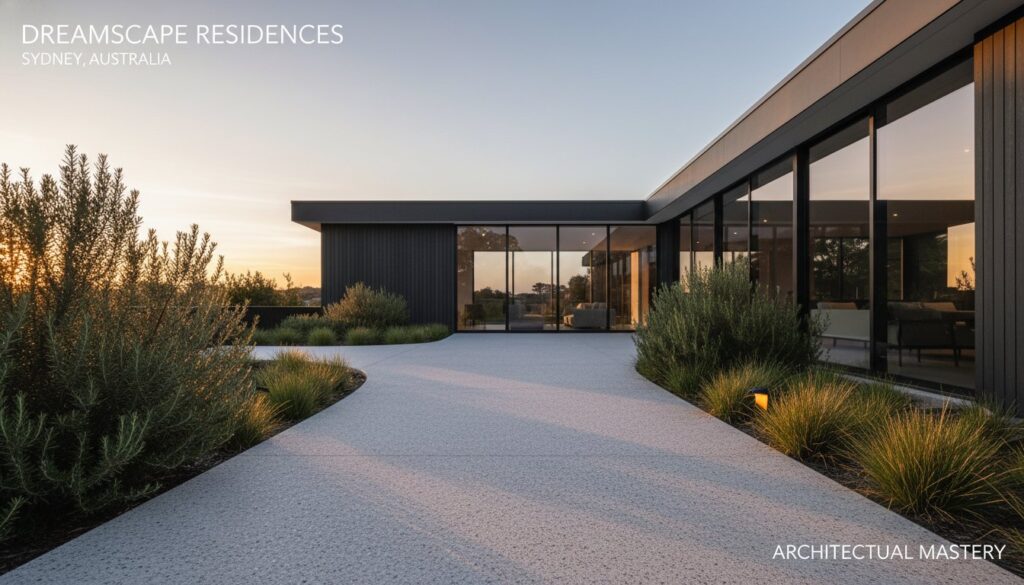
A straight line might be the most efficient route across your yard, but it’s often the quickest way to make a high-end Sydney landscape feel like an industrial loading dock. In 2026, the most sophisticated properties are moving away from rigid geometry in favor of “soft minimalism,” using curved concrete pathway ideas to bridge the gap between bold architecture and lush gardens. You likely want an outdoor space that feels like a curated sanctuary, yet the fear of Sydney’s notorious reactive clay soils causing structural cracks often leads homeowners to settle for uninspired, boxy designs.
We understand that a path should be a permanent investment, not a maintenance headache. This guide reveals how to master designs that blend structural resilience with refined craftsmanship. You’ll discover how to pair the right finishes, from textured exposed aggregate to elegant stenciled patterns, with the engineering required to meet Australian Standards for residential pavements. We’re going to walk you through selecting slip-resistant surfaces and design layouts that create a seamless transition through your property, ensuring your landscape adds genuine value and timeless appeal for decades to come.
Key Takeaways
- Learn how organic curves psychologically expand your garden space and soften the rigid lines of modern architecture.
- Compare the most effective curved concrete pathway ideas, from the textured grip of exposed aggregate to the minimalist elegance of coloured concrete.
- Gain technical insight into building for Sydney’s reactive clay soils, ensuring your path remains structurally sound and crack-resistant for decades.
- Discover the “Golden Ratio” for calculating the perfect radius and width, avoiding awkward “wiggly” designs that lack flow.
Why Choose Curved Concrete Pathways for Your Sydney Home?
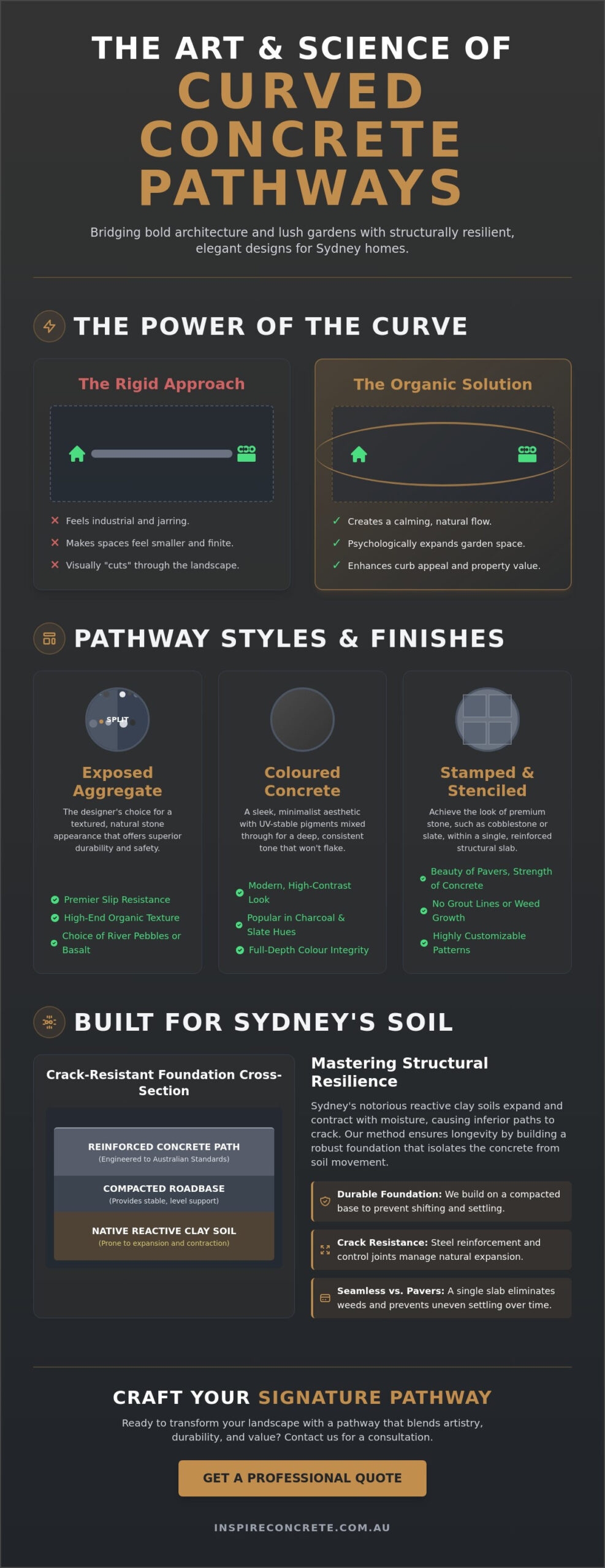
Straight lines serve a purpose in industrial zones, but they often feel jarring and cold in a residential setting. Choosing organic shapes over rigid geometry transforms your yard from a basic outdoor area into a curated experience. Humans are naturally drawn to soft, flowing lines that mimic the environment. This psychological comfort is why many homeowners are now seeking curved concrete pathway ideas that lead the eye on a journey rather than a shortcut. By removing the harsh angles, you create a sense of calm that invites people to explore the garden at a slower pace.
Beyond the visual appeal, curves are a clever design trick for smaller Sydney blocks. A straight path reveals its entire length instantly, making a garden feel finite. A curved path creates mystery. It disappears behind a garden bed or around a corner, suggesting there’s more to explore. This leads the eye along a longer visual route, effectively making your outdoor space feel larger than its physical dimensions. Unlike traditional pavers that shift, settle, and allow weeds to penetrate the joints, these hardscape elements provide a seamless, structural foundation that remains level for decades.
Enhancing Curb Appeal and Property Value
A professional finish is a high-yield investment in Sydney’s competitive real estate market. Real estate agents across the Western Suburbs frequently highlight that a home’s exterior sets the expectation for the interior. A custom curved entrance softens the transition from the public street to your private sanctuary, framing your home’s architecture rather than cutting through it. Because concrete is a permanent, high-durability material, it offers a superior long-term ROI compared to temporary garden paths. It signals to potential buyers that the property has been maintained with a commitment to quality and structural integrity.
Functional Flow and Traffic Management
Effective landscaping isn’t just about looks; it’s about how you move through a space. Curved paths direct foot traffic naturally, guiding guests around existing features like mature trees without the need for awkward 90-degree turns. You can also use these designs to manage pace. By strategically widening a curved section, you create a natural ‘pause’ in the landscape, encouraging people to slow down and enjoy the surroundings. This thoughtful layout also solves a common problem: it reduces ‘corner cutting’ across your lawn, as the path already follows the most comfortable, intuitive walking route.
Top Curved Concrete Pathway Styles and Finishes
Selecting the right finish is what separates a basic walkway from a high-end architectural feature. When exploring curved concrete pathway ideas, you have to consider how the texture interacts with the arc of the path. Unlike rigid pavers that require intricate, dusty cuts to follow a radius, poured concrete flows directly into the formwork. This creates a perfectly smooth, unbroken curve that feels intentional rather than forced. This fluid nature allows for a level of customization that other materials simply cannot match, ensuring your path complements the natural flow of your land.
The choice of finish also dictates the safety and longevity of the installation. For example, exposed aggregate remains the premier choice for Sydney landscapes due to its rugged durability and superior slip resistance. By stripping back the top layer of cement to reveal natural stone, you create a surface that’s both visually striking and incredibly safe underfoot, even during heavy rain. This finish adheres to fundamental landscape design principles by adding organic texture that complements Sydney’s coastal and bushland environments.
For modern homes, coloured concrete offers a sleek, minimalist aesthetic. By mixing UV-stable pigments directly into the wet mix, we achieve a consistent, deep tone that won’t peel or flake like surface paints. Charcoal and slate hues are particularly popular in 2026, providing a high-contrast backdrop for green foliage. If you want the look of premium stone without the maintenance of grout lines, stamped or stencilled concrete is the solution. We can mimic the appearance of European cobblestones or slate tiles within a single, reinforced slab, giving you the best of both worlds: beauty and brawn.
Exposed Aggregate: The Designer’s Choice
Aggregate is the ultimate designer’s choice because it eliminates the visual clutter of joints. In Sydney, we often see a split between warm, earthy river pebbles and the sharp, modern look of charcoal basalt mixes. These palettes allow you to tie the pathway into existing features like exposed aggregate driveways, creating a unified look across the entire property. It’s a hardworking finish that hides dirt and wear, making it perfect for high-traffic residential entries.
Decorative Stencils and Borders
Precision is everything when working with curves. Adding a contrasting header or border is an effective way to highlight the radius of your path. Stencilled patterns can be designed to follow the arc perfectly, giving you a handcrafted look that remains structurally sound. This technique allows you to enjoy the aesthetic of aged stone or brick while benefiting from the strength of professional concrete pathways. It’s about achieving a bespoke look that feels integrated into your home’s unique footprint.
Technical Mastery: Building Durable Curves in Sydney Soil
Executing high-end curved concrete pathway ideas requires more than just an eye for design; it demands a deep understanding of Sydney’s complex geography. From the heavy, reactive clay soils of Western Sydney to the rocky terrain of the Blue Mountains, the ground beneath your feet is constantly moving. These “heaving” soils expand when wet and contract when dry, which can easily snap a poorly reinforced concrete slab. To counter this, we treat every curve as a custom engineering project. By utilizing flexible formwork made from specialized plastics or thin-ply timber, we create a smooth, consistent radius that avoids the jagged, segmented look of amateur work while providing the structural integrity needed to withstand soil pressure.
Reinforcement is where many projects fail. In a non-linear slab, mesh placement must be meticulous to ensure tension is distributed evenly across the arc. We also pay close attention to the “belly” of the curve, which is a natural collection point for water. Without a calculated cross-fall of at least 1 in 100, water will pool, leading to moss growth and slippery surfaces. Our approach aligns with global engineering benchmarks, such as the Oregon DOT pedestrian design standards, which emphasize the importance of surface drainage and material thickness in creating safe, accessible walkways that last for decades.
The Importance of Expansion Joints in Curves
Control joints are essential to prevent unsightly “spider” cracks from radiating through your path. In a curved design, these joints shouldn’t just be straight lines; they should follow the radius of the arc to maintain the visual flow. We place these joints at strategic intervals where the direction of the path shifts or where it meets a fixed structure like a house slab. Because the geometry of a curve creates uneven stress points, cutting curved joints requires significantly more precision and specialized equipment than standard straight-line work.
Subgrade Preparation for Long-Term Stability
The secret to a path that doesn’t sink or shift lies in what you can’t see. Proper subgrade preparation involves excavating to a minimum depth of 75mm for foot traffic and backfilling with a high-quality road base. This base must be mechanically compacted to provide a uniform foundation that bridges any soft spots in the clay. It’s a technical process that requires a thorough site assessment. Engaging expert concreters Sydney residents trust ensures that your subgrade is engineered specifically for your local soil profile, preventing the costly tilting or cracking that plagues DIY attempts.
Planning Your Path: Width, Radius, and Landscape Integration
A path that feels “forced” usually stems from a lack of spatial awareness during the design phase. When you’re evaluating curved concrete pathway ideas, start with the footprint. For secondary garden trails, a width of 1.2 meters is the minimum for comfortable single-file walking. However, for a main entrance, we recommend 1.8 meters. This aligns with City of Sydney footway standards and allows two people to walk side-by-side without stepping onto the lawn. This extra width doesn’t just improve function; it adds a sense of grandeur to your property’s approach.
Achieving a professional look requires following the “Golden Ratio” of landscape design. This means your curves should be generous and intentional rather than tight and “wiggly.” A path that meanders too much feels aimless and often leads to guests taking shortcuts across your garden beds. We look at the existing architecture, such as retaining walls or alfresco areas, to ensure the path’s radius complements these fixed structures. Lighting is another critical layer. Low-voltage LED path lights should be placed on the outside of each curve. This highlights the shape of the path at night and ensures safe navigation by clearly defining the edges.
Measuring the Perfect Radius
Visualization is the first step in precision engineering. We often suggest the “garden hose method” for homeowners to test their layout. Lay out a hose to define the edges, then walk the route several times. Does it feel natural? Can you easily navigate the turns with a pram or a lawnmower? If the curve is too sharp, it becomes a point of friction. A successful curve should allow for a steady walking speed, gently guiding you toward your destination rather than demanding constant attention to your footing.
Landscaping Around the Concrete
The transition between your concrete and the surrounding garden defines the final aesthetic. Softening a curved edge with layered planting creates that “soft minimalism” trend popular in 2026 Sydney landscapes. Use groundcovers or mulch to bridge the gap between the path and the lawn, hiding the structural edge of the slab. It’s also vital to consider the future. If you’re planting near a new concrete slab, choose species with non-invasive root systems. This prevents the concrete from lifting or cracking as the garden matures, protecting your investment for decades.
Ready to transform your front yard? Explore our range of specialized concrete pathway finishes to see how we can bring your custom layout to life.
The Inspire Concrete Difference: Crafting Signature Pathways
At Inspire Concrete, we don’t just pour slabs; we engineer transitions. Our 20-year history across the Sydney Metro area has taught us that every property has a unique rhythm. We approach each project with an architectural drafting mindset, ensuring that your curved concrete pathway ideas are grounded in structural reality. A true curve isn’t just about bending a piece of wood; it’s about calculating a smooth, mathematical radius that maintains consistent thickness and strength throughout the entire arc. We manage the process from the initial site assessment through to the final pour, acting as your project partner to ensure the result matches your creative vision.
The technical distinction between a professional installation and a DIY attempt often lies in the formwork. While amateurs often struggle with rigid timber that creates jagged “kinks” or flat spots in a curve, we utilize specialized flexible formwork. This high-grade material allows us to create tight, elegant radii without compromising the structural integrity of the concrete edge. Once the concrete has cured, we prioritize the longevity of the work through high-pressure cleaning and the application of premium chemical sealers. This critical final step protects the surface against Sydney’s intense UV rays and prevents organic stains from garden mulch or leaf litter from penetrating the finish.
Bespoke Solutions for Sydney Homeowners
Customization is the core of our service. We offer precise colour matching to ensure your new path complements an existing concrete driveway or alfresco area. Our team also provides expert guidance on local council requirements, helping you determine if your project fits within exempt development limits or requires specific permits. We take immense pride in our rugged professionalism, which means showing up on time and leaving your site clean and ready for use. It’s a refined approach to a hardworking trade, focusing on the long-term value of your property.
Ready to Transform Your Landscape?
Choosing a licensed, family-owned Sydney business means you’re getting local expertise backed by two decades of hands-on experience. We understand the specific challenges of our climate and soil, and we build every path to withstand them. If you’re ready to move beyond basic utility and realize a high-end vision for your home, we’re here to help. Our team provides detailed, transparent quotes that reflect the precision and quality of our craftsmanship. Contact Inspire Concrete for a design consultation and let’s start planning a pathway that elevates your entire landscape.
Transform Your Outdoor Vision into a Lasting Landmark
A well-designed path does more than connect two points; it defines the character of your entire property. By choosing curved concrete pathway ideas that respect both local soil conditions and architectural flow, you ensure your landscape remains a source of pride for decades. We’ve explored the necessity of mastering Sydney’s reactive clay soils and the aesthetic impact of premium finishes like exposed aggregate. These technical and design elements turn a simple walkway into a durable, artistic statement that enhances your lifestyle and property value.
Inspire Concrete brings over 20 years of Sydney industry experience to every project. We specialize in the precise engineering required for reactive clay soil management and the mastery of decorative finishes that stand the test of time. Our team is ready to transition your garden from basic utility to a sophisticated realization of your creative vision. Precision is our standard, and your long-term satisfaction is our legacy.
Request a Professional Concrete Quote for Your Sydney Project and let’s build something extraordinary together. Your property deserves the certainty of expert craftsmanship and a finish that lasts for generations.
Frequently Asked Questions
Are curved concrete pathways more expensive than straight ones?
Curved designs involve higher labor requirements due to the complexity of setting flexible formwork and ensuring a precision finish. In the Australian market, these complex geometries can increase labor time by 20% to 30% compared to standard straight runs. This investment covers the specialized craftsmanship needed to set a perfect radius and ensure the structural reinforcement follows the non-linear path correctly without compromising strength.
How do you prevent a curved concrete path from cracking?
Preventing cracks in Sydney’s reactive clay soils requires deep subgrade compaction and strategic reinforcement placement. We use heavy-duty steel mesh and place expansion joints at specific intervals along the arc to allow for natural ground movement. These joints act as pre-planned relief points, ensuring that if the soil shifts, the concrete remains structurally sound without developing unsightly “spider” cracks across the surface.
What is the best concrete finish for a curved garden path?
Exposed aggregate is widely considered the premier choice for a curved garden path because its natural texture provides superior slip resistance. This finish hides wear and tear effectively while offering a rugged, organic look that complements various curved concrete pathway ideas. For those seeking a minimalist aesthetic, coloured concrete with a light broom finish provides a sleek, uniform appearance that integrates perfectly with modern architecture.
How wide should a residential concrete pathway be?
For a comfortable residential walkway, a width of 1.2 metres is the minimum standard for single-file traffic. If you want to create a grander entrance where two people can walk side-by-side, we recommend a width of 1.8 metres, which aligns with City of Sydney footway guidelines. Selecting the right width ensures the path feels like a generous architectural feature rather than a narrow, utilitarian shortcut.
Can you add a curve to an existing straight concrete path via resurfacing?
Concrete resurfacing is designed to refresh the surface texture and colour, but it cannot change the physical footprint of an existing slab. To add a true curve, we must extend the concrete base with a new pour before applying a decorative finish. However, we can use stencilled patterns during the resurfacing process to create the visual illusion of a curved border or arc on a straight surface.
Do I need council approval for a new concrete path in Sydney?
Many residential pathways fall under “exempt development” in Sydney if the total paved area on the lot doesn’t exceed 15% of the lot’s area or 150m². However, it’s vital to check with your local council for specific requirements. This is especially important if your property is in a heritage conservation zone or if the work involves a kerb, crossover, or public land.
How long does it take to install a curved concrete pathway?
A professional installation typically takes between two to four days depending on the weather and project complexity. The first day is dedicated to site preparation, excavation, and setting the flexible formwork. We pour and finish the concrete on the second day, then return after the initial curing period for high-pressure cleaning and chemical sealing to ensure a durable, high-end result.
How do I maintain the look of my curved pathway over time?
Maintaining the integrity of your path involves regular high-pressure cleaning and resealing every few years. This protects the decorative surface from Sydney’s intense UV rays and prevents stains from garden mulch or leaf litter from penetrating the concrete. We provide professional cleaning and sealing services to ensure your investment remains as striking and slip-resistant as the day it was installed.
