
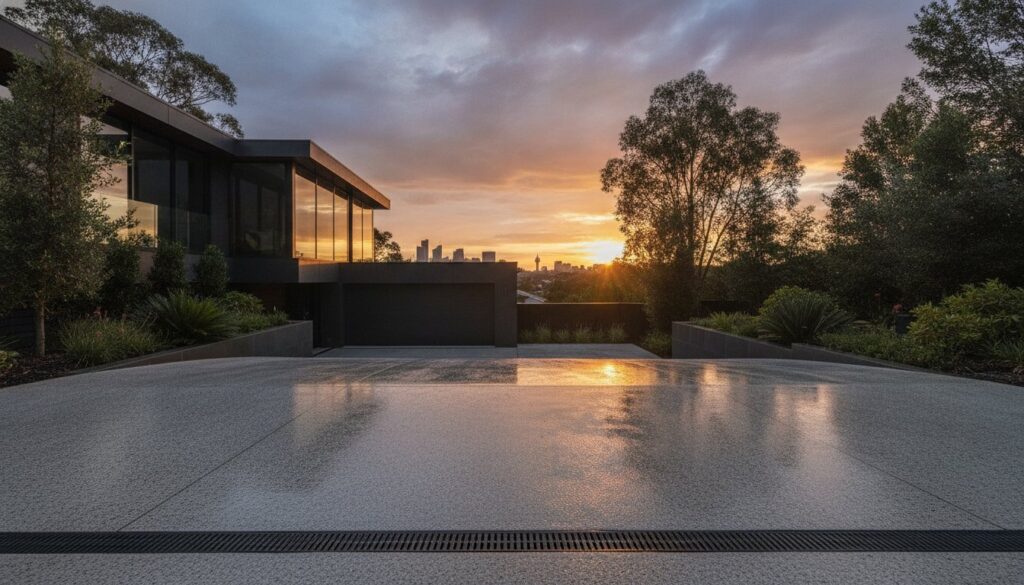
One minute you’re admiring a Sydney sunset, and the next, a flash flood is sending a torrent of water straight toward your garage. For many homeowners, this isn’t just a hypothetical scenario; it’s a seasonal stress that threatens both their property’s foundation and its curb appeal. Finding high-performance driveway drainage solutions sydney is no longer just a utility requirement. It’s a critical design choice that protects your investment from the increasingly intense storm cycles we’re seeing in 2026.
We know you value a home that looks as good as it functions, and you shouldn’t have to settle for unsightly plastic drains that ruin a premium concrete finish. This guide will show you how to implement professional drainage systems that blend seamlessly with high-end architectural design. You’ll learn about navigating local council stormwater regulations and the latest Australian Standards for subsurface water management. We’ll explore how to achieve a dry, safe driveway foundation using sophisticated engineering that remains virtually invisible to the naked eye.
Key Takeaways
- See how strategic water management protects your driveway’s structural integrity and your 7-year statutory warranty against Sydney’s intense East Coast Lows.
- Compare the high-volume capacity of trench drains with the minimalist aesthetic of slot drains to find the most effective driveway drainage solutions sydney for your property.
- Master the technical requirements of Australian Standard AS3996 to ensure your chosen materials safely handle residential vehicle traffic without failing.
- Identify critical installation points like garage thresholds and property boundaries to prevent flooding and maintain compliance with local council regulations.
- Discover how to integrate essential drainage within premium finishes like exposed aggregate for a virtually invisible and high-end architectural result.
The Importance of Effective Driveway Drainage in Sydney’s Climate
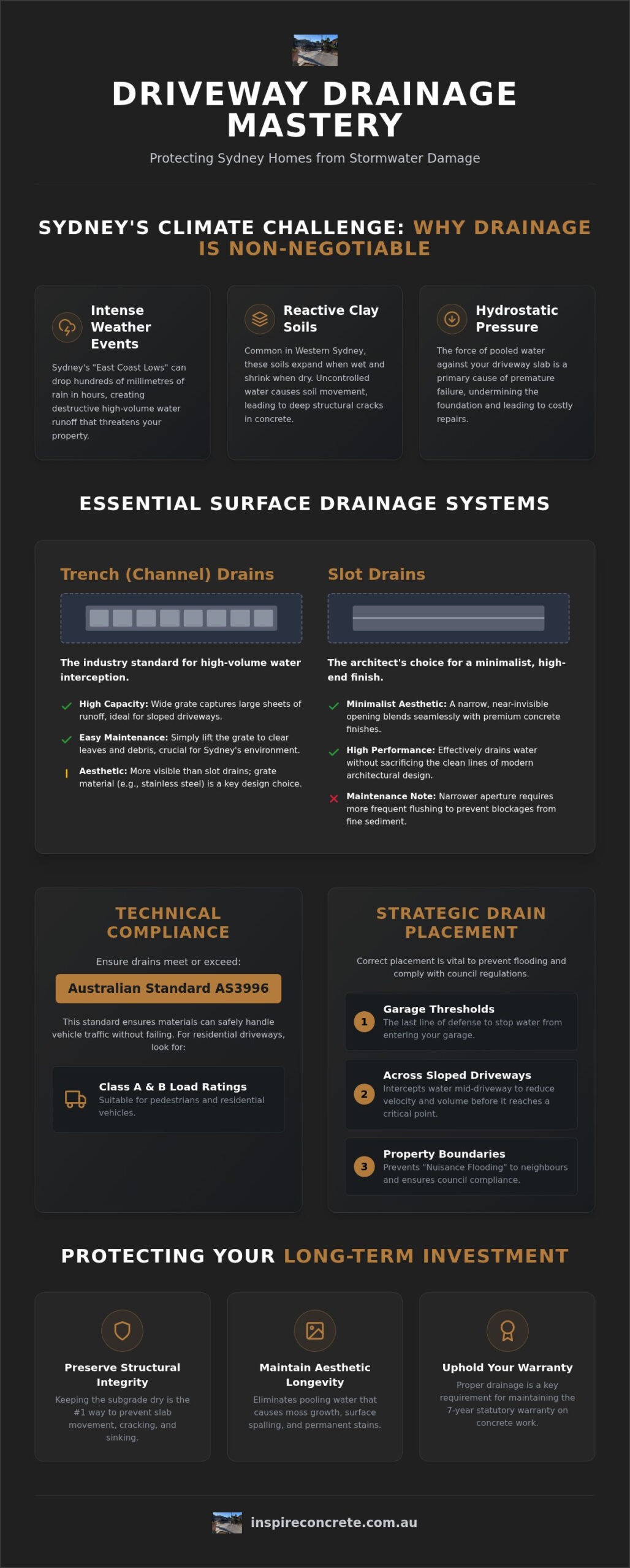
Effective driveway drainage is the strategic management of surface water runoff designed specifically to protect your home’s structural foundation. It’s the difference between a project that lasts decades and one that fails after the first big storm. In Sydney, we don’t just deal with light showers. Our weather is defined by intense summer storms and “East Coast Lows” that can drop hundreds of millimetres of rain in hours. Without professional driveway drainage solutions sydney, that volume of water quickly becomes a destructive force.
Homeowners in Western Sydney face a specific challenge with reactive clay soils. These soils act like a sponge, expanding when wet and contracting as they dry. When water isn’t diverted properly, it pools against the concrete, leading to what engineers call Hydrostatic Pressure. Hydrostatic Pressure is the force of water against a driveway slab that leads to premature failure. By installing integrated surface and subsurface drainage systems, we control the moisture environment around the slab, preventing the soil movement that causes deep structural cracking.
Why Surface Runoff is a Legal Concern
Managing water isn’t just about your own property; it’s a civic responsibility. Local Sydney councils have strict regulations regarding how stormwater is handled. You’re legally required to manage runoff within your boundaries to prevent “Nuisance Flooding” to neighbouring lots. Failing to do so can lead to costly disputes or council orders. Additionally, for new builds or major renovations, a compliant drainage plan is a critical component for obtaining an Occupation Certificate (OC). We ensure your levels are set correctly from the start to meet these standards.
Protecting Your Concrete Investment
A premium concrete driveway represents a significant upgrade to your home’s lifestyle and value. However, standing water is the enemy of durability. When water saturates the ground beneath the concrete, it undermines the subgrade, causing the slab to sink or tilt. This often results in surface spalling, where the finished texture begins to flake away, or permanent discolouration from mineral deposits. Investing in high-end drainage delivers a long-term ROI by:
- Preserving Structural Integrity: Keeping the subgrade dry prevents slab movement.
- Aesthetic Longevity: Eliminating pooling prevents the growth of moss and unsightly water stains.
- Warranty Protection: Proper drainage is often a prerequisite for maintaining the 7-year statutory warranty on concrete work.
Essential Surface Drainage Systems for Modern Driveways
Choosing the right hardware is just as important as the concrete finish itself. In Sydney, we typically deploy four primary systems to ensure a property remains dry and compliant. Trench drains, often called channel drains, are the industry standard for high-volume water interception. They feature a wide grate that captures large sheets of runoff before they reach your garage. For a more refined look, slot drains offer an “architect’s choice” aesthetic. These systems use a narrow, near-invisible opening that provides a minimalist finish without sacrificing performance.
While surface water is the immediate priority, managing subsurface moisture is equally vital. French drains utilize perforated pipes and gravel to redirect water away from garden edges and the driveway’s sub-base. Finally, catch basins, or gully pits, serve as the collection points for debris. These pits trap silt and leaves before the water enters the main stormwater lines, ensuring your driveway drainage solutions sydney remain functional year-round.
Trench Drains vs. Slot Drains: Which is Right?
The decision between a trench and a slot drain often comes down to the specific topography of your lot. Trench drains are superior for high-flow areas where water gains significant velocity. They are also much easier to maintain when dealing with Sydney’s heavy eucalyptus leaf fall; you simply lift the grate and clear the channel. Slot drains provide a cleaner visual impact, but their narrower aperture requires more frequent flushing to prevent blockages. When matching materials to your home’s architecture, stainless steel grates offer a premium, modern edge compared to standard plastic options. If you’re unsure which system suits your site, an expert drainage consultation can clarify the best path forward.
The “Invisible” Drainage Trend in 2026
In 2026, we’re seeing a shift toward “invisible” drainage that integrates directly into the driveway’s layout. Custom-formed concrete slots are increasingly popular, replacing traditional metal grates with a seamless opening cast directly into the slab. We also utilize stone-filled permeable borders to create a natural transition between the driveway and the landscape. A sophisticated technique involves integrating drainage channels into the expansion joints of a concrete slab. This approach ensures compliance with NSW driveway drainage regulations while maintaining the clean lines of a high-end design. By treating drainage as a design feature rather than an afterthought, we transform a functional necessity into a subtle architectural detail.
Selecting the Right Drain: Load Ratings and Material Choice
Specifying the correct hardware for driveway drainage solutions sydney requires a deep understanding of structural requirements. It isn’t just about catching water; it’s about supporting the weight of your lifestyle. The technical benchmark for this is Australian Standard AS3996. This standard governs the load-bearing capacity of grates and access covers, ensuring they remain safe and functional under pressure. Without the right rating, a drain becomes a structural liability that can compromise your entire driveway slab.
Materials play a decisive role in long-term performance, especially given Sydney’s harsh UV index. While budget-grade plastic grates are widely available, they often become brittle and warp after just a few summers. We advocate for the use of stainless steel, ductile iron, or polymer concrete. These materials offer the rugged durability needed to withstand thermal expansion and heavy traffic. In high-traffic pedestrian areas or near alfresco entries, we install “Heel-Guard” grates. These feature narrow apertures that prevent trip hazards and stop small debris from clogging the system, all while maintaining a sophisticated, high-end finish.
AS3996 Load Classes for the Modern Home
The rise of heavy Electric Vehicles (EVs) and the popularity of large 4WDs in Sydney suburbs have changed the engineering requirements for residential drainage. A Class A rating, designed only for pedestrians, will fail almost immediately under a modern vehicle. Class B (rated to 80kN) is the absolute minimum for a residential driveway. Using under-rated grates leads to “chatter,” which is that annoying metallic clanging sound, followed quickly by cracking and collapse. We only install certified Class B or Class C components to ensure your drainage remains silent and secure for decades.
Aesthetics and Finishes
A truly professional drainage installation should enhance your property’s visual appeal. We carefully select grate finishes that complement our coloured concrete and decorative aggregate designs. Polymer concrete channels are significantly superior to traditional PVC; they provide a more rigid foundation and bond more effectively to the surrounding concrete. This superior bonding prevents the hairline gaps where water can seep in and cause rust stains. By choosing marine-grade 316 stainless steel, we ensure your drainage remains a polished architectural feature rather than a source of unsightly maintenance issues.
Strategic Placement: Where to Install Drains for Maximum Impact
Engineering a driveway on a Sydney slope requires more than just a slight tilt; it demands a strategic interception plan. We focus heavily on the “Critical Threshold,” which is the precise line where your driveway meets the garage slab. Without a dedicated strip drain at this junction, even a moderate storm can push water under the door and into your home’s internal structure. On longer, steeper blocks common across the North Shore and Eastern Suburbs, we implement “Mid-Slope Interceptors.” These break the velocity of the water, preventing it from gaining the destructive energy that leads to erosion and surface damage by the time it reaches the bottom of the incline.
Managing “Boundary Runoff” is another non-negotiable aspect of modern site design. Sydney councils have become increasingly strict about water leaving your property and entering the public gutter or a neighbor’s lot. We also prioritize placement around alfresco and entertaining areas. By catching water at the perimeter of these zones, we ensure your outdoor lifestyle isn’t interrupted by pooling water or soggy garden beds. If you’re dealing with a complex, multi-level block, our team can design bespoke driveway drainage solutions sydney that protect your home’s foundation and its long-term market value.
The 5-Step Placement Strategy
We approach every project with a steady, logical rhythm to ensure the drainage performs under the most extreme conditions. Our process follows these five critical steps:
- Step 1: Topography Mapping. We use precision laser levels to identify the natural fall of the land and any hidden low points.
- Step 2: Utility Integration. Our team maps out existing stormwater connection points to ensure the new system integrates seamlessly with your home’s plumbing.
- Step 3: Catchment Calculation. We calculate the total surface area of the driveway to size the drains and pipes correctly for 2026 storm benchmarks.
- Step 4: Compliance Check. We determine the best discharge point in strict accordance with local Sydney council regulations and Australian Standards.
- Step 5: Cross-Fall Design. We engineer the final fall of the concrete to feed the drains efficiently, ensuring no water lingers on the surface.
Common Placement Mistakes to Avoid
Many drainage failures stem from simple placement errors that are easily avoided with professional oversight. The “Dead Spot” is a frequent issue, where drains are placed in corners with no exit flow, leading to stagnant water and silt buildup. We also account for the “Splash Factor” at the base of steep inclines. If a drain is too narrow or placed too close to a vertical change, high-velocity water can jump right over the grate. Finally, we always factor in leaf litter from overhanging trees, ensuring pits are accessible for cleaning so that Sydney’s eucalyptus debris doesn’t cause a total system backup during a flash flood.
Integrating Drainage with Decorative Concrete Finishes
High-end architectural design shouldn’t be sacrificed for the sake of utility. In modern Sydney construction, the most successful driveway drainage solutions sydney are those you barely notice. We treat the drainage system as an extension of the driveway’s texture rather than a separate fixture. For exposed aggregate driveways, this means selecting grates that mirror the stone’s tones or using custom-formed channels that disappear into the aggregate’s natural variations. The goal is a finished product where sophisticated craftsmanship meets rugged, storm-ready utility.
When working with stencil or stamped concrete, we often utilize “Tile-Insert” grates. These clever systems allow us to place a segment of the decorative concrete directly into the drain lid, leaving only a narrow perimeter gap for water to enter. This creates a continuous visual flow across the entire surface. While the hardware is important, the true hero of any aesthetic drainage plan is the “Fall” of the concrete. We engineer the slope with millimetre precision to ensure water moves toward the hidden collection points without requiring deep, unsightly trenches that break up the home’s curb appeal.
The Seamless Transition
Achieving a professional finish requires meticulous attention to the points where materials meet. We focus heavily on eliminating “Lip Trips,” which occur when the concrete isn’t perfectly flush with the drain grate. It’s a common flaw in amateur installs that creates both a safety hazard and a collection point for dirt. For aggregate finishes, we ensure the stones are exposed right up to the very edge of the drainage channel, avoiding the “halo” of plain concrete often seen around poorly installed drains. To finish the look, we use colour-matched sealants to blend the drain housing into the surrounding coloured concrete, ensuring a unified aesthetic.
Why Hire a Specialist Concreter for Drainage?
One of the biggest risks to a driveway’s longevity is a lack of coordination between the drainage install and the concrete pour. Plumbers often set drains based on a “best guess” of the final height, which frequently results in drains that sit too high or too low. By hiring a professional concreter in Sydney who manages the entire process, you ensure the excavation, level-setting, and final pour are perfectly synchronized. We handle the technical level-setting where most drainage fails, protecting your investment and your 7-year statutory warranty. Transform your driveway with Inspire Concrete’s integrated drainage solutions and enjoy a property that remains dry, safe, and stunning through every Sydney storm.
Secure Your Property Against the Elements
A high-end driveway is only as durable as the water management system supporting it. By prioritizing professional driveway drainage solutions sydney, you aren’t just meeting council regulations; you’re safeguarding your home’s structural integrity and your 7-year statutory warranty. We’ve explored how the right load ratings, strategic placement, and seamless aesthetic integration transform a functional necessity into a sophisticated design feature that stands the test of time.
Don’t leave your property’s safety to chance during the next Sydney flash flood. Our licensed and insured craftsmen bring 20+ years of Sydney experience to every project, ensuring every level is set with absolute precision. We provide custom architectural design to ensure your drainage remains virtually invisible while performing under pressure. It’s time to transition from basic utility to a lasting creative vision that enhances your lifestyle and property value. Book a Drainage & Driveway Consultation with Inspire Concrete today to start your property’s transformation. Your home deserves a foundation built with precision and pride.
Frequently Asked Questions
Do I legally need a drain at the end of my driveway in Sydney?
Yes, in most residential scenarios. NSW regulations require that surface water runoff is managed through a drainage system connected to the existing stormwater network. This prevents water from flooding public roads or neighboring properties. It’s also a critical requirement for obtaining an Occupation Certificate (OC) for new builds. Ensuring your driveway is compliant protects you from council orders and potential legal disputes with neighbors over water damage.
How much does it cost to install driveway drainage in 2026?
The investment for driveway drainage solutions sydney depends on material choice, the length of the run, and excavation complexity. Premium options like stainless steel grates or polymer concrete channels involve a different cost structure than standard PVC systems. We also factor in the depth of the connection to your existing stormwater mains. Every site presents unique topographical challenges that dictate the specific engineering requirements and labor involved for your project.
Can I add a drain to my existing concrete driveway without replacing it?
Yes, we can retrofit drainage into existing slabs through precision concrete cutting. This process involves saw-cutting a channel into the concrete to accommodate a new trench drain or slot system. It’s a highly technical task that requires careful level-setting to ensure the new drain bonds correctly with the old surface. This is a common solution for homeowners who find their original driveway design can’t handle modern Sydney storm intensities.
What is the best type of drain for a steep driveway?
A high-capacity trench drain with a heavy-duty grate is the most effective choice for steep inclines. These systems are designed to capture high-velocity water before it gains enough momentum to cause erosion or bypass the drain entirely. On long Sydney blocks, we often recommend “Mid-Slope Interceptors.” These break the water’s flow at various points, preventing the “splash factor” where water jumps over the final grate at the bottom of the hill.
How often do I need to clean my driveway grates?
You should inspect and clean your grates at least twice a year, or immediately after a major Sydney storm. Leaf litter from eucalyptus trees is a primary cause of blockages in local systems. Maintenance involves lifting the grates and removing silt or debris from the channel and catch basins. Regular upkeep ensures your driveway drainage solutions sydney remain fully operational, preventing water from backing up and threatening your home’s foundation.
What happens if my driveway drainage causes flooding to a neighbour?
You may be held legally liable for “Nuisance Flooding” under NSW law. Homeowners are responsible for managing stormwater runoff within their own boundaries. If your driveway redirects water onto a neighboring lot, the local council can issue an order requiring you to rectify the drainage at your own expense. Professional installation ensures your levels and discharge points are engineered correctly to avoid these costly legal and social disputes with your community.
Is a slot drain better than a traditional grate for a modern home?
It depends on your priority between aesthetics and maintenance. Slot drains offer a minimalist, near-invisible look that complements high-end modern architecture perfectly. However, they have a narrower opening and can be more difficult to clear of heavy debris. Traditional trench grates provide easier access for cleaning and can handle larger volumes of water during flash floods. We often combine both systems to provide the perfect balance of performance and style.
Do I need council approval to change my driveway drainage?
Minor repairs don’t usually require formal approval, but significant alterations to stormwater management often do. Under the NSW Planning Portal, many driveway works are classified as “exempt development” only if they connect correctly to an existing stormwater system. If your project involves installing a new On-Site Detention (OSD) system or changing how water leaves your lot, you’ll likely need to submit a plan to your local Sydney council for review.
