
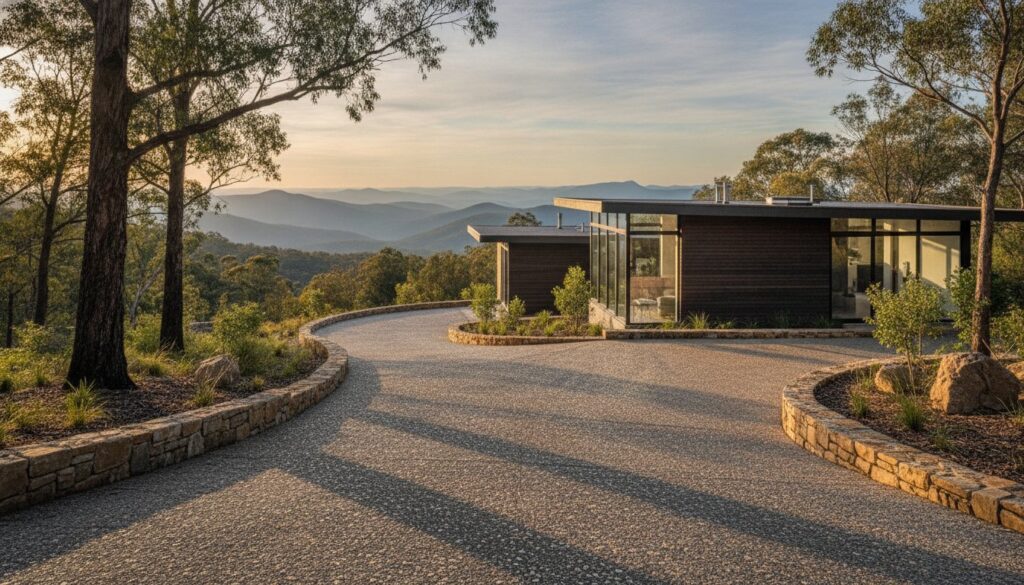
What if your driveway could do more than just survive a Blue Mountains winter? In a landscape defined by dramatic slopes and ancient sandstone, your entry should be a structural masterpiece that balances rugged durability with refined craftsmanship. Building an exposed aggregate driveway blue mountains residents can rely on requires more than just pouring concrete; it demands an intimate understanding of the ridge’s unique geology and strict environmental regulations.
It’s frustrating when excavation costs spiral because of hidden rock or when contractors shy away from steep, narrow access sites. You deserve a project partner who treats your property with the precision of an architect and the grit of a local tradesman. This guide provides the 2026 roadmap for navigating BMCC permits, mastering BAL bushfire compliance, and managing unpredictable sandstone excavation. We’ll explore how to transform a basic utility into a slip-resistant, “mountain-chic” statement piece that adds long-term value to your home. From Section 138 crossover requirements to the latest aggregate trends, you’ll learn exactly how to achieve a high-end finish that stands firm against the elements.
Key Takeaways
- Understand why the unique topography of the Blue Mountains requires a labour premium and how project scale influences your total investment.
- Master the engineering of sloping blocks by utilizing rock-sawing for sandstone and designing transition zones to prevent vehicle scraping.
- Explore why an exposed aggregate driveway blue mountains provides essential slip resistance for icy conditions while blending seamlessly with the local landscape.
- Ensure your project meets all local standards by navigating BMCC crossover permits and BAL bushfire regulations for non-combustible construction.
- Maximise your property’s value through architectural-grade specifications, including 32MPa concrete and F82 reinforcement tailored for mountain durability.
2026 Cost Drivers for Blue Mountains Exposed Aggregate Driveways
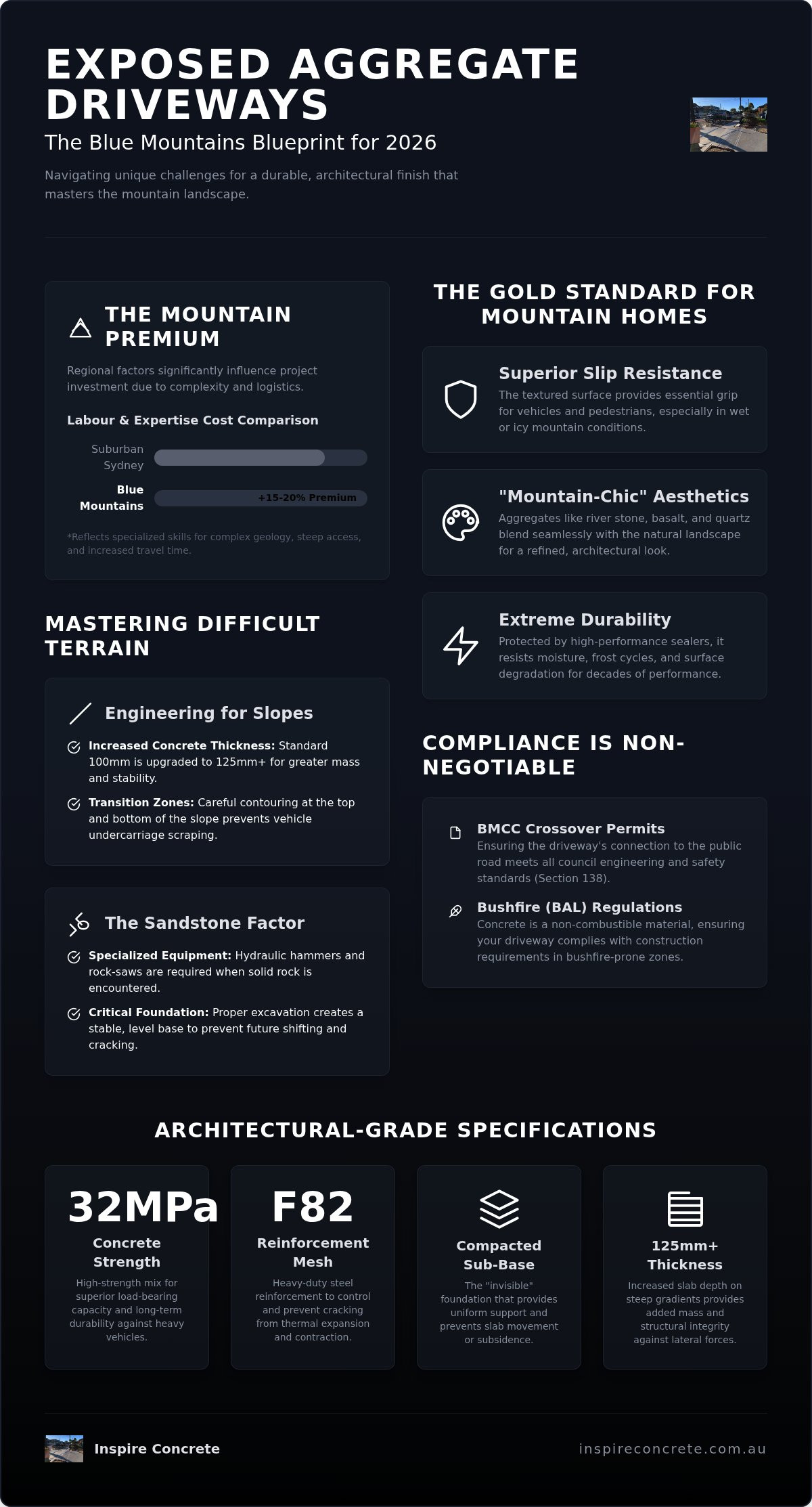
Investing in an exposed aggregate driveway blue mountains homeowners can be proud of involves more than just selecting a beautiful stone mix. It requires a realistic understanding of the regional cost drivers that define our unique landscape. In 2026, labour rates in the Blue Mountains carry a 15-20% premium over suburban Sydney. This isn’t an arbitrary increase. It reflects the specialised expertise required to manage the region’s complex geology and the additional travel time for skilled crews navigating the ridge.
Project scale also plays a pivotal role in your final investment. Smaller mountain driveways often incur higher unit costs because fixed expenses, such as concrete pump hire and site mobilisation, are distributed over a smaller square metreage. We also account for material transport logistics to upper mountain towns like Katoomba and Leura. Because concrete is a perishable product, the time spent climbing the Great Western Highway requires precise scheduling and often results in priority delivery surcharges to ensure the mix arrives in peak condition for a high-quality finish.
Beyond the surface, we focus heavily on “invisible” infrastructure. A durable driveway depends on a heavily compacted sub-base and heavy-duty F82 reinforcement mesh. These elements provide the structural backbone necessary to withstand the shifting thermal conditions common in the mountains. The long-term performance of Decorative Concrete Finishes is only as reliable as the ground preparation beneath them.
Complexity Factors: Flat vs. Sloping Sites
Mountain geography rarely offers a perfectly flat canvas. We categorise site access as “standard” or “complex” based on the gradient and the ability to maneuver heavy machinery. On steep residential gradients, we often increase the concrete thickness from the standard 100mm to 125mm. This added mass, combined with specialised mountain-grade concrete mixes designed for high-traction surfaces, ensures your driveway remains stable under the lateral forces of descending vehicles. Our approach treats every slope as an engineering challenge that requires specific technical solutions.
Variable Costs: From Excavation to Finish
Your choice of stone aggregate, whether it’s a rugged basalt, a luminous quartz, or a locally sourced river stone, will shift the final price point. Each material offers a different aesthetic and level of durability. To protect this investment, we utilise high-performance sealers that act as a barrier against the constant mountain moisture and frost cycles that can otherwise lead to surface degradation. Budget-focused quotes often appear attractive because they omit the critical drainage systems and compacted sub-base layers that prevent mountain driveways from shifting or cracking over time. Selecting a premium exposed aggregate driveway finish ensures that your home’s entry remains both functional and visually striking for decades.
Managing Sloping Blocks and Sandstone Excavation
The Blue Mountains landscape is visually stunning but presents unique structural challenges for residential construction. When installing an exposed aggregate driveway blue mountains residents often encounter the “Sandstone Factor.” Unlike the soft clay soils found in the Sydney basin, our ridge-top geology frequently transitions from thin topsoil to solid rock within centimetres. This underlying geology dictates your foundation depth. If we hit solid sandstone, standard excavators reach their limit. We then deploy hydraulic hammers or rock-saws to create a level, stable base. This is an engineering necessity to prevent the slab from shifting or cracking under the immense pressure of the mountain’s incline.
Engineering steep gradients involves more than just a thick slab. We design specific transition zones at the top and bottom of the driveway to prevent vehicles from scraping their undercarriages. This careful contouring, combined with the superior grip of an exposed aggregate driveway blue mountains homeowners value, ensures your entry is as functional as it is aesthetic. If you’re dealing with a particularly challenging slope, our team can help you manage the engineering and excavation process from start to finish.
Rock Breaking and Site Preparation
Identifying the difference between ‘rippable’ rock and solid sandstone layers is a specialist skill developed over decades. Rippable rock can be cleared with a standard bucket, but solid layers require precision attachments to avoid vibrating nearby structures. Site preparation also includes the logistical challenge of spoil removal. Narrow mountain roads often lack the space for large trucks, meaning we coordinate smaller, more frequent loads to clear debris without blocking local traffic. This meticulous preparation ensures structural integrity on even the most reactive or rocky mountain soils.
The Role of Concrete Pumping on Ridges
For homes perched on ridges or tucked into valley sides, ‘barrow and pour’ methods are physically impossible and technically inferior. We utilise high-pressure concrete pumps to bridge the gap between the street and your project site. Calculating pump line reach is critical for homes set back from the kerb. It requires high-pressure equipment to push concrete over long distances or steep drops while maintaining the integrity of the mix. Safety is paramount during these operations. Our crews manage every line transition to ensure a steady, controlled flow that results in a uniform, high-quality finish across the entire surface.
Why Exposed Aggregate is the Gold Standard for Mountain Homes
The rugged beauty of the Blue Mountains demands a driveway surface that performs with the same intensity as the environment. Choosing an exposed aggregate driveway is a strategic decision for homeowners who prioritise safety without compromising on architectural elegance. Unlike smooth finishes, the textured surface of an exposed aggregate driveway blue mountains residents rely on provides essential traction during those notorious icy mornings when frost transforms standard concrete into a hazard. This mechanical grip is a fundamental requirement for the steep, winding entries common across the ridge.
Aesthetic integration is another area where this finish excels. By selecting stone colours that mirror the natural hues of local sandstone and the silvery-green tones of eucalyptus forests, your driveway becomes an extension of the landscape rather than a jarring addition. Beyond its visual appeal, the durability of exposed aggregate is unmatched in bush settings. The variegated tones and complex texture naturally mask leaf litter, bark debris, and organic staining that would instantly mar the appearance of plain or stencilled concrete. It’s a low-maintenance solution that retains its “mountain-chic” sophisticated look for decades, offering far superior long-term value compared to thinner, stamped alternatives.
Selecting Your Mix: Basalt, Quartz, and River Stone
The technical success of your driveway starts with the stone selection. For optimal grip on steep slopes, we often recommend a 7mm aggregate size. The smaller stones provide a higher density of edges for tyre traction. Conversely, a 10mm mix offers a bolder, more traditional mountain aesthetic. We specialise in custom aggregate blending to match your property’s specific character. Whether you prefer the dark, modern sophistication of basalt, the crystalline brightness of quartz, or the natural, earthy warmth of river stone, our “Inspire” approach ensures your driveway complements your home’s architectural style, from heritage mountain cottages to contemporary glass-fronted designs.
Safety Ratings and Slip Resistance
In the construction industry, we measure surface safety through P4 and P5 slip ratings. Achieving these high-performance standards is critical for residential driveways in high-altitude zones. The multi-faceted texture of exposed aggregate provides superior mechanical grip underfoot, making it the safest choice for Katoomba’s winter climate where frost and black ice are persistent hazards. To further enhance this safety, we incorporate specialised anti-slip additives into the final chemical sealing process. This dual-layered approach ensures that even when wet or icy, an exposed aggregate driveway blue mountains installation provides a secure path for both vehicles and pedestrians.
Navigating BMCC Regulations and Bushfire (BAL) Zones
Navigating the administrative landscape of the Blue Mountains is just as critical as the physical construction. Every exposed aggregate driveway blue mountains project must comply with the Blue Mountains City Council (BMCC) standards for crossovers and verge management. This isn’t just about aesthetics; it’s about engineering a safe transition from the public road reserve to your private land. You’ll likely require a Section 138 permit under the Roads Act 1993, which is a specific approval separate from your Development Application. This process involves a ‘Verge Bond’, a security deposit that ensures the integrity of the kerb and nature strip is maintained throughout the build.
Environmental stewardship is a non-negotiable part of our mountain craftsmanship. Because we operate within a World Heritage-listed area, managing sediment runoff is a high priority. We use specialised barriers to protect local flora and ensure that no construction debris enters the delicate mountain ecosystem. This level of detail ensures your project moves from the initial spark of an idea to a final, durable result without council delays or environmental penalties.
BMCC Permits and Crossover Standards
BMCC crossover standards are precise, covering everything from the concrete’s slip resistance to the specific geometry of the kerb transition. To operate in the road reserve, your contractor must hold a minimum of $20 million in public liability insurance. Navigating these requirements requires a partner who understands the nuances of local permits. For tips on vetting a team that handles council liaison end-to-end, refer to our Master Guide to Hiring Concreters.
Concreting for Bushfire Resilience
Bushfire Attack Level (BAL) ratings dictate the materials allowed for construction in our region. In high-risk zones like BAL-40 and BAL-FZ (Flame Zone), concrete and sandstone are the gold standard for non-combustible surfaces. A well-designed exposed aggregate driveway blue mountains serves as a vital fire break, creating a defensible space between your home and the surrounding bushland. We also engineer our driveways to meet Rural Fire Service (RFS) requirements for heavy appliance access, ensuring that fire tankers can safely enter and turn around on your property during an emergency. If you need a site that balances safety with high-end design, contact our expert craftsmen to discuss your BAL-compliant driveway.
Engineering Value: The Inspire Concrete Mountain Approach
At Inspire Concrete, we believe a successful entry begins long before the first truck arrives. For a high-end exposed aggregate driveway blue mountains, we provide in-house architectural drafting to ensure every gradient, transition zone, and drainage point is engineered for the specific topography of your block. This foresight eliminates the risk of structural failure or vehicle scraping on steep terrain. Our “No Guesswork” quoting process explicitly accounts for the sandstone excavation and site access challenges we’ve discussed previously, providing you with a transparent roadmap for your investment. We view every project as a partnership, moving beyond simple utility to realise a creative vision that matches the grandeur of the mountains.
We specify 32MPa concrete and F82 reinforcement as our baseline for all mountain projects. While standard residential builds in flatter regions might use lower grades, the thermal swings, frost cycles, and intense runoff in the Blue Mountains demand superior compressive strength. This high-performance specification ensures a long-term ROI, preventing the structural fatigue and surface wear that can plague inferior installations. We don’t just pour concrete; we transform difficult blocks into high-value landscape masterpieces that enhance your property’s overall market appeal and functional lifestyle.
Project Management for Complex Sites
Delivering a premium finish on a ridge-top requires a level of coordination that most general contractors simply can’t provide. We manage the entire lifecycle of the project, synchronising rock-sawing teams with high-pressure pumping schedules to hit tight weather windows. Our end-to-end management includes handling the BMCC Section 138 applications, verge bond inspections, and the final chemical sealing process. We take immense pride in our craftsmanship and our commitment to leaving mountain sites cleaner than we found them, ensuring all sediment controls are effectively managed and the surrounding environment is environmentally secure.
Securing Your 2026 Project Quote
To provide an accurate remote estimate for your exposed aggregate driveway blue mountains, we typically require site photos, survey plans, and your property’s BAL rating. However, for ridge-top or valley-side properties, an on-site consultation is essential to assess the rock profile and pump line reach. This face-to-face assessment allows us to provide a certain price that leaves no room for guesswork. Ready to elevate your home’s entry? Transform your property with a custom concrete driveway in Sydney and the Blue Mountains by partnering with the region’s trusted expert craftsmen.
Elevating Your Entry with Mountain-Grade Precision
Building a durable exposed aggregate driveway blue mountains homeowners can rely on requires a deliberate balance of engineering and artistry. Success on these ridge-top sites hinges on mastering the “invisible” work: navigating the complexities of sandstone excavation, ensuring strict BAL bushfire compliance, and managing the intricate BMCC permit process. By prioritising high-performance materials like 32MPa concrete and F82 reinforcement, you aren’t just installing a driveway; you’re securing a long-term asset that withstands the region’s unique thermal cycles and steep gradients.
Inspire Concrete brings 20+ years of experience to every complex mountain terrain project. As licensed and insured master concreters, we act as your project partner, handling everything from architectural drafting to council liaison with meticulous attention to detail. Don’t leave your property’s transformation to guesswork. Request a Quote for Your Blue Mountains Driveway today and partner with experts in BMCC council compliance. We look forward to helping you realise a creative vision that enhances your lifestyle and adds lasting value to your home.
Frequently Asked Questions
How much does an exposed aggregate driveway cost in the Blue Mountains?
Investment for an exposed aggregate driveway blue mountains homeowners undertake is influenced by site-specific variables rather than a flat rate. Factors include the complexity of your slope, the depth of sandstone excavation required, and the specific stone blend selected. Because Katoomba and Leura require specialised logistics and higher labour premiums for ridge-top access, your total project value will reflect these regional challenges. We provide transparent, project-based quotes that account for these technical requirements from the outset.
Do I need council approval (BMCC) for a new driveway in Katoomba or Leura?
Yes, any construction or modification of a driveway crossover requires formal approval from the Blue Mountains City Council (BMCC). This is typically managed through a Section 138 permit under the Roads Act 1993, which covers all works within the public road reserve. You’ll also need to provide a security deposit, known as a Verge Bond, to ensure the nature strip and kerb are protected during the build. Our team manages this liaison process end-to-end for our clients.
Is exposed aggregate slippery on steep mountain slopes during winter?
Exposed aggregate is specifically designed to provide superior traction on steep mountain slopes, even during icy winter mornings. The textured finish offers a mechanical grip that smooth concrete or stencilled surfaces simply can’t match. We target P4 and P5 slip resistance ratings for residential entries to ensure maximum safety. By incorporating anti-slip additives into the final chemical seal, we create a secure surface for both vehicles and pedestrians navigating the ridge’s challenging winter climate.
How does sandstone excavation affect the cost of my concreting project?
Encountering solid sandstone layers during site preparation significantly impacts the project timeline and equipment requirements. Unlike soft clay, sandstone often requires hydraulic hammers or rock-sawing attachments to reach the necessary foundation depth. This specialised machinery and the additional hours spent breaking rock are critical for ensuring your driveway’s structural stability. While it adds to the initial site preparation phase, it provides a rock-solid base that prevents the slab from shifting on sloping mountain terrain.
Can an exposed aggregate driveway be installed in a BAL-FZ (Flame Zone) area?
Concrete is a highly recommended non-combustible material for properties located in BAL-FZ (Flame Zone) or BAL-40 areas. An exposed aggregate driveway blue mountains installation acts as a strategic fire break between the bush and your dwelling. It provides a defensible space that doesn’t ignite under ember attack or radiant heat. We ensure our designs meet Rural Fire Service (RFS) requirements for heavy tanker access, providing essential safety infrastructure while maintaining a sophisticated, high-end aesthetic for your property.
How long does it take to install a driveway on a sloping mountain block?
Most mountain driveway installations take between seven and fourteen days to complete, depending on the extent of the rock breaking required. The process begins with site preparation and sandstone excavation, followed by the installation of drainage and F82 reinforcement mesh. Once the concrete is poured and the aggregate is exposed, the surface must cure before the final high-pressure clean and chemical seal. We coordinate every trade window meticulously to ensure the project stays on schedule despite unpredictable mountain weather.
What maintenance is required for an aggregate driveway in the mountains?
Maintenance for a mountain driveway involves a professional high-pressure clean and a fresh application of chemical sealer every two to three years. This process protects the stone aggregate from the constant mountain moisture and prevents frost from penetrating the concrete’s pores. Regular cleaning also removes organic staining from leaf litter and eucalyptus bark, which can accumulate in bush settings. This simple maintenance schedule preserves the “mountain-chic” aesthetic and ensures the structural integrity of the surface for decades.
Is concrete better than pavers for the Blue Mountains climate and terrain?
Concrete is generally superior to pavers for the Blue Mountains climate because it forms a monolithic slab that won’t shift or sag on steep gradients. Individual pavers can become unstable over time due to heavy mountain runoff and the freeze-thaw cycles common in Katoomba. A reinforced concrete slab provides better structural stability on reactive soils and requires significantly less weeding and maintenance. It offers a cleaner, more contemporary look that easily handles the lateral forces of descending vehicles.
