
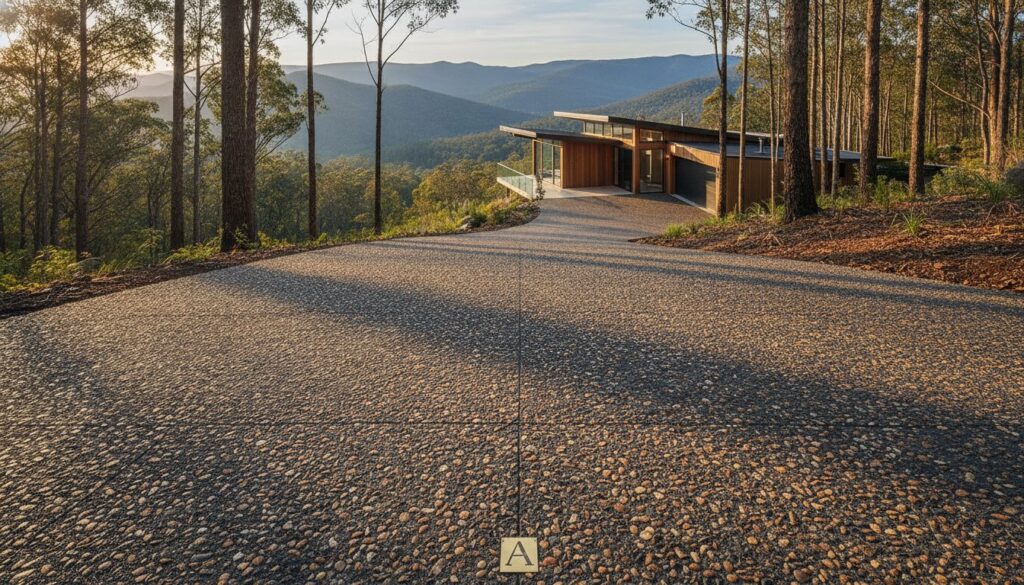
In the Blue Mountains, the true cost of your driveway is determined by the stone beneath your feet, not just the surface area you want to cover. You likely already understand that building on a rugged ridge or a steep Katoomba block isn’t the same as a flat suburban lot. The terrain is breathtaking, but it presents unique logistical hurdles that can quickly turn a standard quote into a series of expensive surprises. Accurately estimating the exposed aggregate driveway cost blue mountains residents will pay in 2026 requires looking beyond simple square meterage and into the specific geology of your site.
We’ll help you navigate the complexities of sandstone excavation, BAL-FZ requirements, and BMCC compliance to ensure your project remains on budget. You’ll gain clarity on how difficult site access and specialized drainage engineering impact your final investment. This guide breaks down the essential factors of material selection and council standards, providing the technical certainty you need to move forward. We focus on transforming your vision into a slip-resistant, elegant entrance that masters both the engineering and the artistry required for our unique mountain environment.
Key Takeaways
- Master the ‘Mountain Factor’ by understanding how local geology and steep gradients dictate project complexity beyond basic square-metre rates.
- Accurately budget for your 2026 exposed aggregate driveway cost blue mountains by accounting for premium stone selections and specialized climate-specific curing techniques.
- Identify logistical challenges like narrow-lane delivery and long-reach pumping fees that frequently impact projects in townships like Leura.
- Navigate BMCC approval processes and strict Bushfire Attack Level (BAL) standards to ensure your installation is fully compliant and built to last.
- Prioritize structural integrity and refined craftsmanship to secure a higher long-term ROI and a seamless aesthetic transformation for your property.
Why Blue Mountains Driveway Costs Differ from Greater Sydney
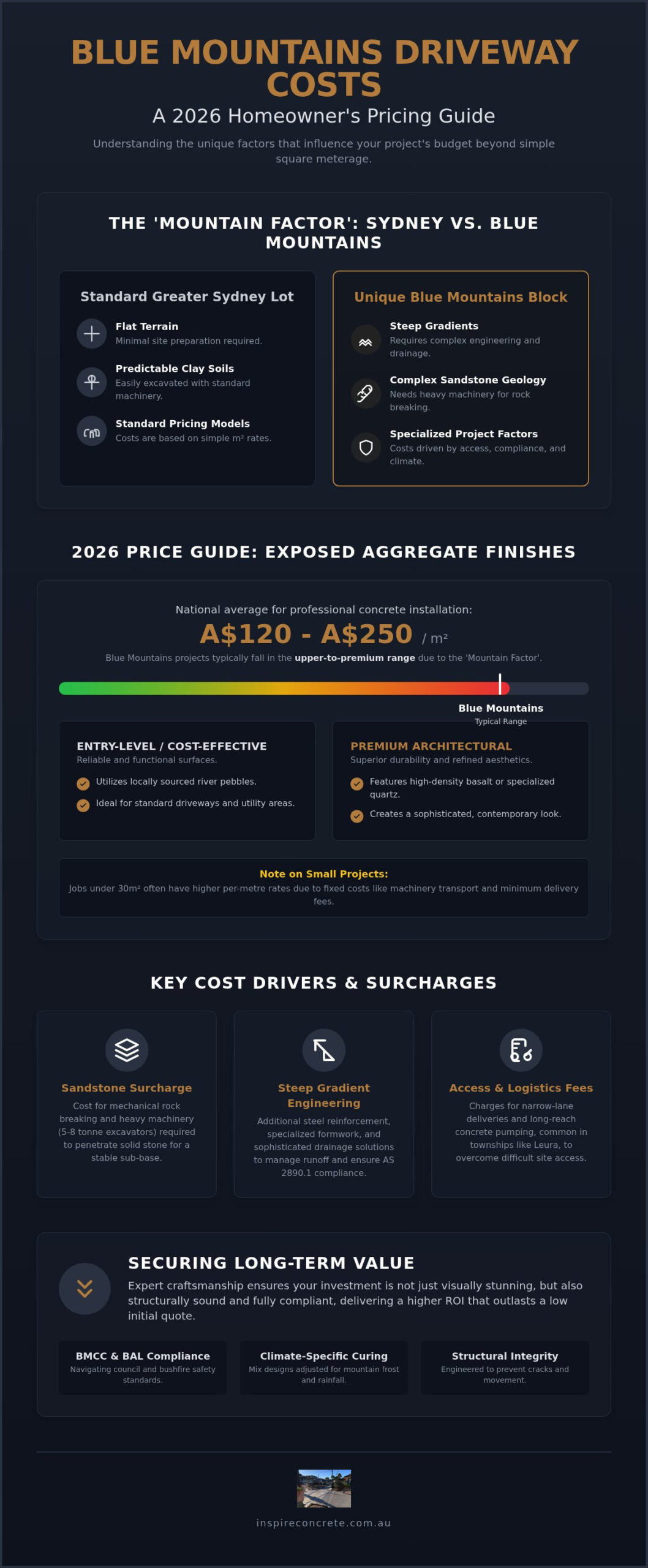
Estimating the exposed aggregate driveway cost blue mountains homeowners face in 2026 requires a departure from standard Sydney pricing models. While a project in Penrith might rely on predictable clay soils and flat terrain, mountain blocks are defined by the ‘Mountain Factor’. This is the intersection of complex geology and extreme gradients that often overrides simple square-metre rates. Relying on ‘Sydney average’ quotes is a common pitfall that leads to significant budget blowouts because those figures don’t account for the specialized labor and engineering required to build on a ridge. Mountain residents often find that a ‘one size fits all’ quote fails the moment a bucket hits rock.
The unique climate of the Blue Mountains, characterized by higher rainfall and lower overnight temperatures, directly influences concrete curing times and long-term durability. We adjust our mix designs and pouring schedules to ensure the structural integrity of the finish isn’t compromised by mountain frost or sudden downpours. Professional architectural drafting is essential here; it prevents costly engineering mistakes by mapping out the exact requirements for a steep mountain block before the first excavator arrives. Choosing Decorative concrete options like exposed aggregate allows for a slip-resistant surface that handles these gradients safely while maintaining a sophisticated aesthetic that complements the natural landscape.
The Geology of the Ridges: Sandstone vs. Soil
Excavating mountain rock isn’t a job for light machinery. You’ll often see us utilizing 5-tonne or 8-tonne excavators with specialized rock-breaking attachments to carve out a level sub-base. Proper preparation is the only way to prevent driveway movement on uneven mountain rock, which requires significantly more labor hours than digging into soft soil. The Sandstone Surcharge is the specific cost associated with mechanical rock breaking and the additional machinery time required to penetrate solid stone. Without this rigorous sub-base work, a premium exposed aggregate finish would eventually crack as the ground settles unevenly around the sandstone shelf.
Gradient and Drainage: Engineering for the Slope
Steep driveways demand more than just a standard pour. They require additional steel reinforcement and specialized formwork to ensure the wet concrete stays exactly where it’s placed during the installation process. We also integrate sophisticated drainage solutions to manage high-rainfall runoff, protecting the surrounding World Heritage areas from erosion and preventing water from pooling against your home’s foundation. Safety compliance is a non-negotiable part of our process. We design transitions with precision, ensuring that driveway grades comply with Australian Standard AS 2890.1 to prevent vehicles from ‘bottoming out’ on steep entries. This level of engineering ensures your driveway is as functional and safe as it is beautiful.
2026 Price Guide for Exposed Aggregate and Decorative Finishes
Selecting the right finish for your property involves balancing aesthetic aspirations with the practicalities of mountain life. In 2026, the exposed aggregate driveway cost blue mountains homeowners encounter is largely defined by a tiered structure that separates entry-level utility from premium architectural transformations. An entry-level project typically utilizes locally sourced river pebbles, providing a reliable and cost-effective surface. In contrast, a premium installation often features high-density basalt or specialized quartz mixes, which offer superior durability and a more refined, contemporary look. While national averages for professional concrete installations in 2026 generally span from A$120 to A$250 per square metre, projects in our region often gravitate toward the higher end of this spectrum due to the specific logistical demands of the terrain.
The scale of your project also dictates the efficiency of the rate. For smaller installations, such as garden pathways or bin pads under 30m2, you’ll likely find higher per-metre rates. This ‘Small Job’ minimum accounts for fixed costs like machinery transport, site setup, and minimum concrete delivery fees that don’t scale down with the size of the area. Investing in a comprehensive plan that combines your driveway with exposed aggregate driveways and connecting pathways can often provide better overall value. Precision matters. We ensure every mix is optimized for the specific conditions of your site.
Exposed Aggregate: The Gold Standard for Mountain Homes
Exposed aggregate remains the premier choice for mountain residences because it solves several environmental challenges simultaneously. Its naturally textured surface provides essential slip resistance during frosty winter mornings and periods of heavy mist, offering a level of safety that smoother finishes can’t match. Beyond utility, the ability to customize stone mixes allows you to choose tones that seamlessly integrate with the natural sandstone outcrops of your landscape. This creates a high long-term ROI, as the finish is significantly more resilient to wear and tear than plain or coloured concrete driveways, maintaining its visual appeal for decades with minimal maintenance.
Comparing Stencil, Stamped, and Plain Options
For those looking for a different aesthetic or a tighter budget, other decorative finishes offer unique benefits. Stencil concrete can mimic the appearance of hand-laid stone or brick without the full investment of a premium aggregate mix. However, safety is non-negotiable on steep gradients. If you opt for plain concrete, we always recommend a heavy broom finish to provide the necessary traction for vehicles and pedestrians. It’s also vital to consider Bushfire (BAL) driveway requirements, as non-combustible materials are a mandatory safety standard in high-risk zones. To ensure your project meets these rigorous standards while achieving your design goals, you might consider reaching out for a professional site consultation to explore the best options for your property.
Hidden Cost Drivers: Access, Logistics, and Pumping
Access in the Blue Mountains is rarely straightforward. While a suburban Sydney lot might allow a concrete truck to back right up to the formwork, mountain properties often feature narrow, winding lanes and significant setbacks. These constraints mean that the exposed aggregate driveway cost blue mountains residents see on a quote is heavily influenced by the logistics of getting materials to the site. In townships like Leura or Wentworth Falls, the width of the road might dictate the use of smaller, more frequent deliveries. This increases the total labor hours and delivery surcharges. Hiring concreters Sydney professionals who specialize in these high-altitude logistics is vital to avoid the delays that come from underestimating the physical reality of the terrain.
Before the first cubic metre of concrete arrives, the site must be cleared of existing old paths, asphalt, or dense vegetation. Removing these materials isn’t just about labor; it involves disposal fees that have increased into 2026. This initial phase sets the foundation for everything that follows. We approach site clearing with the same precision as the final pour, ensuring the ground is stable and ready for the structural demands of a new driveway.
Concrete Pumping Requirements in the Mountains
In the mountains, concrete pumping is almost never an optional extra. Because of steep gradients and homes set far back from the street, a line pump or a long-reach boom pump is mandatory for 90% of our projects. These units come with their own hire rates and ‘travel time’ surcharges, particularly for the Upper Mountains. Beyond just reaching the site, pumping ensures a superior finish by allowing for a continuous, rapid pour. This prevents the concrete from setting before it’s properly placed and finished, which is crucial for achieving the consistent texture required in a high-end aggregate project.
Site Preparation and Waste Management
Creating a level, functional parking surface on a slope requires ‘benching’. This is the process of cutting into the hillside to create flat tiers. It requires precision engineering and often involves the removal of significant amounts of excavated sandstone or heavy tree roots. Environmental management is equally critical. Working within sensitive bushland means we must strictly manage sediment and runoff to protect the local ecosystem. Disposal fees for old concrete and organic waste are calculated by weight, making the removal of a thick, old driveway a significant line item in your 2026 project planning.
Council Compliance and Bushfire (BAL) Requirements
Building in a World Heritage listed area means your project is subject to some of the strictest environmental and safety regulations in Australia. When calculating the exposed aggregate driveway cost blue mountains homeowners need to realize that compliance isn’t just a hurdle; it’s a structural necessity. The Blue Mountains City Council (BMCC) requires specific approvals for any work within the road reserve, known as the driveway crossover. While you are responsible for the construction cost of this section, it remains council property and must adhere to rigid specifications regarding width, thickness, and reinforcement. The Blue Mountains City Council mandates a minimum slip resistance rating of P4 or P5 for all new driveway surfaces to ensure pedestrian safety on steep gradients.
Safety extends beyond the surface. With over 1,500 low-speed driveway accidents occurring annually across Australia, the BMCC places a high premium on clear sightlines and compliant gradients. We ensure your crossover meets the mandatory 100mm thickness and 25MPa concrete strength required for residential vehicle crossings. Navigating these standards requires a partner who understands the local landscape. You can ensure your project meets every regulatory benchmark by booking an expert site assessment to review your specific property requirements.
Designing for BAL (Bushfire Attack Level)
In high-risk zones, your driveway is more than a path for your car; it’s a critical fire break. Concrete is the preferred material for driveways in BAL-40 and BAL-FZ (Flame Zone) areas because it’s non-combustible and provides a ‘defendable space’ for emergency services. To meet these rigorous standards, we utilize SL82 mesh on chairs with a 40mm cover to ensure structural integrity under extreme heat. We also incorporate specialized expansion joints that prevent the slab from buckling, ensuring your driveway remains a reliable exit route when it matters most. Choosing a high-end aggregate finish allows you to meet these life-saving standards without sacrificing the aesthetic elegance of your home.
BMCC Permits and Inspection Fees
The approval path depends on the scope of your work. Most standard driveway replacements or new crossovers require a Minor Works permit, while larger transformations involving significant excavation might trigger a full Development Application (DA). Council inspection fees for new driveway connections are a standard part of the 2026 budgeting process and are mandatory to ensure the work meets Australian Standard AS 2890.1. Attempting ‘unauthorised works’ is a significant risk; it can lead to heavy fines and complicated issues during property valuations or future sales. We handle the technical documentation and ensure your project is fully insured with the required A$20 million in public liability insurance, providing you with total peace of mind.
Securing Value: Why Expert Craftsmanship Outlasts a Low Quote
When evaluating the exposed aggregate driveway cost blue mountains contractors provide, the bottom line rarely tells the full story of the investment. A low quote often signals a compromise in engineering integrity, particularly regarding sub-base preparation and reinforcement. In the mountains, these shortcuts lead to rapid deterioration. Choosing a team with 20 years of experience ensures your project accounts for the specific geological pressures of the region. A professionally installed concrete slab or driveway acts as a permanent capital improvement, offering a long-term ROI that far exceeds the initial savings of a budget contractor. We don’t just pour concrete; we engineer durable transitions that master the topography of your land.
Finalizing your project requires a comprehensive approach to maintenance and protection. Our process concludes with meticulous concrete cleaning and sealing, which preserves the vibrant colors of your chosen aggregate and protects the surface from mountain frost and oil spills. Before signing any agreement, ensure your checklist includes the following technical benchmarks:
- Verified site drainage plan to manage high-velocity runoff.
- Confirmed concrete strength of at least 25MPa or 32MPa.
- Specific mesh reinforcement schedules (SL82).
- Detailed expansion joint mapping for thermal movement.
The Anatomy of a Quality Mountain Driveway
The structural backbone of a mountain driveway is the steel reinforcement. While some contractors might suggest SL72 mesh for flat residential lots, we utilize SL82 mesh to provide the necessary tensile strength required on unstable ridges and steep gradients. This is paired with high-strength 25MPa or 32MPa concrete, which offers the density needed to resist the freeze-thaw cycles common in the Upper Mountains. Precision expansion joints are equally vital. We place these strategically to allow the slab to breathe during extreme seasonal temperature shifts, preventing the unsightly cracking that plagues inferior installations. This meticulous attention to detail ensures your driveway remains as stable as the sandstone it sits upon.
Getting Your 2026 Quote Started
To receive an accurate and fixed-price quote, it’s helpful to have your property’s technical details ready. Start by clearing any surface debris from the proposed area to allow for a precise site measure. You should have your Bushfire Attack Level (BAL) rating and any existing site surveys available during the consultation. Knowing your desired stone mix helps us calculate material costs accurately from the outset. At Inspire Concrete, we view every project as a partnership. We bring a master’s eye to every detail, from the initial excavation to the final seal. Contact us to begin a transformation that blends technical excellence with the rugged beauty of the Blue Mountains landscape.
Mastering Your Mountain Transformation
Building a driveway in the Blue Mountains requires balancing environmental respect with structural precision. You now understand that your project’s budget is primarily shaped by the unique sandstone geology beneath the surface and the strict bushfire safety standards required for mountain living. By prioritizing high-strength concrete and expert engineering, you ensure your investment withstands extreme frost and steep gradients for decades. Navigating the exposed aggregate driveway cost blue mountains residents face in 2026 is ultimately about choosing long-term value over the lowest quote to secure a result that enhances both your lifestyle and property value.
As licensed and insured Blue Mountains specialists with over 20 years of craftsmanship, we specialize in the steep and rocky terrain that defines our community. We take pride in transforming basic utility into a refined architectural statement that complements the natural landscape. We invite you to Request a Precision Quote for Your Blue Mountains Driveway and partner with a team that values excellence as much as you do. Your vision for a durable, elegant entrance is within reach; let’s build something that truly belongs in the mountains.
Frequently Asked Questions
How much does an exposed aggregate driveway cost per m2 in the Blue Mountains in 2026?
In 2026, the cost per square metre is determined by site complexity and material selection rather than a flat rate. Factors like premium basalt mixes, steep gradients, and the level of excavation required mean that every project is uniquely priced. We focus on providing a fixed-price quote after a thorough site assessment to avoid the hidden fees often found in generic estimates.
Do I need council approval for a new driveway in the Blue Mountains?
Yes, you must obtain approval from the Blue Mountains City Council for any driveway work that connects to the road reserve. This typically involves a Minor Works permit for the crossover section. We ensure all work complies with Australian Standard AS 2890.1 and that we maintain the mandatory A$20 million public liability insurance required for council-approved projects.
What is the best concrete finish for steep, slippery mountain driveways?
Exposed aggregate is the gold standard for the steep and often frosty terrain of the region. Its naturally textured surface provides the essential grip needed to meet P4 or P5 slip resistance ratings. This makes it significantly safer than smoother alternatives during winter mists or icy mornings, ensuring both vehicles and pedestrians maintain traction on difficult slopes.
Does sandstone excavation significantly increase the cost of a driveway?
Sandstone excavation is a major factor that influences the exposed aggregate driveway cost blue mountains residents will pay. Unlike the soft soils of Western Sydney, mountain rock requires specialized 5-tonne or 8-tonne machinery and mechanical rock breakers. This increases the labor hours and machinery costs needed to establish a stable, level sub-base for your new concrete installation.
Can an exposed aggregate driveway help improve my home’s bushfire (BAL) rating?
While a driveway doesn’t change your property’s mapped BAL rating, it serves as a critical fire break and defendable space. Concrete is a non-combustible material that meets the strict requirements for BAL-40 and BAL-FZ zones. It provides emergency services with a safe access point and creates a clear zone that helps prevent ground fires from reaching your home’s structure.
How long does it take to install a concrete driveway on a steep mountain site?
Most mountain installations take between seven to ten working days to complete, depending on the volume of rock excavation required. We account for the unique mountain climate, as lower temperatures can extend the initial concrete set time. Once the pour is finished, we allow for a specific curing period before the final cleaning and sealing process begins to ensure maximum durability.
What is the difference between a line pump and a boom pump for mountain delivery?
A line pump uses flexible hoses laid along the ground to transport concrete, while a boom pump utilizes a remote-controlled hydraulic arm to reach over obstacles. In the mountains, we often favor line pumps for properties with narrow side access or low tree canopies. Boom pumps are ideal for steep sites where the driveway is set significantly higher or lower than the street level.
Why is my Blue Mountains driveway quote higher than the ‘Sydney average’?
Mountain quotes are typically higher because they must account for the logistical challenges of narrow lanes, steep gradients, and rocky geology. These factors require specialized equipment, additional labor for manual handling, and strict compliance with local bushfire regulations. We price for the complexity of the environment to ensure your driveway is engineered to last, rather than offering a generic price that leads to future failure.
