

What if the most expensive piece of equipment in your workshop isn’t the four-post hoist or the CNC machine, but the foundation sitting silently beneath them? For many Sydney property owners, the fear of seeing a fresh slab spider-web with cracks under the weight of a heavy vehicle is a constant source of anxiety. Building with heavy duty concrete for shed slab applications requires a move away from standard residential thinking toward true structural engineering. It’s not just about more material; it’s about the precision of the system.
We understand the frustration of trying to decode technical jargon like MPa ratings and reinforcement mesh sizes while worrying about how Sydney’s notorious reactive clay soils will impact your build. This guide promises to strip away the confusion, providing you with the exact technical specifications and professional installation secrets required to support heavy machinery for a lifetime. You’ll gain the confidence to hand your contractor a precise brief, covering everything from the 25MPa minimum strength standards to the critical role of SL82 mesh in preventing structural failure. We’ll explore the site classification process, current 2026 pricing for materials, and the engineering logic that ensures your investment remains level and intact for decades.
Key Takeaways
- Learn why heavy-duty performance requires a specialized engineering system designed for point loads rather than a standard residential mix.
- Master the technical specifications for heavy duty concrete for shed slab construction, including why 32 MPa is the gold standard for long-term durability.
- Understand how to stabilize Sydney’s reactive clay soils through proper excavation and sub-base preparation to prevent structural movement.
- Discover the critical role of concrete “slump” and why professional water management during the pour is essential for maintaining compressive strength.
- Identify the professional sealing and maintenance protocols required to protect your workshop floor from oil spills, chemicals, and industrial wear.
Defining Heavy-Duty: Why Standard Shed Slabs Fail Under Load
The structural integrity of a concrete slab rests on three pillars: compressive strength, thickness, and reinforcement. In Sydney’s challenging environment, where reactive clay soils expand and contract with the seasons, over-engineering is the only way to ensure a long-term return on investment. If you cut corners during the initial pour, you’ll likely pay for it later in expensive remedial resin injection or total slab replacement. We view the slab as the most critical component of the build, demanding the same precision as the high-end machinery it eventually supports.
The Difference Between Garden Slabs and Workshop Foundations
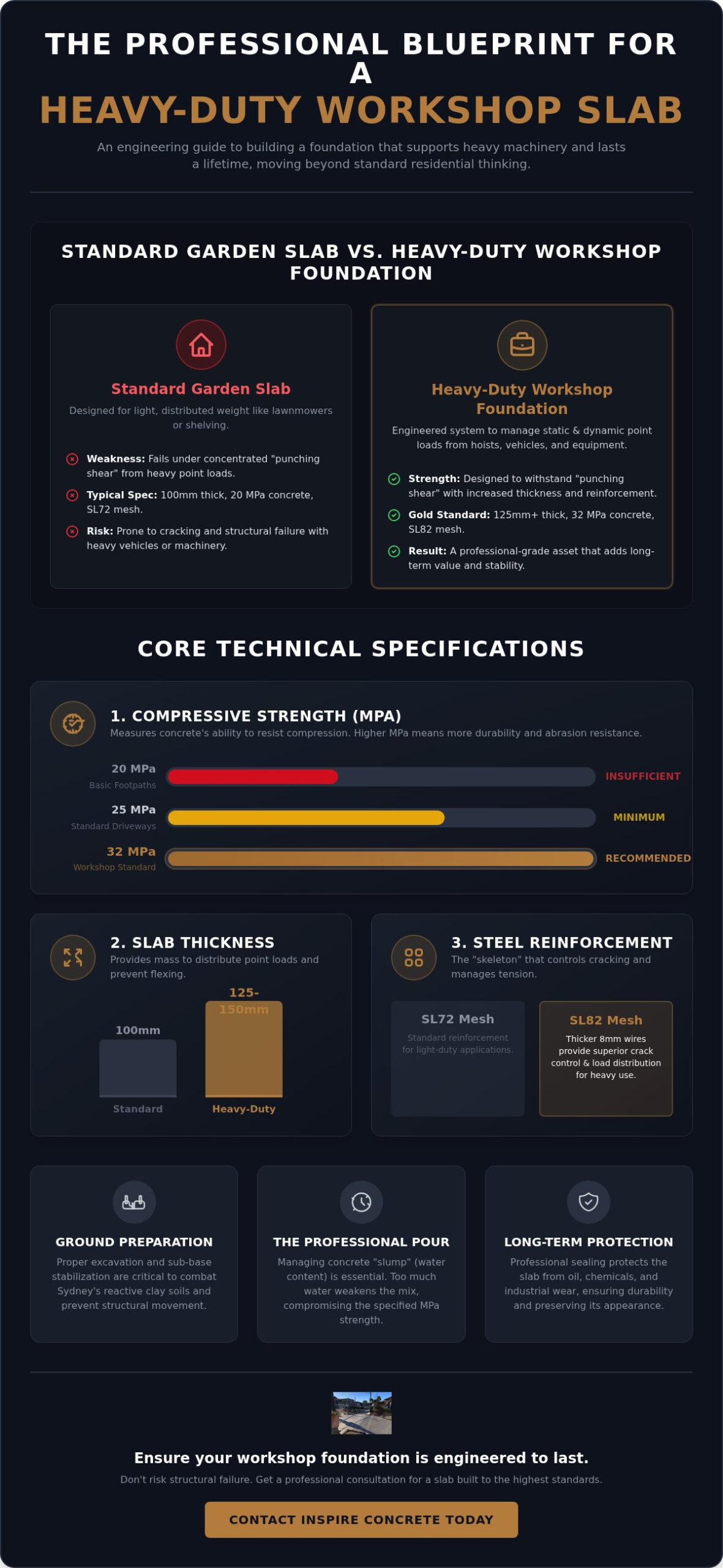
A garden slab supports distributed weight, like a lawnmower or light timber shelving. A workshop foundation is a different beast entirely. It must withstand “punching shear,” which occurs when the concentrated weight of a vehicle hoist or heavy industrial shelving pierces through a thin slab like a needle through fabric. We design these heavy duty concrete for shed slab systems with increased thickness and specific edge thickening. This extra mass at the perimeter supports the shed’s structural frame, ensuring the entire building remains stable even when the ground beneath it shifts during a Sydney dry spell.
Assessing Your Specific Load Requirements
Before the first concrete truck arrives, you need to define exactly how you’ll use the space. Will you install a four-post hoist? Are you planning for floor-to-ceiling pallet racking? These are static loads that put constant, intense pressure on specific points. Conversely, driving a car or forklift onto the slab creates dynamic loads, which generate different types of stress through vibration and movement. If your equipment exerts high pressure on small contact points, you might need an engineer’s certificate to confirm your design meets Australian Standards AS 3600. Getting these specifications right during the planning phase is the hallmark of a professional build and prevents the heartbreak of structural failure down the road.
Technical Specifications: MPa, Mesh, and Thickness for 2026
Building a high-performance floor starts with precision engineering. For a heavy duty concrete for shed slab project, the thickness isn’t just about bulk; it’s about the depth-to-strength ratio. Increasing your slab thickness from the residential standard of 100mm to a robust 125mm or 150mm provides the necessary mass to distribute heavy point loads. This extra depth prevents the slab from flexing under the weight of a hoist or a loaded trailer, maintaining structural integrity across the entire surface. When you combine this depth with the correct material specs, you create a foundation that can handle almost anything you throw at it.
Choosing the Right MPa Concrete Strength
As per AS 3600, MPa (Megapascals) represents the compressive strength of concrete measured 28 days after the pour. While 20 MPa is sufficient for basic footpaths, 25 MPa is the baseline for residential driveways and standard sheds. However, for a workshop that sees regular vehicle movement or heavy equipment, 32 MPa is the gold standard. Higher MPa ratings don’t just provide more strength; they significantly improve surface abrasion resistance. This means your floor won’t “dust” or wear down as quickly when you’re moving heavy jacks or machinery around. All work should align with the NSW Guide to Standards and Tolerances to ensure the finish meets professional expectations.
Steel Reinforcement: SL72 vs. SL82 Mesh
Reinforcement is the skeleton that keeps your slab together under tension. For heavy-duty applications, we move beyond standard SL72 mesh and specify SL82. SL82 features thicker 8mm longitudinal and cross wires, providing superior crack control and load distribution. Simply throwing mesh on the ground isn’t enough. It must be positioned in the top third of the slab using plastic “chairs” or spacers. This ensures the steel is exactly where it needs to be to counteract the tension forces that lead to cracking. We also ensure a minimum 500mm lap where mesh sheets meet, creating a continuous structural bond that spans the entire footprint. Correct lapping is non-negotiable for a professional result.
Getting these technical details right is what separates a professional installation from a DIY disaster. If you’re planning a high-spec project, looking at a professional shed slab ensures these engineering standards are met without compromise. By investing in 32 MPa concrete and SL82 mesh from the start, you’re not just pouring a floor; you’re building a lifetime asset.
Ground Preparation: Navigating Sydney’s Reactive Clay Soils
Success in concrete construction isn’t just about what you pour; it’s about what you prepare. In the Sydney basin, we face a unique geological challenge: reactive clay. This soil type is notorious for its high plasticity, meaning it expands significantly when wet and contracts as it dries. For a heavy duty concrete for shed slab, this movement is the primary enemy of structural integrity. Without a meticulously prepared sub-grade, even the strongest concrete will eventually succumb to ground-induced stress. We treat site preparation as the most critical phase of the build, ensuring the foundation is as resilient as the steel reinforcement within it.
Proper excavation must account for more than just the thickness of the concrete. You’re creating a multi-layered system. This involves digging deep enough to house a substantial sub-base and a high-quality vapor barrier. This plastic membrane is essential for preventing rising damp, which can ruin machinery and compromise the bond of professional floor sealers. For a deeper dive into local requirements, consult The Essential Guide to Concrete Slabs in Sydney. This resource explains how we tailor our approach to the specific soil classifications found across the metropolitan area.
The Role of Sub-base and Mechanical Compaction
A heavy-duty slab requires a stable platform to distribute weight evenly. We typically specify 50-100mm of compacted road base, such as DGB20, to create a non-reactive buffer between the clay and the concrete. During excavation, we look for “soft spots,” which are pockets of unstable or organic material that could lead to localized sinking. These must be removed and replaced with structural fill. A heavy-duty plate compactor is the most important tool on the site during this phase. We use it to lock the road base into a solid mass, removing air voids and ensuring the ground won’t settle once the weight of your workshop equipment is applied.
Drainage and Site Levels in the Sydney Metro Area
Water management is the secret to a long-lasting slab. If water pools around the perimeter, it can saturate the reactive clay and cause the edges of your slab to lift or sink. We use laser levels to set precise site heights, often incorporating a subtle fall to guide runoff away from the structure. This is particularly vital for Western Sydney properties, where heavy summer rain cycles can dump significant volumes of water in short periods. By controlling the site levels and ensuring adequate drainage, we protect the sub-base from erosion and maintain the constant moisture levels required to keep the underlying soil stable.
The Professional Pour: Execution Steps for a Flawless Slab
When the agitator truck arrives on-site, the margin for error disappears. For a heavy duty concrete for shed slab, the pour is a race against the chemical reaction known as hydration. The process begins with checking the “slump,” which is the measure of the concrete’s workability. While it’s tempting to add water to make the mix easier to spread, doing so is a critical mistake. Extra water dilutes the cement paste, permanently lowering the MPa rating and increasing the likelihood of future surface dusting. We maintain the mix exactly as it left the plant to ensure the structural integrity remains uncompromised.
Placement involves more than just raking the wet concrete into position. We use mechanical immersion vibrators to consolidate the mix as it’s poured. This tool removes trapped air pockets, known as honeycombing, which can create hidden weak points within the foundation. Once the concrete is level, professional finishing begins. We use power trowels to “close” the surface, creating a dense, abrasion-resistant finish that’s perfectly level for machinery or vehicle hoists. This level of precision ensures your equipment won’t wobble or require shimming once installed.
Formwork and Vapor Barrier Installation
The pressure exerted by a 150mm thick pour of 32 MPa concrete is immense. We use heavy-duty timber or steel formwork, braced with additional stakes to prevent a “blow out” during the pour. Before the steel mesh goes in, the vapor barrier must be installed with absolute care. We tape every seam and seal around any plumbing penetrations to create a continuous moisture shield. This prevents rising damp from entering the shed, which is vital for protecting sensitive electronics and preventing rust on your tools. We also inspect the mesh to ensure it’s free of loose scale or oil, allowing the concrete to bond perfectly to the steel.
Curing and Control Joints: Preventing Cracks
Concrete cures through a chemical process; it doesn’t just dry out. In the harsh Sydney heat, moisture can evaporate too quickly from the surface, leading to “plastic shrinkage” cracks. We manage this by applying professional curing compounds or using a consistent water misting protocol for the first seven days. This allows the internal strength to develop fully. Within 24 hours of the pour, we saw-cut control joints into the slab at specific intervals. These joints act as intentional weak points, directing the natural shrinkage of the concrete into straight, manageable lines rather than allowing random cracks to wander across your workshop floor.
Executing a pour of this magnitude requires a team that understands the science behind the material. If you want to ensure your workshop foundation is built to last, explore our professional shed slab solutions for a result that combines engineering excellence with a flawless finish.
Protecting Your Investment: Sealing and Maintenance
The final trowel pass doesn’t mark the end of your project; it marks the beginning of your slab’s service life. For a heavy duty concrete for shed slab, professional sealing is the insurance policy that protects against the harsh realities of a working shop. Bare concrete is naturally porous. Without a protective barrier, oil leaks, hydraulic fluids, and chemical spills will penetrate deep into the matrix, causing permanent staining and potential structural degradation. We apply high-performance sealers to ensure your floor remains as resilient as the day it was poured, transforming a simple utility surface into a professional-grade workspace.
In high-traffic environments, we often recommend penetrating densifiers over standard topical sealers. While topical coatings sit on the surface and can eventually peel under the friction of turning tyres, densifiers penetrate the concrete to create a chemical reaction that hardens the surface from within. This creates a dust-proof, liquid-resistant finish that actually becomes tougher as it ages. To keep your floor in peak condition, follow the steps in our guide on How to Clean and Maintain Concrete. Consistent maintenance ensures that dirt and metal shavings don’t act as abrasives against your sealed finish.
Choosing the Right Finish for a Workshop Environment
The texture of your slab should reflect its primary use. For most internal workshops, a smooth steel trowel finish is the gold standard. It’s easy to sweep, resists oil absorption, and allows heavy tool chests to roll effortlessly across the floor. However, if your shed involves wet work or steep ramps, we can incorporate a light broom finish or a non-slip additive into the sealer to provide essential grip. Densifiers are particularly effective here, as they maintain the slab’s breathability while significantly increasing its resistance to heavy rolling loads and impact.
The Inspire Concrete Advantage in Sydney
We bring more than 20 years of specialized experience to every project across the Sydney Metro and Western Suburbs. Our team understands that a heavy duty concrete for shed slab is a significant investment, which is why we approach every pour with architectural precision. We don’t just provide the muscle; our services include architectural drafting to ensure your slab meets all local council requirements and Australian Standards. We act as your project partner, managing the technical complexities so you can focus on the work that happens on top of the floor.
Ready to build a foundation that supports your vision? Get a professional quote for your heavy-duty shed slab today and experience the difference of expert craftsmanship.
Build Your Foundation With Engineering Precision
Your workshop is only as reliable as the ground it stands on. By prioritizing high-strength 32 MPa mixes and SL82 reinforcement, you’re not just pouring a floor; you’re engineering a professional asset capable of supporting your heaviest machinery for decades. Navigating Sydney’s reactive clay soils requires more than just a standard approach. It demands the meticulous ground preparation and moisture management we’ve discussed. When you combine these technical specifications with a professional pour and high-performance sealing, you eliminate the risk of structural failure and surface wear.
At Inspire Concrete, we bring over 20 years of Sydney experience to every project. Our team of licensed and insured craftsmen provides more than just labor; we offer a complete project partnership that includes expert architectural drafting to ensure your build meets all local standards. If you’re ready to transform your vision into a durable, high-performance reality, it’s time to take the next step. Request a Professional Concrete Slab Quote for your heavy duty concrete for shed slab today. Let’s build a foundation that supports your passion and stands the test of time.
Frequently Asked Questions
How thick should a heavy-duty shed slab be for a vehicle hoist?
A minimum thickness of 150mm is the professional standard for slabs supporting a vehicle hoist. While a standard 100mm slab is sufficient for general storage, the concentrated point loads of a hoist require the extra depth to prevent punching shear. Many engineering specifications also call for localized thickening or reinforced footings directly beneath the hoist mounting points to ensure the slab doesn’t flex under load.
Do I really need 32 MPa concrete, or is 25 MPa enough?
While 25 MPa is the baseline for residential driveways, 32 MPa is highly recommended for heavy-duty workshop environments. The higher MPa rating provides significantly better compressive strength and surface density. This increased density makes the floor more resistant to “dusting” and abrasion, which is vital if you’re frequently moving floor jacks, heavy tool chests, or steel-wheeled equipment across the surface.
What is the best steel mesh for a workshop slab?
SL82 reinforcing mesh is the superior choice for any heavy duty concrete for shed slab project. It features 8mm thick steel bars that provide greater tensile strength than the standard SL72 mesh. This extra steel is essential for controlling shrinkage cracks and distributing the weight of heavy machinery across the slab, especially when building on Sydney’s reactive clay soils.
How long should I wait before driving a car onto my new shed slab?
You should wait at least 7 to 14 days before driving a light vehicle onto the new concrete. Although concrete feels hard within hours, it takes 28 days to reach its full design strength. For heavy machinery or the installation of a vehicle hoist, it’s best to wait the full 28-day curing period to ensure the internal structure has matured enough to handle the stress without cracking.
While you’re waiting for your new workshop floor to reach its peak strength, why not spend that time experiencing the world’s finest machinery on the open road? Supercar Holidays offers exclusive luxury driving tours across Australia, perfect for automotive enthusiasts who demand the same high standards in their travel as they do in their construction projects.
Does a shed slab in Sydney require a council permit?
Many residential sheds in Sydney fall under “Exempt Development” rules, but this depends on the size, height, and location of the structure. If your shed exceeds specific floor area limits or is positioned near a boundary, you may need a Complying Development Certificate (CDC) or a full Development Application (DA). It’s essential to verify the current requirements with your local council or the NSW Planning Portal before you begin excavation.
Should I use gravel or road base under my concrete slab?
Compacted road base, specifically DGB20, is the only choice for a heavy-duty foundation. Unlike loose gravel, road base contains a mix of stone sizes and “fines” that lock together under mechanical compaction. This creates a rock-solid, unyielding platform that won’t shift. This stability is critical in Sydney, where the sub-grade must be isolated from the movement of reactive clay soils.
How much does a heavy-duty shed slab cost per square metre in Sydney?
The total investment for a high-performance slab depends on site access, the required excavation depth, and the specific engineering specs like 32 MPa concrete and SL82 mesh. In 2026, material costs for 25 MPa concrete average between $410 and $420 per cubic metre, while SL82 mesh sheets are approximately $165. Because every site has different drainage and soil reactivity challenges, a professional site assessment is the only way to get an accurate figure.
Can I pour a shed slab myself, or should I hire a professional?
While DIY is an option for small garden pads, a heavy duty concrete for shed slab requires professional execution. The margin for error is slim when you’re dealing with 32 MPa mixes and complex reinforcement. Professionals have the specialized equipment, such as mechanical vibrators and power trowels, needed to ensure the slab is structurally sound and perfectly level for your machinery.
