
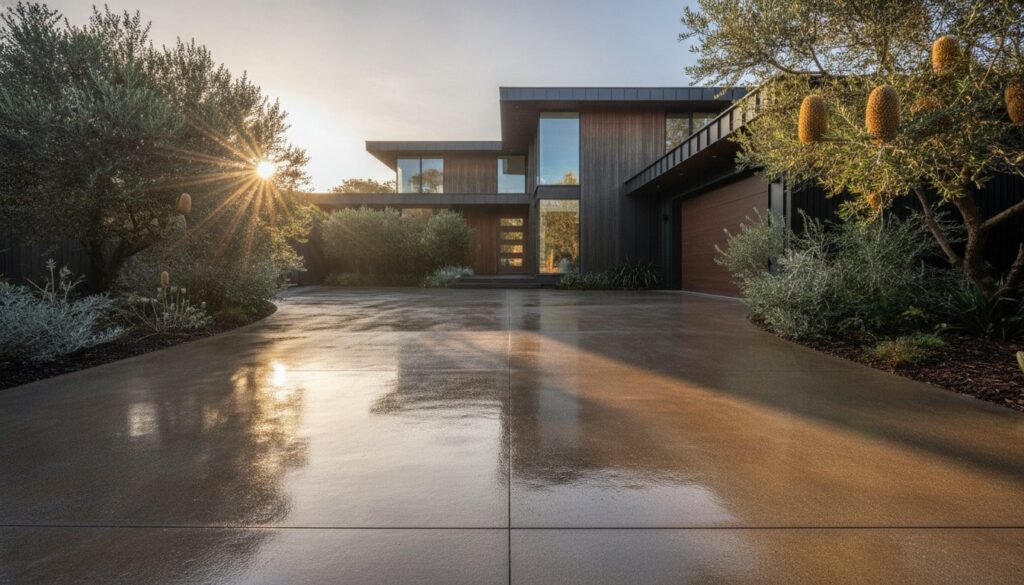
The “bargain” sealer sitting on a hardware store shelf might be the most expensive mistake you ever make for your property’s curb appeal. You want a driveway that reflects the quality of your home, not one that succumbs to the brutal Sydney humidity or the relentless UV rays. It’s frustrating to watch a significant investment fade into a dusty, oil-stained eyesore just months after application. This guide provides the definitive professional framework to help you identify the best concrete sealer for driveways in Australia, ensuring your surface remains a high-end asset rather than a maintenance burden.
Selecting the right protection is about more than just aesthetics; it’s a calculated decision to preserve structural integrity against heavy wear. We’ll explore the shift toward low-VOC, water-based technologies and compare the “wet-look” of trade-grade acrylics against the invisible strength of penetrating silanes. You’ll learn how to navigate the 2026 Green Star standards and application timelines, moving from the initial spark of a renovation idea to a durable, elegant result that genuinely increases your property value.
Key Takeaways
- Understand how extreme UV exposure and thermal expansion in the Australian climate dictate the specific sealer chemistry required for long-term surface preservation.
- Identify the best concrete sealer for driveways in Australia by matching professional-grade resin densities to your specific finish, whether it’s exposed aggregate or stamped concrete.
- Compare the technical advantages of solvent-based versus water-based sealers to ensure breathability and prevent common failures like white blushing and peeling.
- Master the professional ‘Clean, Dry, Apply’ protocol to guarantee a flawless bond and avoid the moisture traps that compromise the structural integrity of your driveway.
- Discover why trade-grade resins offer superior protection and aesthetic transformation compared to thinned-down retail alternatives, directly impacting your home’s long-term value.
Understanding Driveway Sealers in the Australian Climate
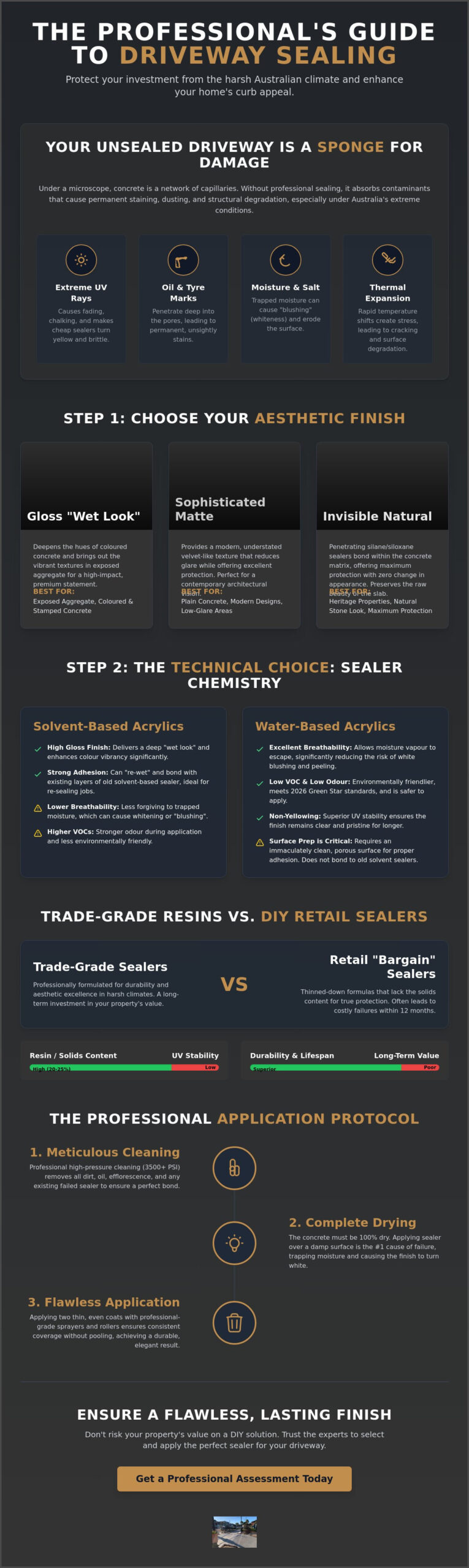
Concrete appears impenetrable, but under a microscope, it’s a labyrinth of tiny capillaries. Without a professional Concrete sealer, your driveway acts like a porous sponge. It drinks in motor oil, tyre marks, and salt, leading to permanent staining and surface dusting. In the context of the Australian climate, the stakes are higher than elsewhere. Our extreme UV levels and rapid thermal expansion create a cycle of stress that can degrade an unprotected slab in just a few seasons. Sealing isn’t just about a quick shine. It’s a vital maintenance protocol that preserves the structural integrity and aesthetic value of your home.
Finding the best concrete sealer for driveways in Australia requires understanding that the sealer is your first line of defence. We don’t view this as a simple utility. It’s a recurring commitment to excellence that prevents the “chalking” and fading common in neglected properties. A high-quality finish acts as a sacrificial layer, taking the brunt of the weather so your concrete doesn’t have to. This proactive approach ensures your driveway remains a high-end asset rather than a deteriorating liability.
The Role of UV Stability in 2026
The chemistry of protection has evolved significantly. In 2026, the industry standard focuses on non-yellowing acrylic resins that withstand the intense radiation found in Sydney’s Western Suburbs. Cheap, retail-grade sealers often lack the high-solids content needed for true UV resistance. This leads to a brittle, yellowed finish that peels within twelve months. We distinguish between topical blockers, which sit on the surface to reflect light, and penetrating blockers that bond within the concrete matrix. This technical choice determines whether your driveway maintains its clarity or turns into a cloudy mess under the summer sun.
Aesthetic Outcomes: Gloss vs. Matte vs. Natural
Your driveway’s finish should reflect your architectural vision. For many homeowners, the “Wet Look” is the ultimate goal. It deepens the hues of coloured concrete and brings out the vibrant textures in exposed aggregate. It’s a high-impact transformation that signals quality. If you prefer a modern, understated aesthetic, matte finishes provide a sophisticated, velvet-like texture that reduces glare. For those who value the raw beauty of their slab, penetrating sealers offer maximum protection with zero change in appearance. This versatility ensures the best concrete sealer for driveways in Australia isn’t just a protective coat, but a design tool that enhances your lifestyle and property value.
Choosing the Best Sealer for Your Concrete Finish
A driveway’s texture isn’t just an aesthetic choice; it’s a structural profile that dictates which chemical bond will perform best. The best concrete sealer for driveways in Australia is one that matches the specific resin density to your surface’s porosity. A dense, smooth finish requires a different approach than a rugged, textured one. If you apply a thick, high-build sealer to a non-porous surface, it will likely peel within a season. Conversely, using a thin sealer on a heavy texture leaves the “matrix” exposed to erosion. We look at the age of your slab too. New concrete needs time to hydrate before sealing, while older slabs often require solvent-based solutions to “re-wet” and bond with existing layers.
Safety is a non-negotiable part of our craftsmanship. For high-traffic areas or steeper gradients common in Sydney’s suburbs, we integrate slip-resistance additives into the final coat. These micronized powders provide essential grip without compromising the elegant finish of your property. If you’re unsure about the current state of your surface, a professional concrete cleaning and sealing assessment can determine the ideal resin match for your specific finish.
Sealing Exposed Aggregate Driveways
For exposed aggregate driveways, high-solids acrylic is the undisputed gold standard. These sealers, typically containing 20% to 25% resin, provide a robust protective film that locks the stones in place. This prevents the cement matrix between the pebbles from washing away or hosting weed growth. Beyond protection, this treatment creates the “stone-pop” effect, intensifying the natural colours of the river stones or quartz for a premium, high-end look.
Solutions for Stencilled and Stamped Surfaces
Decorative concrete requires a delicate balance of UV protection and breathability. Stencilled patterns are prone to colour fade if left exposed to the Australian sun. Solvent-based acrylics are often preferred here because they can penetrate through old, chalky layers to rejuvenate the original pigments. For stamped surfaces, we focus on preventing the “peeling” risk by ensuring the sealer doesn’t pool in the deeper imprints of the pattern, which can lead to unsightly white patches if moisture gets trapped.
Penetrating Sealers for Plain and Coloured Concrete
If you prefer the raw, architectural look of contemporary grey concrete, penetrating sealers are the superior choice. These Silane-Siloxane blends don’t form a film on top; instead, they bond deep within the pores to create a water-repellent barrier. They provide up to ten years of protection without changing the appearance or slip-resistance of the surface. This makes them the best concrete sealer for driveways in Australia when dealing with steep inclines where maintaining maximum tyre grip is the priority.
Solvent-Based vs. Water-Based Sealers: The Technical Debate
Choosing between solvent-based and water-based chemistry is a pivotal decision that dictates the long-term performance of your driveway. While both options aim to protect, they behave differently at a molecular level. Solvent-based sealers have historically been the industry workhorse, known for their deep penetration and ability to enhance colour. However, as of April 2026, the Green Building Council of Australia has reinforced strict TVOC content limits. For one and two-pack performance coatings used on floors, the limit is 140 g/L. This regulatory shift has accelerated the development of high-performance water-based resins that rival their solvent counterparts in durability while offering a significantly lower environmental footprint.
The “breathability” of a sealer is a critical factor in the Australian climate. If a coating is too dense, it traps moisture rising through the concrete slab. This leads to efflorescence, often called “white blushing,” where salt deposits form a cloudy, white haze beneath the sealer. Finding the best concrete sealer for driveways in Australia involves selecting a product with a high vapour transmission rate. This allows the concrete to “breathe” while still repelling liquid water and oils from the surface. Compatibility is another non-negotiable rule: you cannot apply a water-based sealer over an old solvent-based finish. The water-based resin won’t bond to the solvent-slick surface, leading to immediate delamination and failure.
When to Choose Solvent-Based Acrylics
Solvent-based sealers remain the premier choice for restoration projects. If your driveway has lost its lustre, these resins can “re-wet” the original pigments to bring back a deep, vibrant colour that looks brand new. They offer superior bond strength on non-porous surfaces where other coatings might struggle to find a foothold. Solvent sealers effectively melt into previous layers to create a seamless, monolithic finish. This chemical bond ensures that maintenance coats integrate perfectly with the existing surface rather than just sitting on top.
The Benefits of Modern Water-Based Sealers
In 2026, water-based resins are no longer the “weaker” alternative. They offer low odour and are significantly safer for nearby garden beds, pets, and family members. In high-humidity areas like coastal Sydney, water-based options often provide more reliable drying times because they don’t rely on the evaporation of volatile hydrocarbons. They are the preferred choice for eco-conscious builds and homeowners who prioritize air quality. When searching for the best concrete sealer for driveways in Australia, these modern formulations provide a sophisticated, long-lasting finish that aligns with contemporary environmental standards.
The Professional Preparation and Application Protocol
Precision in preparation distinguishes a master craftsman from a DIY enthusiast. We follow a strict ‘Clean, Dry, Apply’ mantra because preparation accounts for ninety percent of the final result. Sealing damp concrete is the fastest way to trigger a total system failure. Trapped moisture creates hydrostatic pressure that forces the resin to delaminate, resulting in those dreaded white patches and peeling edges. Even the best concrete sealer for driveways in Australia will fail if the substrate isn’t bone-dry. We also monitor atmospheric conditions with clinical detail. Applying sealer in the midday Australian sun causes the solvent to “flash dry” on the surface before it can penetrate the pores, leading to unsightly bubbles and streaks.
Before any resin touches the ground, we perform the ‘X-test’ to check for existing coatings. We score a small ‘X’ into the surface and apply high-tack tape. If the tape pulls up old sealer flakes, the surface requires chemical stripping to ensure the new bond is monolithic. This level of certainty leaves no room for guesswork. For those seeking a flawless finish, it’s essential to understand that the timing of application is as critical as the chemical chosen. Current 2026 industry standards suggest waiting at least 24 hours for foot traffic and five full days before allowing vehicles back onto the surface.
Step 1: Industrial High-Pressure Cleaning
A standard garden hose is insufficient for professional-grade results. It lacks the pressure to dislodge ingrained oils, tyre rubber, and lichen. We utilize industrial-grade pressure cleaners combined with specialized degreasers that lift contaminants from deep within the concrete matrix. In some cases, a mild acid wash is necessary to “etch” the concrete, opening the pores to accept the sealer. This meticulous detail is standard in our concrete cleaning and sealing services, ensuring the bond is permanent rather than superficial.
Step 2: Application Techniques for a Streak-Free Finish
Consistency is the hallmark of quality. While rollers are excellent for smaller pathways, airless sprayers often deliver the most even coat on expansive driveways. We employ a ‘cross-hatch’ method, applying the first coat in one direction and the second perpendicular to it. This ensures 100% coverage without “holidays” or thin spots. A single coat is never enough for long-term protection. The first coat primes and bonds, while the critical second coat provides the durable wear-layer that defends against the elements. If you’re ready to transform your home’s entrance, contact our team for professional concrete cleaning and sealing today.
Why Expert Application Outlasts DIY Hardware Solutions
The allure of a quick Saturday project often masks the technical complexity of chemical application. While hardware store aisles are lined with generic options, the best concrete sealer for driveways in Australia isn’t found in a retail tub. Trade-grade sealers typically contain 20% to 25% resin solids. Retail versions are frequently thinned down with additional solvents or water to meet a lower price point. This lower resin count means a thinner wear layer and a significantly shorter lifespan for your driveway. A professional application ensures you’re investing in a high-solids barrier that can actually withstand the thermal expansion and UV stress common in our climate.
Working with a licensed contractor provides a level of certainty that no DIY kit can offer. We provide a professional warranty on the finish, giving you peace of mind that the aesthetic transformation will endure. More importantly, consistent professional maintenance prevents the structural decay that eventually makes concrete resurfacing necessary. By sealing correctly now, you avoid the heavy expense of a full surface restoration in the future. We view ourselves as your project partner, focusing on long-term driveway health rather than a temporary fix.
The Real Cost of DIY Failure
Stripping a failed sealer is a gruelling, messy, and expensive process. It often costs three times more to remove a peeling, cloudy DIY coating than it does to have it professionally applied from the start. Over-application is the most common pitfall. Homeowners often think “more is better,” but thick layers trap gases as the sealer cures. This leads to ‘solvent pop’, a common DIY disaster where trapped gases create tiny, permanent bubbles that ruin the clarity and bond of the finish. Bubbling in the heat is another frequent failure, usually caused by applying product during the peak of a Sydney summer day when the concrete is too hot.
The Inspire Concrete Difference
At Inspire Concrete, we bring over 20 years of refined craftsmanship to every project across the Sydney Metro and Blue Mountains area. We don’t just apply a product; we engineer a solution tailored to your property. This includes custom-blending slip-resistance for the steep gradients found in our local topography, ensuring safety doesn’t compromise style. Our team understands the artistry required to make your driveway a high-end asset. If you’re ready to protect your investment with a durable, elegant finish, request a professional sealing quote from our expert team today.
Elevate Your Property’s Entrance with Professional Protection
Your driveway is more than just a functional slab; it’s the gateway to your home and a reflection of your lifestyle. We’ve explored how matching the right chemistry to your specific finish and adhering to a strict ‘Clean, Dry, Apply’ protocol are the only ways to combat the harsh Australian elements. Whether you’re enhancing the vibrant “stone-pop” of an exposed aggregate surface or seeking the modern, understated look of a penetrating sealer, the quality of the resin defines the longevity of the result. Identifying the best concrete sealer for driveways australia is ultimately about choosing professional-grade durability over retail convenience.
With over 20 years of Sydney trade experience, Inspire Concrete brings a meticulous eye for detail and expert project management to every transformation. We utilize specialized UV-stable trade-grade resins that provide a superior bond and lasting aesthetic value. Don’t leave your property’s curb appeal to the risks of DIY guesswork. Protect your investment with a professional concrete sealing quote from Inspire Concrete and ensure your driveway remains a high-end asset for years to come. Your vision for a pristine, durable entrance is well within reach.
Expert Insights: Driveway Sealing FAQs
How long does concrete sealer take to dry in Sydney’s humidity?
Concrete sealers typically require two hours to become touch-dry and rain-safe, though Sydney’s coastal humidity can extend this window. While the surface may feel dry quickly, you must wait a full 24 hours for foot traffic and five days before allowing vehicles back onto the driveway. This curing period ensures the resin reaches its maximum hardness and bond strength, preventing tyre marks from marring the new finish.
Will sealing my driveway make it slippery when wet?
Topical acrylic sealers can increase surface slickness, but we mitigate this risk by integrating micronized slip-resistance additives into the final coat. These powders provide essential grip without compromising the elegant “wet-look” finish. If slip resistance is your primary concern, penetrating sealers are an excellent alternative. They protect the concrete from within the pores without forming a film, leaving the original texture and traction of the slab completely unchanged.
How often should I re-seal my concrete driveway in Australia?
The maintenance cycle depends on the type of protection you choose and its exposure to the harsh Australian sun. Topical acrylic sealers generally require a fresh coat every two to five years to maintain their lustre and protective barrier. In contrast, high-performance penetrating sealers are more durable, often providing robust moisture and oil protection for up to ten years before a re-application is necessary.
Can I seal a driveway that was already sealed years ago?
Re-sealing an older driveway is entirely possible provided the new coating is chemically compatible with the existing layer. We use the ‘X-test’ with high-tack tape to determine if the old sealer is still bonded or if it requires stripping. It’s critical to remember that you can’t apply water-based products over old solvent-based sealers. The new resin won’t find a foothold, leading to immediate peeling and failure.
What is the best sealer for a steep concrete driveway?
Penetrating Silane-Siloxane blends are often considered the best concrete sealer for driveways in Australia when dealing with steep gradients. Because these sealers don’t create a topical film, they don’t reduce the natural slip-resistance of the concrete finish. This ensures maximum tyre grip during wet weather while still providing deep protection against salt and water ingress that can compromise the slab’s internal structure.
Does driveway sealer prevent cracks from forming?
A sealer won’t stop structural cracks caused by reactive soil or ground movement, but it does prevent the moisture-driven erosion that leads to surface spalling. By blocking water from entering the capillaries of the concrete, you stop the freeze-thaw cycle and thermal expansion stress that often cause fine hairline fractures to widen. Think of it as a protective skin that keeps the internal matrix dry and stable.
Can I apply sealer myself or should I hire a professional concreter?
Why has my concrete sealer turned white or cloudy?
Cloudiness, often called “white blushing,” is almost always the result of moisture being trapped beneath the sealer’s surface. This happens if the concrete wasn’t bone-dry before application or if the sealer was applied too thickly, preventing the slab from breathing. In the Australian climate, hydrostatic pressure can force water vapour up through the concrete, hitting the underside of a non-breathable sealer and creating a hazy, opaque appearance.
