
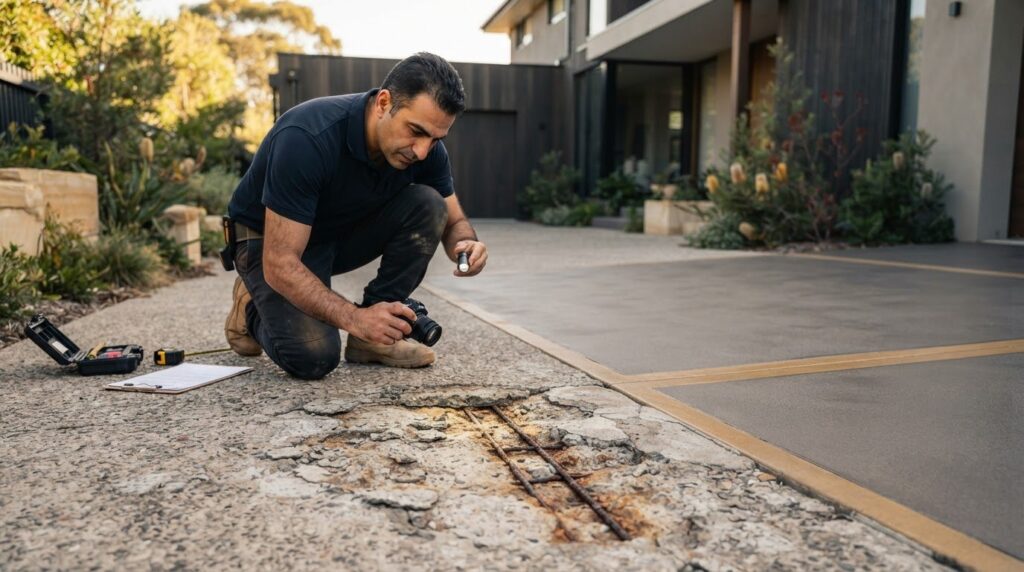
Could the quickest-looking fix be the one that lets the damage return? If you’re researching how to fix spalling concrete, a surface patch may seem like the obvious answer. But it won’t address deterioration beneath the surface. In Sydney, corrosion of steel reinforcement can push concrete apart, while cracks, flaking and rust stains can be signs that the damage needs closer assessment.
It can be difficult to tell whether spalling is cosmetic or more serious, and whether patching, resurfacing or a broader repair is appropriate. The right approach depends on the damage’s depth and extent, the surrounding concrete and the likely cause. This guide explains what to look for, what can contribute to spalling and how repair options compare. You’ll also learn how to record the damage and when a professional assessment can help identify a practical next step for your property.
Key Takeaways
- Flaking, chips and loose fragments can signal spalling, but appearance alone won’t show how deep the damage goes.
- Water entry, reinforcement corrosion and concrete or workmanship issues can all contribute. Assess the cause rather than assuming it.
- When considering how to fix spalling concrete, match a patch, resurfacing or more extensive repair to the damage and the condition of the concrete beneath it.
- Photograph and monitor the affected area. Don’t chip concrete or expose reinforcement as a DIY diagnostic step.
- Inspire Concrete offers repair, maintenance and resurfacing for properties in Sydney and surrounds.
How to Recognise Spalling Concrete and Judge Its Urgency
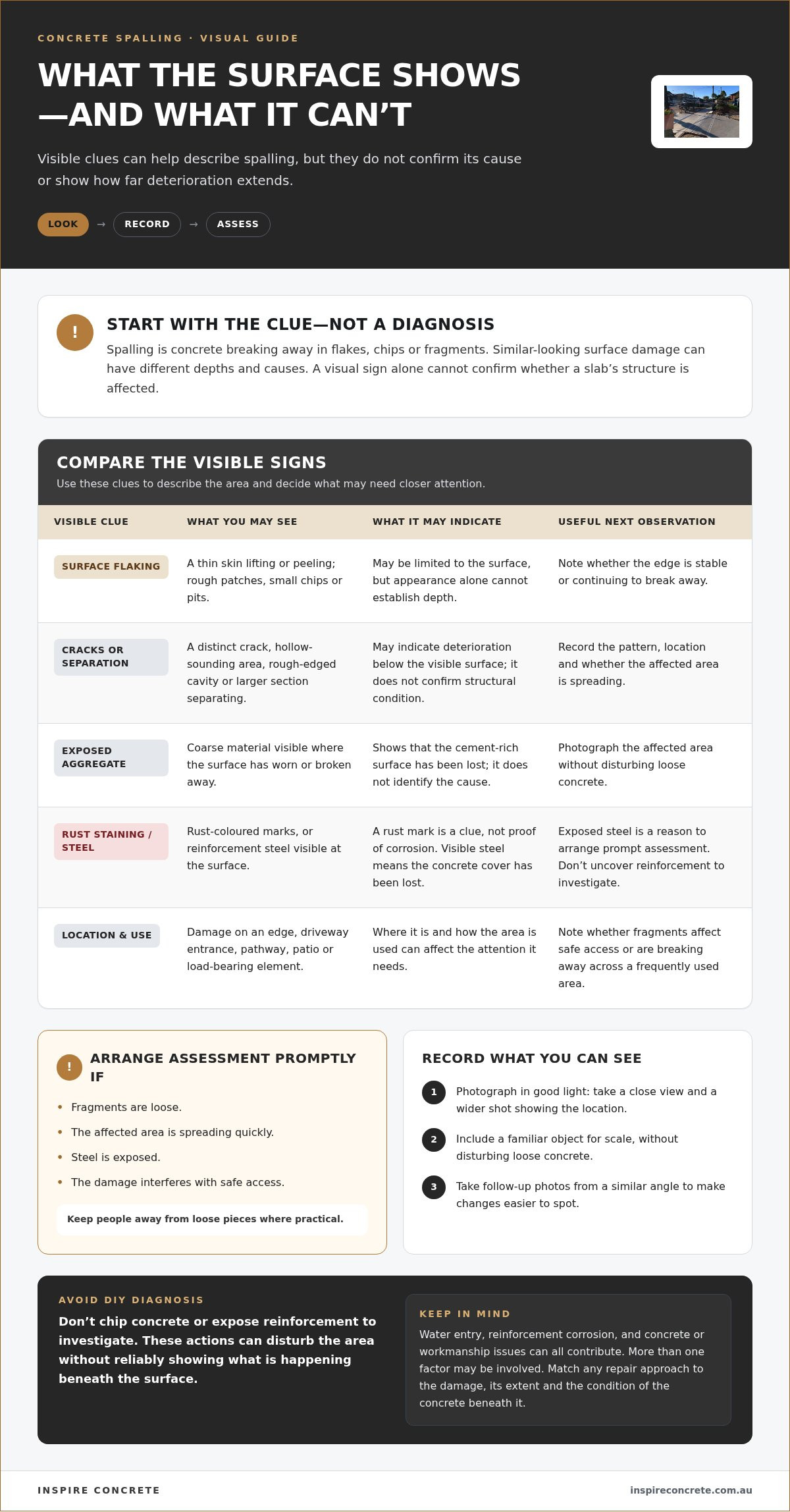
Spalling is concrete breaking away in flakes, chips or fragments. On a Sydney driveway, pathway or patio, it may start as a rough patch or a small piece coming loose. Look for shallow flaking, pits, exposed aggregate, rust-coloured staining or edges that keep crumbling. These signs help describe what you can see, but they don’t reveal the full condition of the concrete.
Surface loss and deeper deterioration can look similar from above. A thin layer lifting away may be limited to the surface, while a distinct crack, hollow-sounding area or larger section separating from the slab may indicate damage below. Exposed aggregate shows that the cement-rich surface has worn or broken away. Visible steel reinforcement is a separate concern because it means the concrete cover has been lost. Neither sign alone confirms the cause or whether the slab’s structure is affected. The general overview of What is Spalling? explains how the term applies to concrete degradation.
Location matters as well as size. A small loose patch on a little-used edge may need a different level of attention from fragments breaking away across a frequently used path, driveway entrance or entertaining area. The risk also changes if the concrete is part of a slab or another load-bearing element. Don’t assume every chip is dangerous, but take spreading damage seriously.
What does spalling concrete look like?
Shallow flaking often looks like a thin skin lifting or peeling from the surface. Deeper breaks tend to leave rough-edged cavities or a visible separation line. Photograph the area in good light, with both a close view and a wider shot showing its location. Take follow-up photos from a similar angle so changes are easier to spot.
- Note whether the edge is stable or continuing to break away.
- Record visible rust staining, cracks or exposed aggregate.
- Include a familiar object nearby for scale, without disturbing loose concrete.
When should spalling concrete be assessed promptly?
Arrange an assessment promptly if fragments are loose, the affected area is spreading quickly, steel is exposed or the damage interferes with safe access. Keep people away from loose pieces where practical. Don’t chip concrete or uncover reinforcement to investigate. Those actions can disturb the area without reliably showing what is happening beneath the surface.
A visual guide can help you recognise warning signs, but it can’t confirm structural condition or pinpoint the cause. If you’re unsure how to fix spalling concrete, a professional assessment can help match the next step to the concrete’s condition instead of simply covering the visible damage.
What Causes Concrete Spalling in Sydney Properties?
Spalling is a visible symptom, not a diagnosis. Concrete has broken away, but the reason still needs to be investigated. Water entry, corrosion of embedded steel, and issues with the concrete’s composition or placement can all contribute. More than one factor may be involved, so a rust mark or surface chip alone can’t confirm the cause.
Consider the concrete’s setting before assuming why it has spalled. A coastal property may be exposed to salt carried in the air. A driveway, pathway or patio may also be affected by water repeatedly reaching a crack, edge or poorly drained section. These are possible site conditions, not proof of what has happened to a particular slab. The damage’s location and extent help guide an assessment.
How water and reinforcement corrosion can contribute
Moisture can enter concrete through cracks, joints or a surface that allows water to pass through. If steel reinforcement is present, moisture and salts reaching the steel can contribute to corrosion. As steel corrodes, it can expand and press against the surrounding concrete, leading to cracking, separation and eventual loss of cover. Rust staining may be a clue, but it doesn’t prove that reinforcement corrosion is the cause.
A stain near a crack, for example, may warrant closer investigation, particularly if the concrete is also lifting or breaking away. But stains can have other explanations, and corrosion may not be visible at the surface. A sound assessment considers the pattern and location of damage, the concrete’s exposure and the condition of the affected area rather than relying on one sign.
Can concrete quality, finishing or exposure cause spalling?
Concrete mix, placement, finishing and curing can influence the finished surface. Concrete that was placed or finished poorly, or didn’t cure as intended, may be more vulnerable to deterioration. A visible defect doesn’t prove how the concrete was made or who was responsible. Existing records and a close assessment may help clarify the likely factors.
Environmental exposure matters too, but examples should fit the property. Freeze-thaw cycles and de-icing salts are common explanations in some colder regions—where renovation and construction contractors such as HMJ Contracting routinely manage freeze-thaw impacts—but they shouldn’t be applied automatically to a Sydney driveway or patio. Salt exposure may be relevant in coastal settings. Elsewhere, water entry and the concrete’s condition may deserve closer attention. Consider local exposure without assuming it is the cause.
When deciding how to fix spalling concrete, identifying the likely cause matters. A surface treatment alone may leave the underlying issue untouched. Note where water collects or runs across the affected concrete, whether nearby joints or cracks are present, and whether the damage is close to reinforcement. These observations provide useful context, but they aren’t a diagnosis.
If you’re unsure what the visible damage means, Inspire Concrete’s concrete repair and resurfacing can be considered in light of the concrete’s condition and likely cause. A project-specific assessment helps shape a repair scope for the surface rather than relying on a one-size-fits-all fix.
Concrete Spalling Repair Options: Patch, Resurface or Repair More Extensively?
The right repair depends on more than how much concrete has come away. Consider the damage’s depth and spread, whether the surrounding concrete is sound and whether the cause is still active. A small, isolated defect may be suitable for a local patch. A worn surface may call for resurfacing. If deterioration extends below the surface or across a larger area, assess the affected concrete before choosing a repair.
Use this comparison as a starting point, not a diagnosis. The condition of the concrete beneath the visible damage can change which option is practical.
| Option | May suit | Limitations and when to seek assessment |
|---|---|---|
| Local patch | Small, contained damage with sound concrete around it. | Unsuitable if the surrounding material is loose or the underlying cause remains active. Seek assessment if damage spreads or reinforcement may be affected. |
| Resurfacing | Some surface-level wear where the existing concrete is in suitable condition. | Doesn’t restore deteriorated concrete beneath the surface. Have the substrate assessed if there are deeper breaks, separation or widespread damage. |
| More extensive repair | Damage that is deeper, widespread or affecting the integrity of the affected area. | The scope depends on what inspection reveals. Professional assessment can help establish how far the damage extends and what needs attention. |
When might a local concrete patch be suitable?
A local patch may suit a small, isolated area if the concrete around it is firm and stable. Loose or deteriorated material and any contributing factor need attention. Otherwise, a fresh patch may not bond well or the problem may return. Don’t judge suitability by the size of the visible chip alone, as deterioration can extend beyond its edges.
When should resurfacing or broader repair be considered?
Resurfacing may suit a worn or affected surface when the underlying concrete can support a new finish. It isn’t a substitute for repairing deep deterioration. If damage is widespread, keeps appearing or suggests the concrete is separating below the surface, have the area assessed before choosing a finish or repair scope.
Coatings and sealers can help protect a suitable surface, but they don’t automatically remove the cause of spalling or restore concrete that has already broken down. Applying a new layer over unstable material risks concealing the problem rather than resolving it. The surface needs to be sound enough for the chosen treatment.
Inspire Concrete provides concrete repair and resurfacing for property owners in Sydney and surrounds. The practical choice depends on the concrete’s condition, not just the finish you’d like to achieve. If you’re weighing up how to fix spalling concrete, a professional concrete repair assessment can help match the repair scope to the damage.
How to Assess Spalling Concrete Before Choosing a Repair
A few careful observations can make a professional assessment more useful without disturbing the concrete or trying to diagnose what lies beneath it. Focus on what you can safely see: where the damage is, how far it extends and whether it appears to be changing. This gives an estimator practical context for discussing the repair scope and next steps.
What can you check without disturbing the concrete?
Keep your checks visual. Don’t chip, scrape or drill the surface, and don’t try to expose reinforcement. Loose material may be unstable, and disturbing the area won’t reliably reveal the cause or depth of deterioration. If fragments are falling or the damage affects access, keep clear of the area where practical while arranging an assessment.
Use this simple sequence to build a clear record:
- Record the location. Note whether the affected section is on a driveway, pathway, patio, slab edge or another surface. Describe its position in relation to nearby features.
- Map the visible spread. Make a simple sketch or mark the affected area on a copy of a photo. Note cracks, pits, loose fragments, staining and any exposed aggregate or steel.
- Take clear photographs. Capture close-ups and wider views in good light. Include the surrounding surface so the extent and setting are easy to understand. Don’t touch loose pieces just to improve a photo.
- Watch for changes. Take another set of photos later from a similar angle. Note whether cracks appear longer, edges break away or the affected area grows.
Also note conditions around the site. Does water run across or collect near the damage? Is the concrete exposed to coastal conditions? Record these details as context, not confirmed causes. A wet patch or rust-coloured mark may be relevant, but it can’t establish why the concrete is spalling.
When is professional concrete assessment the safer next step?
Seek professional assessment if the damage is spreading, reinforcement is visible, loose material could affect safe access or you can’t tell whether the problem is shallow or deeper. A visual inspection by a homeowner can’t confirm structural condition or establish the cause. Don’t rely on surface appearance alone to decide whether a patch or resurfacing is appropriate.
Share your photos, location notes and observations with the estimator. A qualified estimator can discuss the project scope and repair direction based on the concrete’s condition. This moves the question of how to fix spalling concrete from general guidance towards a considered plan for your specific surface.
For property owners in Sydney and surrounds, including inner Sydney and the Western Suburbs, arrange a free, no-obligation quote with Inspire Concrete to discuss the affected concrete and potential next steps.
How Inspire Concrete Can Help Repair Spalling Concrete in Sydney
Choosing a repair starts with understanding the concrete’s condition and the result you need. Inspire Concrete provides concrete repair, maintenance, resurfacing and respraying. The right direction depends on the project, rather than a one-size-fits-all solution. A residential driveway, pathway or entertaining area may need a different scope of work depending on the damage and the condition of the existing surface. Similarly, in commercial settings where concrete repairs coincide with broader property refurbishments, infrastructure and maintenance specialists such as House of Maverick highlight how structured, turnkey planning ensures long-term facility integrity.
Inspire Concrete works across Sydney and surrounds, including inner Sydney and the Western Suburbs. With 24 years of construction experience and over 600 projects completed, the team brings practical construction knowledge to residential concrete projects. The company also provides a 10 Year Workmanship Warranty.
What happens when you request an Inspire Concrete quote?
A qualified estimator provides a free, no-obligation quote. Explain what you’ve noticed, describe the affected area and outline what you want the finished space to achieve. Photos and observations can provide helpful context, while the estimator discusses the project scope and a suitable repair direction.
The scope and costs are set out before work proceeds. Inspire Concrete’s approach includes no hidden or extra charges, giving you a straightforward basis for considering the proposed work. The aim is to match the project to the concrete’s condition, whether repair, maintenance, resurfacing or respraying is the appropriate direction.
What makes Inspire Concrete a practical Sydney repair partner?
Concrete work calls for sound construction knowledge and attention to the finished result. Inspire Concrete brings 14 years of concreting experience and 4 years of architectural drafting expertise, with turnkey project delivery. Work is carried out according to relevant building standards, business operating requirements and safety regulations.
If resurfacing is part of the project, both the existing concrete and intended finish matter. The guide to concrete resurfacing in Sydney explains how resurfacing can help transform a concrete surface. The guide to hiring professional concreters in Sydney offers further context on planning concrete work.
Understanding how to fix spalling concrete means choosing a response that fits the actual condition, not simply covering what’s visible. If you’re in Sydney and surrounds and would like to discuss your concrete project, request a free, no-obligation quote from a qualified estimator.
Choose a Clear Next Step for Your Concrete
The most useful next step isn’t guessing at a patch or coating. It’s finding a repair direction that suits the concrete and the way you need the space to work. A clear scope helps you move ahead with confidence and avoid treating visible damage without understanding what the surface needs.
If you’re still weighing up how to fix spalling concrete, Inspire Concrete can help you consider practical options for your property. A qualified estimator provides a free, no-obligation quote, backed by 24 years of construction experience, over 600 completed projects and a 10 Year Workmanship Warranty.
Take the first step towards a considered repair plan for your Sydney property. Request your free, no-obligation concrete quote from Inspire Concrete.
Frequently Asked Questions
What is the difference between spalling and cracking concrete?
Cracking describes a split or line in concrete; spalling describes pieces breaking away from its surface or edges. They can occur together, but one doesn’t automatically prove the other is present. For example, a fine crack across a garden path may not involve any material loss, while a chipped corner is spalling even without an obvious crack. The pattern, location and change over time help guide an assessment.
Can I repair spalling concrete myself?
You may be able to address a minor cosmetic flaw if you’re confident the surrounding concrete is sound and the damage isn’t progressing. But a DIY patch can conceal a deeper issue if you don’t know why the surface has failed. If you’re researching how to fix spalling concrete and see exposed steel, loose sections or spreading damage, don’t chip it out. Arrange a professional assessment first.
Is spalling concrete dangerous?
Not all spalling presents an immediate safety risk, but loose pieces can create a trip hazard or fall from an elevated concrete edge. Damage may also warrant closer attention if it affects a frequently used driveway or walkway, or if reinforcement is visible. Keep people clear of unstable fragments where practical. If the affected area is part of a structural element, don’t rely on a visual check to judge its safety.
How do you repair a small area of spalled concrete?
A small repair generally starts by confirming that the damage is local and the surrounding concrete can support a patch. The repair approach needs to suit the affected surface and address any contributing issue, rather than simply covering loose material. Preparation, repair material and finishing all matter, so follow the chosen system’s instructions. If the patch area grows or the concrete keeps breaking away, get advice before repeating the repair.
Will resurfacing fix spalling concrete permanently?
No resurfacing method can be promised as a permanent fix for every spalled surface. Resurfacing may refresh concrete that’s suitable for a new finish, but it won’t by itself restore unsound material beneath that layer or resolve an ongoing cause. Assess the existing surface first. If the concrete is unstable or deterioration runs deeper, a different repair scope may be more appropriate than an overlay.
What causes new concrete to start spalling?
Spalling in relatively new concrete can have several possible causes, including issues with the mix, placement, finishing or curing, as well as water entry or corrosion where reinforcement is present. Surface appearance alone can’t establish which factor is responsible, and it doesn’t automatically mean poor workmanship. Note when the damage appeared, where it’s located and whether it’s spreading. Those details can help an assessment distinguish between possible causes.
When should I replace spalled concrete instead of repairing it?
Replacement may be considered when deterioration is widespread or deep, the concrete is no longer suitable to support a repair, or the required repair scope approaches rebuilding the affected section. Don’t make the decision from a surface photo alone. An assessment can help compare the concrete’s condition with the intended use of the area and determine whether targeted repair, resurfacing or replacement is the more practical direction.
Can spalling concrete be repaired on a Sydney driveway?
Yes, spalling on a Sydney driveway can be assessed for repair. The appropriate approach depends on the damage and the condition of the surrounding concrete. A contained surface defect may need a different scope from deterioration affecting a wider section. Inspire Concrete provides concrete repair and resurfacing in Sydney and surrounds, including inner Sydney and the Western Suburbs, to help property owners plan work suited to their driveway.
