
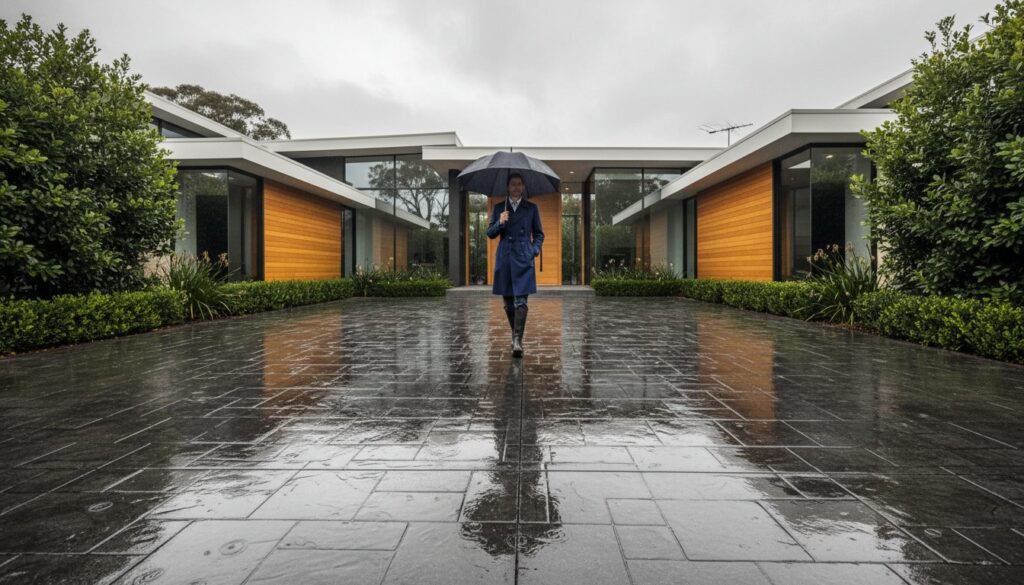
Imagine hosting a family lunch on a drizzly Sydney afternoon, only to watch a guest lose their footing on your beautiful new driveway. It’s a nightmare scenario that keeps many homeowners awake. You’ve likely spent hours choosing the perfect pattern and colour to elevate your home’s curb appeal, but the nagging question remains: is stamped concrete slippery when wet? It’s a valid concern, especially when children or elderly parents are involved.
We understand that a driveway should be more than just a visual statement; it must be a secure foundation for your daily life. Slips, trips, and falls accounted for 21.8% of serious workers’ compensation claims in Australia between 2023 and 2024, highlighting just how critical surface safety is. This guide will show you that safety and style don’t have to be mutually exclusive. We’ll reveal why some surfaces become hazards and the professional techniques we use to keep your driveway slip-resistant and stunning in any weather. You’ll gain a clear understanding of Australian safety standards like AS 4586:2013 and how to maintain a high-end finish that stays safe underfoot, even during a heavy downpour.
Key Takeaways
- Understand why the answer to the question, is stamped concrete slippery when wet, usually points to the sealer choice rather than the material itself.
- Compare the mechanical grip of popular finishes, including why exposed aggregate remains the gold standard for wet-weather traction.
- Discover the science behind anti-slip additives and how they retro-fit safety into existing residential pathways or pool surrounds.
- Learn how to balance refined craftsmanship with Australian safety standards to ensure your home’s entrance remains secure during Sydney’s heavy rain events.
Is Stamped Concrete Slippery When Wet? The Short Answer for 2026
The straightforward answer is yes; stamped concrete can be slippery when wet. However, this isn’t a fundamental flaw of the material itself. It’s often a result of how the surface is finished and maintained. For Sydney homeowners, the goal is to achieve that high-end, textured look without turning the driveway into a skating rink during a summer storm. While Decorative concrete offers incredible versatility and aesthetic transformation, its safety profile depends heavily on the choices made during the final stages of installation. We believe that a beautiful entrance should never compromise the safety of your family or guests.
In our experience, the question of whether is stamped concrete slippery when wet usually arises from seeing poorly executed projects. When handled by a master of the craft, the concrete is engineered for both elegance and traction. The secret lies in understanding the physics of the surface. By balancing the depth of the stamp with the right chemical profile of the sealer, we create a result that feels secure underfoot, even in Sydney’s unpredictable humidity. It’s about moving beyond basic utility to create a durable, safe, and sophisticated landscape.
Why Glossy Sealers Create a Slip Hazard
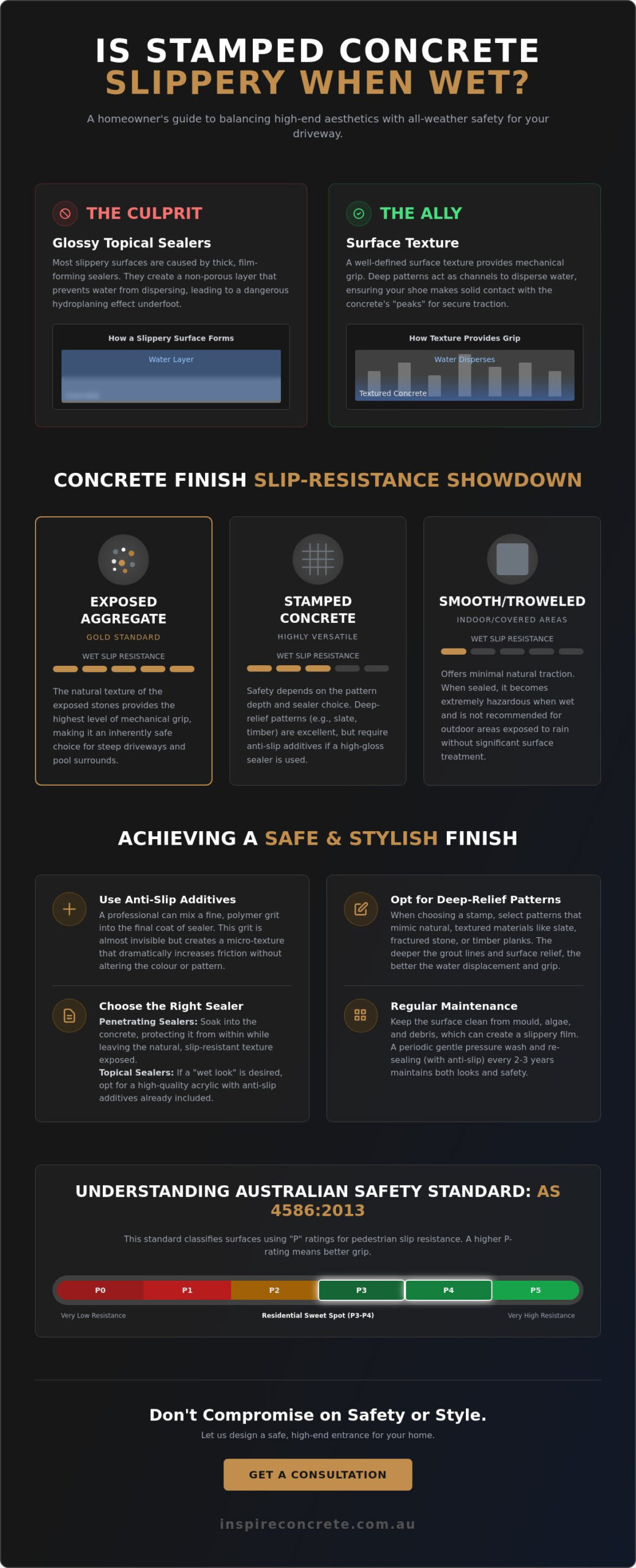
The primary culprit behind a slippery surface is almost always the topical sealer. These products are designed to protect the concrete and enhance its colour, but they work by creating a non-porous film on the surface. This film prevents water from soaking into the concrete, which is great for durability but can be problematic for safety. Water simply sits on top of this smooth, microscopic layer, significantly reducing the friction coefficient. Hydroplaning on concrete occurs when a layer of water builds up between the surface and a shoe or tyre, causing a loss of traction and potential sliding. While high-gloss finishes look stunning, they require specific additives to remain safe during a heavy downpour.
The Role of Surface Texture in Traction
Surface texture is your best ally in the fight against slips. Deep-relief patterns, such as those mimicking natural slate, fractured stone, or timber planks, provide inherent mechanical grip. These patterns create a series of “peaks and valleys” across the slab. When it rains, these valleys act as tiny drainage channels, helping to disperse water away from the areas where you actually step. The timing of the stamp is critical here. We apply the stamps during a precise window in the curing process to ensure every detail is crisp and every ridge provides maximum traction. A well-textured surface ensures that even if a topical sealer is applied, the physical profile of the concrete continues to offer the resistance needed for a secure walk to the front door.
Factors That Influence Concrete Slip Resistance in Sydney
Sydney’s coastal climate presents unique challenges for any outdoor surface. The humidity isn’t just a comfort issue; it directly impacts how your driveway behaves underfoot. When heavy rain hits after a dry spell, the initial slickness is often exacerbated by accumulated dust and oils. To manage this, we look to the Australian Standard AS 4586:2013. This standard classifies surfaces using “P” ratings, where P0 is the lowest and P5 is the highest level of slip resistance. For a residential driveway or pathway, achieving a P3 or P4 rating is often the sweet spot for safety and aesthetics.
Understanding why is stamped concrete slippery when wet requires a deep dive into the chemistry of the finish. Recent scientific research on concrete slip-resistance suggests that friction coefficients are highly sensitive to surface treatments. If an installer uses a thick, low-quality sealer without considering these metrics, you’re left with a surface that looks like glass but acts like ice. Our role as craftsmen is to ensure the technical specifications of your project match the practical demands of the Sydney environment.
Topical vs. Penetrating Sealers
Acrylic sealers are popular because they provide that desirable “wet look” and vibrant colour. However, they sit on top of the concrete, creating a smooth film that can be hazardous without additives. In Sydney’s heat, the ground often shifts due to reactive clay soils, causing thermal expansion in the slab. While topical sealers are durable, penetrating sealers offer a different advantage. They soak into the concrete pores, protecting the material from within while leaving the natural, slip-resistant texture of the stamp exposed. Choosing the right one depends on your specific site conditions and desired finish.
Environmental Factors: Mould and Debris
Sydney’s humidity is a breeding ground for algae and mould, especially in shaded areas. This organic buildup acts as a lubricant, making even the most textured stamps dangerous. Regular maintenance isn’t just about looks; it’s a safety requirement. A professional concrete cleaning and sealing service removes this slick layer, restoring the mechanical grip of the original design. Without this, dirt and grime fill the valleys of your stamp pattern, effectively levelling out the surface and increasing the risk of a fall. Keeping the surface clear ensures the texture can do its job during a downpour.
Stamped vs. Stencil vs. Exposed Aggregate: The Slip-Resistance Showdown
Choosing the right finish for a Sydney home involves a delicate balance between visual allure and practical safety. While many homeowners ask, is stamped concrete slippery when wet, it’s helpful to look at how it stacks up against other popular local finishes. Each method offers a different level of mechanical grip, which is the physical resistance the surface provides against a sliding foot. Understanding these differences is the first step toward a driveway that doesn’t just look like a masterpiece but performs like one too. We see this choice as an opportunity to transform a basic utility into a safe, high-end asset for your property.
We often categorise these finishes by their texture profile. Stamped concrete relies on deep indentations and a smooth surface for its premium aesthetic, which requires the most attention to safety additives. In contrast, stencil and exposed aggregate offer more consistent surface-level friction. Adhering to the Australian Standards for slip-resistance is non-negotiable for our team. We ensure every project meets the rigorous safety expectations of the modern homeowner, leaving no room for guesswork when the clouds roll in over the harbour.
Why Exposed Aggregate is the Safest Choice for Slopes
For properties with steep inclines, exposed aggregate is the undisputed champion of traction. By stripping away the top layer of cement paste to reveal the natural stones beneath, we create a surface with permanent, built-in grip. The physical profile of these stones provides a level of friction that no amount of stamping can replicate. It’s the ideal solution for high-traffic zones and steep Sydney driveways where safety is the top priority. If you’re considering this rugged yet refined option, our Exposed Aggregate Driveways Sydney: The Ultimate 2026 Homeowner’s Guide provides a deep dive into why this finish remains a local favourite for durability and style.
Stencil Concrete: A Middle Ground for Safety
Stencil concrete occupies a unique space between the smoothness of stamped finishes and the coarseness of aggregate. The process involves applying a colour hardener over a stencil, which typically leaves a sandier, more granular texture than the “skin” of a stamped slab. This granularity provides a consistent level of slip resistance across the entire area. While it lacks the deep crevices of a stamp, it offers a more uniform friction coefficient that remains reliable over time. It’s a sophisticated choice for those who want the patterned look of pavers with a more predictable grip underfoot. Maintaining this safety is simple; regular cleaning ensures the surface profile remains effective and free from organic lubricants.
Professional Solutions to Fix Slippery Stamped Concrete
Inheriting a driveway that feels like a skating rink after a light sprinkle is a common frustration for many Sydney homeowners. If you’re currently dealing with a surface that makes you wonder why is stamped concrete slippery when wet, you don’t have to choose between safety and style. Retro-fitting slip resistance into an existing driveway or pool surround is a precise process that requires a master’s touch. We focus on restoring the mechanical grip of the slab while preserving the elegant, high-end finish that adds value to your property. It’s a transformation that takes a hazardous area and turns it back into a secure, functional part of your home.
One of the most effective strategies we employ is the “thin is win” approach to sealer application. In Sydney’s intense summer heat, applying sealer too thickly is a recipe for disaster. Heavy layers can trap moisture, bubble, or create a glass-like film that offers zero traction. Instead, we apply multiple thin, even coats that bond deeply with the concrete. To maintain this balance, we recommend professional concrete cleaning and sealing every 2-3 years. This regular maintenance schedule prevents the buildup of organic matter and ensures the anti-slip properties remain active and effective.
Anti-Slip Additives: The Invisible Safety Net
Modern chemistry has given us tools that provide incredible traction without altering the visual depth of your concrete. We utilise micronised polymers, such as Shark Grip or glass bead technology, to create a subtle “sandpaper” texture. These additives are nearly invisible to the naked eye, ensuring your slate or stone patterns remain the star of the show. For residential applications, these polymers provide a comfortable feel for bare feet around pools, while heavier-duty grits are reserved for commercial zones. To ensure a consistent finish, these additives must be mixed into the final sealer coat rather than sprinkled on top, creating a uniform safety net across the entire surface.
Resealing and Surface Restoration
If your driveway has suffered from years of over-sealing, it may have a thick, yellowed, or peeling layer that hides the original texture. The solution often involves stripping the old product back to the bare concrete to start fresh. This allows us to apply a new, slip-resistant system specifically tailored to the relief of your stamp pattern. For surfaces that are beyond a simple reseal, The 2026 Guide to Concrete Resurfacing Sydney outlines how we can completely revitalise an old slab with a new, safe, and durable finish. If your current driveway is causing anxiety every time the clouds turn grey, contact us for a professional surface assessment to find the right safety solution for your home.
Designing a Safe, High-End Entrance with Inspire Concrete
Creating a high-end entrance is about more than just selecting a pattern from a catalogue. It requires a deep understanding of how materials interact with the environment. Many homeowners approach us with a primary concern: is stamped concrete slippery when wet? Our answer is always rooted in our commitment to precision. We don’t believe you should have to choose between a sophisticated aesthetic and a surface that remains safe for your family. By treating every project as a unique architectural challenge, we ensure the final result is as secure as it is stunning.
Our process begins with a technical evaluation of your property’s specific needs. We adjust our concrete mix designs and stamp depths based on the incline of your land and the intended usage of the area. For instance, a pool surround requires a different texture profile than a flat driveway or a steep pathway. This level of customisation ensures that the mechanical grip of the surface is optimised for its specific purpose. We take pride in this meticulous eye for detail, focusing on long-term value rather than quick fixes. The result is a driveway that looks elegant on day one and stays safe for decades.
The Inspire Concrete Difference
With over 20 years of experience navigating Sydney’s reactive clay soils and humid weather patterns, we’ve refined the art of decorative concrete. Our approach integrates architectural drafting and project management to ensure safety is built into the design from day one. We exclusively use premium Australian-grade sealers and additives, ensuring your investment stands up to the elements without becoming a hazard. This rugged professionalism is what allows us to transform a basic utility into a realization of your creative vision. We act as your project partner, guiding you from the initial spark of an idea to a final, durable result.
Start Your Transformation Today
Whether you are planning a new build or need to rectify an existing surface, a professional assessment is the first step toward peace of mind. We provide expert consultations to help you navigate the choices between stamped, stencil, or exposed aggregate finishes, ensuring your selection matches both your style and safety requirements. We take the guesswork out of the process, providing a sense of certainty that only comes from decades of hands-on expertise. If you’re ready to elevate your home’s exterior with a finish that remains safe in any weather, contact Inspire Concrete for a professional quote on your Sydney project.
Secure Your Home’s Entrance for the Years Ahead
A high-end driveway should provide absolute peace of mind every time the Sydney clouds roll in. We’ve explored how the choice of sealer, the precision of the stamp depth, and consistent maintenance work together to ensure your property remains safe underfoot. While the question of whether is stamped concrete slippery when wet is a valid concern for any homeowner, it’s a challenge easily solved through professional craftsmanship and modern anti-slip technology. By balancing architectural beauty with technical safety standards, you can enjoy a stunning entrance that never compromises on security.
With over 20 years of Sydney experience, our licensed and insured master concreters are specialists in non-slip decorative finishes. We take pride in transforming basic utility into a durable, elegant asset that stands the test of time. Don’t leave your family’s safety to guesswork or poor installation. Request a professional concrete assessment and quote from the Inspire team today. We look forward to helping you create a secure foundation that enhances your lifestyle and adds lasting value to your home.
Frequently Asked Questions
Is stamped concrete more slippery than plain concrete?
Stamped concrete is typically more slippery than plain concrete because it requires a topical sealer to protect the colour and pattern. Plain concrete is usually left unsealed with a porous, broom-finished surface that naturally provides high traction. To ensure your decorative finish remains safe, we integrate specific textures and anti-slip additives that compensate for the smoothness of the protective sealer.
What is the best anti-slip additive for stamped concrete?
Micronised polymer additives, such as Shark Grip, are the most effective choice for residential driveways and pathways. These tiny, transparent spheres are mixed into the final sealer coat to create a subtle, uniform texture that provides grip without altering the visual depth of the pattern. For steeper inclines or commercial zones, we may utilise heavier-duty glass beads or aluminium oxide for maximum friction.
Can I make my existing stamped concrete less slippery?
Yes, you can retro-fit safety into an existing surface through a professional deep clean and the application of a new slip-resistant sealer. If you’re wondering why is stamped concrete slippery when wet at your home, it’s often because the original sealer lacked sufficient additives. We can apply a fresh system tailored to your specific pattern to restore the mechanical grip and ensure the surface is secure.
How often should I reseal my stamped concrete in Sydney?
We recommend resealing your stamped concrete every two to three years to maintain its protective barrier and slip resistance. Sydney’s harsh UV rays and heavy rain events can gradually wear down the sealer and the anti-slip particles suspended within it. Regular maintenance ensures the concrete remains protected from stains while keeping the surface profile safe for pedestrians and vehicles alike.
Does the pattern of the stamp affect how slippery it is?
The physical profile of the stamp pattern significantly influences traction levels. Patterns with deep relief and natural textures, like fractured slate or stone, provide inherent “peaks and valleys” that help disperse water and offer more mechanical grip. Flatter, smoother patterns have more surface area for water to sit on, which increases the risk of hydroplaning if the correct additives aren’t used.
Is stamped concrete safe for pool surrounds?
Stamped concrete is an excellent, safe choice for pool surrounds when it’s installed with the correct texture and slip-resistant additives. Because these areas are constantly exposed to water and bare feet, we use deeper stamp patterns and a higher concentration of polymer grits. This creates a sophisticated, high-end look that meets Australian safety standards for wet pedestrian areas while enhancing your outdoor entertaining space.
What should I do if my concrete is slippery even when dry?
Slipperiness when dry usually indicates an “over-build” of sealer where too many layers have been applied over time, filling in the concrete’s natural texture. It can also be caused by a buildup of fine dust or organic oils. In these cases, we often recommend stripping the old sealer back to the bare slab and starting fresh with a thin, professional-grade system that restores the surface’s original friction.
Will anti-slip additives make my driveway look dull?
Anti-slip additives are specifically engineered to be transparent and won’t dull the vibrant appearance of your driveway. Micronised polymers are nearly invisible once they’re suspended in the sealer, allowing the rich colours and intricate details of the stamp to shine through. You’ll enjoy the same high-end aesthetic and gloss level you desire, but with a secure, sandpaper-like feel that provides essential traction in the rain.
