
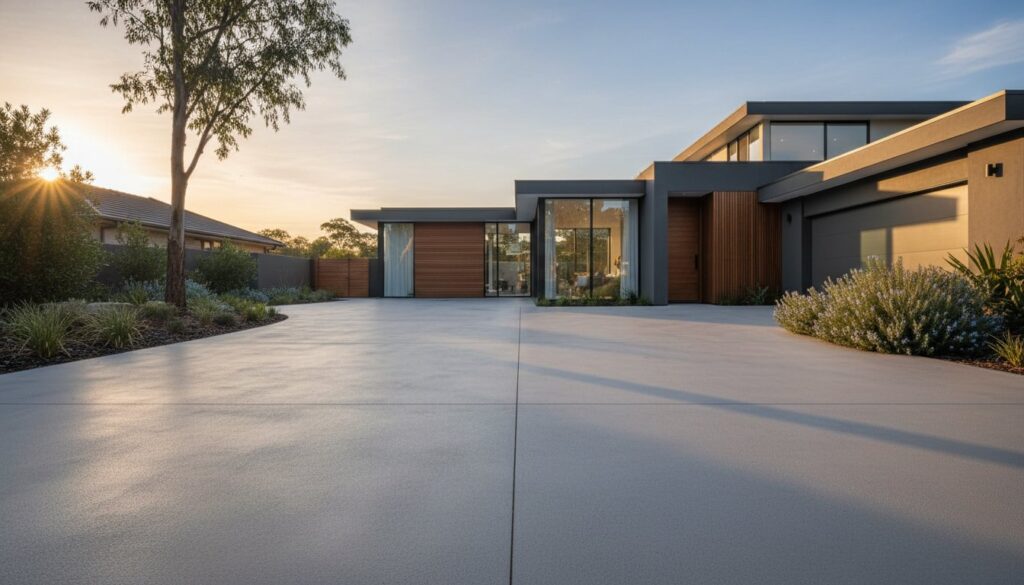
What if the most expensive mistake you could make with your new driveway happens when the surface looks perfectly dry? It’s a common trap for homeowners who are tired of parking on the street and eager to reclaim their property. Understanding the actual concrete curing time before driving on it australia wide is the difference between a lifetime of elegance and a surface riddled with avoidable cracks. While the visual change happens quickly, the chemical hydration process beneath the surface requires a managed timeline to reach its full structural potential.
To further enhance your home’s curb appeal with professional landscaping that complements your new driveway, click here to explore the options offered by INEX Landscaping.
We know how frustrating it is to receive conflicting advice from different contractors while your significant financial investment sits idle. You want certainty, not guesswork. This guide provides a clear, safe timeline for use based on the latest Australian Standards, including AS 2870 for residential slabs. We’ll explore exactly how to protect your concrete during that critical first week, the impact of our unique climate on hydration, and the specific milestones you need to hit before moving your vehicles back home.
Key Takeaways
- Learn the critical 24-hour rule for foot traffic and why the 7-day milestone is the industry standard for light passenger vehicles.
- Understand the specific concrete curing time before driving on it australia requires to prevent internal structural damage that often remains invisible until it’s too late.
- Discover how local factors like Sydney’s humidity and reactive clay soils can accelerate or delay your project’s readiness.
- Master the art of “wet curing” and moisture retention to ensure your new driveway reaches its maximum design strength.
- See how professional steel reinforcement and precise slab thickness significantly reduce the risk of surface cracking during the hydration phase.
Understanding the Science: Concrete Curing vs. Drying
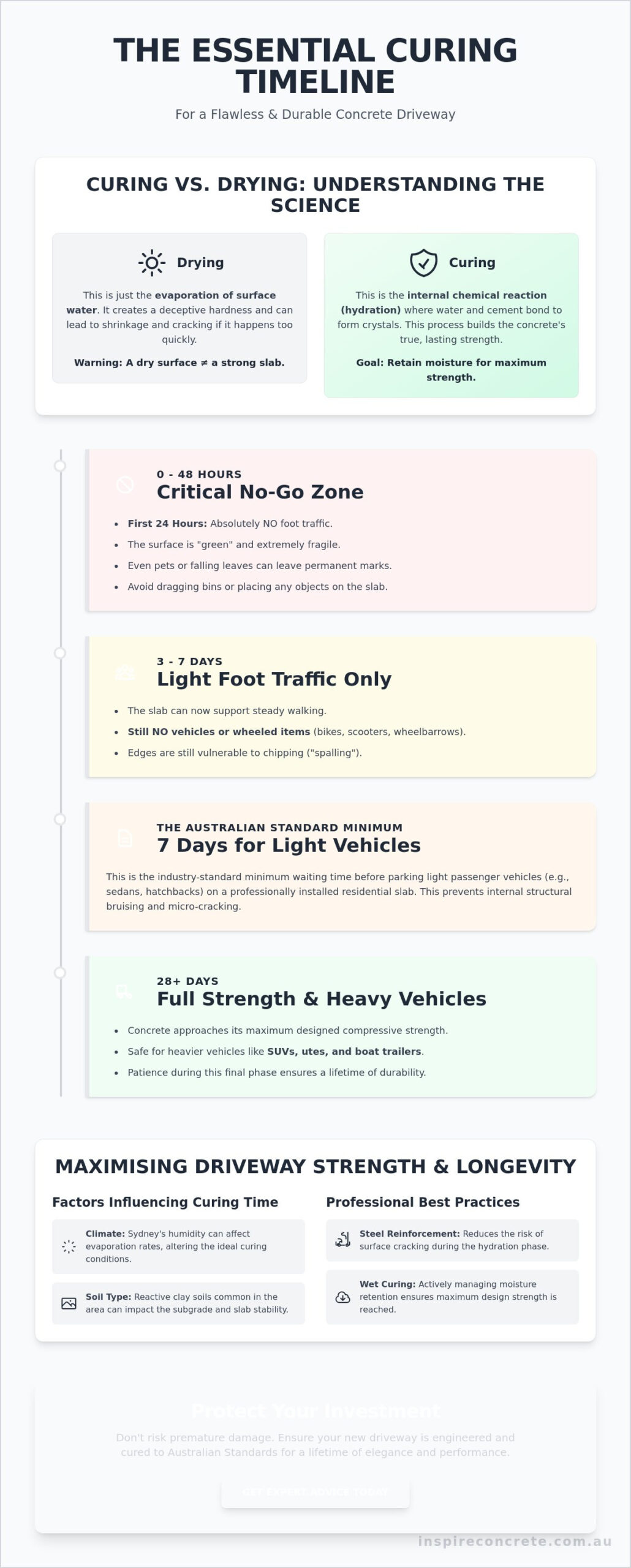
Many property owners believe that once the wet sheen disappears from a new pour, the driveway is ready for action. This is a dangerous misconception that can lead to a compromised slab. Drying is simply the evaporation of excess water from the mix, but curing is a sophisticated chemical reaction known as hydration. To ensure your investment stands the test of time, you must respect the concrete curing time before driving on it australia standards dictate. According to AS 3600, the Australian Standard for Concrete Structures, the development of compressive strength is directly tied to how well moisture is retained within the concrete matrix during the initial phase.
Curing isn’t a passive wait; it’s the active management of internal temperature and moisture. In the first 72 hours, the slab is at its most volatile. If the internal moisture escapes too quickly, the chemical bonds fail to form correctly. This leaves you with a brittle surface that looks perfectly fine but lacks the structural integrity to support a two-tonne vehicle. We treat this phase with the same precision as the pour itself, ensuring the internal environment of the concrete remains stable enough to reach its design strength.
The Hydration Process Explained
To truly grasp the science of concrete curing, you have to look at the microscopic level. During hydration, cement particles bond with water to form a complex crystalline structure. This web of crystals is what literally knits the aggregate together. While the mix is in its “green” state, it possesses high volume but low density. Applying weight too early causes permanent structural bruising. These are microscopic fractures within the core that don’t show up immediately but eventually manifest as major surface cracks years down the line. It’s a structural debt that can never be fully repaid once the damage is done.
Why Surface Hardness is Deceptive
The face of your concrete is a liar. Because it’s exposed to the air, the surface dries and hardens significantly faster than the core. This creates a tension imbalance. If the top shrinks while the bottom remains moist and expanded, the slab can suffer from “curling.” This is where the edges of the slab literally lift off the subgrade, creating a hollow space beneath the concrete. When you eventually drive on it, that unsupported edge will snap under the weight of your car. A cured core is what carries the load, and that takes a level of patience that a simple visual check cannot measure. We look for a uniform hydration profile throughout the entire depth of the slab before giving the green light for vehicle use.
The Essential Timeline: When Can You Safely Drive on New Concrete?
Patience is the foundation of a flawless finish. While the science of hydration works beneath the surface, your primary responsibility is managing the weight applied to the slab. The standard concrete curing time before driving on it australia wide follows a strict hierarchy of timing and tonnage. Ignoring these milestones doesn’t just cause immediate cracks; it compromises the internal crystalline structure we discussed earlier. For Sydney homeowners, this timeline is non-negotiable, especially when dealing with the high-performance mixes used in modern residential projects.
We categorize the waiting period into three distinct phases. Each phase represents a leap in compressive strength. While a small hatchback might be safe at the one-week mark, a heavy SUV or a boat trailer requires significantly more time to ensure the slab doesn’t deflect or bruise. If you are planning a new project, consulting with an expert craftsman ensures your slab is engineered for the specific vehicles you own.
The First 48 Hours: No-Go Zone
The first 24 hours are critical for protecting the surface aesthetic. We recommend a total ban on all foot traffic during this window. Even a small pet or a stray leaf can leave permanent indentations in the “green” concrete. By the 48-hour mark, the surface has usually hardened enough for cautious walking, but you must avoid any mechanical force. Don’t drag wheelie bins, move furniture, or allow children to ride scooters near the edges. The perimeter of the slab is the most vulnerable to “spalling” or chipping during this initial set.
Day 3 to Day 7: Light Use Only
By day three, the concrete has gained enough strength to support steady foot traffic. However, this is not an invitation for wheels of any kind. Bicycles, skateboards, and even heavy wheelbarrows can create localized pressure points that lead to micro-cracking. This is particularly important for exposed aggregate driveways. The decorative stones on the surface need a full week to be completely locked into the cement paste. Driving too early can cause “scuffing,” where the tyres pull the aggregate out of the surface, leaving unsightly bald spots that are difficult to repair.
Day 28: Full Capacity Reached
The 28-day mark is the gold standard in the construction industry. At this point, the concrete has achieved approximately 90% of its total design strength. This is the only time it’s safe to bring in heavy delivery trucks, skip bins, or park large caravans. This duration is essential for concrete slabs in Sydney intended for structural use, such as shed foundations or granny flats. We use this 28-day milestone as the definitive point for final strength testing, ensuring the slab is ready to realize its full architectural potential without the risk of structural failure.
Factors That Impact Curing Time in Sydney
While the 7-day milestone is a reliable benchmark, your actual concrete curing time before driving on it australia wide is heavily influenced by Sydney’s unique geography. Our city isn’t a monolith; the conditions in Cronulla differ vastly from the dry heat of Penrith. One of the most overlooked factors is the presence of reactive clay soils, particularly common across Western Sydney. These soils expand and contract aggressively with moisture changes, exerting external pressure on your slab while it’s still developing its internal strength. If the soil shifts while the concrete is in its “green” state, you’re looking at structural stress that no amount of surface finishing can hide. Understanding the concrete curing time before driving on it australia requires means looking at more than just the calendar.
Sydney’s coastal humidity also plays a dual role. While high humidity prevents the mix from drying out too quickly, it can also mask the true state of the slab’s maturity. We often adjust the mix with specific retarders during summer to prevent “flash setting,” where the surface hardens before the core has even begun its journey. Conversely, during a cold snap, we might use accelerants to ensure the hydration process doesn’t stall. This level of technical calibration is what separates a standard contractor from a master craftsman. The type of finish you choose also dictates the timeline. For instance, stamped concrete requires a different management approach than a plain slab because the texture creates high and low points that can trap moisture unevenly. We monitor these variations closely to ensure the entire surface reaches uniform strength.
Sydney Weather: Heatwaves and Rain
Summer in Sydney presents a unique challenge for new pours. On 35°C+ days, the risk of the concrete “going off” too fast is high. We use specialized techniques to keep the internal temperature stable and prevent the water from evaporating before it can bond with the cement. Rain is another variable. If a heavy downpour hits within 6 hours of the pour, it can cause “pockmarks,” which are small craters that ruin the aesthetic elegance of the finish. In contrast, a pour in the Blue Mountains during winter requires a much longer wait than a CBD project because the lower ambient temperature slows the chemical hydration process to a crawl.
Material and Finish Considerations
The physical dimensions of your project matter. A 125mm heavy-duty slab generates more internal heat than a standard 100mm residential driveway, requiring a more controlled cooling period to avoid thermal cracking. When we perform concrete resurfacing, the curing timeline is compressed because the layer is thinner, but the focus shifts to bond strength rather than bulk hydration. For exposed aggregate, the process of washing away the top layer of slurry actually introduces beneficial moisture. This acts as a natural form of wet curing that can enhance the final durability and vibrant look of your driveway.
Best Practices: How to Cure Concrete for Maximum Strength
Achieving a masterpiece requires more than just a high-quality pour. It demands active stewardship during the hydration phase. To optimize the concrete curing time before driving on it australia homeowners should adopt the “wet curing” method. This involves keeping the surface continuously damp to slow down evaporation and allow the crystalline structure to reach its full density. While we often apply liquid membrane-forming curing compounds, compliant with AS 3799, to provide a professional-grade moisture barrier, supplementary misting by the homeowner provides an extra layer of insurance against the harsh Sydney sun.
While the center of the slab retains moisture well, the edges are exposed on multiple sides, making them the most vulnerable part of your new driveway. These perimeters dry significantly faster, which can lead to edge-crumbling or “spalling” if not managed. We often utilize heavy-duty plastic sheeting or specialized curing compounds to wrap these edges, creating a micro-climate that mirrors the core of the slab. This meticulous attention to detail prevents the structural bruising mentioned earlier and ensures the entire driveway performs as a single, cohesive unit. To preserve the integrity of your investment, we recommend our precision concrete cleaning and sealing to ensure a durable, stain-resistant result.
The Homeowner’s Watering Schedule
Think of your new driveway as a living project for the first seven days. In the peak of a Sydney heatwave, you should mist the slab five to ten times daily. Start early in the morning before the sun hits the surface and continue through the evening. Never use a high-pressure hose. The force can strip the “fat” or cement paste from the surface, leaving it rough and porous. If you notice fine, spiderweb-like lines appearing, it’s a sign the concrete is drying too fast. Increase your watering frequency immediately to halt these surface-level shrinkage cracks before they deepen.
Sealing and Long-Term Protection
Sealing represents the final transformation from a construction site to a refined architectural feature. Working with elite concreters in Sydney ensures this step is timed perfectly. Generally, we wait between 7 and 28 days before applying the first coat of sealant. This window allows the moisture levels to stabilize so the sealer can bond deeply with the substrate rather than sitting on top of trapped water. A professional-grade sealer acts as a shield against oil stains, tyre marks, and UV degradation. It’s the difference between a driveway that looks aged in three years and one that retains its elegance and value for decades.
Why Professional Installation Minimizes Your Wait Time
Precision engineering is the silent partner of a durable driveway. While the calendar provides a general guide, a professional installation ensures that the concrete curing time before driving on it australia requires is a predictable, managed process rather than a guessing game. Expert architectural drafting allows us to determine the exact slab thickness needed for your specific lifestyle. Whether you are parking a compact car or a heavy-duty boat trailer, we calculate the load-bearing requirements before the first cubic metre of concrete is even poured. This foresight prevents the structural bruising and subgrade failure that often plague DIY or cut-price projects.
Steel reinforcement plays a dual role that many homeowners overlook. Beyond providing long-term tensile strength, it acts as a thermal regulator during the hydration phase. It helps distribute the heat generated by the chemical reaction of the cement, significantly reducing the risk of internal stress cracks as the slab cools and shrinks. Our local knowledge of Sydney’s diverse soil profiles, from the sandy coast to the reactive clays of the west, allows us to prepare the ground with surgical precision. At Inspire Concrete, we bring over 20 years of refined craftsmanship to every project, ensuring your investment is built on a foundation of certainty and elegance.
The Importance of a Correct Mix Design
Not all concrete is created equal. We customize the MPA (MegaPascals) rating of your mix based on the intended use of the area. A standard residential pathway might only require 20 or 25 MPA, but a driveway designed for heavy SUVs or delivery trucks often necessitates a 32 MPA mix or higher. Professional contractors use specific chemical additives to control the “set time,” ensuring the curing window is predictable even in volatile Sydney weather. This technical mastery gives you the peace of mind that your slab isn’t just drying, but is reaching the exact compressive strength required for a lifetime of performance. It’s the difference between a surface that simply exists and one that truly performs.
Start Your Transformation with Inspire Concrete
Your property deserves more than just a functional slab; it deserves an aesthetic transformation that adds genuine value to your lifestyle. We invite you to explore our project gallery to see how we’ve turned basic driveways into sophisticated architectural statements across Sydney. From the rugged beauty of exposed aggregate to the refined texture of stamped patterns, our work reflects a deep commitment to excellence and a meticulous eye for detail. When you’re ready to move from the initial spark of an idea to a durable, high-end result, our team is here to partner with you. Get a professional concrete quote for your Sydney home today and ensure your next project is handled with the expertise it deserves.
Secure the Future of Your New Driveway
Your new driveway represents a significant architectural investment that deserves the highest level of care. As we’ve explored, the concrete curing time before driving on it australia wide is not a suggestion; it’s a critical requirement for structural integrity. By respecting the 24-hour ban on foot traffic and the 7-day milestone for light passenger vehicles, you ensure the internal hydration process completes without interruption. This patience prevents the invisible structural bruising that leads to premature cracking and surface failure.
Don’t leave the durability of your home to guesswork. Our licensed and insured expert craftsmen bring over 20 years of Sydney industry experience to every project, specializing in both decorative and structural concrete solutions. We understand how to navigate local soil conditions and humidity to deliver a result that lasts a lifetime. When you’re ready to start your property’s transformation, our team is standing by to help.
Request a Free Quote from Sydney’s Trusted Concreters
Let’s work together to turn your creative vision into a durable, high-end reality that enhances your lifestyle for years to come.
Frequently Asked Questions
Is it okay if it rains on my new concrete driveway after 4 hours?
No, rain within the first 4 to 6 hours can compromise the structural integrity and aesthetic finish of your slab. If heavy rain hits this early, it can wash away the cement paste or create permanent “pockmarks” on the surface. While the concrete might feel hard to the touch, the hydration process is still extremely volatile. We recommend keeping the area covered if a downpour is forecast shortly after the pour.
Can I park my heavy caravan or boat on the driveway after one week?
You should strictly wait 28 days before parking heavy loads like caravans, boats, or trailers. While the 7-day milestone is safe for light passenger vehicles, your slab hasn’t yet reached its full design strength to support concentrated heavy tonnage. Parking a multi-tonne boat too early can cause the slab to deflect or “bruise” internally, leading to structural cracks that appear months later.
What happens if I drive on the concrete too early?
Driving too early causes permanent structural damage that often remains hidden beneath the surface. The weight of a vehicle creates localized pressure that the “green” concrete cannot yet distribute. This leads to micro-cracking and can even cause the slab to shift on its subgrade. Beyond structural failure, you risk “tyre scuffing,” where the rotating rubber pulls aggregate or decorative patterns right out of the immature surface.
Do I need to hose down my new concrete every day while it cures?
Yes, misting your concrete daily is one of the most effective ways to manage the concrete curing time before driving on it australia wide. This “wet curing” method prevents the water inside the mix from evaporating too quickly, which is essential for developing maximum strength. In Sydney’s peak summer heat, we recommend misting the slab multiple times a day to ensure the hydration process remains stable and consistent.
Will my driveway crack if I don’t wait the full 28 days?
It won’t necessarily crack immediately, but you are significantly increasing the risk of long-term failure if you apply heavy loads. Concrete reaches approximately 90% of its compressive strength at the 28-day mark. If you introduce heavy delivery trucks or skip bins before this milestone, the slab is far more likely to suffer from structural debt. Following the concrete curing time before driving on it australia standards is your best insurance against future repairs.
Does the colour of the concrete affect how fast it cures in the sun?
Yes, darker pigments like charcoal or deep basalt absorb more UV radiation and heat than plain or light-coloured mixes. This increased surface temperature can cause the top layer to dry out much faster than the core, leading to a tension imbalance. If you’ve opted for a dark coloured concrete driveway, you’ll need to be even more diligent with your watering schedule to prevent surface-level shrinkage cracks from forming.
Can I walk on my new concrete in high heels after 24 hours?
We strongly advise against wearing high heels on new concrete for at least 48 to 72 hours. While the slab can support flat-soled shoes after 24 hours, high heels create intense “point-loading” pressure. This concentrated force can leave permanent, unsightly indentations in a surface that is still technically maturing. It’s better to stick to soft-soled shoes or wait a few extra days to preserve the flawless finish of your investment.
When is the best time of year in Sydney to pour a new driveway?
The temperate months of Autumn and Spring provide the most predictable conditions for a perfect pour in Sydney. During these periods, the moderate temperatures and stable humidity levels allow for a steady, controlled hydration process. While we can pour year-round, the extreme heat of January or the biting frosts of a Blue Mountains winter require more complex additives and management to ensure the concrete reaches its full architectural potential.
