
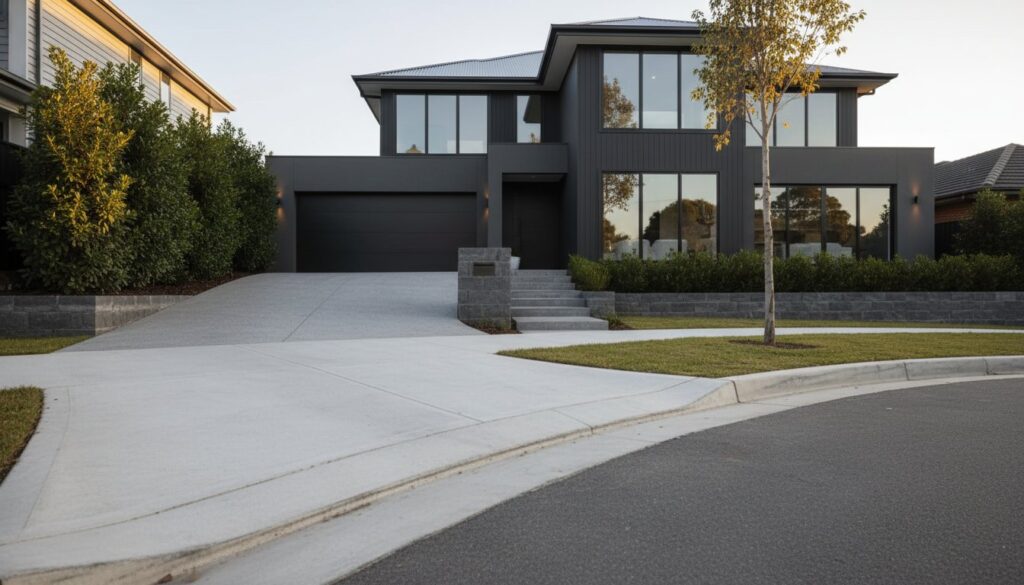
Your kerb is the only thing standing between a dry garage and a flooded foundation during a Sydney downpour. You likely already know that a crumbling street frontage is a major eyesore, but the real danger lies in how poor kerb and gutter drainage can undermine your entire driveway. In Sydney, where reactive clay soils contribute to nearly 40% of localized pavement cracking, getting the engineering right is non-negotiable. At Inspire Concrete, we believe your streetscape should do more than just direct water; it should frame your home with precision.
It’s time to take control of your property’s first impression and its long-term protection. This guide helps you master the technical and regulatory essentials of kerb and guttering to protect your property’s structural integrity and enhance its curb appeal. We’ll walk through the specific kerb profiles available, explain how to navigate council crossover applications without the stress, and show you how to ensure your property entrance stays flawless for years. We aim to transform these functional necessities into durable assets that elevate your lifestyle and secure your investment.
Key Takeaways
- Understand how high-quality kerb and gutter systems protect your Sydney home from foundation erosion by expertly managing stormwater runoff.
- Identify the ideal profile for your property, whether you require the pedestrian safety of a barrier kerb or the seamless accessibility of a mountable roll kerb.
- Navigate the complexities of Sydney Council regulations, including the essential Section 138 approval, to avoid costly demolition orders and fines.
- Discover why precision sub-grade preparation is the secret to overcoming Sydney’s reactive clay soils and ensuring your concrete remains stable for decades.
- Learn how professional civil-grade engineering elevates your property’s curb appeal while securing its long-term structural integrity and market value.
Understanding Kerb and Gutter: The Structural Frame of Sydney Properties
Kerb and guttering represents the essential concrete edge that defines the boundary between your private sanctuary and the public thoroughfare. It isn’t just a strip of grey material; it’s a precision-engineered structural frame designed to manage heavy stormwater volumes and provide a rigid termination point for road surfaces. By Understanding Kerb and Gutter systems, homeowners can appreciate how this infrastructure protects the structural integrity of their entire allotment. Without this boundary, the transition from the road to your property would lack the necessary resistance to withstand the lateral pressure of vehicle traffic and the erosive force of Sydney’s coastal weather patterns.
The concept of the ‘crossover’ is central to your property’s functionality. This is the specific section where your private driveway meets the public street infrastructure. It’s a high-stress zone that requires expert craftsmanship to ensure a seamless transition. A poorly executed kerb and gutter installation at the crossover leads to jarring bumps, vehicle undercarriage damage, and eventual cracking. When we transform a standard entry into a bespoke concrete masterpiece, we focus on the geometry of the layback to ensure that every arrival at your home feels smooth and intentional.
Why Sydney Homeowners Can’t Ignore the Kerb
Protecting your driveway from edge-break is a primary concern for any property owner. When the edge of a driveway isn’t supported by a robust kerb and gutter, the concrete or asphalt begins to crumble under the weight of vehicles, leading to water ingress that softens the sub-grade. This structural decay can reduce property valuations by up to 10 percent because first impressions are everything. While many local councils provide standard pours, these often lack the refined finish that complements a high-end architectural home. You’re legally responsible for the maintenance of the ‘layback’ or crossover section under most Sydney local government regulations, making it a critical investment in your home’s long-term viability and aesthetic appeal.
Stormwater Management 101
The specific profile of a gutter is designed to catch and direct water toward the local Sydney catchment systems with maximum efficiency. If the levels are off by even a few millimeters, you’ll experience ‘ponding’. This standing water is a catalyst for concrete cancer, where moisture penetrates the surface and corrodes the internal steel reinforcement, causing the concrete to expand and flake away. In Sydney’s climate, where high-intensity rainfall events are common, this drainage becomes your property’s most important asset. Kerb and gutter serves as the primary defense against localized flooding in residential blocks. By ensuring the sub-grade is compacted correctly and the fall is precise, we prevent the sub-surface failures that lead to costly driveway replacements.
Common Kerb and Gutter Profiles Used in Sydney Developments
Selecting the right profile for your property isn’t just about meeting council compliance. It defines how your home interacts with the street, how water flows during a Sydney downpour, and how easily you can access your garage. We see three dominant shapes across the Greater Sydney region, each serving a specific structural and aesthetic purpose.
Barrier Kerbs vs. Mountable Kerbs
The 150mm upright barrier kerb remains the gold standard for pedestrian safety and garden protection. Its vertical face creates a definitive physical boundary that prevents vehicles from encroaching on your nature strip. These are typical in high-traffic areas like Parramatta or the Sydney CBD where clear separation is vital. While they offer maximum protection for your turf and letterbox, they are notorious for collecting leaf litter and street silt. This debris often requires manual clearing to prevent blockages in the kerb and gutter system.
In contrast, roll-top or mountable kerbs are now the standard in newer Western Sydney residential estates. These profiles feature a gentle slope that allows vehicles to mount the edge without risking tyre or rim damage. They offer a softer, more modern aesthetic and are significantly easier to maintain. Because there’s no sharp corner, water and debris flow more freely toward the pits. However, they provide less of a deterrent for guest parking on your grass, which can lead to soil compaction over time.
The Anatomy of a Crossover (Layback)
The layback is the critical transition piece where your private driveway meets the public road. A standard Sydney crossover consists of the ‘apron’, which is the flat section your car traverses, and the ‘wings’. These wings are the splayed, angled transitions on either side that blend the layback into the existing upright kerb line.
- NSW Standard Widths: Most local councils require a minimum width of 3 metres for a single residential crossing. For double garages, 5.5 to 6 metres is the standard to ensure sufficient clearance for two vehicles.
- Clearance Matters: A poorly designed layback can cause low-profile vehicles to scrape. Precision in the transition angle is essential for modern car clearance.
- Material Harmony: To elevate your home’s street appeal, you can match the texture of your layback and apron to a high-end Exposed Aggregate Driveway. This creates a seamless visual flow from the street to your front door.
For bespoke architectural projects in suburbs like Mosman or Vaucluse, standard profiles often won’t suffice. Custom-tooled edges are frequently required to match unique landscaping heights or specific stone masonry. These bespoke solutions ensure structural integrity while maintaining the refined, minimalist aesthetic that high-end homes demand. If you want to ensure your street frontage reflects the quality of your build, you can inspire your next project with a professional site assessment to determine the best profile for your specific block.

Navigating Sydney Council Requirements for Kerb and Guttering
Modifying the streetscape requires more than just technical skill; it demands a deep understanding of local governance. Any work performed beyond your property boundary involves council assets. This means you must secure a Section 138 Approval under the Roads Act 1993 before a single spade hits the dirt. This permit ensures that your new kerb and gutter installation integrates seamlessly with the existing public infrastructure while maintaining safety standards for pedestrians and motorists alike.
Council requirements fluctuate significantly across the Greater Sydney basin. The City of Sydney often prioritizes heritage preservation and high-density drainage capacities, requiring specific bluestone or integrated gutter profiles. Conversely, councils like Blacktown or The Hills focus on managing heavy suburban runoff and accommodating wider residential vehicle crossings. We manage these nuances by coordinating with council engineers—and often referencing the transport planning expertise of ML Traffic Engineers Australia—to ensure every pour meets local expectations. You’ll also need to provide proof of A$20 million public liability insurance and pay a security bond, which typically ranges from A$2,000 to A$5,000, to cover potential damage to surrounding assets.
The Application Process Simplified
Securing approval starts with a formal Driveway Crossover or Footway Works application. You’ll submit detailed site plans and levels for review. Rejections are common if the proposed layout sits within 3 metres of a protected street tree or less than 1.5 metres from a power pole or utility pit. In the current 2026 Sydney construction market, homeowners should allow for lead times of 4 to 8 weeks for council processing. Precision in the initial paperwork prevents costly delays and gets your project moving faster.
Standard Drawings and Specifications
Every council provides “Standard Drawings,” such as the KGP-1 specification, which dictate the exact geometry of the kerb and gutter. Ignoring these diagrams leads to immediate fines and orders to demolish non-compliant work. We utilize high-grade concrete mixes, typically 25MPa for residential areas and 32MPa for high-traffic zones, to ensure long-term structural integrity. Before construction begins, we conduct a Dilapidation Report. This photographic record of the existing street condition protects your bond by proving you aren’t responsible for pre-existing cracks in the asphalt or footpath. This meticulous preparation allows us to inspire confidence in both the homeowner and the council inspector.
The Engineering of Durability: Managing Sydney’s Reactive Clay Soils
Sydney’s geography presents a unique challenge for civil infrastructure. Much of the Greater Sydney basin sits on reactive Wianamatta Shale clay, a soil type that acts like a sponge. During the heavy rains experienced in 2022 and 2024, these soils expanded significantly, while the prolonged dry spells of 2026 caused the ground to contract and pull away from rigid structures. This constant cycle of heave and shrinkage is the primary reason a standard kerb and gutter will lift, sink, or snap if the engineering doesn’t account for ground movement.
Protecting your investment requires more than just pouring a mix. It demands a deep understanding of how to isolate the concrete from these shifting foundations. We focus on structural integrity from the ground up, ensuring the aesthetic finish you see on day one remains perfectly aligned two decades later.
Sub-base and Compaction
Achieving a 20 year lifespan starts well beneath the visible surface. We prioritise a minimum 150mm thick layer of DGB20 (Densely Graded Base) to create a stable, non-reactive platform. While recycled road base is an excellent sustainable choice for many Sydney civil projects, virgin crushed rock often provides the superior predictability needed for high-load residential transitions. 90% of kerb failures in Sydney are caused by poor sub-grade compaction, not the concrete itself. Without professional mechanical compaction reaching a minimum 98% dry density, the concrete is essentially floating on a moving foundation that will eventually fail.
Control Joints and Expansion Gaps
Concrete is a dynamic material that breathes with the seasons. In 2026, Sydney’s temperature fluctuations have become more erratic, requiring expansion gaps every 3 to 6 metres to accommodate significant thermal movement. We use “dummy joints” to create a weakened plane, which essentially tells the concrete where to crack so the stress doesn’t ruin the bespoke aesthetic finish. It’s vital to distinguish between types of damage; a fine hairline crack is often a cosmetic result of initial curing, but a gap wider than 3mm typically indicates a structural failure in the sub-grade or a lack of adequate expansion room.
To prevent the dreaded “concrete cancer,” we ensure all steel reinforcement has a minimum 50mm of concrete cover. When salt or moisture reaches the internal steel, the metal oxidises and expands, blowing the concrete apart from the inside. This is particularly critical in Sydney’s coastal suburbs where salt spray is a constant environmental factor. By sealing the system and using high-quality expansion fillers, we transform a simple utility into a durable asset.
Ensure your next project stands the test of time by partnering with the experts at Inspire Concrete for precision engineering and refined craftsmanship.
Professional Installation: Enhancing Curb Appeal and Property Value
Attempting a DIY kerb and gutter project is a high-risk gamble that rarely pays off for Sydney homeowners. Local councils maintain incredibly strict standards for any work performed on the nature strip. Under the Roads Act 1993, specifically Section 138, unauthorized or sub-standard work can lead to immediate council-ordered demolition. Homeowners often find themselves facing thousands of dollars in fines plus the cost of professional removal. Inspire Concrete eliminates this risk by bridging the gap between heavy-duty civil engineering and high-end residential aesthetics. We don’t just pour concrete; we engineer a transition that elevates your entire property entrance while meeting every local regulatory benchmark.
The Value of Expert Craftsmanship
Precision formwork is the invisible backbone of a professional kerb and gutter. Achieving a “straight-as-an-arrow” line requires laser-level accuracy and rigid steel bracing that many residential contractors overlook. Cheap installations often result in a “bubbly” or “rough” finish that traps debris and degrades under the harsh Australian sun. Our team focuses on a glass-smooth finish that ensures optimal water flow and long-term durability. This level of detail is vital when you consider how these structures tie into your broader landscape. You can see how we handle Concrete Pathways that integrate with your new kerb to create a unified, bespoke look for your home.
Transforming Your Property Entrance
A property entrance serves as the handshake of your home. We manage the complex logistics of the build, including coordinating with utility providers to ensure NBN pits or water meter adjustments are handled correctly. This proactive approach prevents the disjointed “patchwork” appearance common in many Sydney suburbs. We follow the AS 2876:2000 standards for concrete kerbs and channels, ensuring the structural integrity of every pour. After the concrete is placed, we apply specialized curing compounds to help the mix reach its full design strength, typically 25-32 MPa. This ensures your entrance can withstand the daily weight of heavy vehicles without cracking or shifting. It’s a comprehensive process that turns a functional necessity into a design asset. When selecting a contractor for this work, reviewing a master guide to hiring professional concreters in Sydney can help you identify the right team with the credentials and experience to meet 2026 council standards. To further protect your investment, using a dedicated checklist for choosing the best concrete contractors in Sydney ensures you verify licensing, assess soil management strategies, and avoid the costly mistakes that come with hiring underqualified tradespeople.
Integrating your driveway and street frontage into one seamless design adds immediate market value to your Sydney residence. We take pride in delivering results that look as good in ten years as they do on the day of the pour. Ready to transform your street presence? Contact the Sydney experts at Inspire Concrete today.
Secure Your Property’s Future with Precision Engineering
A well-executed kerb and gutter system does more than manage stormwater; it defines the boundary of your investment and defends against the movement of Sydney’s reactive clay soils. You now understand that navigating council regulations and choosing the right profile are essential steps in protecting your home’s structural integrity. Achieving that seamless blend of utility and curb appeal requires a partner who treats concrete as a craft rather than just a commodity. Every project demands a balance between engineering durability and aesthetic refinement.
Inspire Concrete delivers over 20 years of Sydney-specific experience to your doorstep. Our licensed and insured contractors specialize in both residential and commercial projects, providing the expert architectural drafting needed to clear complex council hurdles with ease. We don’t just pour concrete; we build lasting value through meticulous attention to detail and technical mastery. It’s time to elevate your property with a finish that reflects your standards of excellence. Request a Bespoke Concrete Quote from Sydney’s Trusted Experts and let’s start your transformation today. Your vision deserves a foundation that stands the test of time.
Frequently Asked Questions
Who is responsible for the kerb and gutter in front of my house in Sydney?
Local councils generally maintain the public road infrastructure under the NSW Roads Act 1993. However, property owners are responsible for the construction and maintenance of the driveway crossover, which includes the layback section. If a private tree or construction activity on your land damages the street assets, the council typically requires you to fund the professional repairs. We help homeowners navigate these requirements to ensure their street frontage remains compliant and safe.
Can I change the height of the kerb to make my driveway flatter?
You cannot unilaterally alter the height of a kerb because it serves as a critical component of the street drainage system. Standard barrier kerbs in Sydney usually stand 150mm high to direct stormwater away from properties. Any modification requires an application to your local council’s engineering department to ensure it doesn’t cause flooding. We design bespoke driveway solutions that work within these regulated levels to provide a seamless transition for low-clearance vehicles.
How much does it cost to replace a section of kerb and gutter in Sydney?
Costs for infrastructure restoration are set by individual local council fee schedules, which are typically updated on July 1st each year. Many Sydney councils currently list restoration rates between A$350 and A$550 per linear metre for standard concrete profiles. These figures often exclude costs for traffic management, waste disposal, and site establishment. We recommend reviewing your specific council’s “Fees and Charges” document for the most accurate pricing for your suburb. Before committing to any contractor, it’s also worth understanding how to get an accurate concrete quote in Sydney so you can compare proposals on equal terms and avoid unexpected excavation fees.
What is a ‘layback’ and do I need one for my new driveway?
A layback is the sloped section of the kerb and gutter designed specifically to allow vehicles to cross from the road surface onto a private driveway. It replaces the vertical barrier with a reinforced ramp that maintains the flow of water while protecting your car’s undercarriage. You must install a layback for any new vehicle entrance to comply with Australian Standard AS2890.1. Our team specialises in crafting these transitions to ensure they are both durable and elegant.
Why is my kerb cracking and pulling away from the road?
Cracking and separation are usually caused by reactive clay soils or invasive roots from large street trees. When soil moisture levels fluctuate significantly, the ground shifts and puts immense pressure on the concrete structure. This movement can cause the kerb and gutter to tilt or fracture. We use high-grade expansion joints and specific reinforcement techniques to mitigate this ground movement and extend the lifespan of your concrete assets.
Do I need council approval to repair a damaged kerb myself?
You must obtain a Section 138 permit from your local council before any work begins on a public road reserve. Councils don’t allow homeowners to perform DIY repairs on street infrastructure because the work requires specific public liability insurance and trade qualifications. We act as your expert partner, handling the technical drawings and council applications to ensure the project meets all local engineering standards. This path guarantees a result that adds long-term value to your home.
How long does it take for a new concrete kerb to cure before I can drive over it?
You should wait at least 7 days before driving a standard passenger vehicle over a newly poured kerb. While the concrete feels hard within hours, it only reaches about 70 percent of its structural integrity during the first week. It takes a full 28 days to reach its maximum design strength. Driving over it too early causes internal fractures that lead to premature failure. We provide clear timelines for every project to ensure your investment is protected during the curing phase.
What concrete strength is required for a residential kerb in NSW?
Residential kerbs in NSW typically require a minimum compressive strength of 25MPa, though many Sydney councils now mandate 32MPa for improved durability. This higher strength ensures the concrete can withstand the 2.5 tonne loads common with modern SUVs and delivery vans. In industrial contexts where precise load data is required, companies like Independent Scale Service provide the weighing equipment and calibration needed for heavy-duty operations. We always verify the specific mix design against the IPWEA (Institute of Public Works Engineering Australasia) standard drawings. This meticulous attention to detail ensures your street frontage remains robust for decades. When planning your full driveway project, understanding how to choose the best concrete for a driveway in Sydney will help you select the right mix design and reinforcement specifications to complement your new kerb and gutter installation.
