
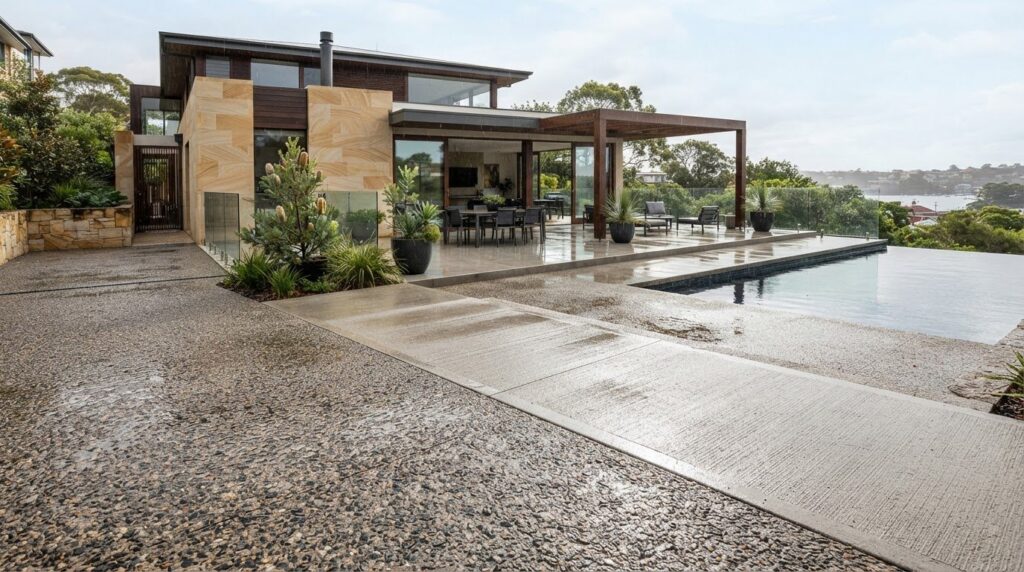
According to the Australian Institute of Health and Welfare, slips, trips, and falls account for 43% of all injury hospitalisations across Australia. When wet weather strikes, the wrong surface quickly turns an architectural entertaining area into a genuine hazard. Achieving the correct slip rating for outdoor concrete isn’t about applying a temporary topcoat after the fact; true safety comes from the structural texture engineered directly into the slab. It’s completely natural to worry that high-traction finishes will look industrial, or to feel lost trying to decipher complex Australian testing codes.
You don’t have to sacrifice refined curb appeal to keep your family and guests safe. This guide helps you master Australian slip resistance standards so you can choose a fully compliant finish that elevates your home’s outdoor lifestyle. We break down the exact P-ratings required under AS 4586 for driveways, alfresco areas, and pool surrounds, while examining how penetrating sealers and anti-slip grit additives safeguard your traction for years to come.
Key Takeaways
- Master Australian Standards by understanding how AS 4586:2013 wet pendulum classifications (P0 to P5) define the required slip rating for outdoor concrete across various exterior zones.
- Discover the exact minimum P-ratings mandated by the National Construction Code for high-risk zones, including swimming pool surrounds, stepped pathways, and steep driveways.
- Compare the intrinsic traction profiles of exposed aggregate, broom finishes, and stamped patterns to achieve premium curb appeal without creating a slippery hazard.
- Learn how standard film-forming sealers can compromise wet grip, and how penetrating siloxane treatments or micronised grit additives protect both your slab and your footing.
- Understand how professional concreters engineer lasting slip compliance through precise drainage grading, textural manipulation, and verified on-site testing methods.
Understanding Slip Rating for Outdoor Concrete Under Australian Standards
Australian Standard AS 4586:2013 governs how pedestrian surfaces resist slipping before installation. On dry concrete, microscopic ridges grip shoe soles with ease. Rainwater breaks that mechanical bond instantly. A thin film of water forms a lubricating boundary across untextured surfaces, causing footwear to hydroplane in a fraction of a second.
Outdoor residential slabs endure storm downpours, garden runoff, and pool splashback. They demand significantly higher frictional resistance than interior floors. The National Construction Code (NCC) enforces strict Deemed-to-Satisfy benchmarks for outdoor walkways, ramps, and stair treads. Determining the correct slip rating for outdoor concrete protects your family from preventable domestic accidents while keeping your project fully certified.
The AS 4586 Wet Pendulum Test Explained
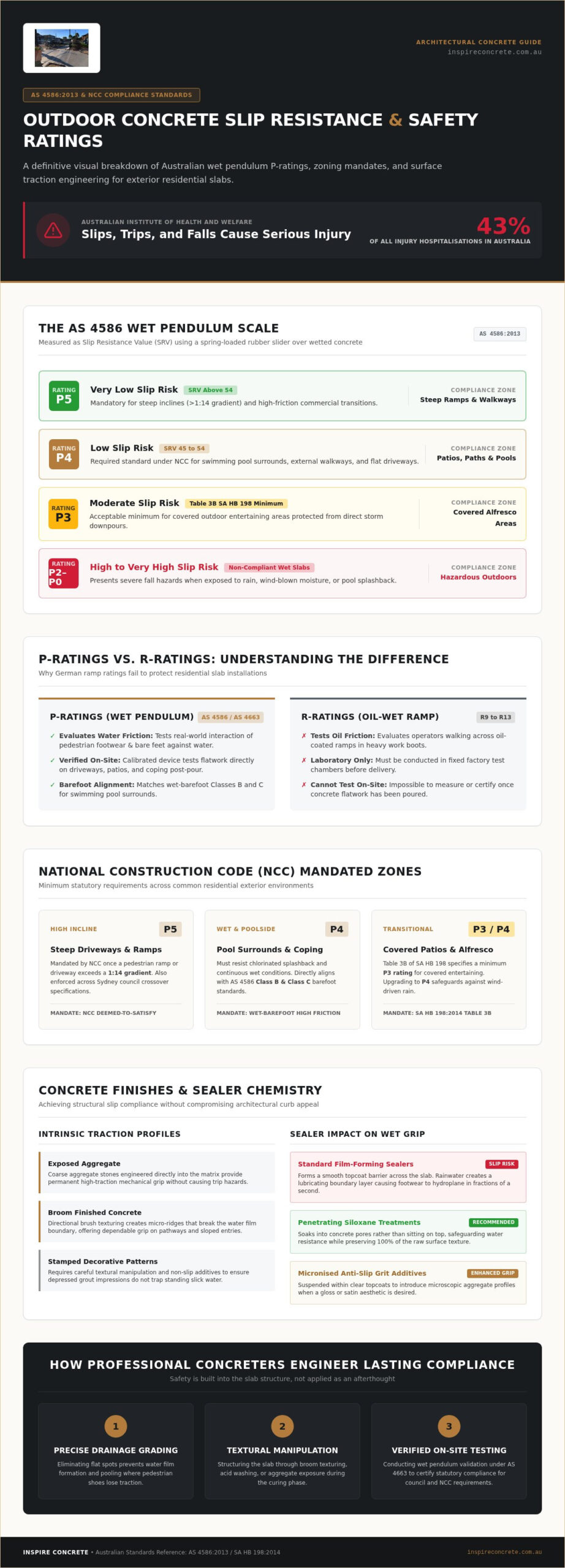
The wet pendulum test serves as Australia’s primary legal benchmark for measuring slip resistance. Testing technicians swing a calibrated pendulum arm fitted with a spring-loaded rubber slider across a thoroughly wetted slab. This device records frictional resistance as a Slip Resistance Value (SRV). As established across standard floor slip resistance testing methods, this process accurately simulates how pedestrian footwear and bare feet interact with wet ground.
The resulting numbers generate classifications from P0 to P5:
- P5: Very low slip risk (SRV above 54), mandatory for steep inclines and commercial transitions.
- P4: Low slip risk (SRV 45 to 54), the required standard for external walkways, patios, and pool surrounds.
- P3 to P0: Moderate to very high slip risk, presenting severe fall hazards when exposed to rain.
P-Ratings vs. R-Ratings: What Is the Difference?
Homeowners often confuse P-ratings with R-ratings. German oil-wet ramp tests determine R-ratings (ranging from R9 to R13), where operators walk across oil-coated ramps in heavy boots. These tests apply to commercial machine shops and loading docks, but they must be conducted in fixed laboratory conditions. They cannot be tested on-site once your slab is poured.
Residential flatwork relies on P-ratings because the wet pendulum test evaluates real-world water friction directly on your driveway or patio under AS 4663. For swimming areas, AS 4586 also includes wet-barefoot ramp classifications (Classes A, B, and C). Class B and C denote superior barefoot friction, which directly matches the performance expected from a dependable P4 or P5 concrete finish.
What Slip Rating Do You Need for Specific Outdoor Concrete Areas?
Every outdoor zone presents distinct slip hazards based on moisture exposure, incline, and foot traffic. A finish suitable for a flat courtyard can become treacherous on a sloped garden path. Handbook SA HB 198:2014, which interprets Standards Australia AS 4586:2013, outlines clear classification benchmarks for external living. Failing to achieve the appropriate slip rating for outdoor concrete risks domestic injuries and exposes homeowners to significant liability if an uncertified surface causes a fall.
Driveways, Footpaths, and Sloped Walkways
Steep residential sites require serious mechanical grip. Flat driveways perform reliably at a P4 rating, but the National Construction Code mandates a P5 rating once a ramp or sloping walkway exceeds a 1:14 gradient. Across Sydney, council crossover specifications also enforce rigid traction requirements where private paths intersect public easements. Balancing coarse aggregate exposure ensures car tyres grip securely without catching pedestrian footwear or causing trip hazards.
Alfresco Entertaining Areas and Covered Patios
Covered outdoor spaces live in a transitional category. While sheltered from direct downpours, wind-driven rain and family foot traffic bring moisture under the roofline. Table 3B of SA HB 198 recommends a minimum P3 rating for covered outdoor entertaining areas, though upgrading to P4 provides peace of mind when weather turns foul. This threshold keeps everyday maintenance simple, allowing easy sweeping and mopping without sacrificing sudden wet-weather traction.
Swimming Pool Surrounds and Wet Zones
Pool copings and adjacent sun decks face the harshest domestic conditions. Constant splashing, chlorinated water, and oily sunscreen residues drastically reduce friction under bare feet. These zones demand a strict P4 rating or a barefoot Class B classification under Australian standards, stepping up to P5 or Class C for submerged steps. Meeting these benchmarks requires tactile balance; the surface needs sufficient micro-texture to channel water away from the foot, yet remain gentle enough to prevent uncomfortable scraping on bare skin.
Getting these friction levels right during planning eliminates costly rectification later. Partnering with structural trade specialists like Inspire Concrete ensures your driveway, patio, and pool surrounds achieve certified slip resistance alongside seamless, high-end styling.
Comparing Slip Resistance Across Popular Concrete Finishes
Aesthetic appeal and surface traction should complement each other. Homeowners often worry that achieving high friction requires an unrefined, industrial finish, but decorative concrete provides sophisticated options that meet Australian compliance. Safe design starts at the drawing board. As highlighted in Safe Work Australia guidance on slips and trips, eliminating slip hazards begins with choosing the right surface material before construction commences.
Every finish alters the functional slip rating for outdoor concrete differently. The choice impacts daily sweeping routines, barefoot texture, and your home’s broader architectural style.
Exposed Aggregate Concrete: The Gold Standard for Traction
Exposed aggregate achieves an intrinsic P4 to P5 rating naturally. Washing away the top layer of surface slurry exposes natural river stones and quartz pebbles, creating multidirectional micro-texture that channels water beneath foot traffic. Selecting smaller, rounded stone profiles between 7mm and 10mm ensures steady underfoot grip without feeling abrasive on bare feet around pools or patios. For an in-depth breakdown of aggregate blends, read our detailed guide on exposed aggregate driveways Sydney.
Honed, Stamped, and Stencilled Concrete Finishes
Alternative finishes require deliberate textural control to remain compliant when wet:
- Honed Concrete: Highly popular for contemporary alfresco areas. Mechanical grinding must stop at a coarse 60-grit profile for exterior slabs. Refining beyond this level creates an ultra-smooth finish that drops wet friction down to an unsafe P2.
- Stamped and Stencilled Concrete: Imprinted brick and slate patterns incorporate recessed joint lines that help disperse standing surface water. The raised stone facets themselves remain relatively flat, meaning they rely on textured sealers to maintain a legal P4 rating.
- Broom and Salt Finishes: Pulling a medium-bristle broom across fresh plain concrete yields a durable, linear P4 texture ideal for perimeter paths. A classic rock-salt finish presses coarse mineral crystals into the wet cream, washing out later to leave subtle, slip-resistant surface indentations.
Pairing these finishes with your home’s exterior creates visual cohesion. Exposed river pebbles suit coastal and Hamptons architecture, while clean broom-finished or lightly honed surfaces complement sharp, minimalist modern facades.
The Impact of Concrete Sealers and Anti-Slip Additives
Protective sealers defend outdoor slabs against oil stains, salt attack, and fading caused by harsh sunlight. Applying the wrong product can quietly ruin your surface friction. The chemistry of your sealer directly dictates the working slip rating for outdoor concrete over its entire lifespan.
Sealers fall into two distinct structural categories:
- Penetrating Silane/Siloxane Sealers: These treatments sink deep into the concrete’s open capillaries without forming a surface film. They repel water internally while leaving natural stone micro-textures exposed, preserving your slab’s built-in P4 or P5 rating.
- Film-Forming Topical Sealers: Acrylics and polyurethanes cure into a solid protective barrier over the concrete. While they produce vibrant colour depth, they bridge natural microscopic peaks and valleys, transforming textured slabs into slick skating rinks when wet.
How Topical Sealers Affect Surface Friction
Gloss acrylic sealers create smooth, non-porous membranes. When rain falls, water cannot drain through microscopic channels, creating an unbroken fluid film that triggers hydroplaning. Slabs that achieved a solid P4 rating unsealed can instantly plummet to a non-compliant P1 or P2 once coated in high-gloss film. Opting for matte or semi-gloss sealers significantly reduces this hazard, but topical products placed in uncovered outdoor areas require traction additives to guarantee wet foot safety.
Using Anti-Slip Additives Effectively in Resealing
Anti-slip additives introduce mechanical texture directly into topical coatings. Stirring micronised polypropylene polymer beads into the sealer suspended in the mix creates a fine, uniform profile that remains gentle on bare feet around pools. High-wear zones, such as steep driveways and public access ramps, require denser, angular media like aluminium oxide or crushed glass grit to deliver enduring P5 performance.
Traction particles wear down under foot traffic, vehicle tyres, and UV exposure. Slabs sealed with topical coatings typically need maintenance resealing every two to three years to maintain statutory compliance. If existing decorative concrete has become dangerously slick from heavy sealer build-up, professional concrete resurfacing Sydney strips worn layers and applies freshly gritted, slip-rated architectural textures.
Don’t risk family safety on an uncertain finish. Arrange a site evaluation with Inspire Concrete to assess your exterior slabs and apply certified anti-slip sealing systems tailored to your property.
How Professional Concreters Achieve and Verify Compliant Slip Ratings
Engineering lasting friction into a concrete slab requires deep trade expertise during the pour. Achieving the required slip rating for outdoor concrete is never an afterthought left to a clear topcoat. True slip compliance stems from structural decisions made before the mixer truck even leaves the batch plant.
Meticulous planning eliminates expensive post-installation grinding or chemical etching. Experienced contractors evaluate property orientation, seasonal shade lines, and drainage runoff patterns before formwork begins. Where local certifiers or commercial contracts demand statutory proof, specialists commission NATA-accredited field testing. Technicians execute in-situ wet pendulum tests under AS 4663 across dedicated 1-metre trial sections, verifying slip resistance values on the cured slab with zero guesswork.
Precision Pouring and Texturing Techniques
Timing dictates texture. When washing exposed aggregate slabs, a finisher must read the ambient temperature and humidity to wash away surface cream at the exact right moment. Washing too early loosens the embedded stone; washing too late leaves the aggregate submerged beneath a slick slurry skin. Applying chemical surface retarders evenly prevents patchy pebble depth, guaranteeing consistent traction across the entire span. Hiring licensed concreters Sydney ensures your installation meets strict National Construction Code tolerances and delivers durable textural uniformity.
Site Drainage and Ongoing Traction Maintenance
Ponding water transforms compliant surfaces into hazardous slip zones. Installing a continuous 1:100 fall across outdoor paths, alfresco slabs, and pool surrounds directs surface water straight toward drainage channels. This prevents stagnant puddles from breeding slick green algae during humid months. Keeping that built-in friction active involves straightforward maintenance:
- Routine Washing: Pressure-wash slabs twice annually to blast out dirt, garden tannins, and mould without stripping decorative sealers.
- Organic Debris Removal: Sweep wet leaves promptly from shaded pathways to eliminate decomposing organic slicks.
- Targeted Resealing: Reapply non-film penetrating treatments or anti-slip gritted sealers whenever water stops beading on the surface.
Protecting your property value and your family demands proven craftsmanship. Schedule an expert site assessment with Inspire Concrete to ensure your next outdoor project pairs flawless architectural design with certified slip safety.
Secure Your Outdoor Living Space With Lasting Traction
Selecting the ideal slip rating for outdoor concrete isn’t just about passing building inspections; it’s about creating an outdoor sanctuary where your family walks with absolute confidence. Safe surfaces don’t force you to settle for an unrefined finish. By engineering natural aggregate textures and pairing them with deep-penetrating sealers, you achieve an elevated architectural aesthetic that holds firm under torrential downpours and poolside splashes.
Bringing this balance of beauty and safety to life takes experienced trade hands. With over 20 years of structural concreting experience across Sydney Metro and Western Sydney, Inspire Concrete designs slip-resistant driveways, alfresco entertaining areas, and pool surrounds that strictly comply with AS 4586 and the National Construction Code. Book a consultation with Inspire Concrete today to engineer a safe, stunning outdoor surface built to endure for decades.
Frequently Asked Questions
What is the minimum slip rating required for an outdoor concrete patio in Australia?
Under Australian Standard AS 4586 and handbook SA HB 198, an uncovered outdoor patio requires a minimum P4 wet pendulum rating to ensure safe pedestrian grip in wet conditions. If your alfresco area is completely sheltered from wind-driven rain, a P3 rating may satisfy building codes. Across Sydney properties exposed to sudden coastal storms, installing an uncovered slab with a certified P4 finish prevents sudden falls and guarantees compliance with the National Construction Code.
Can you make existing slippery stamped concrete slip-resistant without replacing it?
Yes, you can restore safe grip to slick stamped concrete without breaking up the slab. Professional concrete resurfacing strips degraded sealers and applies an engineered, textured decorative overlay. Alternatively, a thorough clean and reseal incorporating micronised polymer beads or fine aluminium oxide grit rebuilds surface friction. This treatment upgrades smooth imprinted patterns back to safe, compliant pedestrian standards while revitalising your driveway or patio colour.
Does exposed aggregate concrete hurt bare feet around a swimming pool?
Properly installed exposed aggregate feels comfortable underfoot. Concreters achieve gentle barefoot traction by selecting 7mm to 10mm rounded river pebbles rather than sharp, crushed quarry gravel. Expert timing during the washing process leaves just enough stone exposed to channel water away without creating rough edges. This careful balance provides Sydney families with an organic, slip-resistant surface that feels great to walk on directly out of the pool.
How often do you need to reapply anti-slip additives to sealed concrete?
Anti-slip grit suspended in topical sealers generally requires reapplication every two to three years. Foot traffic, vehicle tyres, and Sydney’s intense UV radiation gradually erode the surface resin, dislodging suspended traction beads. Checking your slab annually helps spot early wear. When water stops beading or surfaces begin feeling slick under light rain, it’s time to arrange professional cleaning and resealing with fresh traction additives to maintain code compliance.
What is the difference between a P4 and P5 slip rating on outdoor slabs?
The difference lies in frictional resistance measured during wet pendulum testing. A P4 rating yields a Slip Resistance Value between 45 and 54, representing a low slip risk suitable for standard level patios, pool decks, and footpaths. A P5 rating requires an SRV above 54, indicating very low slip risk. When determining the right slip rating for outdoor concrete, steep driveways exceeding a 1:14 incline mandate P5 to counteract gravity during wet descents.
Does concrete sealer always make an outdoor driveway slippery when wet?
Sealer doesn’t automatically make your driveway slippery. Standard film-forming acrylic sealers create slick surfaces because their glossy resins smooth over concrete micro-textures. In contrast, deep-penetrating silane or siloxane sealers soak beneath the slab’s surface, waterproofing the concrete from within without altering its natural grip. If you choose a topical sealer for colour enhancement, stirring anti-slip media into the topcoat maintains dependable traction for vehicles and walking.
Will pressure washing outdoor concrete damage its anti-slip profile?
Routine pressure washing will not damage structural concrete textures like exposed aggregate or broom finishes. In fact, washing away slick algae, mould, and accumulated garden grime actually restores natural traction. However, using industrial turbo nozzles too close to sealed surfaces can strip topical clear coats and blast away suspended anti-slip beads. Using a wide fan nozzle at moderate pressure cleans the slab safely while keeping your grip profile intact.
