
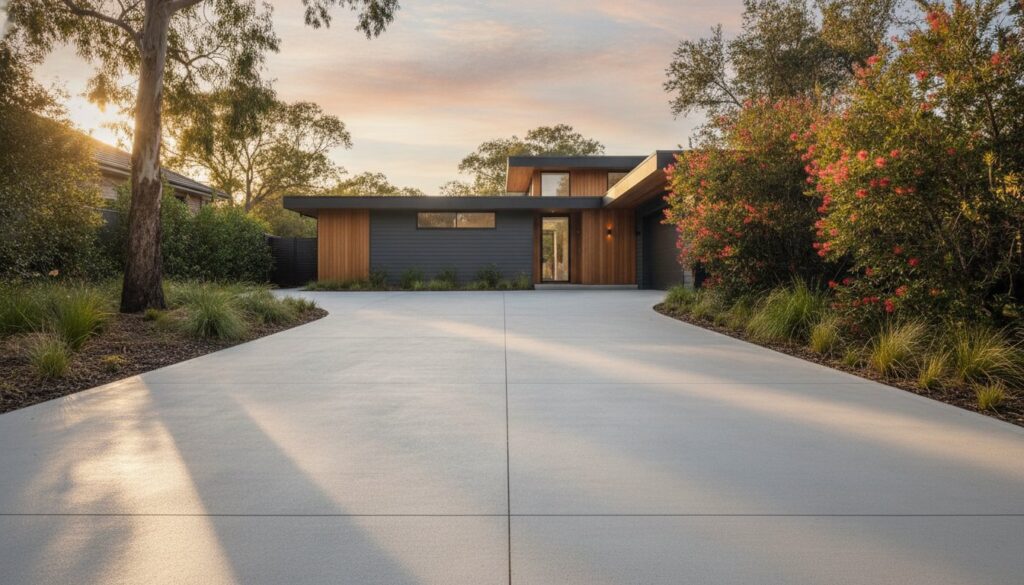
The true plain concrete driveway cost in Sydney is rarely found in a simple per-square-metre rate. While a basic quote might catch your eye, it often ignores the engineering precision required to handle our city’s notorious reactive clay or the complexities of local council compliance. You deserve absolute transparency before the first shovel hits the ground. Most homeowners expect a straightforward process, yet they’re often blindsided by the technical realities of Sydney’s terrain and the strict standards mandated by the Roads Act 1993.
It’s frustrating to start a project only to be hit with surprise fees for traffic management or Section 138 permits that weren’t clearly explained. We understand that a driveway is a significant investment in your property’s value, with the potential to increase perceived worth by up to 8%. This guide provides a definitive breakdown of 2026 market conditions, from material price shifts to the essential structural standards that prevent premature cracking. You’ll learn how to manage Sydney Metro requirements and ensure your finished surface delivers both rugged durability and a refined, professional aesthetic that stands the test of time.
Key Takeaways
- Understand the current plain concrete driveway cost in Sydney and how site-specific variables like steep slopes or limited access can influence your final quote.
- Learn why Sydney’s reactive clay soils require high-strength 32MPA concrete and a proper sub-base to prevent structural cracking within the first 24 months.
- Navigate the complexities of Section 138 permits and council requirements for driveway crossovers to avoid costly fines or demolition orders.
- Discover why investing in professional finishing and penetrating sealers protects your structural investment while significantly enhancing your property’s market value.
Understanding the Baseline: Plain Concrete Driveway Costs in Sydney (2026)
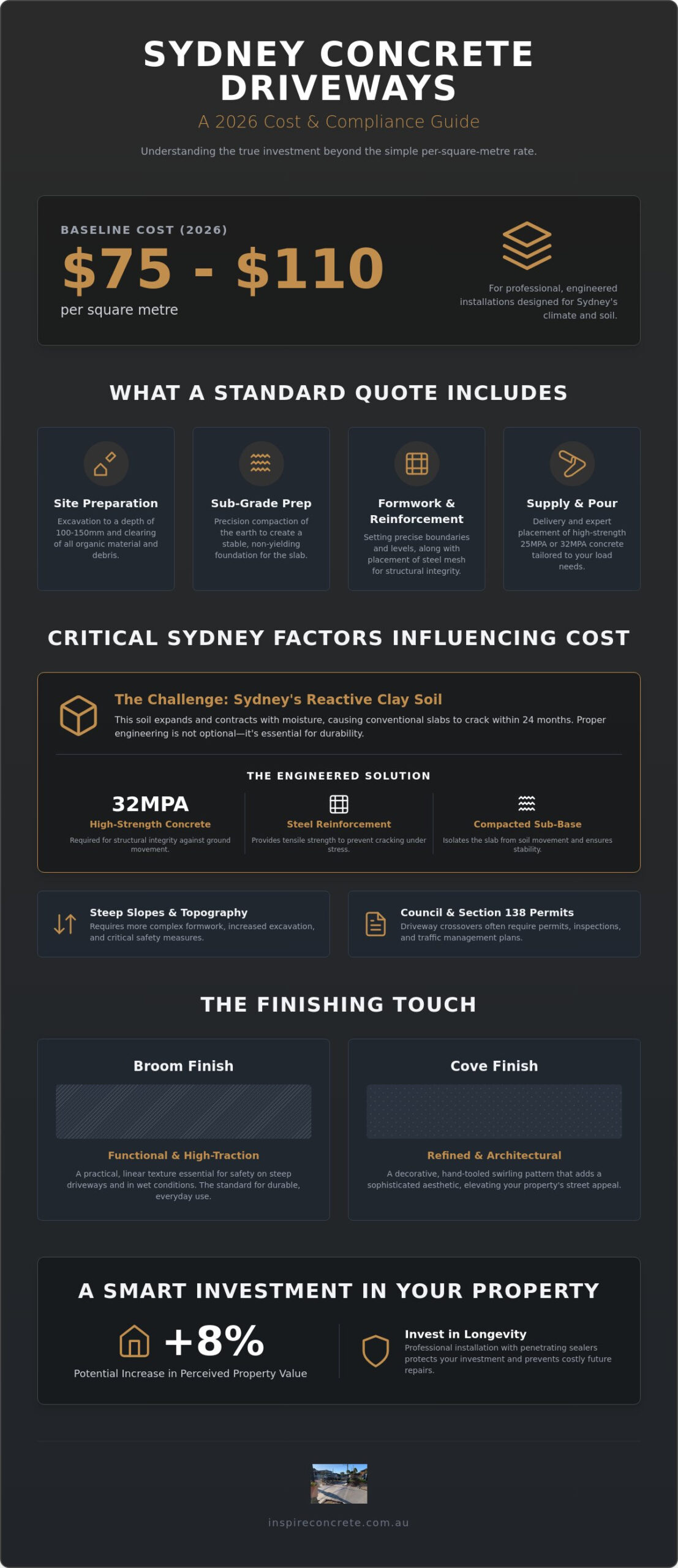
Plain concrete, often referred to as ‘grey’ concrete, remains the backbone of Sydney’s residential landscape. It isn’t just a budget-friendly utility; it’s a deliberate choice for homeowners who appreciate a clean, minimalist aesthetic and long-term versatility. While generic online estimators often still reference outdated 2022 figures, the 2026 market reflects significant shifts in material supply and specialist labour availability. For a professional, standard residential installation, you should expect a plain concrete driveway cost in Sydney to range between $75 and $110 per square metre. This range accounts for the essential engineering required to handle our local climate and soil conditions.
In regions like Western Sydney, where reactive clay soils present a constant challenge to structural integrity, plain concrete is the preferred choice for concrete driveways. It provides a reliable, stable surface that manages ground movement far more effectively than many thinner, decorative alternatives. There’s also a significant ‘hidden value’ in choosing a plain finish. It serves as a high-quality canvas for the future. If your design preferences evolve in a few years, a well-poured plain slab is the perfect foundation for concrete resurfacing or stencilling, allowing for a total aesthetic transformation without the immense cost of demolition and replacement.
What is Included in a Standard Quote?
A professional quote is far more than a simple price per metre. It represents a meticulous sequence of trade-specific tasks that ensure the durability of concrete under the constant weight of vehicle traffic. A transparent, high-quality quote from a trusted craftsman in Sydney typically includes:
- Site Preparation: Standard excavation to a depth of 100mm to 150mm, ensuring the area is clear of organics and debris.
- Sub-grade Preparation: Precision compaction of the earth to create a stable, non-yielding foundation.
- Formwork and Reinforcement: Setting the precise boundaries and levels, along with the placement of steel mesh to prevent structural failure.
- Supply and Pour: The delivery and expert placement of 25MPA or 32MPA concrete, tailored to your specific load requirements.
The Cost of the ‘Broom’ vs. ‘Cove’ Finish
The texture of your driveway’s surface dictates both its safety and its visual appeal. A broom finish is achieved by drawing a specialized concrete broom across the wet surface, resulting in a high-traction, linear texture. It’s an essential, functional choice for the many steep driveways found across Sydney’s varying terrain. In contrast, a cove finish involves a more intricate swirling motion with a hand tool, creating a refined, decorative pattern that catches the light differently. While the cove finish requires a higher level of manual skill and more time on the tools, it transforms basic grey concrete into a sophisticated architectural feature. Choosing the right finish ensures your property remains safe during a heavy Sydney downpour while still presenting a polished, professional face to the street.
The Sydney Variables: Why Your Quote Might Differ from the Average
Every Sydney suburb presents its own set of logistical puzzles. A quote for a flat lot in Blacktown won’t look like a quote for a terraced property in Seaforth. The plain concrete driveway cost in Sydney fluctuates based on the physical environment as much as the material volume. While baseline rates provide a starting point, the specific topography of your land and the constraints of your street often dictate the final investment. Gravity, access, and what lies beneath the surface are the three silent partners in every concreting project.
Regional labour rates also play a role in the variation. The high demand for specialist trades in the Northern Beaches or the Hills District can sometimes lead to higher premiums compared to the more industrially central Western Sydney hubs. Beyond labour, excavation surprises often represent the biggest budget variable. If your property sits on a sandstone shelf or requires the removal of established tree roots, the manual hours required to clear the site will increase. Always ensure your project partner conducts a thorough site assessment to identify these factors before the first pour. For many homeowners, checking the NSW Planning Portal guidelines is a vital first step to understand how site conditions impact exempt development status.
Sloped Driveway Engineering
Gravity is a relentless foreman. When pouring on a steep grade, we utilize ‘low slump’ concrete mixes. This specialized batch is thicker and designed to stay in place rather than sliding down the incline during the vibration and finishing process. A 15-degree incline can increase labour costs by 20% due to the increased physical demand on the crew and the precision required to maintain a consistent depth. High-traction finishes are non-negotiable here, requiring a master’s touch to ensure the surface is safe for vehicles in all weather conditions.
Logistics and Pumping Fees
Sydney’s narrow streets and tight side-access often prevent a standard 10-tonne concrete truck from reaching the pour site. In these scenarios, a concrete pump is essential. A line pump is typically sufficient for residential backyards, but complex sites may require a boom pump to reach over existing structures. These logistics add to the daily rate, as does the necessity for professional traffic management on busy arterial roads. If you are unsure how your property’s access might affect your budget, reaching out for a professional site consultation can provide the clarity you need to move forward with confidence.
Engineering for Durability: Beyond the Surface of Plain Concrete
The integrity of a slab is decided long before the agitator truck arrives. In Sydney, specifically across the Western suburbs, reactive clay soils act as a living foundation. They expand and contract with moisture changes, putting immense pressure on your concrete. If a contractor offers a significantly lower plain concrete driveway cost in Sydney, they’re likely cutting corners on the sub-base compaction or the quality of the reinforcement. Skimping on these invisible elements is a recipe for structural failure within 24 months.
True craftsmanship involves preparing the ground to resist this movement. We focus on a multi-layered approach: precision excavation, the application of a high-quality road base, and mechanical compaction. This creates a non-yielding platform that ensures the concrete remains a monolithic structure rather than a series of disconnected plates. This level of engineering is what separates a temporary fix from a generational asset.
Reinforcement and Steel Grades
Steel mesh is the skeletal system of your driveway. While budget contractors often opt for SL72 mesh, we recommend SL82 for the majority of Sydney residential projects. SL82 provides significantly higher tensile strength, which is essential for managing the lateral forces of heavy vehicles. We utilize plastic chairs to ensure this mesh sits perfectly in the centre of the slab. Without these chairs, the mesh often sinks to the bottom, rendering it useless for structural support. We also implement edge thickening at the driveway’s entry and exit points to prevent spalling and cracking where the concrete is most vulnerable to impact.
MPA Strength and Thickness
The strength of concrete is measured in Megapascals (MPA). For a standard car, 25MPA is often sufficient, but for families with heavy 4WDs, boats, or caravans, upgrading to 32MPA is the gold standard. A 32MPA mix is denser and more resilient against Sydney’s extreme summer heat cycles, which can cause significant thermal expansion. While a standard 100mm thickness is common, increasing to 125mm for high-traffic zones adds a level of structural insurance that far outweighs the marginal increase in material cost. Choosing 32MPA concrete is a strategic investment in longevity, reducing the likelihood of surface wear and internal fatigue over decades of use.
Council Regulations and Compliance: The Hidden Costs of Sydney Driveways
The administrative side of a project often carries the most significant “hidden” impact on the total plain concrete driveway cost in Sydney. Any work that extends beyond your property boundary onto the nature strip is governed by Section 138 of the Roads Act 1993. This legal mandate requires a specific permit for any construction on public land. Failing to secure these approvals isn’t just a minor oversight; it can lead to heavy fines, mandatory demolition orders, and significant delays during property settlements. When you sell your home, a non-compliant driveway can become a major sticking point for savvy buyers and building inspectors.
Budgeting for these requirements is essential. For instance, a Section 138 application in the Blacktown council area starts at approximately A$340, but fees vary significantly across the Sydney Metro area. You must also account for council inspection fees, which typically cover a pre-pour check of the formwork and a final post-pour verification. If your property is located on a busy arterial road, you may also be required to provide a professional Traffic Management Plan (TMP), which can add between A$900 and A$2,800 to your initial estimate. These are the technical realities that a “cheap” quote will often ignore until it’s too late.
The Driveway Crossing (The ‘Verge’)
The “crossover” or “layback” is the section of the driveway that connects your property to the street. Because this area supports heavy council vehicles and protects underground infrastructure, councils demand much higher specifications than a standard backyard slab. You’ll generally need a 125mm to 150mm thick slab with heavy-duty SL82 mesh. Navigating this space requires a licensed concreter in Sydney who understands how to manage local utility assets. Accidentally damaging an NBN pit or a water meter during excavation can result in repair bills that far exceed the cost of the driveway itself.
Drainage and Run-off Compliance
Sydney Water and local councils have strict regulations regarding stormwater management to prevent street flooding and erosion. Your driveway must be designed to direct water into the appropriate drainage systems rather than onto your neighbour’s property or the public footpath. This often necessitates the installation of trench grates or pits, which adds to the material and labour investment. A ‘Standard Drawing’ is a council-issued technical blueprint that specifies the exact dimensions, reinforcement, and levels required for a driveway crossing to be deemed compliant. If you want to ensure your project meets every legal and structural benchmark, you can request a compliance-focused quote from our team today.
Investing in Longevity: Why Quality Installation Saves You Thousands
Choosing a contractor based solely on the lowest plain concrete driveway cost in Sydney is a high-risk strategy that often backfires. When a slab is poured without the rigorous engineering standards we’ve discussed, such as proper sub-grade compaction or the use of SL82 mesh, the cost of failure is astronomical. You aren’t just paying for a repair; you’re paying for the demolition of the failed slab, the disposal of tonnes of waste, and a complete reconstruction. In the 2026 market, this can easily escalate into a A$15,000 project that could have been avoided with a commitment to quality from day one.
At Inspire Concrete, we bring over 20 years of Sydney-specific experience to every site. We view ourselves as project partners, providing end-to-end management that includes architectural drafting and navigating complex council requirements. This holistic approach ensures that your driveway isn’t just a utility, but a durable legacy that enhances your property’s lifestyle and market value. Maintenance is simple when the foundation is right. A routine pressure clean every 12 to 18 months and a fresh application of sealer every few years will keep your plain concrete looking pristine for over two decades.
The Sealing and Cleaning Process
While plain concrete offers a timeless, minimalist look, it is inherently more porous than exposed aggregate driveways. This porosity makes it susceptible to oil stains, tyre marks, and moisture ingress that can lead to internal fatigue during Sydney’s wet seasons. Applying a high-quality penetrating sealer is the most cost-effective way to preserve the ‘new’ look of your slab. You can choose between a natural finish that maintains the raw concrete aesthetic or a wet-look sealer that deepens the grey tones and adds a subtle sheen, both of which provide a critical chemical barrier against the elements.
Choosing the Right Project Partner
Before signing a concrete quote, you must vet your project partner on their technical processes. Ask specifically about their use of plastic mesh chairs and their method for sub-grade compaction; a true craftsman will answer these with precision. It’s also vital to ensure the quote accounts for site cleanup and the removal of all excavation waste, as these costs can surprise homeowners in the final stages. Choosing a licensed, long-standing Sydney business provides more than just a surface; it provides the warranty and peace of mind that your investment is protected for the long haul. The plain concrete driveway cost in Sydney should always be viewed through the lens of total cost of ownership, where quality installation is the only way to ensure lasting value.
Securing Your Property’s Future Foundation
Navigating the technicalities of a new driveway requires more than just a surface level understanding of the plain concrete driveway cost in Sydney. It demands a commitment to the invisible engineering that prevents structural failure, from high-grade SL82 mesh to the precise sub-base compaction required for our city’s reactive clay soils. By prioritising structural integrity and full council compliance today, you eliminate the risk of future legal complications and the massive expense of early replacement. A well executed plain slab is a long term asset that provides a clean, professional finish while anchoring your home’s street appeal and functional value.
Inspire Concrete brings over 20 years of Sydney experience as licensed and insured master concreters. We manage the entire process, including full council compliance management, so you can focus on the transformation of your property. Our team treats every project as a partnership, ensuring that every pour meets our rigorous standards for durability and craftsmanship. Get a precise, no-obligation quote for your Sydney plain concrete driveway-built to last by Inspire Concrete. We look forward to helping you realize your vision with a foundation you can trust for decades to come.
Frequently Asked Questions
Is plain concrete the cheapest driveway option in Sydney?
Plain concrete is generally the most cost-effective permanent surfacing solution compared to premium options like exposed aggregate or stencilled finishes. While loose materials like gravel or recycled road base have lower entry prices, they lack the structural permanence and property value boost of a solid slab. It provides the most balanced plain concrete driveway cost in Sydney for homeowners seeking a professional, low-maintenance finish that lasts decades.
How much does a Section 138 permit cost in Sydney?
Permit fees vary by local government area, but as of 2026, a standard Section 138 application for driveway works in the Blacktown council area starts at approximately A$340. Other Sydney councils may have different fee structures based on the complexity of the crossover and required site inspections. You should also factor in the potential cost of a professional Traffic Management Plan if your property fronting is on a busy arterial road.
Can I park my car on a new plain concrete driveway immediately?
You must wait at least 7 days before parking a standard passenger vehicle on your new surface. While the concrete may feel hard enough to walk on within 24 to 48 hours, it takes a full week to reach roughly 70% of its structural design strength. For heavier loads like caravans, boats, or trade trucks, we recommend waiting 14 days to ensure the internal matrix has cured sufficiently to handle the weight without risk of cracking.
Why did my plain concrete driveway crack so quickly?
Rapid structural failure is almost always linked to poor sub-grade preparation or inadequate reinforcement for Sydney’s reactive clay soils. If the earth wasn’t mechanically compacted or if a contractor used thin SL72 mesh instead of the heavier SL82 grade, the slab cannot resist the ground’s natural expansion and contraction. Skipping essential expansion joints or pouring a slab thinner than 100mm also significantly compromises the durability of the installation.
Does plain concrete add value to my Sydney home?
A professionally installed concrete driveway can increase a property’s perceived market value by 5% to 8%. It creates an immediate sense of “move-in ready” quality and structural permanence that unpaved or dilapidated entrances lack. Even a minimalist plain finish suggests the home has been maintained with a focus on quality, offering a high return on the initial plain concrete driveway cost in Sydney during a property appraisal.
How do I clean oil stains off plain concrete?
You should blot the spill immediately with an absorbent material like kitty litter before scrubbing the area with a specialized alkaline degreaser and hot water. Because plain concrete is naturally porous, oil will penetrate deep into the slab if it isn’t treated quickly. For older, set-in stains, a professional high-pressure clean followed by the application of a penetrating sealer is the best way to lift the mark and protect against future spills.
What is the difference between 25MPA and 32MPA concrete?
MPA signifies the compressive strength of the concrete mix once fully cured. 25MPA is the standard residential grade for light vehicle traffic, but 32MPA is a denser, high-strength alternative that offers superior resistance to heavy loads and Sydney’s intense summer heat cycles. We often recommend 32MPA for homeowners with heavy 4WDs or those who want the highest possible level of internal durability for their investment.
Can I resurface my old plain concrete driveway instead of replacing it?
Resurfacing is an excellent way to transform your entrance if the existing slab is structurally sound and free from deep settlement cracks. If the foundation is stable, we can apply a high-strength polymer-modified coating to create a fresh, modern look without the cost of full demolition. However, if the original concrete is crumbling or shifting due to poor sub-base preparation, a complete replacement is the only way to guarantee a long-term result.
