
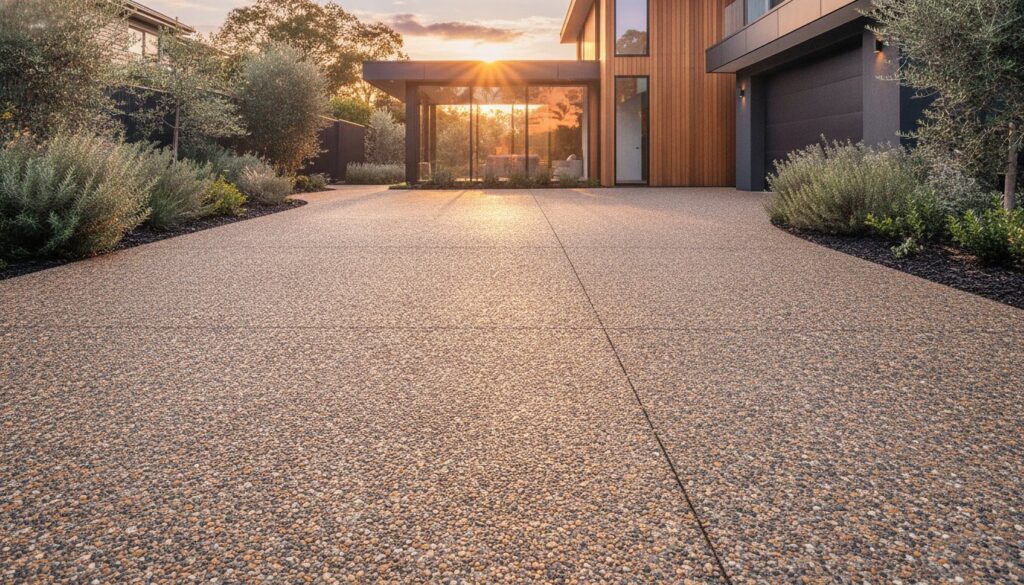
What if the most expensive part of your new driveway isn’t the concrete itself, but the cost of ripping it out because a contractor ignored local regulations? In the reactive clay soils of the region, installing an exposed aggregate driveway western sydney homeowners can be proud of requires more than just a mixer and a trowel. It demands the precision of an engineered structural asset. We understand the frustration of deciphering vague quotes and the genuine fear that poor workmanship might lead to structural cracks or a failed council crossover inspection.
You deserve a front entrance that reflects refined craftsmanship without the stress of unreliable tradies or hidden costs. This guide will teach you how to master the art of vetting Sydney concreters to ensure a durable, council-compliant finish. We’ll preview the essential 2026 homeowner’s checklist, covering everything from Section 138 approvals to the architectural details that guarantee ten years of peace of mind. By the end of this article, you’ll have the certainty needed to transform your property’s utility into a high-end lifestyle statement.
Key Takeaways
- Understand why modern Sydney driveways have evolved into architectural assets and how to avoid the “cheap quote” trap that leads to structural failure.
- Learn the technical requirements for an exposed aggregate driveway western sydney homeowners need, specifically regarding subgrade compaction for reactive clay soils.
- Identify the seven non-negotiable questions to ask your contractor to ensure they’re licensed, insured, and providing a fixed-price contract.
- Navigate the complexities of council crossover compliance and Section 138 approvals to avoid costly demolition orders or fines.
- Discover how an architectural drafting approach prevents drainage issues and secures long-term value through a 10-year workmanship warranty.
Navigating the Sydney Concrete Driveway Market in 2026
The Sydney residential landscape has undergone a significant transformation. Driveways have evolved from simple, functional slabs into sophisticated architectural statements that define a home’s street presence. While there are many common driveway materials available, concrete remains the premier choice for its structural integrity and versatility. In 2026, we see a distinct shift away from basic grey finishes toward high-end textures that complement modern Australian home designs. This evolution reflects a growing understanding that a driveway is an investment in a property’s long-term value, not just a place to park a car.
The demand for an exposed aggregate driveway western sydney wide has surged as homeowners seek a balance between rugged durability and refined aesthetics. This finish, along with stencilled and stamped patterns, has become the hallmark of quality property development from the bustling Western Suburbs to the foothills of the Blue Mountains. However, this growth in popularity has also seen an influx of operators who prioritize speed over substance. Choosing the lowest quote often results in the highest long-term costs. Sydney’s unique climate and reactive clay soils demand precise engineering. A cut-price contractor might skip essential subgrade compaction or use inferior reinforcement mesh, leading to premature cracking that is both unsightly and expensive to rectify. Real value lies in technical excellence and a commitment to longevity.
The Risks of Hiring Unlicensed Contractors
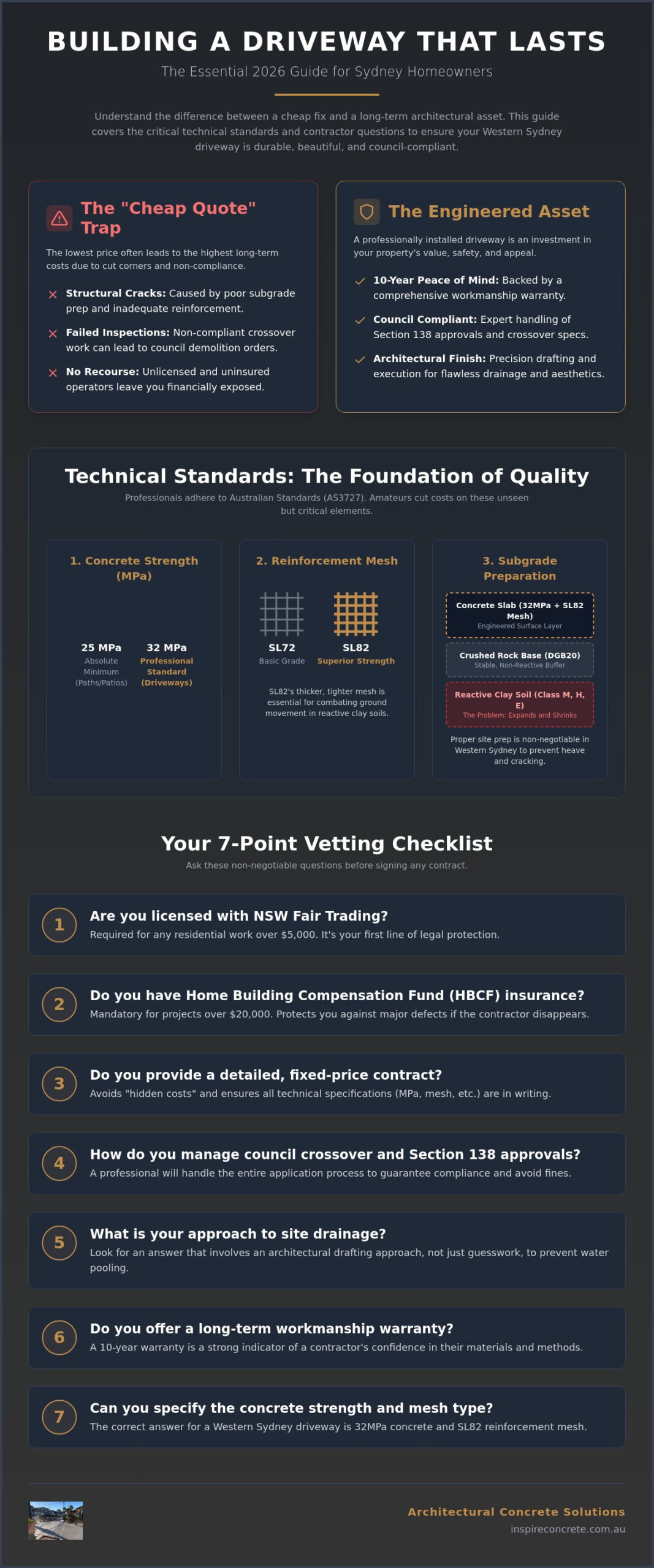
In New South Wales, any residential building work valued at more than $5,000 for labour and materials requires a contractor to hold a valid NSW Fair Trading license. Many “handyman” concreters operate without this, leaving homeowners legally and financially exposed. Beyond the license, it’s vital to verify if they have the Home Building Compensation Fund (HBCF) insurance required for projects over $20,000. Without it, you lack protection against major structural defects if the contractor disappears. We’ve seen far too many homeowners left with sinking slabs and no recourse because they chose an uninsured provider.
Setting Your Project Goals: Aesthetic vs. Utility
Before the first pour, define how your driveway will actually be used. Are you parking a heavy caravan, or is it strictly for standard passenger cars? Structural thickness and steel reinforcement grades must match these loads to prevent subsidence. Balancing this utility with kerb appeal is what creates lasting property value. For a deeper dive into planning your project, consult The Ultimate Guide to Concrete Driveways in Sydney to ensure your vision aligns with technical reality and council requirements.
Technical Standards: What Separates Expert Concreters from Amateurs
A driveway isn’t just a surface; it’s a structural pavement that must support tonnes of moving weight. In Australia, professional installations must adhere to AS3727 (Residential Pavements), a standard that dictates the minimum requirements for safety and performance. Amateurs often ignore these technical benchmarks to save on material costs, but an expert knows that the longevity of an exposed aggregate driveway western sydney families invest in depends on invisible engineering. Skipping a few millimetres of steel or using a lower concrete grade might save money today, but it guarantees a structural failure tomorrow.
Concrete strength is measured in MPa (Megapascals). While 25MPa is the absolute minimum for residential paths, we frequently utilize 32MPa for driveways to ensure they withstand the pressure of modern SUVs and heavy delivery vans. Reinforcement mesh is the skeleton of your slab, and the choice between SL72 and SL82 mesh is critical. SL82 features thicker steel bars and tighter spacing, providing the superior tensile strength needed to combat the ground movement inherent in our region. If you’re looking for a project partner who prioritizes these technical nuances, a professional site assessment is the first step toward a durable result.
Soil Types and Site Preparation in Western Sydney
Western Sydney is notorious for reactive clay soils, classified as Class M, H, or E. These soils expand when wet and shrink when dry, applying immense pressure to any structure built upon them. To mitigate this, we install a high-quality crushed rock base, typically DGB20, which acts as a stable, non-reactive buffer. Subgrade compaction is the essential foundation that determines whether your driveway will remain level for thirty years or fail within three. Without this rigorous preparation, even the thickest concrete will eventually succumb to the shifting earth below.
Thickness and Curing: The Silent Quality Markers
Standard residential slabs are often 100mm thick, but for heavy-duty applications or properties with steep gradients, a 125mm slab is the professional choice. This extra depth provides the structural backbone required for larger vehicles or caravans. Once the pour is complete, the science of curing begins. Concrete doesn’t just dry; it undergoes a chemical hydration process that takes time to reach full strength. You shouldn’t park a vehicle on your new driveway for at least 7 to 14 days to avoid compromising the finish. For a deeper understanding of these structural requirements, see The Essential Guide to Concrete Slabs in Sydney.
The 2026 Checklist: 7 Critical Questions to Ask Before Signing
Vague quotes are the birthplace of project delays and hidden costs. When you’re investing in an exposed aggregate driveway western sydney, you aren’t just buying concrete; you’re hiring a project partner to manage a complex construction process. Vetting a contractor requires looking past a glossy Instagram feed—often curated by digital experts like CWS Marketing (Client Winning Strategies)—and interrogating their technical process. A professional should be able to answer these seven questions with absolute certainty, leaving no room for guesswork regarding the structural stability of your home’s entrance.
- Are you licensed and insured for structural concrete work in NSW? Verify their license number via Fair Trading and ensure they carry at least A$20 million in public liability insurance, as required by councils like Blacktown.
- Does your quote include excavation, steel reinforcement, and waste removal? Soil removal alone for a standard driveway can cost between A$1,500 and A$2,000. Ensure these aren’t “hidden extras.”
- How do you manage drainage and prevent water pooling? Effective stormwater management is a legal requirement in Sydney. Ask about internal pits or grates.
- What is your specific process for expansion joints? Joints must be strategically placed to accommodate ground movement and prevent random cracking.
- What concrete strength and mesh will you use? Demand at least 25MPa (or 32MPa for crossovers) and SL82 mesh for superior durability.
- Do you handle the council crossover application? A Section 138 approval is mandatory for work on council land.
- Do you provide a written workmanship warranty? At Inspire Concrete, we provide a 10-year workmanship warranty to ensure long-term peace of mind.
Deciphering the Quote: Itemised vs. Lump Sum
A lump sum quote that simply says “driveway installation” is a major red flag. A professional quote must be itemised, specifying the square meterage, the depth of the DGB20 base, and the exact MPa of the concrete. In Western Sydney, council crossover fees can reach A$800, and inspection fees, such as the A$300 charged by the City of Parramatta, should be clearly accounted for. Opting for an all-inclusive, fixed-price contract protects you from the “cost-plus” trap where excavation surprises suddenly inflate your final bill.
Reviewing the Portfolio: Beyond the Photos
Freshly poured concrete always looks good. To judge true craftsmanship, ask for local references in suburbs like the Hills District or Parramatta where the driveways are at least three years old. This allows you to see how the finish has weathered Sydney’s heat and how the expansion joints have performed. A contractor who utilizes architectural drafting can demonstrate how they solved complex level issues or drainage challenges on previous projects, proving they have the technical eye required for a high-end transformation.
Understanding Council Compliance and Crossover Requirements
The most critical phase of your project happens before the first cubic metre of concrete is even ordered. While the portion of the driveway on your property offers some design flexibility, the “crossover” is strictly regulated. This is the section of the driveway that sits on council land, spanning from your property boundary to the road kerb. In Sydney, any work performed in this zone is governed by the Roads Act 1993. To legally proceed, you must obtain a Section 138 permit from your local government area (LGA). Failing to secure this approval or ignoring the specific engineering drawings provided by the council can lead to expensive demolition orders and heavy fines.
Constructing a council-compliant exposed aggregate driveway western sydney requires technical knowledge of laybacks and kerb restoration. The layback is the sloped part of the kerb that allows vehicles to transition from the road. If your existing layback is cracked or incorrectly positioned, the council will require a full restoration as part of your project. Because this work occurs on public land, many Sydney councils insist that you hire an “Approved Council Contractor.” These professionals carry the mandatory A$20 million in public liability insurance and have a proven track record of meeting the rigorous standards set by municipal engineers. If you’re ready to navigate these regulations with a partner who handles the paperwork, contact us for a turnkey compliance assessment.
Specific Council Variations Across Sydney
Compliance isn’t a one-size-fits-all process. Blacktown City Council, for instance, typically requires a 125mm thickness and 32MPa concrete strength for the crossover to ensure it handles heavy service vehicles. In contrast, Penrith City Council specifications for residential driveways often allow N25 concrete with SL72 mesh, though they maintain strict rules on width at the boundary. The Hills Shire also has its own set of standard drawings that must be followed to the millimetre. A council engineer will perform a final inspection before the project is signed off; if the cross-fall gradient exceeds 4% or the surface doesn’t meet non-slip requirements, you’ll be forced to rectify it at your own expense.
Managing Drainage and Runoff
Sydney homeowners have a legal responsibility to manage stormwater runoff within their property boundaries. You cannot simply allow water to sheet off your new driveway and onto your neighbour’s land or into the street without proper infrastructure. We utilize architectural drafting to identify low points where water might pool near your garage or foundation. By integrating strip drains and ag-lines, we redirect water into the legal point of discharge. For those looking to upgrade an existing surface rather than start from scratch, The 2026 Guide to Concrete Resurfacing Sydney offers insights into modernizing your property while maintaining drainage integrity.
Why Architectural Precision is the Key to Your Transformation
Most contractors view a driveway as a standalone slab of stone and sand. We view it as the foundational element of your home’s exterior architecture. Achieving a high-end exposed aggregate driveway western sydney families can rely on for decades requires more than physical labour; it demands the precision of architectural drafting. By mapping out levels and drainage before the first shovel hits the dirt, we eliminate the expensive errors that plague amateur installations. This technical foresight is the backbone of our four-pillar framework: Clarity, Construction, Compliance, and Care. It ensures that every joint, slope, and finish is intentional rather than accidental.
A driveway shouldn’t exist in isolation from the rest of your property. Modern homeowners are increasingly looking for a unified aesthetic that flows seamlessly from the street to their alfresco areas and pool surrounds. Our drafting background allows us to design integrated concrete packages that enhance your lifestyle and significantly boost property value. Because we are certain of our engineering and the quality of our pour, we back every project with a 10-year workmanship warranty. This isn’t just a promise; it’s a reflection of our pride in the craft and our commitment to providing long-term value that moves beyond simple utility.
From Utility to Artistry: Choosing Finishes
Selecting the right texture is where your personal vision meets our technical expertise. Exposed Aggregate Driveways in Sydney remain the gold standard for those seeking a slip-resistant, sophisticated finish that hides wear and tear. If your home has a more traditional architectural style, stencil or stamped patterns might offer the character you’re looking for, provided they’re engineered to withstand the Western Sydney heat. Regardless of the finish, the key to longevity is maintenance. We recommend regular high-pressure cleaning and professional chemical sealing every few years to protect the vibrancy of the aggregate and prevent oil penetration.
The Turnkey Experience: Your Project Partner
Managing a driveway replacement can be a logistical headache, especially when dealing with council permits and multiple subcontractors. We position ourselves as your project partner, providing a single point of contact from the initial drafting phase to the final seal. This holistic approach is essential for large-scale residential developments where timing and precision are non-negotiable. Inspire Concrete provides a fixed-timeline, fixed-budget solution that eliminates the financial uncertainty often associated with residential construction. By handling the heavy lifting of project management, we allow you to focus on the transformation of your property into the realization of your creative vision.
Secure Your Property’s Future with Technical Excellence
Investing in an exposed aggregate driveway western sydney homeowners can be proud of requires a shift in perspective. It isn’t just about the surface finish; it’s about the engineered foundation and the precision of the planning phase. You now have the tools to spot the difference between an amateur quote and a professional proposal that respects Australian Standards and council regulations. By prioritizing architectural drafting and structural integrity, you protect your property from the common pitfalls of reactive soil and poor drainage.
At Inspire Concrete, we bring over 20 years of construction experience and specialized architectural drafting expertise to every project. We handle the complexities of compliance and construction so you can enjoy a seamless transformation. Every project we build is backed by a 10-year workmanship warranty, giving you the certainty that your investment will endure. Transform your property with a professional concrete quote from Inspire Concrete. Your vision for a beautiful, durable entrance is well within reach when you choose a partner committed to excellence.
Frequently Asked Questions
Do I need council approval for a new concrete driveway in Sydney?
You must obtain formal approval for the crossover section of your driveway, which is the area between your property boundary and the road. While the portion on your private land may sometimes fall under Complying Development, any work on council land requires a Section 138 permit under the Roads Act 1993. This ensures the construction meets specific engineering and safety standards for public infrastructure.
How long does it take to install a standard concrete driveway?
A standard installation typically requires three to five days of active construction. This timeframe covers the initial excavation, formwork placement, steel reinforcement installation, and the final pour. You should also factor in the four to six weeks often required for council permit processing before any physical work begins on your property.
What is the best type of concrete for a steep driveway in Sydney?
Exposed aggregate is the premier choice for steep gradients because of its exceptional non-slip properties. The textured surface created by the protruding stones provides the high level of traction necessary for vehicle safety during wet weather. An exposed aggregate driveway western sydney families choose for steep blocks offers a perfect blend of rugged utility and sophisticated kerb appeal.
How much does a concrete driveway cost per square metre in 2026?
Project costs are influenced by site-specific variables rather than a simple flat rate. The final investment depends on the depth of excavation required, the soil classification of your land, and whether you require heavy-duty SL82 reinforcement mesh. We focus on providing fixed-price contracts that encompass all technical requirements, including council fees and drainage solutions, to prevent budget blowouts.
Why is my concrete driveway cracking, and can a contractor fix it?
Cracking is frequently caused by the expansion and contraction of reactive clay soils or the absence of correctly placed expansion joints. While hairline cracks are often cosmetic, deep structural cracks usually suggest that the subgrade wasn’t compacted properly during the initial build. A professional can often use resurfacing techniques to fix surface-level damage, but structural issues may require a more comprehensive engineered solution.
What is a Section 138 permit and who applies for it?
A Section 138 permit is a mandatory legal authorization required for any works performed on a public road or nature strip. This permit ensures that your driveway crossover meets the specific requirements of the local government area for drainage and structural strength. We typically manage this application process as part of our turnkey service to ensure your project remains fully compliant with the law.
Can I drive on my new concrete driveway immediately after pouring?
You shouldn’t drive on your new slab for at least seven to fourteen days. Although the concrete may appear solid within twenty-four hours, it undergoes a chemical curing process that takes time to reach its full rated strength. Driving a vehicle on the surface too early can cause permanent structural damage or mar the decorative finish you’ve invested in.
What is the difference between 25MPa and 32MPa concrete for driveways?
The MPa rating indicates the compressive strength and density of the concrete mix. 25MPa is a standard residential grade suitable for footpaths and light-use areas. 32MPa is a superior, high-strength mix that is often required by Sydney councils for crossovers because it’s better equipped to handle the weight of heavy delivery vehicles and long-term wear.
