
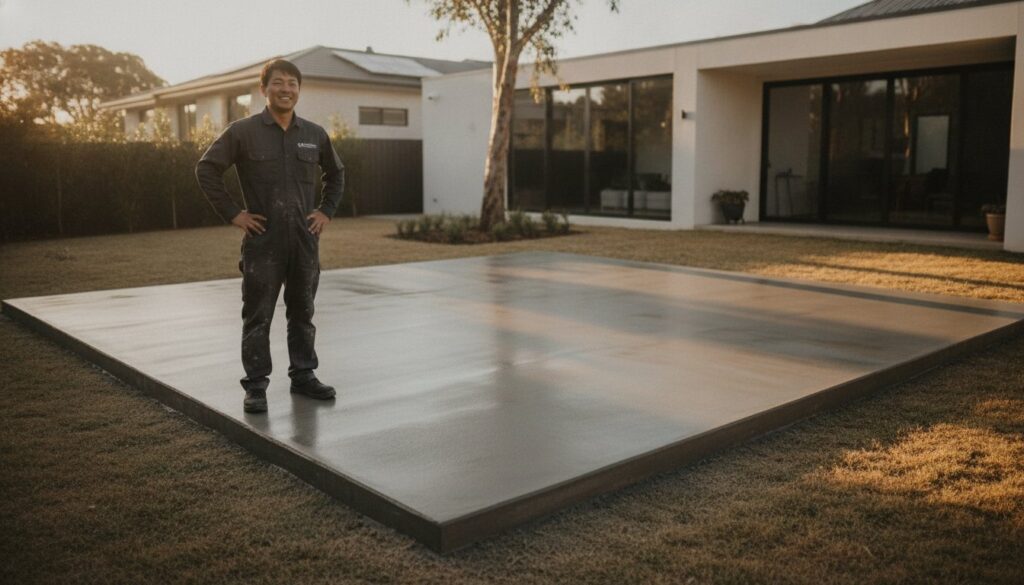
A standard concrete slab might look solid on the surface, but without the right engineering, Sydney’s reactive clay will eventually turn your investment into a web of cracks. Building a shed should be a straightforward upgrade to your lifestyle, yet many homeowners find themselves buried in confusing council jargon and the fear of a non-compliant build. It’s frustrating when you simply want a durable space for your equipment without the looming threat of council fines or structural instability.
We’ve designed this guide to help you master shed foundation requirements nsw, ensuring your project is both legally sound and built to endure. You’ll learn how to navigate the 2026 Exempt Development codes, manage the specific challenges of local soil, and achieve a finish that balances heavy-duty utility with refined craftsmanship. We’ll walk you through the essential setbacks, size limits, and structural benchmarks required to transform a basic utility area into a lasting asset for your property.
Key Takeaways
- Identify the legal size and setback limits that allow your project to proceed as an exempt development without a full council application.
- Master the technical shed foundation requirements nsw by selecting the precise concrete strength and slab thickness needed for your shed’s intended use.
- Protect your investment against Sydney’s reactive clay soils with specialized engineering techniques designed for long-term stability.
- Navigate the entire construction process with a professional timeline that covers everything from site excavation to the critical curing phase.
- Avoid the costly legal and structural risks of non-compliant DIY builds by understanding the value of professional craftsmanship and local expertise.
Understanding NSW Shed Regulations: When is a Foundation “Exempt”?
Precision in the planning stage is just as critical as the pour itself. In New South Wales, most residential sheds fall under the category of Exempt Development. This means you don’t need a full building permit if you follow specific rules. Meeting the shed foundation requirements nsw starts with understanding the State Environmental Planning Policy (SEPP). The footprint of your concrete slab is the primary measurement council uses to determine if your build is exempt. For residential zones, your shed must not exceed 20 square metres in floor area. If you’re on a rural property, this limit often increases to 50 square metres, but the structural standards remain high.
Cutting corners on compliance carries heavy risks. A non-compliant foundation isn’t just a structural hazard; it’s a legal liability that can stall the sale of your home or result in expensive demolition orders. Councils use aerial mapping and site inspections to enforce these codes. If your slab is too large or placed incorrectly, you might face significant fines. Compliance ensures your structure is safe and your property value remains protected.
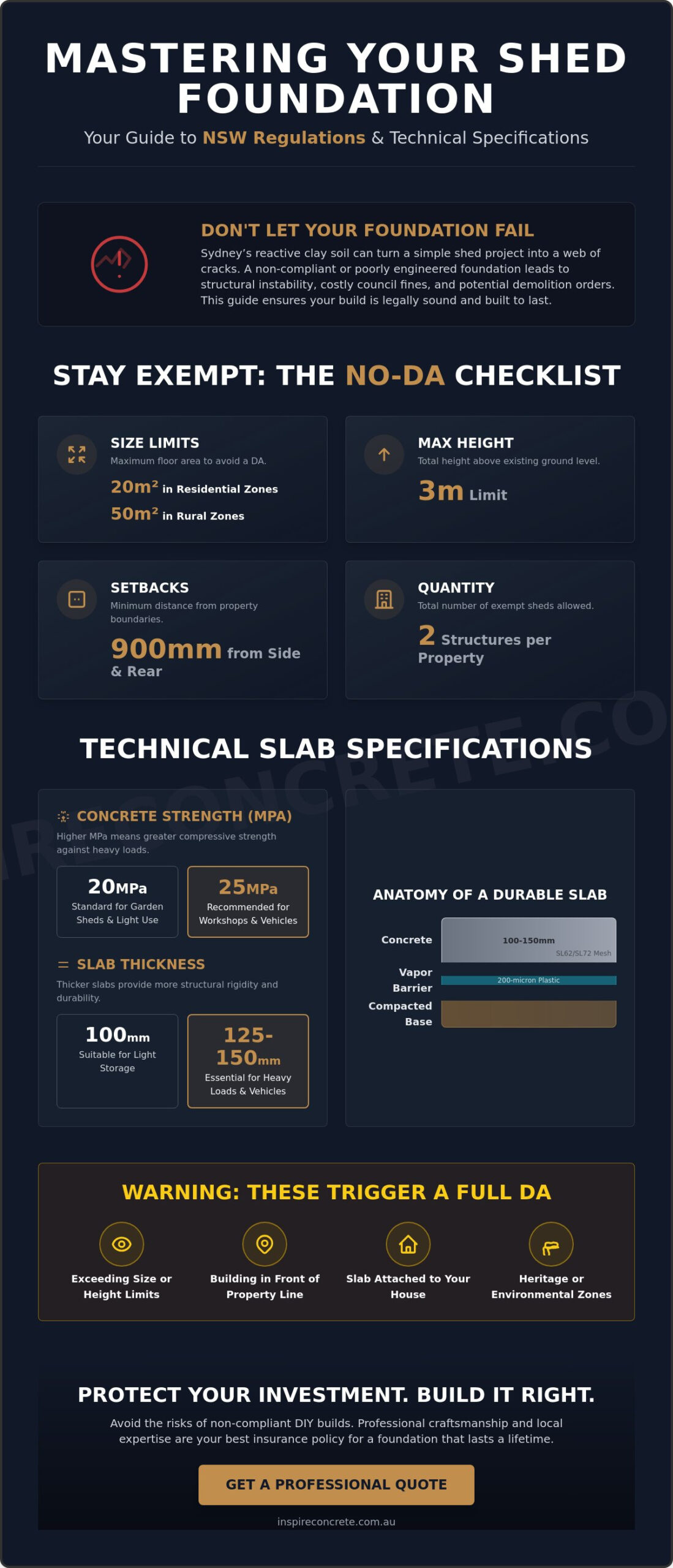
- Size Limits: Maximum 20sqm in residential areas; 50sqm in rural zones.
- Height: Maximum 3 metres above ground level.
- Setbacks: At least 900mm from side and rear boundaries in residential zones.
- Quantity: Limited to two exempt structures per property.
The 2026 SEPP Framework for Backyard Structures
The State Environmental Planning Policy (Exempt and Complying Development Codes) 2008 provides the legal backbone for your build. In 2026, these rules remain strict about location and materials. To stay exempt, your shed must be detached. This means your new slab cannot be physically joined to your house foundation. If it is, the council classifies it as an house extension, which requires significantly more paperwork. On bushfire-prone land, any structure within 5 metres of a dwelling must use non-combustible materials to protect the main residence from ember attacks.
When Your Foundation Requires a Development Application (DA)
Exceeding the 20-square-metre limit is the fastest way to trigger a full Development Application. However, size isn’t the only factor. If you plan to build in front of the building line of your road frontage, you’ll need council approval. This is a common trap for Sydney homeowners with large front yards. Heritage conservation areas and environmental zones also have their own sets of rules. In these locations, even a small garden shed slab might require a formal assessment to ensure it doesn’t impact the character or ecology of the area. Mastering these shed foundation requirements nsw ensures your project remains a lifestyle asset rather than a regulatory headache.
Technical Concrete Slab Requirements for Sheds in NSW
Building a shed that lasts decades requires more than just pouring wet concrete into a wooden frame. It demands a technical approach that respects the physics of the material. To meet the shed foundation requirements nsw, you must start with the correct concrete grade. For a standard residential garden shed, a 20MPa mix is the industry baseline. However, if your vision involves a heavy-duty workshop or housing a vehicle, upgrading to 25MPa is a wise investment. This higher compressive strength prevents surface dusting and ensures the slab can handle the point loads of heavy machinery without fracturing.
Slab thickness is the next non-negotiable factor. While a 100mm slab is suitable for light storage, any structure intended for significant weight should be at least 125mm to 150mm thick. This volume of concrete provides the thermal mass and structural rigidity needed to resist the elements. Beneath the concrete, a 200-micron vapor barrier is essential. This heavy-duty plastic membrane prevents ground moisture from seeping into your shed, protecting your equipment from rust and keeping the internal environment dry.
Reinforcement mesh provides the internal skeleton of your slab. For most backyard projects, SL62 or SL72 steel mesh is the standard. It provides the tensile strength needed to hold the concrete together as it cures and settles. If you’re aiming for a premium finish, consulting with experts in shed slabs ensures your technical specifications match the unique demands of your site.
Australian Standards (AS 2870) for Residential Slabs
Even though sheds are often classified as non-habitable Class 10a structures, following AS 2870 (Residential Slabs and Footings) is the best way to ensure longevity. This standard is particularly relevant in Sydney, where soil movement is a constant threat. Edge thickening is a key requirement under these guidelines. By increasing the concrete depth around the perimeter, typically to 300mm, you create a beam effect that supports the weight of the shed walls and prevents the slab from tilting or sinking.
Reinforcement and Jointing
Precision placement of the steel mesh is what separates a professional build from a DIY failure. The mesh must never sit on the ground; it needs to be suspended on plastic chairs so it sits within the top third of the concrete pour. This ensures the steel is fully encased and can effectively manage tension. Additionally, control joints must be saw-cut into the slab within 24 hours. These joints act as planned weak spots that encourage the concrete to crack in a straight, controlled line during shrinkage, preserving the aesthetic and structural integrity of the rest of the floor.
Site Preparation: Managing Sydney’s Reactive Clay and Sloping Blocks
Sydney’s geological diversity presents a unique set of challenges for any construction project. From the shale of the Inner West to the highly reactive clay common in Western Sydney, the ground beneath your feet is constantly in motion. These soils are often classified as H1 or H2, meaning they experience high to very high ground movement. To meet shed foundation requirements nsw, your site preparation must account for this volatility. Without proper engineering, the expansion and contraction of clay will eventually force even the thickest concrete to crack. A floating slab is frequently the preferred solution here, designed to move as a unified structure with the soil rather than resisting it until failure occurs.
Drainage is the silent partner in structural stability. You must ensure that water is directed away from the foundation at every stage. Standing water saturates the clay, causing localized swelling that puts uneven pressure on the concrete. By installing a slight grade around the perimeter or integrating localized drainage pits, you protect the sub-base from erosion. This proactive approach ensures your foundation remains a stable platform for your shed, regardless of Sydney’s unpredictable weather patterns.
Dealing with Sloping Backyards
Level ground is a luxury many Sydney homeowners don’t have. Creating a flat site usually involves a “cut and fill” process, where soil is moved from the high side of the slope to the low side. However, the structural integrity of the “fill” side is critical. If the slope is significant, you may need a retaining wall to support the foundation. Under NSW Exempt Development rules, a retaining wall can generally be built up to 600mm without a separate permit, provided it meets setback requirements. Always ensure the fill is compacted in layers to prevent the slab from sinking on one side over time.
The Importance of a Compacted Sub-Base
You can’t pour a professional slab directly onto topsoil or grass. Organic matter eventually rots, leaving voids that cause the concrete to sag. The process begins by stripping the site back to stable subsoil and replacing it with a layer of high-quality road base or gravel. Precision matters during this stage. We use a mechanical plate compactor to ensure the base is rock-solid. A hand-tamp simply won’t achieve the density required to support a heavy shed. This phase is also where we establish the Relative Level (RL), ensuring the finished height of your slab perfectly aligns with your property’s creative vision and practical needs. Mastering these shed foundation requirements nsw at the ground level is what guarantees a build that lasts for decades.
The Concreting Checklist: From Excavation to Curing
Precision on the day of the pour transforms a pile of raw materials into a structural masterpiece. Following the established shed foundation requirements nsw involves a disciplined sequence that respects both the chemistry of concrete and the legal boundaries of your property. Every tool, from the laser level to the bull float, plays a part in ensuring the final result is perfectly square and level. It’s not just about getting the concrete on the ground; it’s about managing the environment to allow the material to reach its full potential. A well-executed timeline prevents the rushed decisions that lead to aesthetic flaws or structural weaknesses.
Step-by-Step Foundation Execution
- Step 1: Marking out. We start by double-checking the 900mm setbacks from your boundaries. Using string lines and a 3-4-5 triangle method ensures the footprint is perfectly square before the first shovel hits the dirt.
- Step 2: Excavation and formwork. After removing the topsoil, we install sturdy timber formwork. This acts as the mold for your slab, and it must be braced heavily to withstand the immense pressure of the wet concrete.
- Step 3: Internal preparation. We lay the compacted sub-base, the 200-micron vapor barrier, and the steel reinforcement. Each component must be positioned with millimetre precision to meet NSW structural standards.
- Step 4: The pour. We manage the “slump” of the concrete as it arrives, ensuring it has the right workability to be screeded and finished to a smooth, professional level.
Sydney’s climate requires constant vigilance. High temperatures can cause the concrete to “go off” too quickly, leading to surface cracking, while unexpected rain can pit the finish. When you’re ready to move from planning to production, partnering with experts for professional shed slabs guarantees your project starts on a rock-solid foundation.
Curing and Finishing Touches
The most common mistake homeowners make is rushing to build the shed too soon. Concrete doesn’t just “dry”; it undergoes a chemical process called hydration. While the slab might feel hard to the touch within 24 hours, it takes significantly longer to reach its design strength. You should wait at least 7 days before bolting the shed frame to the slab. During this first week, keeping the concrete slightly moist—a process known as wet curing—is essential. This slows down the moisture loss and results in a much harder, more durable surface that won’t flake or dust over time. Stripping the formwork should also be done carefully after the first few days to avoid chipping the “green” concrete edges, preserving the clean lines of your new foundation.
By respecting these shed foundation requirements nsw, you ensure the longevity of your build. A patient approach to curing is the final step in achieving a finish that balances rugged durability with refined craftsmanship.
Why Professional Installation is Your Best Insurance Policy
Building a shed is a significant investment in your property’s utility and aesthetic value. While a DIY approach might seem like a path to savings, the hidden costs of a failed pour often far outweigh the initial economy. Professional installation acts as a structural insurance policy, protecting you from the long-term consequences of shifting soil or poor drainage. Meeting shed foundation requirements nsw is about more than just reading a checklist; it involves applying professional trade standards to every cubic metre of concrete to ensure the structure remains stable for decades.
Shed manufacturers are notoriously strict regarding their warranty terms. If your slab is unlevel by even a few millimetres, it can put undue stress on the shed frame, causing doors to jam, panels to warp, and seals to fail. Most warranties specifically state that the structure must be installed on a compliant, level foundation. Losing this protection because of a “cheap” slab is a mistake that’s difficult and expensive to rectify once the steel is already bolted down. Professional concreters provide the precision required to keep your manufacturer’s warranty fully intact.
Local council variations across Sydney can also be a minefield for the uninitiated. While state-level policies provide the framework, individual local environmental plans often include specific nuances regarding drainage or site coverage. We handle these complexities daily, ensuring your project doesn’t just meet the basic shed foundation requirements nsw, but also satisfies the specific expectations of local building inspectors. This level of project management is essential for larger sheds that may require architectural drafting or formal certification.
Expertise in Sydney Conditions
From the challenging slopes of the Blue Mountains to the reactive clay of Western Sydney, we’ve mastered the local terrain. We provide the necessary certification for complying development, taking the guesswork out of the approval process. Our team understands that a shed is often just the beginning of a property’s transformation. We can seamlessly integrate your foundation with other high-end projects, such as a new concrete driveway or a refined alfresco entertaining area, creating a cohesive look for your home.
The Inspire Concrete Advantage
Inspire Concrete brings over 20 years of specialized experience in crafting durable concrete slabs across the Sydney region. We believe in the value of refined craftsmanship and rugged professionalism, which is why we offer fixed-price contracts that include comprehensive site preparation and a professional finish. We act as your project partner, ensuring that every detail, from the sub-base compaction to the final curing, is handled with meticulous care. Contact Inspire Concrete for a professional shed slab quote today and ensure your vision is built on a foundation of excellence.
Securing the Future of Your Backyard Transformation
A compliant shed begins with a deep respect for local regulations and ends with a slab that can withstand the unique pressures of the Sydney landscape. By mastering the shed foundation requirements nsw, you move beyond a simple storage solution toward a lasting property asset that enhances your lifestyle. You now understand that structural success depends on more than just pouring concrete; it requires precise site preparation, the correct reinforcement mesh, and a patient approach to the curing process.
Don’t leave the integrity of your build to guesswork or generic advice. With over 20 years of Sydney concreting experience, our licensed and insured tradesmen specialize in navigating reactive soil foundations to deliver a result that is both legal and elegant. We transform the technical complexity of building codes into a seamless, high-end experience for every client.
Ready to start your project? Get a Professional Shed Slab Quote from Inspire Concrete and build with the confidence of a master craftsman. Your vision deserves a foundation that lasts a lifetime.
Frequently Asked Questions
Do I need council approval for a shed slab in NSW?
You generally don’t need formal council approval if your project qualifies as Exempt Development under the State Environmental Planning Policy. This requires the structure to meet specific size, height, and setback limits. If your shed exceeds these benchmarks, you’ll need to lodge a Development Application (DA) or obtain a Complying Development Certificate (CDC) before pouring the concrete.
How thick should a concrete slab be for a garden shed?
A standard garden shed foundation should be at least 100mm thick to provide adequate structural support. If you plan to store heavy machinery or vehicles, increasing the thickness to 125mm or 150mm is essential. This added depth ensures the slab can handle higher point loads without cracking under the pressure.
What is the maximum size shed I can build without a permit in NSW?
In residential zones across NSW, the maximum floor area for an exempt shed is 20 square metres. Rural properties in zones RU1 to RU4 and R5 allow for larger structures up to 50 square metres without a permit. Staying within these limits is a primary part of mastering the shed foundation requirements nsw while avoiding the paperwork of a full council application.
Can I pour a shed foundation myself in Sydney?
You can technically pour a slab yourself, but DIY builds often fail to account for Sydney’s reactive clay soils. Professional installers bring the specialized equipment and engineering knowledge required to prevent structural failure. A self-poured slab that isn’t perfectly level can also void your shed manufacturer’s warranty, leading to expensive repairs later.
How far from the fence does a shed need to be in NSW?
Most residential sheds must be set back at least 900mm from any side or rear boundary to qualify as an exempt development. If the structure is higher than 2.4 metres and located within 900mm of the fence, it likely won’t meet the state’s simplified rules. Rural zones have stricter requirements, often demanding a 5-metre setback from boundaries.
Does a shed foundation need reinforcement mesh?
Yes, internal reinforcement is vital for managing the tensile stresses that cause concrete to pull apart. Using SL62 or SL72 steel mesh provides the necessary skeleton to keep the slab intact during soil movement. Without this steel reinforcement, your foundation will likely develop structural cracks that compromise the entire building’s stability.
How long should concrete cure before I build my shed on it?
You should wait a minimum of 7 days before bolting your shed to the new concrete. While the surface may feel hard within 24 hours, the internal chemical hydration process takes time to reach the required compressive strength. Building too early can cause the anchors to pull out or the slab to crack under the sudden weight of the frame.
What happens if I build a shed foundation without approval?
Building a non-compliant foundation can result in heavy council fines or formal demolition orders. It also creates significant hurdles when you try to sell your property, as unauthorized structures are flagged during the conveyancing process. Ensuring your project meets all shed foundation requirements nsw from the start protects your investment and your peace of mind.
