
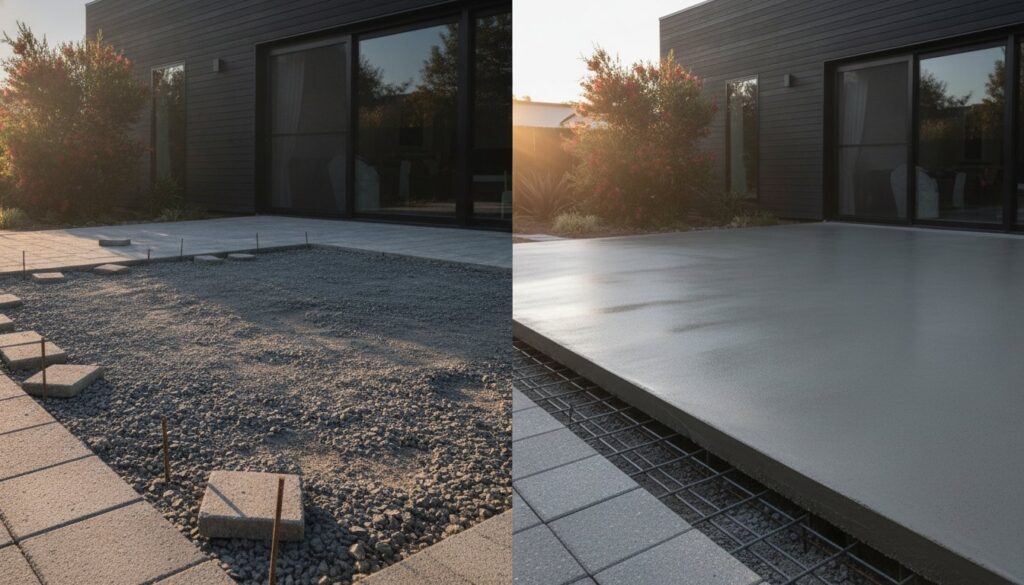
What if the “budget-friendly” paver base you’re considering for your new backyard workshop actually ends up costing you double in structural repairs and a voided warranty within just a few years? It’s a frustrating reality for many Sydney homeowners who watch their shed doors jam and floors warp as the ground beneath them inevitably shifts. You want a foundation that reflects the quality of the structure it supports, ensuring your investment remains level and secure regardless of the season.
Choosing between a shed slab vs paver base sydney requires more than just a quick price comparison; it demands an understanding of our local reactive clay and modern building standards. We’ve seen how the right engineering can transform a basic utility area into a permanent asset that lasts 40 years or more. In this guide, we’ll compare the long-term stability of reinforced concrete against the flexibility of pavers, while navigating the 2026 NSW council regulations for exempt developments. You’ll discover exactly how to protect your shed’s structural integrity and maintain full warranty compliance through expert craftsmanship.
Key Takeaways
- Discover why a professional monolithic foundation is essential for preventing structural failures like jammed doors or warped frames in Sydney’s unique landscape.
- Evaluate the true lifetime ROI of a shed slab vs paver base sydney property owners need to know, accounting for long-term maintenance and structural warranties.
- Learn how Sydney’s reactive clay and sandstone basins impact ground movement and why specialized reinforcement is the key to a 40-year foundation.
- Navigate the latest NSW building regulations and exempt development thresholds to ensure your shed foundation remains fully compliant and legally secure.
- Determine the ideal foundation for your specific site using a decision matrix that balances shed size, load requirements, and sloping terrain.
Shed Slab vs Paver Base: Choosing the Right Foundation for Sydney
The foundation is the most critical component of any backyard structure. It’s the silent partner that dictates whether your shed remains a functional asset or becomes a structural liability. When evaluating a shed slab vs paver base sydney, the decision hinges on how you intend to use the space and the specific geological profile of your suburb. From the heavy clay of Western Sydney to the sandstone ridges of the North Shore, the ground is constantly in motion. Your choice of base must be able to withstand these local environmental pressures.
What is a Reinforced Concrete Shed Slab?
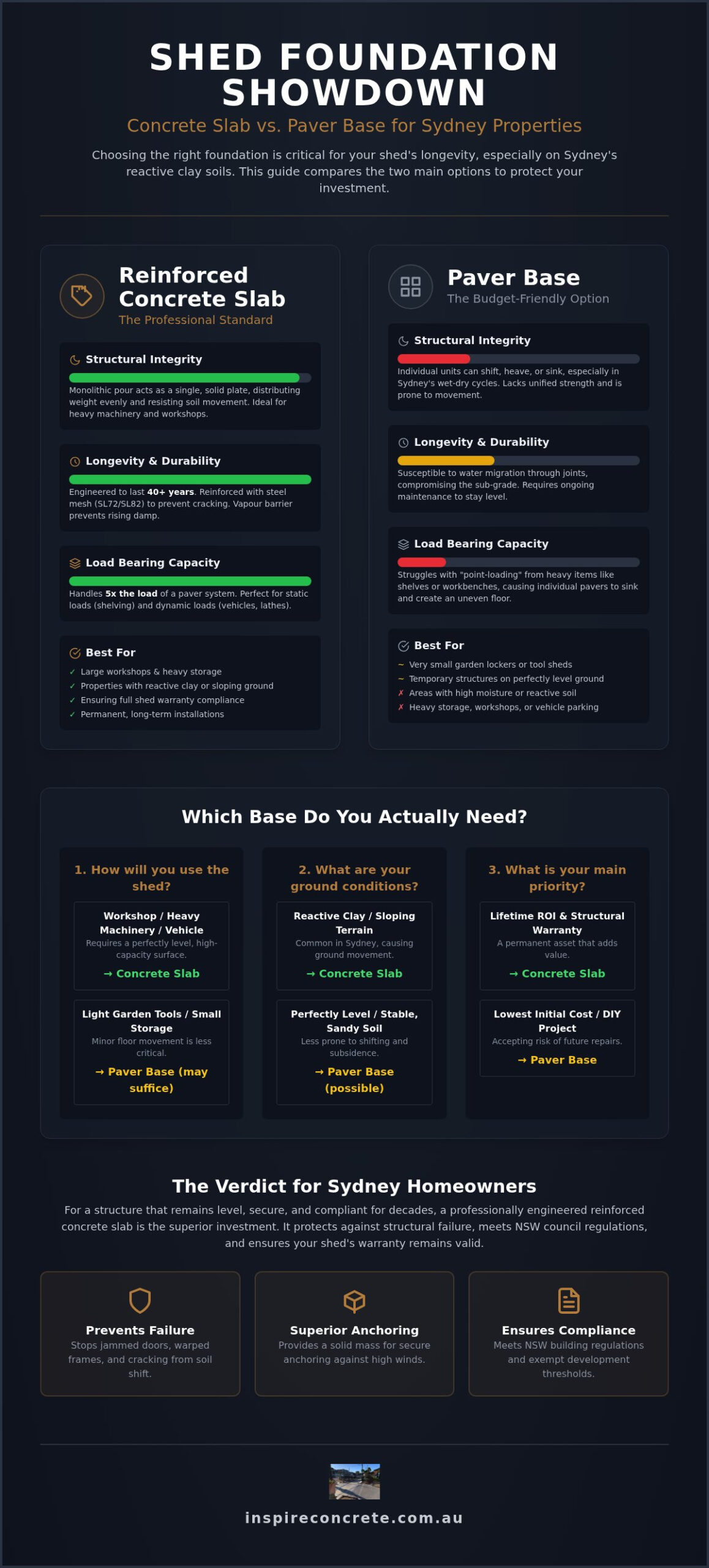
A concrete shed slab is a reinforced, monolithic foundation engineered for permanent stability. It’s a single, continuous pour that acts as a solid plate, distributing weight evenly and resisting the upward pressure of reactive soils. We view the slab as an engineering feat rather than just a utility floor. A professional installation involves a meticulous sequence of preparation:
- Precision excavation and a compacted road base to create a stable sub-grade.
- High-quality vapour barriers to prevent rising damp from reaching your equipment.
- Strategic placement of SL72 or SL82 steel mesh to provide essential tensile strength.
This reinforcement is vital. It prevents the structural cracking that often plagues thinner, non-engineered pours. A professional finish, whether a non-slip broom finish or a smooth steel trowel, ensures the shed walls sit perfectly flush. This precision eliminates gaps where pests or water might enter, protecting your shed’s structural integrity from day one.
The Reality of a Paver Base System
A paver base consists of individual units laid on a multi-layered bed of compacted road base and bedding sand. While it offers a degree of flexibility, it lacks the unified strength of a monolithic pour. The system relies heavily on edge restraints to keep the units from spreading over time, but it remains susceptible to the elements. Moisture is the primary adversary here. Unlike a solid concrete barrier, water can migrate through the joints of a paver base, potentially compromising the sub-grade below.
In Sydney’s intense wet-dry cycles, this moisture migration often leads to individual units “heaving” or sinking. When one paver shifts, the level of the entire floor is compromised. This movement is what causes the dreaded jammed door or a frame that no longer sits square. While pavers might serve for a small garden locker, they rarely provide the long-term certainty required for larger workshops or heavy storage.
Structural Integrity and Load-Bearing Capacity
Building a shed isn’t just about the walls; it’s about the physics of what happens inside. You need to distinguish between static loads, like a lawnmower sitting still, and dynamic loads, like a running wood lathe or a vehicle moving over the floor. When considering a shed slab vs paver base sydney, the way your foundation handles these forces determines if your shed remains square over the next decade. A concrete slab acts as a unified plate. When you place a heavy workbench in one corner, the slab distributes that weight across its entire surface area. This prevents the foundation from tilting or cracking under pressure.
In Sydney, where wind ratings can be high, a solid slab also provides the necessary mass for secure anchoring. Dynabolts or chemical anchors into concrete offer far superior pull-out resistance compared to anchoring into pavers or a timber frame. Without this heavy, solid connection to the earth, high-wind events can put immense stress on the shed’s frame, leading to structural fatigue or even lifting.
Why Slabs Win for Workshops and Heavy Storage
If your shed is destined to be a workshop, the floor must support heavy machinery, automotive tools, and high-density shelving. Precision work requires a perfectly level surface; even a few millimetres of tilt can throw off a table saw or cause cabinet doors to swing open. A standard 100mm thickness of 25MPa reinforced concrete provides an incredibly dense foundation that comfortably handles five times the load-bearing capacity of a typical paver system. This structural density ensures that even under the vibration of heavy power tools, the floor remains silent and stable. For those planning a serious workspace, professional shed slabs provide the only foundation that won’t give way under pressure.
The Limitations of Paver Weight Distribution
Pavers struggle with “point-loading.” This occurs when the entire weight of a heavy shelf is concentrated on the four small feet of the unit. Because pavers are individual units, that pressure is forced directly into the bedding sand below. If moisture has compromised that sand layer, the paver will sink or tilt independently of its neighbours. This leads to the “rocking” effect. Once one paver moves, the edge restraints are stressed, and the surrounding units often follow. Most major steel shed manufacturers understand this risk. That’s why they often specify a reinforced concrete base as a mandatory requirement for their structural warranties. Without it, the frame of the shed can twist, leading to leaks and premature rust.
Cost vs. Longevity: The True ROI of Your Shed Foundation
Viewing your foundation as a long-term investment rather than a line-item expense changes the perspective on shed slab vs paver base sydney comparisons. While pavers often appear as the low-barrier entry point, the total cost of ownership tells a different story. A professionally poured slab is a permanent asset. It typically offers a lifespan of 50 years or more with zero maintenance. In contrast, even a well-installed paver base often begins to show signs of distress within 5 to 7 years. In the high-stakes Sydney property market, a reinforced concrete foundation signals quality and durability to future buyers, adding tangible value to your home’s infrastructure.
The hidden costs of a DIY paver installation often erode any initial savings. Homeowners frequently underestimate the expense of hiring specialized equipment like plate compactors or the price of high-quality bedding sand and edge restraints. Mistakes during the excavation phase can lead to significant material waste or the need for professional remediation. When you factor in the labor required for ongoing upkeep, the “cheap” alternative often becomes the more expensive path over a decade of use. It’s about building it once and building it right.
Initial Investment vs. Maintenance Costs
Paver bases are inherently high-maintenance systems. Over time, the jointing sand washes away during Sydney’s heavy rain events, requiring regular re-filling to maintain structural friction. Without constant vigilance, weeds and insects inevitably find their way into the gaps, undermining the aesthetic of your backyard. Concrete offers a “set and forget” solution that respects your time. It provides a seamless, easy-to-clean surface that remains impervious to pests and vegetation. For a deeper dive into why permanent foundations win, explore The Essential Guide to Concrete Slabs in Sydney.
Impact on Shed Manufacturer Warranties
Protecting your investment means keeping your shed’s warranty intact. Most major manufacturers list “unlevel or unstable ground” as the primary reason for denying warranty claims. If a paver shifts by just 10mm, the resulting torque on the steel frame can cause roof leaks or structural failure. A reinforced slab provides the absolute level of precision required for a valid claim. It also allows for the chemical or physical anchoring systems that Sydney’s wind ratings demand. We often recommend a rebated slab edge, a sophisticated design feature where the shed walls sit lower than the floor level. This prevents water from seeping under the walls, effectively stopping floor rot and moisture ingress before they start.
Navigating Sydney’s Specific Environmental Challenges
Sydney’s geography presents a unique set of challenges that can quickly dismantle a poorly planned foundation. From the rugged sandstone ridges of the North Shore to the deep alluvial clay basins in the west, the ground is rarely static. When deciding on a shed slab vs paver base sydney, you must account for the dramatic wet and dry cycles that define our local climate. These cycles cause the earth to expand and contract with enough force to snap unreinforced footings or heave individual pavers out of alignment. Choosing the right base isn’t just about today’s aesthetics; it’s about anticipating how the land will behave over the next twenty years.
Reactive Clay Soils in Western Sydney
Western Sydney and parts of the Blue Mountains are notorious for Class H (High) and Class E (Extremely) reactive soils. These soil types are essentially sponges that swell significantly when wet and shrink during our hot, dry summers. Pavers are virtually guaranteed to shift in these conditions because they lack the collective mass to resist ground movement. Professional house slab builders understand that these sites require more than just a surface-level pour. We utilize deep edge beams and specific steel reinforcement to anchor the structure into more stable sub-soil layers, ensuring your shed remains level while the surrounding yard moves.
Termite Protection and Australian Standards (AS 3660)
Termite protection is a non-negotiable factor under Australian Standard AS 3660, especially in Sydney’s leafy suburbs. A monolithic concrete slab creates a clear visual inspection zone around the perimeter of your structure. This makes it nearly impossible for termites to enter undetected. Conversely, pavers laid directly on soil or sand create a subterranean highway for pests. They can build mud tunnels through the gaps between pavers, reaching your timber workbenches or stored valuables without ever being seen. Ensuring your foundation complies with AS 3660 isn’t just a legal checkbox; it’s the only way to ensure your shed doesn’t become a buffet for local colonies.
Local council regulations also play a pivotal role in your foundation choice. In NSW, most residential sheds under 20 square meters are considered exempt development, provided they meet specific height and setback requirements. For example, a shed within 900mm of a boundary is restricted to a height of 2.4 meters. If your project exceeds these dimensions or requires complex drainage solutions, a structural slab often becomes a mandatory part of the building approval process. If you’re unsure about your site’s soil classification or local setbacks, our team can provide the technical expertise needed for a professional shed slab that meets every regulatory standard.
The Decision Matrix: Which Base Do You Actually Need?
Selecting the right foundation for your project isn’t just about the immediate budget; it’s about matching the engineering to the intended purpose. When navigating the choice between a shed slab vs paver base sydney homeowners often find themselves at a crossroads between temporary convenience and permanent value. To make the right call, you need to evaluate three core factors: the scale of the structure, the complexity of your site, and the value of what you’re storing inside. A small plastic locker for pool toys requires a different level of structural commitment than a 6×4 metre steel workshop destined to house a high-end tool collection.
Your site’s topography also dictates the terms of the build. While pavers might suffice on a perfectly level, sandy patch in a coastal suburb, they’re rarely suitable for sloping blocks. Building on a gradient requires the structural mass of a reinforced slab to prevent the entire foundation from creeping downhill over time. If you’re planning to store a riding mower, a boat, or a $10,000 workshop setup, the foundation must be as uncompromising as the equipment it protects.
When Pavers are a Practical Choice
Pavers are a sensible solution in specific, limited scenarios. If you’re installing a small garden locker on stable, sandy soil, a well-compacted paver base can provide adequate support for lightweight items. They’re also the preferred choice for rental properties where permanent concrete structures aren’t permitted, as they can be lifted and removed when the lease ends. Additionally, if your shed is situated directly over critical underground utilities or inspection points, pavers allow for future access without the need for a jackhammer. However, this flexibility comes at the cost of the absolute stability found in a monolithic pour.
Why Professionals Recommend a Poured Slab
For any structure intended to last more than a few seasons, professional concreters in Sydney will almost always recommend a reinforced slab. It’s the only foundation that provides total structural security against Sydney’s intense weather extremes and reactive ground movement. Beyond the technical benefits, there’s a significant aesthetic advantage. A professionally finished slab provides a clean, refined look that can be designed to integrate seamlessly with your existing concrete pathways, creating a cohesive visual flow across your property.
Ultimately, a shed slab is an investment in peace of mind. It ensures your shed doors stay aligned, your floor stays dry, and your manufacturer’s warranty remains intact. If you’re ready to transform your backyard with a foundation that stands the test of time, contact Inspire Concrete for a professional shed slab quote. We bring the precision and craftsmanship required to turn a basic utility area into a durable, high-value asset for your Sydney home.
Secure Your Investment with a Foundation Built for Sydney
Your shed is more than just four walls; it’s a workspace, a storage hub, and a permanent part of your home’s footprint. We’ve explored how the choice between a shed slab vs paver base sydney homeowners face impacts everything from structural warranty to daily functionality. While pavers offer a quick fix, they lack the monolithic strength required to resist the shifting movement of our local reactive clay soils. A reinforced concrete slab provides the absolute precision and load-bearing capacity that modern steel structures demand.
At Inspire Concrete, we bring over 20 years of Sydney experience to every project. As family-owned and operated specialists in reactive soil foundations, we ensure your structure remains square and secure for decades to come. Don’t leave your shed’s integrity to chance with a shifting base that voids your warranty. Get a Professional Shed Slab Quote from Inspire Concrete Today and build with the certainty of expert craftsmanship. It’s time to transform your backyard with a foundation that stands as a testament to quality.
Frequently Asked Questions
Can I put a garden shed on pavers instead of concrete?
You can install a small garden shed on pavers, but this is only recommended for lightweight structures on stable, sandy soil. For larger workshops or steel sheds, a concrete slab is essential to prevent the frame from twisting. When comparing a shed slab vs paver base sydney homeowners should prioritize the slab for any structure housing valuable equipment or requiring a level floor for door alignment.
How thick should a concrete shed slab be in Sydney?
A standard thickness of 100mm is the industry benchmark for most residential shed slabs in Sydney. This depth provides ample strength for domestic storage, home offices, or hobby workshops. If you’re planning to store heavy vehicles, trailers, or industrial-grade machinery, a thicker slab with specialized steel reinforcement may be necessary to ensure the foundation doesn’t fail under high-point loads.
Do I need council approval for a shed slab in NSW?
Council approval isn’t required in NSW if your shed qualifies as an exempt development. To meet this criteria in 2026, the structure must be 20 square meters or smaller and no higher than 3 meters. It must also sit behind the existing building line and maintain a 900mm setback from side and rear boundaries. Always verify local variations with your specific Sydney council before starting work.
Is it cheaper to do a paver base or a concrete slab?
A professional concrete slab is often more cost-effective than a high-quality paver installation. While DIY pavers appear cheaper at first, the hidden costs of hire equipment, bedding sand, and edge restraints quickly add up. When evaluating a shed slab vs paver base sydney, the long-term ROI of concrete consistently outperforms the high maintenance costs of pavers, offering a 40-year lifespan with minimal upkeep.
How do I stop my shed slab from cracking in reactive clay?
Preventing cracks in Sydney’s reactive clay requires a combination of proper sub-grade preparation and internal reinforcement. We use SL72 or SL82 steel mesh to provide the tensile strength needed to resist soil movement. Deepened edge beams are also critical in Western Sydney. They anchor the slab into more stable ground, ensuring the entire foundation moves as a single, unified plate rather than snapping under pressure.
What is a rebated shed slab and do I need one?
A rebated slab is a foundation with a recessed edge designed specifically so the shed walls sit lower than the floor level. You need this feature if you want to prevent water from seeping into your shed during heavy rain. It creates a physical barrier against moisture ingress and protects your floor and contents from rot, making it a vital upgrade for high-end workshops.
Can termites get through a concrete shed slab?
Termites cannot penetrate a solid, professionally poured concrete slab. However, they are experts at finding paths through the many joints and gaps inherent in a paver base. A concrete foundation allows for a clear visual inspection zone around the perimeter. This compliance with Australian Standard AS 3660 ensures you can spot and stop termite activity before it reaches your shed’s internal contents or timber workbenches.
How long does a concrete shed slab take to cure before I can build?
Your concrete slab needs time to cure before it can safely support a structure. While you can typically walk on the surface after 48 hours, we recommend waiting at least 7 days before assembling the shed. This curing period ensures the concrete has reached sufficient structural strength to handle the weight of the steel frame and any heavy machinery you plan to install immediately after completion.
