
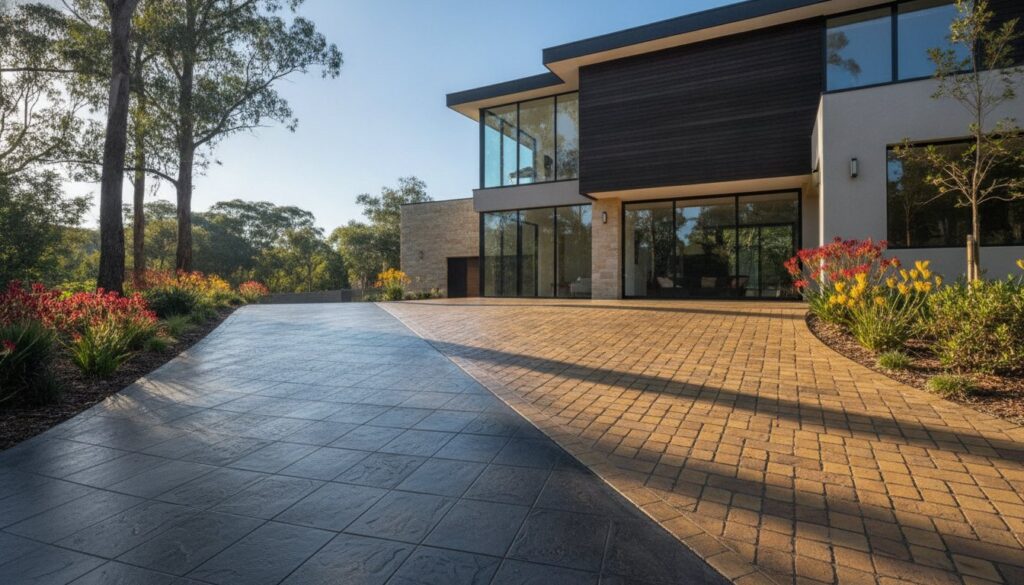
That high-gloss, deep-textured driveway you admired in a design magazine might be the very thing that turns your steep Sydney block into a dangerous skating rink after a sudden summer downpour. Deciding on the right stencil vs stamped concrete sydney finish is rarely just about picking a pattern. It’s a critical engineering decision that impacts your home’s safety and long-term structural health. You likely want a finish that elevates your property’s street appeal while standing firm against the relentless movement of Western Sydney’s reactive clay soils.
We understand the concern of seeing a beautiful investment develop hairline fractures or lose its grip within a few seasons. This 2026 comparison provides the technical clarity you need to balance architectural elegance with the rugged durability required for our local climate. You will discover which decorative finish offers the best slip resistance for sloping blocks and how modern 32MPa pours ensure a 20 year lifespan. We will preview the latest trends in minimalist textures and explain how to meet the newest Australian building standards, ensuring your driveway remains a high-end asset rather than a maintenance burden.
Key Takeaways
- Learn why 32MPa concrete and specialized reinforcement are essential for managing Western Sydney’s reactive clay soil to prevent long-term structural cracking.
- Discover the functional differences between stencil vs stamped concrete sydney to determine which decorative finish aligns with your home’s architectural style and maintenance goals.
- Identify the critical safety requirements for sloping blocks by understanding how P5 slip-resistance ratings keep steep driveways safe in wet weather.
- Explore how to achieve the sophisticated look of natural stone or slate without the high cost and maintenance burdens of traditional paving.
Defining the Decorative Dilemma: Stencil vs. Stamped Concrete
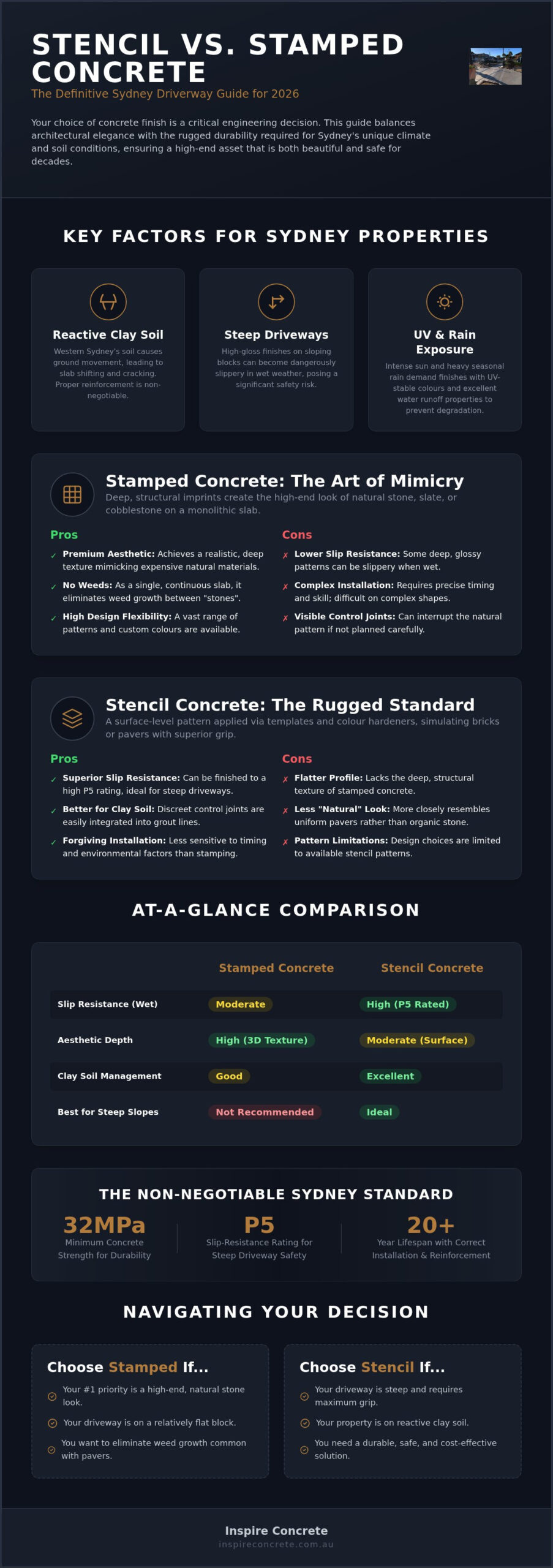
When comparing stencil vs stamped concrete sydney, stamped concrete offers a deep, structural imprint mimicking natural stone, while stencil concrete provides a surface-level pattern using paper templates and colour hardeners to simulate pavers or bricks. Stamped concrete is the art of imprinting textures into wet concrete to mimic slate or cobblestone. Stencil concrete uses a disposable paper stencil to create grout-like patterns, offering a flatter but highly versatile finish. Both techniques are core components of What is Decorative Concrete?, yet the right choice depends heavily on your property’s specific conditions.
Sydney’s geography dictates your decorative strategy. The reactive clay soil found across Western Sydney and the steep gradients of the Blue Mountains put immense pressure on residential slabs. If you don’t account for these environmental factors, even the most expensive finish will fail. Your choice must bridge the gap between architectural vision and structural reality.
The Aesthetic Role of Modern Concrete in Sydney
In 2026, “architectural concrete” has become the standard for high-end Sydney homes. Homeowners are moving away from basic utility toward surfaces that enhance property value and reflect contemporary design trends. In suburbs from the Hills District to the Inner West, the trend leans toward minimalist textures and muted, earthy palettes. These designs must withstand Western Sydney’s harsh weather, including high UV levels and heavy seasonal rain. A well-executed decorative finish doesn’t just look good; it serves as a durable, long-term asset for your home’s exterior.
Core Structural Differences at a Glance
The difference between these finishes starts the moment the concrete hits the ground. Stamping requires imprinting heavy mats into the wet mix, which creates a deep texture but requires precise timing. Stencilling involves laying a pattern on the surface and applying a colour hardener, resulting in a flatter profile. These processes interact differently with Sydney’s soil and terrain:
- Soil Movement: Reactive clay causes slabs to shift. Stencil concrete often allows for more discreet control joint placement, which helps manage this movement without breaking the visual pattern.
- Gradient Safety: On steep Sydney blocks, the texture of the finish determines safety. Stencilled surfaces can be finished with a higher slip-resistance rating than some deep-stamped patterns.
- Installation Complexity: Stamping is a labour-intensive process that demands a perfect environment, whereas stencilling can be slightly more forgiving in Sydney’s unpredictable humidity.
Precision in the planning phase ensures your chosen finish remains beautiful and safe for decades. Every project we undertake considers these structural nuances to ensure the final result is both a visual transformation and a sound engineering investment.
Stamped Concrete Pros and Cons: The Art of Mimicry
Stamped concrete excels at transforming a standard driveway into a textured masterpiece. By imprinting patterns into wet concrete, we can replicate the organic beauty of European slate or traditional bush rock. When weighing up stencil vs stamped concrete sydney, stamping is often the choice for those seeking a premium, monolithic surface that avoids the maintenance headaches of individual pavers. It offers a level of design flexibility that is difficult to match with other decorative methods.
Achieving a High-End Look Without the Maintenance
Individual stone pavers eventually succumb to weed growth and shifting. Stamped concrete provides a continuous, reinforced slab that eliminates these issues while offering endless design flexibility. Whether you are matching a Federation-style cottage or a contemporary residence, 2026 UV-stable oxides allow for sophisticated custom colour blending. This ensures your driveway remains vibrant despite the intense Australian sun. Using the ACI Guide to Decorative Concrete as a baseline for technical excellence, we ensure the imprinting process achieves depth without compromising structural integrity.
While the aesthetic is undeniable, imprinting requires a meticulous eye. On complex or curved driveway shapes, pattern alignment becomes a challenge. A poorly executed stamp can result in “ghosting” or mismatched seams that detract from the high-end finish. Precision in the early stages of the pour is the only way to avoid these visual inconsistencies.
The Reality of Wear in the Sydney Basin
Sydney’s frequent rain and sloping blocks introduce specific performance requirements. Deeply textured stamps can sometimes trap water if the falls aren’t perfectly engineered, affecting runoff. More importantly, these surfaces can become slippery when wet. To mitigate this, we integrate high-performance non-slip additives into the final sealant. This is a non-negotiable step for any property with a gradient to ensure a safe, P4 or P5 rated surface.
In the reactive clay soils of Western Sydney, the visibility of hairline cracks is a valid concern. Intricate patterns like cobblestone can actually help disguise minor movement cracks, but the surface tension created during imprinting must be managed with precise joint placement. Regular maintenance is part of the deal. To keep that “wet look” and protect the integral colour from fading, resealing is typically required every 2 to 3 years. If you are looking for a surface that blends this level of artistry with local durability, our stamped concrete driveways offer a tailored solution for your property’s unique layout.
Stencil Concrete & Exposed Aggregate: The Rugged Sydney Standards
For many homeowners, the choice of stencil vs stamped concrete sydney comes down to the battle between high-fashion aesthetics and everyday utility. Stencil concrete and exposed aggregate have become the rugged standards for a reason. They offer superior natural slip resistance, often reaching a P5 rating. This is a critical safety benchmark for the steep driveways common in the Blue Mountains and Sydney’s hilly northern suburbs. These finishes don’t just look solid; they’re engineered to withstand the weight of modern SUVs and the punishing UV levels of Western Sydney summers.
Why Stencilling and Aggregate Dominate Local Driveways
In our two decades of experience, we’ve seen how local stone mixes provide a structural advantage. Exposed aggregate driveways utilize specific Sydney river pebbles or crushed quartz that significantly increase the density of the slab surface. This stone density improves longevity and makes the surface nearly immune to the unsightly tyre marks that often plague smoother stamped finishes. Stencil patterns offer a similar benefit; the grout lines created by the paper template break up the surface, effectively hiding dirt and minor imperfections that would be glaring on a plain slab.
The Barefoot Test for Families
While durability is paramount, comfort shouldn’t be ignored. A heavy exposure aggregate can be uncomfortable for bare feet, especially around alfresco zones or pool surrounds. We often recommend a light exposure for these areas. This involves washing away less of the surface slurry to leave the stones partially embedded, creating a smoother feel. Safety remains the priority, and adhering to Australian slip resistance standards ensures your outdoor space is safe for children and elderly family members.
Heat retention is another factor for Sydney families. Darker stencil colours or certain basalt-heavy stone mixes can absorb significant heat in mid-January. Choosing lighter, sandier tones can keep surface temperatures manageable while maintaining that sophisticated, high-end look. It’s important to remember that these finishes are difficult to patch. If a utility line needs to be run under the driveway later, a seamless repair is nearly impossible. Getting the underground infrastructure right before the pour is essential. These surfaces are built for a 20 year lifespan, provided the initial installation accounts for Sydney’s unique soil movement.
The Ultimate Comparison: Safety, Cost, and Soil Performance
Deciding on stencil vs stamped concrete sydney involves more than just picking a colour; it’s a choice between two distinct engineering outcomes. Stamped concrete requires significant labour hours during the pour, as the pattern must be imprinted precisely while the mix is at the perfect plasticity. Stencil concrete involves a multi-stage process of laying the template and applying hardeners, which allows for more control over the final texture. While stamping offers unmatched architectural mimicry, stencil and aggregate finishes generally provide a more resilient 20-year value proposition for Sydney homes subject to heavy soil movement.
In the reactive clay soils of Western Sydney, soil performance is a deal-breaker. Stamped surfaces are rigid and deep patterns can occasionally highlight hairline fractures if the slab shifts. Stencil concrete handles these minor defects better, as the pattern doesn’t rely on structural imprinting. For homeowners, the goal is a surface that maintains its integrity without frequent, costly repairs. Choosing a finish that complements Sydney’s ground conditions is the only way to protect your investment.
Understanding the 2026 Investment
Several factors influence the final price of your project, including site access, the gradient of the block, and your choice of stone or oxide. A “cheap” decorative quote often skips essential reinforcement like SL82 steel mesh or 32MPa concrete strength, which are vital for preventing cracks in Sydney’s soil. To understand how these variables impact your budget, refer to our Concrete Driveway Cost Sydney: 2026 Pricing Guide for a detailed breakdown of current market rates.
Safety Standards and AS 3600 Compliance
Safety is a primary concern for Sydney’s sloping blocks. AS 3600 compliance and local council regulations often dictate the level of slip resistance required for a driveway crossover. While stamped concrete can be beautiful, it requires high-performance non-slip additives in the sealer to reach a safe P4 rating. For driveways with a gradient steeper than 1:5, exposed aggregate remains the preferred choice. It consistently achieves a P5 rating, providing the necessary grip to keep vehicles and pedestrians safe during Sydney’s heavy rain events.
Maintenance and Long-Term Kerb Appeal
Maintaining a high-end look requires more than just an occasional hose-down. Modern 2026 UV-stable sealers are essential for preventing colour fade and surface dusting caused by the intense Australian sun. Stencil and aggregate surfaces generally require less frequent resealing than the “wet look” finishes typical of stamped concrete. If your existing surface has already begun to show its age, The 2026 Guide to Concrete Resurfacing Sydney offers solutions to restore your property’s aesthetic value. To ensure your project meets the highest structural standards, book a consultation with our Sydney experts today.
Navigating Your Decision: Which Finish Suits Your Property?
A sleek modern home in the Inner West demands a different finish than a heritage cottage in the Blue Mountains. When evaluating stencil vs stamped concrete sydney, your home’s existing lines should guide the aesthetic choice. We use bespoke finishes tailored to Sydney’s unique microclimates, ensuring the result feels like a deliberate extension of your architecture rather than an afterthought. It’s about matching the rugged trade precision with a design-oriented eye for detail.
The “Gradient Test” often simplifies the decision. If your block features a slope steeper than 1:5, safety requirements for grip will override purely decorative desires. In these cases, the natural texture of exposed aggregate or high-grip stencilled finishes becomes the logical choice. These surfaces ensure safe vehicle access during Sydney’s heavy storm seasons while maintaining a sophisticated look. Your traffic patterns also matter. We anticipate heavy vehicle loads by adjusting the slab’s internal reinforcement, ensuring the decorative surface doesn’t compromise structural integrity.
Application-Specific Recommendations
For driveways, stone density and durability are the primary drivers. We recommend finishes that can handle the sheer weight of heavy SUVs without surface spalling or premature wear. Pool surrounds require a different priority list: slip resistance and coolness underfoot. A light-coloured stencil or fine-stone aggregate keeps the surface temperature manageable for bare feet in mid-January. In alfresco areas, we focus on furniture stability. A flatter stencil finish ensures that tables and chairs remain level, providing a seamless transition from your indoor living zones to your outdoor entertaining space.
Partnering with a Sydney Expert Craftsman
Our approach integrates specialised architectural drafting to help you visualise the transformation before the first truck arrives. This is particularly crucial in Western Sydney, where managing reactive clay soils is a technical necessity. We don’t just pour concrete; we engineer sub-bases with SL82 reinforcement to counteract soil movement and prevent structural failure. This technical backbone allows the artistic finish to truly shine without the fear of future cracking.
Before you request your professional concrete quote, ensure your project plan accounts for drainage, council crossovers, and long-term maintenance. A high-end finish is only as good as the craftsmanship behind it. By choosing a partner who understands the intersection of engineering and artistry, you ensure your property’s value increases while your maintenance stress disappears. We take pride in delivering a final result that reflects your creative vision and stands the test of time.
Elevating Your Property with Enduring Craftsmanship
Choosing the right finish means balancing your home’s architectural identity with the structural demands of the Sydney Basin. Whether you opt for the intricate mimicry of stamped concrete or the high-grip utility of a stencilled surface, the success of your project rests on managing sub-base stability and local soil movement. Finding the definitive answer in the stencil vs stamped concrete sydney debate ensures your driveway remains a safe, high-value asset for decades to come. It’s about more than just a surface; it’s an investment in your property’s long-term kerb appeal and structural health.
With 20 years of industry experience and a commitment to specialised architectural drafting, we transform basic utility into a refined creative vision. Our team manages every technical detail, from reactive clay mitigation in Western Sydney to ensuring full compliance for sloping blocks. We take pride in delivering high-durability decorative finishes that stand firm against the elements while enhancing your daily lifestyle. Transform your property with a bespoke concrete finish; contact Inspire Concrete today. Your vision for a stunning and structurally sound exterior is ready to be realised with professional precision and expert care.
Frequently Asked Questions
Is stamped concrete more expensive than stencil concrete in Sydney?
Stamped concrete generally commands a higher price point due to the increased labour hours and precision required during the imprinting phase. While both are decorative, the stamping process involves manual tool handling that is more intensive than laying a paper template. When comparing stencil vs stamped concrete sydney, homeowners should consider that site access and pattern complexity will ultimately dictate the final investment more than the material choice alone.
Which concrete finish is best for a steep driveway in the Blue Mountains?
Exposed aggregate is the optimal choice for steep Blue Mountains driveways because it consistently achieves a P5 slip-resistance rating. Stamped concrete can be too smooth for high-gradient blocks unless significant non-slip additives are used. Safety is paramount on slopes exceeding 1:5. We prioritise aggregate or heavy-textured stencil patterns to ensure vehicles maintain traction during the high-rainfall events typical of the Blue Mountains region.
Does decorative concrete crack more easily in Western Sydney soil?
Decorative concrete doesn’t inherently crack more easily, but the reactive clay in Western Sydney requires a higher standard of sub-grade preparation. We mitigate soil movement by using SL82 steel mesh and 32MPa concrete strength as a non-negotiable minimum. While hairline fractures can occur in any slab, a professionally engineered sub-base ensures that decorative finishes like stencil or stamp remain structurally sound despite the region’s shifting soil conditions.
Can I change the colour of my stamped concrete driveway later?
You can change the colour of your driveway through a process called concrete resurfacing or by applying a tinted sealer. While the original integral colour is permanent throughout the slab, high-quality decorative stains and opaque sealants allow for a complete aesthetic shift. This is a common choice for homeowners looking to modernise their property’s kerb appeal without the cost and disruption of a full slab replacement.
How often do I need to reseal decorative concrete in the Sydney sun?
We recommend resealing your decorative concrete every 2 to 3 years to protect it from intense UV exposure. The Sydney sun can cause surface dusting and colour fading if the protective barrier is allowed to wear thin. Using 2026-standard UV-stable sealers ensures that the vibrancy of your chosen oxide remains intact. Regular maintenance also preserves the slip-resistance additives that keep your driveway safe in wet weather.
Is exposed aggregate too rough for a pool surround for kids?
Exposed aggregate is not too rough if you specify a light exposure finish during the installation process. This technique leaves the stones partially embedded in the concrete slurry, creating a smoother surface that is gentle on bare feet while maintaining excellent grip. It is a safer alternative to smooth tiles or stamped patterns that can become slippery skate rinks when kids are running around the pool zone.
Which finish adds the most value to a Sydney home in 2026?
Exposed aggregate and minimalist stencil patterns currently add the most value by aligning with the architectural concrete trends of 2026. Buyers increasingly favour monolithic, textured surfaces over traditional faux-brick patterns. A well-executed driveway can increase property value by up to 8% by significantly boosting first impressions. The key is choosing a timeless palette like muted charcoals or warm greys that complements the home’s contemporary or heritage architecture.
How long does the installation of decorative concrete typically take?
Most residential driveway projects take between 4 to 7 days from initial excavation to the final seal. This timeline accounts for site preparation, formwork, the pour itself, and the necessary curing time before the surface can be pressure washed and sealed. Factors such as complex gradients or the inclusion of architectural drafting can add a few days to the schedule. We ensure the process is efficient without rushing the critical curing phase.
