
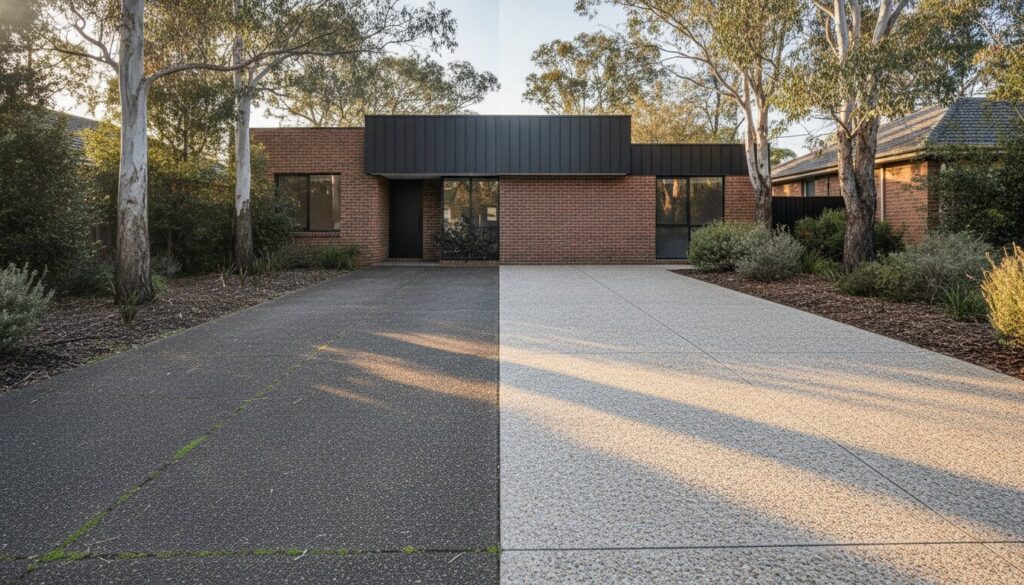
Is the cheapest quote today actually the most expensive mistake you’ll make this decade? When weighing up the asphalt vs concrete driveway cost sydney homeowners often find themselves torn between a lower initial price point and the promise of lifelong durability. It’s easy to be swayed by a budget-friendly estimate, but in a city built on reactive clay soils that shift with every season, the surface you choose is only as good as the engineering beneath it.
We understand that a driveway is more than just a place to park; it’s a significant investment in your property’s curb appeal and structural integrity. You want a solution that won’t succumb to unsightly cracks or require a constant cycle of resurfacing and weeding. This 2026 value comparison dives deep into the total cost of ownership for both materials, specifically tailored to the unique climate and soil conditions of the Sydney Metro and Western Suburbs. You’ll learn how to navigate council requirements, understand the impact of Sydney’s heat on different surfaces, and ultimately decide which material offers the best long-term return for your home.
Key Takeaways
- Realize that the initial asphalt vs concrete driveway cost sydney is only one part of the equation, as subgrade preparation is the true driver of longevity in our local climate.
- Understand how Sydney’s reactive clay soils, particularly in the Western Suburbs, can cause asphalt to rut or wave without the rigid support of reinforced concrete.
- Compare the 10-year total cost of ownership by evaluating the ongoing maintenance requirements of flexible asphalt versus the enduring strength of a sealed concrete surface.
- Discover how high-end finishes like exposed aggregate act as architectural assets that significantly boost property valuation and curb appeal in the Sydney market.
- Learn why concrete’s structural stability makes it the superior choice for residential homes on sloping blocks or reactive soil sites across the Blue Mountains and Greater Sydney.
Upfront Investment: The Price Hierarchy of Sydney Driveways
Deciding between a budget-friendly entry and a premium architectural statement is the first hurdle for any homeowner. While the initial asphalt vs concrete driveway cost sydney comparison often suggests a lower entry price for bitumen-based products, the true price hierarchy is dictated by the complexity of your site and the standard of finish you demand. You aren’t just paying for the material; you’re investing in the engineering that keeps your property functional.
Asphalt vs. Concrete: The Per-Square-Metre Reality
In high-acreage regions like the Blue Mountains, asphalt is frequently the preferred choice for massive rural driveways. Its ability to cover large distances quickly makes it an attractive option when the primary goal is utility over aesthetics. Understanding Asphalt concrete properties reveals a flexible surface that, while efficient for long tracks, lacks the inherent structural rigidity and design versatility of a reinforced concrete slab. For residential Sydney properties where space is at a premium, evaluating the asphalt vs concrete driveway cost sydney requires a look at how each material performs under daily vehicle loads and intense summer heat.
For those who prioritize a refined aesthetic, exposed aggregate driveways offer a textured, high-end finish that masks wear and tear while providing superior grip. While decorative concrete options carry a price premium due to the specialized craftsmanship, acid washing, and sealing involved, the long-term cost-to-benefit ratio is often superior. A well-executed concrete driveway doesn’t just provide a surface; it transforms the entire facade of your home, acting as a permanent value-add for the Sydney property market.
Hidden Costs in the Sydney Market
Sydney’s geography presents unique challenges that can quickly inflate a basic quote. Narrow access in established suburbs often requires specialized machinery hire, such as mini-excavators or concrete pumps, which increases the labor component of the project. Additionally, the subgrade preparation for Sydney’s reactive clay is non-negotiable. Proper excavation and the installation of a compacted road-base are essential to prevent future sinking. Skipping these steps to save on the initial outlay is a gamble that rarely pays off.
Local council requirements also play a significant role in the final budget. Most Sydney councils require a Section 138 permit for any work on the kerb or gutter crossover, ensuring the transition meets specific engineering standards. On sloping blocks, additional costs arise from complex drainage solutions and the necessity of thicker steel reinforcement, such as SL72 or SL82 mesh. This mesh provides the tensile strength needed to bridge shifting soil, ensuring your driveway remains a flat, durable asset for decades rather than a series of cracked, disconnected panels.
Structural Integrity: Sydney’s Reactive Clay and Soil Movement
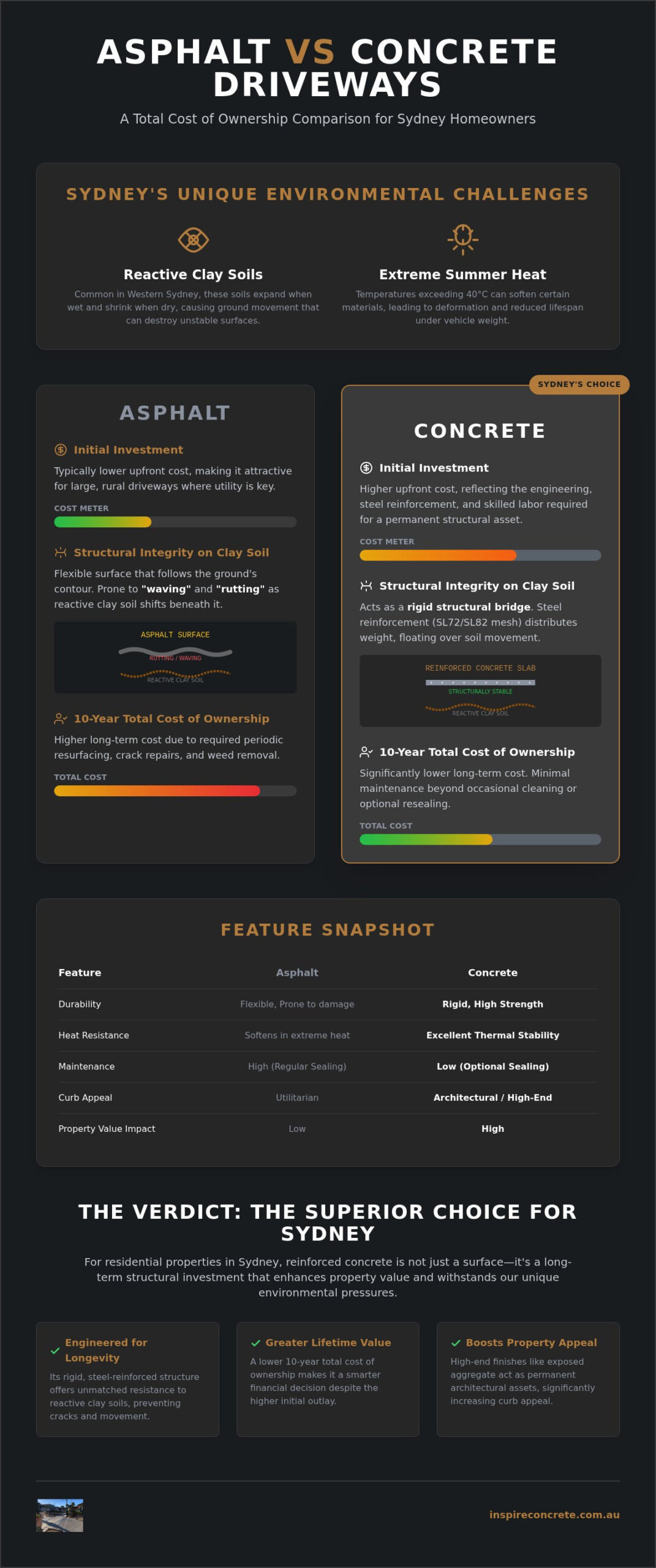
The ground beneath your feet in Western Sydney and the Hills District isn’t as solid as it looks. These regions are characterized by “reactive clay,” a type of soil that behaves like a slow-motion sponge. It expands aggressively when soaked by summer storms and shrinks during the dry periods of late summer. When you compare the asphalt vs concrete driveway cost sydney, the hidden factor you’re really paying for is a foundation that can withstand this constant subterranean shifting without failing.
Asphalt is frequently marketed as a “flexible” solution, but in the context of Sydney’s reactive clay, this flexibility often leads to “waving” or “rutting.” Because asphalt follows the exact contour of the earth, any soil movement beneath it translates directly to the surface in the form of dips and swells. Conversely, a professionally engineered concrete slab acts as a structural bridge. By utilizing steel reinforcement and maintaining a consistent thickness of 100mm to 125mm, concrete distributes the weight of heavy vehicles across a wider footprint, effectively floating over unstable ground rather than sinking into it.
Engineering for Western Sydney Extremes
Temperature is the silent enemy of Sydney driveways. On 40°C+ summer days, asphalt temperatures can soar high enough to soften the bitumen binder. This leads to permanent tyre indentations and “scuffing” when turning heavy SUVs. Reinforced concrete remains thermally stable under these conditions. We use strategically placed control joints to manage the natural expansion and contraction of the material. These joints provide the necessary breathing room for your driveway, ensuring that when the heat peaks, the slab moves in a controlled, predictable way rather than fracturing under pressure.
The Cracking Myth: Flexibility vs. Strength
When homeowners weigh up the asphalt vs concrete driveway cost sydney, they often overlook the long-term structural toll of our local environment. There’s a common misconception that all concrete eventually cracks in an ugly, uncontrolled fashion. This usually happens when subgrade compaction is ignored or steel mesh is poorly placed. When we engineer a driveway, we treat it as a structural element. By using SL72 or SL82 steel mesh and ensuring the sub-base is mechanically compacted, we mitigate the risks associated with soil movement. While asphalt typically requires a major overhaul or resurfacing every 10 to 15 years due to environmental degradation, a high-grade concrete driveway is built to endure for 25 to 30 years or more. Investing in a specialist concrete installation ensures your property is protected by a surface that values structural performance as much as visual appeal.
Maintenance and the 10-Year Total Cost of Ownership
When you evaluate the asphalt vs concrete driveway cost sydney, the true winner only emerges after the first decade of service. While asphalt boasts a lower entry price, it’s a high-maintenance surface that demands regular intervention to survive Sydney’s harsh UV index. Without proactive crack sealing, water penetrates the surface and softens the underlying reactive clay, leading to structural failure. Concrete, by contrast, is a “set and forget” investment that requires only minimal, infrequent care to maintain its structural and aesthetic peak.
The 10-year maintenance schedule for concrete is remarkably straightforward. It primarily involves periodic concrete cleaning and sealing every five years to preserve the colour and protect against oil spills. Unlike bitumen, which absorbs automotive fluids and can soften as a result, high-density concrete is naturally resistant to chemical staining. This makes it a far more practical choice for busy family households where car maintenance or minor leaks are a reality.
Long-Term Surface Protection
Sydney’s sun is a relentless force. Intense UV exposure gradually degrades the bitumen binder in asphalt, causing it to become brittle and lose its deep black luster. This process, known as oxidation, leads to “ravelling,” where the small stones in the mix begin to break away. High-quality penetrative sealants used on concrete prevent “dusting” and create a barrier against the elements. Another often overlooked benefit is weed management. Asphalt edges are prone to crumbling over time, providing a foothold for invasive weeds. The solid, vertical edge of a reinforced concrete slab creates a definitive boundary that remains clean and sharp for decades.
Repairability and Aesthetics
The visual lifecycle of these materials tells two very different stories. When asphalt cracks, the repairs are highly visible. Patching a section of bitumen creates a “quilt” effect, as the new, dark material never quite matches the faded grey of the original driveway. This can significantly detract from your home’s resale value. If a concrete surface ever requires a refresh, the process of concrete resurfacing allows for a complete aesthetic overhaul. We can apply a new decorative wear layer that bonds to the existing slab, making the entire driveway look brand new without the cost of a full excavation. For Sydney homeowners, this means the long-term visual consistency of decorative concrete remains unmatched by any flexible paving alternative.
Aesthetic Value: Curb Appeal and Sydney Property Resale
First impressions are non-negotiable in the competitive Sydney property market. A driveway is often the largest visible element of a home’s facade, and its condition speaks volumes about the care taken with the entire property. When evaluating the asphalt vs concrete driveway cost sydney, savvy homeowners look beyond the immediate price tag to the potential uplift in property valuation. While asphalt offers a functional, utilitarian surface, decorative concrete provides an opportunity for architectural expression that can significantly enhance a home’s marketability.
Exposed aggregate has become the benchmark for high-end residential design across the Sydney Metro area. This finish achieves a level of “Architectural Craftsmanship” that asphalt simply cannot replicate. By revealing the natural beauty of river stones or crushed quartz embedded within the mix, we create a multi-dimensional surface that feels like a deliberate design choice rather than a mere necessity. For those seeking the look of premium hand-laid stone without the prohibitive labor costs, stencil concrete offers a sophisticated alternative, mimicking intricate paver patterns with the structural benefits of a single reinforced slab.
Modern Finishes for Contemporary Homes
Today’s homeowners demand a seamless transition between their indoor and outdoor living spaces. We frequently coordinate driveway textures and tones with alfresco entertaining areas to create a cohesive visual flow. This involves selecting aggregates and pigments that complement the popular Sydney palettes of Basalt, Monument, and deep greys. Beyond aesthetics, the texture of an exposed aggregate surface provides essential slip resistance during Sydney’s sudden downpours, ensuring safety for both vehicles and pedestrians. You have the freedom to customize the final look by choosing specific stone types and sizes, ensuring your driveway is as unique as your home itself.
The “Industrial” vs. “Residential” Aesthetic
Asphalt carries an inherently industrial character. While this works well for sprawling semi-rural estates in the Blue Mountains where the focus is on covering vast distances, it often feels out of place in modern Sydney suburbia. Decorative concrete allows for clean, sharp lines that frame a house facade with precision. This structural definition is a hallmark of high-end residential construction. If you are ready to transform your property’s entrance into a lasting architectural statement, the team at Inspire Concrete can help you select a finish that maximizes both beauty and resale value. The choice between materials ultimately defines whether your driveway is a simple path or a premium asset.
The Verdict: Choosing the Best Surface for Your Sydney Home
The choice between asphalt and concrete ultimately hinges on your property’s specific geography and your long-term financial goals. While we’ve explored the technical nuances of the asphalt vs concrete driveway cost sydney homeowners face, the final verdict rests on a balance of structural necessity and desired lifestyle outcomes. You aren’t just selecting a colour or a texture; you’re choosing the foundation that will support your property’s value for decades.
When to Choose Concrete
Concrete is the undisputed champion for high-traffic residential homes. If your household operates multiple heavy SUVs or requires a “set and forget” solution that will remain pristine for 30 years, reinforced concrete is the superior investment. It’s the only material that provides the rigid bridging effect necessary to survive the volatile reactive clay zones of Western Sydney and the Hills District. Beyond structural peace of mind, it offers a level of customization, from exposed aggregate to coloured finishes, that turns a functional utility into a premium design feature.
When to Choose Asphalt
Asphalt finds its place in specific, large-scale applications. For sprawling semi-rural properties with driveways exceeding 200 metres, the sheer volume of material often makes concrete cost-prohibitive. It remains a viable choice for level sites with exceptionally stable, non-reactive subgrades or for temporary infrastructure where a 10 to 15 year lifespan is acceptable. However, for the standard suburban block, the lower initial cost of asphalt is frequently offset by the ongoing maintenance and lower resale appeal discussed in previous sections.
The Final Decision Framework
To make the right call for your property, evaluate these three pillars:
- Soil Condition: If you’re on reactive clay, reinforced concrete is a structural requirement to prevent waving and rutting.
- Investment Horizon: Choose concrete if you plan to stay in your home for more than seven years or want to maximize resale value.
- Maintenance Appetite: Choose concrete if you prefer a one-time investment over a decade of crack sealing and bitumen repairs.
Regardless of the material you choose, the quality of the installation is the most critical factor. Engaging licensed concreters in Sydney ensures that your project complies with Australian Standards and local council regulations. A professional partner doesn’t just pour a surface; they manage the architectural drafting, subgrade compaction, and final finishes that transform your vision into a durable, high-value reality. When precision meets passion, the result is a driveway that stands the test of time.
Secure Your Property’s Value with a Lasting Entrance
Your driveway is the literal foundation of your home’s curb appeal and a critical structural asset. We’ve seen that the asphalt vs concrete driveway cost sydney isn’t just about the first invoice, but about the decades of performance that follow. Sydney’s reactive clay demands the bridging strength of reinforced concrete to prevent the waving and rutting common in flexible surfaces. By choosing a material that resists UV degradation and chemical staining, you ensure a low-maintenance future for your property.
Inspire Concrete brings over 20 years of local Sydney expertise to every project, providing specialized reactive clay soil solutions that other contractors often overlook. As fully licensed and insured craftsmen, we’re committed to turning your vision into a durable, high-value reality. Request a Master-Built Driveway Quote from Inspire Concrete and take the first step toward a property transformation that lasts. Your property deserves a surface as resilient as it is refined.
Frequently Asked Questions
Is concrete or asphalt better for a steep Sydney driveway?
Concrete is the safer choice for steep Sydney driveways because it remains structurally rigid regardless of the incline. On a slope, asphalt can suffer from “shoving,” where the surface physically moves downhill under the weight of braking vehicles, especially during a heatwave. We recommend a textured concrete finish, such as a heavy broom or exposed aggregate, to provide the necessary tyre traction during Sydney’s intense summer storms.
Do I need council approval to change my driveway material in Sydney?
You generally need a permit for the section of the driveway that crosses the public footpath and kerb. In most Sydney local government areas, this requires a Section 138 Roads Act application to ensure the crossover meets specific engineering standards. While changing the material on your private land may not always require a full Development Application, it’s vital to consult your local council’s Development Control Plan to avoid compliance issues.
Why does concrete crack more in Western Sydney than the coast?
The higher incidence of cracking in Western Sydney is primarily due to the prevalence of reactive clay soils. These soils expand and contract significantly with moisture changes, putting immense pressure on any surface. Coastal suburbs often sit on sandier, more stable foundations that don’t shift as aggressively. When calculating the asphalt vs concrete driveway cost sydney homeowners in the West must prioritize reinforced slabs and deep sub-base compaction to mitigate this movement.
How much value does a new concrete driveway add to a Sydney home?
A professionally installed concrete driveway acts as a permanent architectural asset that can significantly increase a property’s marketability. Real estate professionals in the Sydney market often highlight decorative finishes like exposed aggregate as a key selling point for curb appeal. Unlike asphalt, which can look industrial or dated, modern concrete finishes coordinate with contemporary home palettes, suggesting a higher level of property maintenance and structural quality to potential buyers.
Can I lay asphalt over an existing concrete driveway?
While you can technically lay asphalt over concrete, we don’t recommend it for long-term residential use. This method often leads to “reflective cracking,” where the expansion joints in the underlying concrete slab cause the new asphalt to split in the exact same spots. This creates a maintenance headache and an unsightly finish. It’s almost always more cost-effective to remove the old surface and install a fresh, reinforced concrete slab from the subgrade up.
How long does a concrete driveway last compared to asphalt in Australia?
In the harsh Australian climate, a reinforced concrete driveway typically lasts between 25 and 30 years with minimal maintenance. Asphalt driveways generally have a shorter functional lifespan of 10 to 15 years before they require significant resurfacing or crack sealing to prevent water ingress. The durability of concrete makes it a superior “set and forget” solution for those looking to maximize their asphalt vs concrete driveway cost sydney over the life of their home.
Which material is more slip-resistant for Sydney’s rainy seasons?
Textured concrete finishes, particularly exposed aggregate and stencil concrete, offer superior slip resistance during Sydney’s rainy seasons. The protruding stones in an aggregate mix provide natural mechanical grip for both tyres and footwear. Asphalt can become surprisingly slick when light rain mixes with accumulated oil and dust after a dry spell. For families with sloping blocks or young children, the predictable traction of a sealed, textured concrete surface provides essential safety.
What is the most popular driveway finish in Sydney for 2026?
Exposed aggregate remains the most sought-after driveway finish across Sydney in 2026. Its popularity stems from its ability to blend rugged durability with a refined, high-end aesthetic that complements modern architectural styles. Homeowners are increasingly choosing darker stone mixes that pair seamlessly with popular exterior colours like Monument and Basalt. This finish is also highly practical, as the varied texture effectively hides minor tyre marks and everyday debris better than plain surfaces.
