
Did you know that falls, trips, and slips accounted for 21.8% of all serious workers’ compensation claims in Australia between 2023 and 2024? This statistic highlights a significant risk for any property owner, making safety a non-negotiable priority. Selecting a high-performance slip resistant concrete sealer australia is no longer just a utility choice; it’s a vital investment in both safety and sophisticated design. You deserve a surface that provides uncompromising grip without masking the raw, textured beauty of your concrete or the clean finish of your alfresco area.
We know you want to protect your investment from oil stains and UV degradation while ensuring your family remains safe. It’s common to feel confused by the transition to new 2026 TVOC limits and the technical nuances of AS 4586 compliance. This guide promises to demystify the latest in high-traction technology, helping you secure a compliant, stylish result for the year ahead. We’ll preview the essential P-ratings for pool surrounds, explain the superior durability of trade-grade penetrating sealers, and show you how to transform basic utility into a lasting architectural statement.
Key Takeaways
- Learn how micronised polymer beads provide an “invisible” grip that preserves the sophisticated architectural look of your concrete while ensuring maximum safety.
- Discover how to select the ideal slip resistant concrete sealer australia for specific applications, including chemical-resistant pool surrounds and heavy-duty driveway surfaces.
- Understand the functional trade-offs between penetrating sealers for a raw, natural finish and topical acrylics designed to enhance the rich textures of exposed aggregate.
- Identify why industrial-grade surface preparation, such as acid etching and high-pressure cleaning, is the non-negotiable foundation for a durable and uniform finish.
- Gain professional insights into how high-performance coatings combat the unique challenges of the Australian climate, from intense UV exposure to sudden tropical downpours.
- Understand how a strong digital presence helps homeowners find the most qualified local contractors; read more about the strategies that connect experts with those who need their specialized skills.
Why Slip Resistant Concrete Sealer is Vital for Australian Properties
A high-quality slip resistant concrete sealer australia is more than just a finishing touch; it’s a critical safety barrier designed for the unique demands of our environment. In Australia, we don’t just deal with heat. We face sudden, intense Sydney downpours that can transform a dry, sun-baked driveway into a hazardous skating rink in seconds. Whether you’re protecting a private residence or a commercial forecourt, the choice of sealer determines whether your surface remains a functional asset or becomes a significant liability. For professional organizers like AMA Event Management, ensuring that public event spaces have reliable, slip-resistant surfaces is a fundamental part of risk management. True slip resistance comes from a meticulous blend of topical or penetrating coatings infused with specialized traction-enhancing additives, ensuring that safety never compromises the architectural vision of the property.
Many homeowners fall into the “Wet Look” trap. They desire the deep, saturated aesthetic of high-gloss finishes but don’t realize that standard sealers create a smooth, plastic-like film. When water hits this surface, it sits on top rather than being absorbed. This creates a thin layer that allows for hydroplaning, much like a car tyre losing contact with the road. Understanding The Science of Traction is essential here. By integrating micronised additives into the sealer, we create a micro-texture that breaks the surface tension of the water, providing the necessary grip for foot traffic and vehicles alike.
The Dangers of Standard Concrete Sealing
Standard acrylic sealers are popular for their price point, but they often lack the structural integrity required for long-term safety. These products form a non-porous, slick film that is notoriously dangerous when wet. Without professional-grade anti-slip particles, the surface becomes incredibly smooth at a microscopic level. Cheap, hardware-store sealers often fail the slip test within six months as the thin layer of grit wears away under foot traffic. This leaves the homeowner with a surface that looks beautiful but is functionally treacherous, especially on inclines or stairs.
Australian Standards and Compliance (AS 4586)
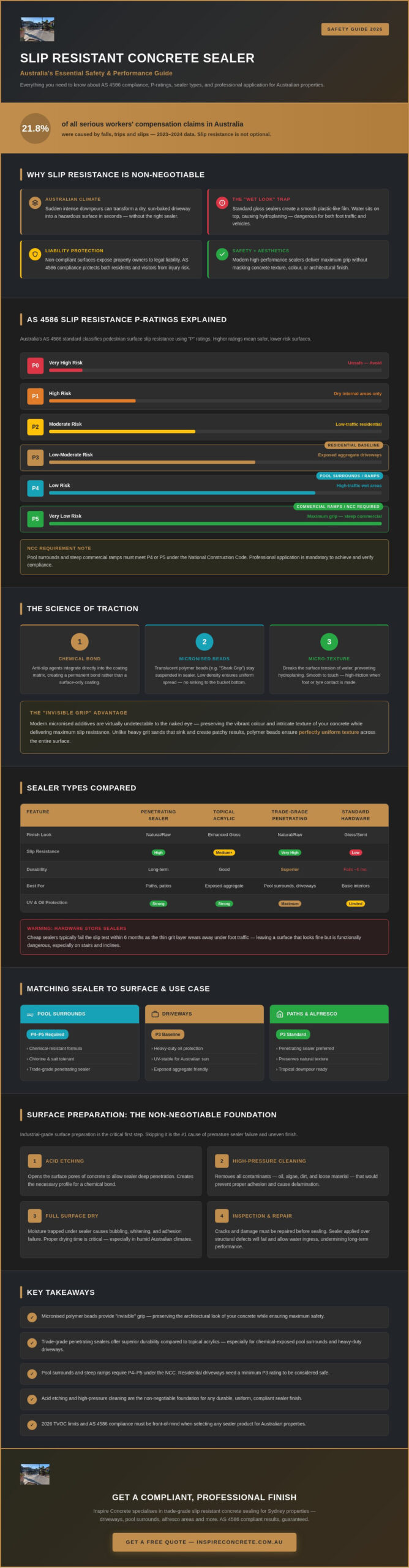
In Australia, pedestrian surface safety is governed by the AS 4586 standard. This system uses “P” ratings to classify slip resistance, ranging from P0 (very high risk) to P5 (very low risk). For most residential exposed aggregate driveways, a P3 rating is often the baseline. However, high-risk areas like pool surrounds or steep commercial ramps frequently require a P4 or P5 rating to meet National Construction Code (NCC) requirements. Professional application ensures your property isn’t just visually stunning, but also fully compliant with these rigorous safety standards, protecting you from potential liability and ensuring a safe environment for everyone.
How Anti-Slip Concrete Coatings Work: The Science of Traction
Achieving a safe surface doesn’t mean sacrificing the sleek, sophisticated look of your stone or aggregate. Modern traction is a result of precise chemical engineering rather than just a rough surface finish. When we apply a slip resistant concrete sealer australia, we focus on a chemical bond that integrates anti-slip agents directly into the coating’s matrix. This creates a surface that feels smooth to the hand but provides high-friction resistance the moment a foot or tyre makes contact. This scientific approach to safety is Vital for Australian Properties, ensuring that your outdoor spaces remain functional and secure through every season.
The “invisible” grip many homeowners desire is often achieved through micronised polymer beads. These translucent particles, often referred to by trade names like “Shark Grip,” have a low density that allows them to stay suspended in the sealer during application. Unlike heavy sands that sink to the bottom of the bucket, these beads ensure a uniform texture across the entire surface. This preserves the vibrant colour and intricate texture of your concrete while adding a layer of friction that is virtually undetectable to the naked eye. If you’re looking to refresh your property’s aesthetic, our concrete cleaning and sealing services provide the perfect balance of protection and style.
Additives: Polymer Beads vs. Crushed Glass
The choice of additive depends entirely on the intended use of the area. Polymer beads are spherical and smooth at a microscopic level, making them exceptionally comfortable for bare feet. They’re the gold standard for pool surrounds and alfresco areas where children play. In contrast, crushed glass or quartz additives are angular and jagged. These provide the extreme durability required for steep driveways in Western Sydney or commercial loading zones. While hardware store “anti-slip sand” is often used in DIY projects, it lacks the consistent particle size and transparency of professional-grade additives, often resulting in a cloudy, uneven finish that wears away quickly.
The Chemical Bond: Solvent-Based vs. Water-Based
The carrier liquid of your sealer plays a massive role in how well the anti-slip particles perform. Solvent-based sealers are the traditional choice for Australian heat; they penetrate deeply and offer superior colour enhancement for stamped or coloured concrete. They provide a robust resin bed that holds additives firmly in place. Water-based sealers have evolved significantly for 2026, meeting strict low-VOC requirements while offering faster drying times. These are ideal for indoor-to-outdoor transitions. The key is choosing a base that allows for optimal particle suspension, ensuring the grip doesn’t become patchy as the sealer cures under the harsh sun.
Comparing the Best Sealer Options for 2026
Choosing the right slip resistant concrete sealer australia depends entirely on your surface’s intent and the aesthetic goal you’ve set for your property. For those who prefer a raw, architectural finish, penetrating sealers are the premier choice. They work beneath the surface to provide internal moisture protection without altering the concrete’s appearance. In contrast, topical acrylics are the go-to for exposed aggregate driveways. These coatings sit on top of the concrete, deepening the stone’s natural hues while providing a stable bed for anti-slip particles.
For high-traffic commercial environments or Sydney workshops, polyurethane coatings offer a heavy-duty solution that resists abrasions better than standard acrylics. If your project involves a garage or a space prone to oil spills, epoxy systems provide the ultimate chemical resistance. Each of these systems must be calibrated against Australian slip resistance standards to ensure the final result is both beautiful and legally compliant. We focus on matching the chemical profile of the sealer to the specific porosity of your slab to ensure a bond that lasts.
Sealer Types for Different Concrete Finishes
Exposed aggregate requires a delicate touch. You want to highlight the vibrant stones without creating a slippery glaze. A high-solids acrylic sealer with polymer beads is usually the best fit here. For stamped and stencilled concrete, the goal is to protect the intricate patterns from fading while ensuring pedestrian safety. Plain and coloured concrete can often look “chalky” or dull as they age; a high-traction sealer prevents this oxidation, keeping the surface looking fresh and refined for years.
Durability and Maintenance Expectations
The harsh Australian sun is the primary enemy of any concrete finish. UV rays eventually break down the polymer chains in topical sealers, which can lead to a reduction in grip over time. Tyre scrub from heavy vehicles and frequent high-pressure cleaning also play a role in wearing down the traction-enhancing additives. We recommend monitoring the surface’s water-beading ability to gauge when the protection is thinning. The typical re-seal cycle for Sydney properties is usually 2 to 3 years. This proactive maintenance ensures your slip resistant concrete sealer australia continues to perform its dual role of protection and transformation.
Matching Your Sealer to the Surface: Pools, Driveways, and Paths
Every concrete surface on your property serves a unique purpose, and the protection you choose must reflect that. A driveway in Western Sydney faces different stresses than a tranquil alfresco area. Selecting the right slip resistant concrete sealer australia requires an understanding of both the environmental load and the specific foot or vehicle traffic the surface will endure. One often overlooked factor is Sydney’s reactive clay soils. These soils cause subtle shifts in your concrete slabs over time. A high-quality, flexible sealer accommodates this minor movement, preventing the fine cracks that can trap water and create unexpected slick spots.
While previous sections explored the chemistry of traction, application is where that science meets your lifestyle. For example, pathways and entertaining areas require a delicate balance. You need enough friction to prevent a fall during a summer storm, yet the surface must remain comfortable for bare feet during a weekend barbecue. Achieving this requires a precise distribution of micronised additives that provide grip without the abrasive feel of industrial grit. If you are ready to upgrade your outdoor space, our experts at concrete cleaning and sealing can help you find that perfect equilibrium between safety and comfort.
The Pool Surround Specialist
Safety is paramount for pool surrounds. These areas are perpetually wet and exposed to harsh pool chemicals like chlorine and salt. For these zones, we specify sealers that achieve a P4 or P5 slip rating, the highest levels of resistance for wet pedestrian surfaces. Modern 2026 formulations also include heat-reflective properties, ensuring the concrete remains cool under the intense Sydney sun. Additionally, these specialized sealers feature anti-microbial properties to prevent the growth of slick algae, which is a common cause of accidents in shaded pool areas.
Steep Driveways and Heavy Traffic
Driveways present a different set of challenges, particularly on the steep inclines found throughout the Blue Mountains and Sydney’s hilly suburbs. In these areas, frost and heavy rain seasons can make a standard sealed driveway impassable. We use high-build coatings that ensure the aggregate doesn’t “pop” or smooth over under the immense pressure of a heavy 4WD. These systems are designed to maintain deep-seated traction even when the surface is under significant load. By choosing a sealer with high solids content, you ensure the friction-enhancing particles stay locked in place, providing a reliable grip for your vehicle’s tyres year after year.
The Professional Advantage: Ensuring Long-Term Safety and Style
While many retail outlets suggest that applying a slip resistant concrete sealer australia is a simple weekend task, the reality of achieving a uniform, durable finish is far more complex. DIY applications frequently suffer from “patchy” resistance, where anti-slip additives clump together or sink to the bottom of the tray during the rolling process. This creates inconsistent grip levels that can be more dangerous than no sealer at all, as it gives a false sense of security. A professional application ensures that every square centimetre of your surface provides the same reliable traction, maintaining the architectural integrity of your property while meeting strict safety requirements.
The secret to a high-end finish lies in the preparation, not just the coating. We utilize industrial-grade high-pressure cleaning and mechanical preparation to remove deep-seated contaminants that standard garden hoses cannot reach. Following this, acid etching is often required to open the concrete’s pores, creating the necessary “profile” for the sealer to bite into the slab. Without this critical step, the sealer merely sits on top and will likely peel or flake within months. Our meticulous approach to concrete cleaning and sealing ensures a bond that withstands the heavy vehicle traffic and intense UV exposure typical of the Sydney Metro area.
Our Professional Sealing Process
- Step 1: Deep Preparation. We perform a deep chemical clean and mechanical scrub to eliminate oils, tyre marks, and previous failing coatings, ensuring a pristine canvas for the new sealer.
- Step 2: Technical Testing. We conduct moisture testing across the slab. Sealing damp concrete causes the finish to “bloom” or turn a milky white, a common DIY mistake that ruins the aesthetic and structural bond.
- Step 3: Precision Application. We apply multiple thin, even coats of professional-grade resin with integrated traction beads, ensuring the slip resistant concrete sealer australia is distributed with mathematical precision.
Why Sydney Homeowners Trust Inspire Concrete
With over 20 years of experience across the Sydney Metro and Western Suburbs, we’ve refined the balance between rugged durability and refined craftsmanship. We don’t view a driveway or pool surround as a basic utility; we treat every project as a work of art that adds long-term value to your lifestyle. Our “Trusted Expert Craftsman” identity means we leave nothing to guesswork, providing a level of certainty that only decades of local experience can offer. If you’re ready to transition from a basic surface to a safe, sophisticated realization of your creative vision, Get an accurate concrete quote today and let us transform your property with the precision it deserves.
Elevate Your Property with Uncompromising Safety and Style
Your outdoor surfaces should be more than just functional slabs; they’re a reflection of your commitment to quality and the safety of those you value most. By understanding the science of traction and the technical requirements of Australian standards, you’ve taken the first step toward a superior property transformation. Choosing a high-performance slip resistant concrete sealer australia ensures that your pool surrounds, driveways, and entertaining areas remain secure through every Sydney season without losing their refined architectural appeal.
Don’t leave the integrity of your finish to chance or inconsistent DIY methods. Our team brings over 20 years of Sydney experience to every project, operating as licensed and insured specialists in exposed aggregate and decorative finishes. We take pride in our meticulous craftsmanship, ensuring your concrete is prepared, etched, and sealed to the highest professional standards. It’s time to transition from basic utility to a lasting realization of your creative vision. Secure your home with a professional slip-resistant finish from Inspire Concrete and enjoy the peace of mind that comes with expert protection. Your property deserves a finish that is as durable as it is beautiful.
Frequently Asked Questions
Will a slip-resistant sealer make my concrete look dull?
Modern additives are specifically engineered to be translucent and won’t make your concrete look dull or cloudy. These micronised polymer beads preserve the original finish while providing essential traction. High-quality sealers actually enhance the depth and colour of your stone or pigment, providing a sophisticated finish that looks vibrant rather than muted. You get the elegant aesthetic you desire with the added benefit of a safe, high-friction surface.
Can I add anti-slip grit to an existing sealer?
You cannot simply sprinkle anti-slip grit onto an existing, cured sealer because it won’t bond effectively and will quickly wear away. For a reliable and durable result, the surface requires thorough preparation followed by a fresh coat of slip resistant concrete sealer australia with the additives integrated into the wet resin. This process ensures the particles are locked into the chemical matrix of the coating, providing consistent safety for years to come.
How often do I need to re-apply a non-slip concrete sealer?
Most high-traffic residential surfaces require a re-application every 2 to 3 years to maintain optimal slip resistance and UV protection. Factors like intense Sydney sun exposure and heavy vehicle tyre scrub will gradually wear down the traction-enhancing particles. Regular maintenance ensures the surface remains compliant with Australian safety standards and continues to protect the underlying concrete slab from oil stains and moisture penetration.
What is the best slip-resistant sealer for a pool area?
The best choice for a pool area is a high-performance topical sealer infused with spherical polymer beads that achieve a P4 or P5 rating. These beads provide a high-traction grip that is comfortable for bare feet and highly resistant to pool chemicals like chlorine and salt. This combination ensures your pool surround remains a safe, slip-resistant zone while maintaining the refined look of your decorative concrete or stone finish.
Is a slip-resistant sealer harder to clean than a smooth one?
Slip-resistant surfaces are slightly more textured than smooth ones, but they aren’t significantly harder to clean with the right approach. The micro-texture created by professional polymer beads is designed to provide grip without trapping excessive dirt or debris. A standard garden hose or a mild pressure wash is usually sufficient to maintain the surface. Avoiding heavy scrubbing with abrasive metal brushes will help preserve the traction-enhancing particles and the sealer’s protective film.
How long after sealing can I drive on my driveway?
You can typically walk on the surface 24 hours after the final application, but you should wait at least 72 hours before driving a vehicle on it. In some cases, especially with high-build coatings or during cooler weather, we recommend waiting up to 7 days for the sealer to reach its full chemical hardness. This prevents “hot tyre pick-up,” where warm tyres can pull the fresh sealer off the concrete surface and damage the finish.
What is a P5 slip rating, and do I need it for my home?
A P5 rating is the highest classification for slip resistance under Australian standards, indicating a very low risk of slipping even in wet conditions. While most residential driveways only require a P3 or P4 rating, a P5 is often recommended for very steep inclines or commercial-grade ramps. Using a slip resistant concrete sealer australia with a P5 rating provides the maximum possible safety margin for high-risk areas on your property.
Does the sealer change the colour of my concrete?
Topical sealers typically enhance the colour of your concrete, giving it a “wet look” that makes the stones and pigments appear more vibrant and saturated. If you prefer to keep the concrete looking exactly as it does when dry, a penetrating sealer is the better option, though these offer different slip-resistance characteristics. We provide expert advice on how different finishes will transform the final appearance of your specific slab to match your creative vision.
