
The most expensive concrete project isn’t the one with the highest quote; it’s the one you have to pour twice. In Sydney’s competitive market, knowing exactly what to ask a concrete contractor is the only way to separate true master craftsmen from the unlicensed “cowboys” who cut corners on sub-base preparation. You shouldn’t have to guess whether your new driveway will crack under the summer sun or if your contractor carries the mandatory Professional Indemnity insurance required as of July 2026. Fines for unlicensed work can reach $110,000 for companies, making the stakes for your property and your wallet higher than ever.
It’s natural to feel anxious when three different quotes for the same pool surround arrive with wildly different price tags. We believe you deserve a result that balances rugged structural integrity with refined aesthetic appeal. This guide will empower you with the critical questions needed to verify licensing, ensure compliance with current Australian Standards, and guarantee a seamless transformation of your home. We’ll reveal the technical red flags to watch for and the essential documentation required to protect your investment for the next decade.
Key Takeaways
- Verify current NSW Fair Trading licenses and the mandatory 2026 Professional Indemnity insurance to ensure your project complies with the latest regulatory standards.
- Identify the technical indicators of high-quality engineering, including specific sub-base compaction methods and the ideal MPa strength for your specific property needs.
- Learn exactly what to ask a concrete contractor to uncover hidden costs in quotes and clarify responsibilities for council permits and site protection.
- Distinguish between basic utility and refined craftsmanship by evaluating a contractor’s expertise in specialized finishes like exposed aggregate or stamped concrete.
Why Vetting Your Concrete Contractor is Critical for Your Property’s Value
Choosing concrete for your Sydney home is a high-stakes architectural decision. It isn’t just a surface to park on; it’s a permanent feature that defines your property’s curb appeal and long-term resale value. A masterfully poured driveway or alfresco area acts as a structural asset, while a poorly executed one becomes a liability that costs thousands to remove and replace. The lifespan of your installation often depends on the due diligence performed before the first shovel hits the ground. Knowing exactly what to ask a concrete contractor helps ensure your project survives thirty years rather than crumbling in five.
The “cheapest” quote frequently transforms into the most expensive project when structural repairs are required later. Professional concreters understand that the visible finish is only as good as the invisible engineering beneath it. They manage the entire lifecycle of the transformation, from the initial excavation to the final, refined finish. By vetting your partner thoroughly, you are investing in a result that resists the elements and enhances your lifestyle for decades.
Defining the Role of a Professional Concreter
A professional concrete specialist provides far more than manual labour. They are project partners who manage a complex lifecycle including site analysis, precise excavation, and technical finishing. While some homeowners might ask What is a General Contractor? and assume any builder can handle the job, a dedicated concreter understands the specific chemistry of the mix and the nuances of Sydney’s coastal and inland environments. From the initial design phase to the final application of chemical sealants, a specialist ensures the work meets both aesthetic goals and functional requirements. A licensed expert distinguishes themselves from a general labourer through their deep understanding of load-bearing capacities and drainage requirements.
The Cost of Poor Vetting: Cracks, Sinking, and Legal Woes
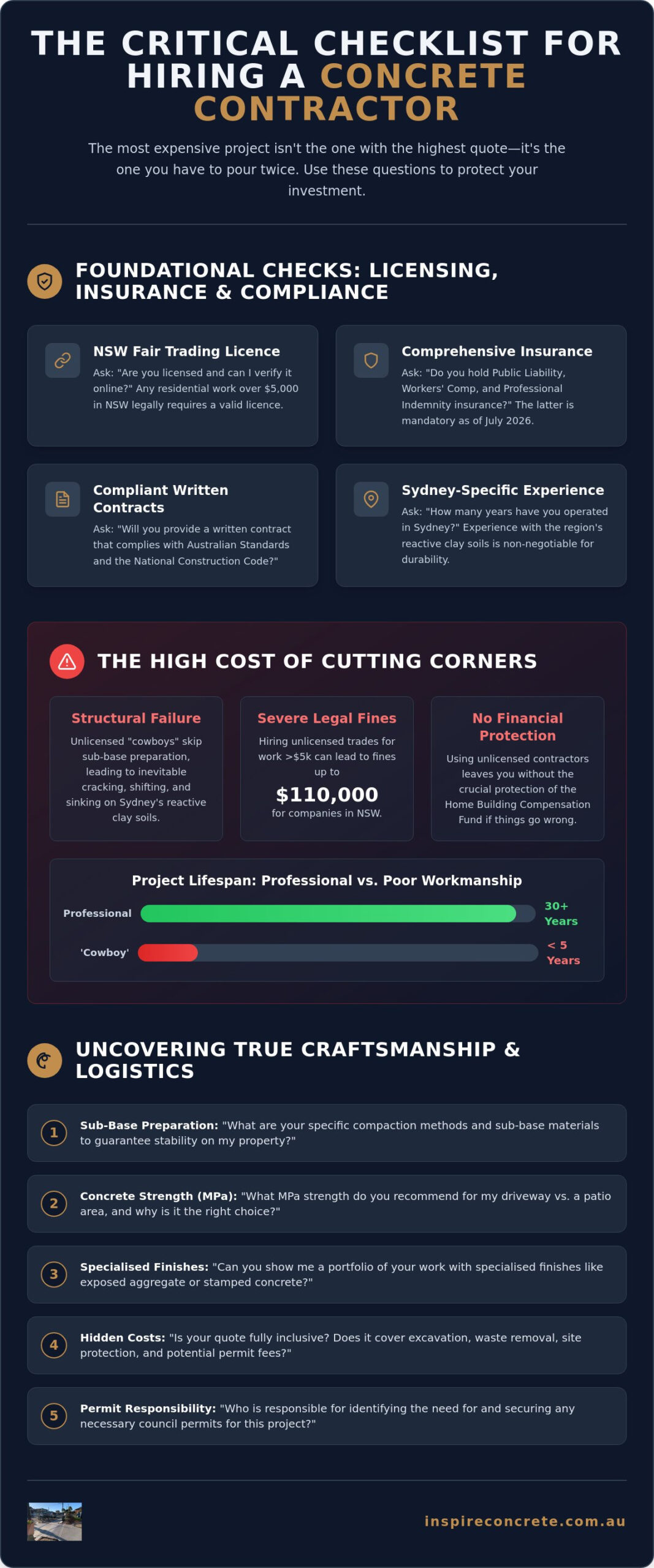
Sydney is famous for its reactive clay soils, which expand and contract significantly with moisture levels. Without expert sub-base preparation and mechanical compaction, your concrete will inevitably shift, sink, and crack. This structural failure is the hallmark of “cowboy” trades who skip the groundwork to save time. Beyond the physical risks, hiring unlicensed trades exposes you to severe legal and financial vulnerabilities. In New South Wales, performing unlicensed work valued over $5,000 can result in fines of up to $110,000 for companies, and it leaves the homeowner without the protection of the Home Building Compensation Fund. Structural integrity is the deliberate result of engineered mesh placement and rigorous soil compaction. Investing time to determine what to ask a concrete contractor filters out those who ignore these invisible but vital engineering steps, ensuring your property remains protected and your vision is realized without compromise.
Foundational Questions: Licensing, Insurance, and NSW Regulations
Building a legacy on your property starts with a signature on a compliant contract. Before the first concrete truck arrives, you must establish a foundation of legal and professional certainty. While consumer protection officials often warn against vague verbal agreements, the specific legal requirements in New South Wales are even more stringent. You aren’t just hiring a person with a mixer; you’re entering a high-value construction agreement that must adhere to state law. When determining what to ask a concrete contractor, start with these non-negotiable queries:
- Are you a licensed concreter with NSW Fair Trading, and can I see your physical or digital credential?
- Do you carry current Public Liability, Workers’ Compensation, and the mandatory Professional Indemnity insurance?
- Will you provide a written contract that explicitly complies with Australian Standards and the National Construction Code?
- How many years have you been operating specifically within the Sydney Metro area?
Verifying NSW Licensing and Insurance
In New South Wales, any residential trade work valued over $5,000 requires a valid contractor licence. You can easily verify a contractor’s history using the NSW Fair Trading online licence check tool. This reveals any past cautions or insurance claims. It’s also vital to understand that standard “handyman” insurance is insufficient for structural work like house slabs or heavy-duty driveways. As of July 1, 2026, all registered building practitioners in NSW must also carry Professional Indemnity insurance. If your project exceeds $20,000, your contractor is legally required to provide a certificate of Home Building Compensation (HBC) cover. This acts as your final safety net, providing up to $340,000 in protection should the contractor be unable to complete the work or rectify defects.
Local Experience and the Sydney Landscape
Sydney’s geography presents unique challenges that an out-of-area contractor might overlook. The reactive clay soils common in the region require specific reinforcement strategies to prevent shifting. Furthermore, the intense heat in Western Sydney demands specialized pouring and curing techniques to avoid “flash setting” or surface crusting. Ask for the addresses of local projects completed at least five years ago. This allows you to see how their work has weathered Sydney’s climate over time. For a deeper dive into these requirements, consult A Master Guide to Hiring Professional Concreters in Sydney (2026). If you are ready to move from planning to execution, exploring our range of exposed aggregate driveways can help you visualize the standard of craftsmanship we bring to every Sydney site. Knowing what to ask a concrete contractor regarding their local tenure ensures they have the proven experience to handle our city’s specific environmental demands.
Technical Questions to Uncover True Craftsmanship
True craftsmanship is rarely found on the surface; it lives in the invisible engineering that supports every square metre of your project. When you are determining what to ask a concrete contractor, you must listen for technical precision rather than vague promises. A contractor who glosses over sub-base preparation is likely the one whose work will fail within a few seasons. You need a partner who treats the structural foundation with the same reverence as the final aesthetic finish. Ask these specific technical questions to gauge their expertise and commitment to durability:
- What is your specific process for sub-base preparation and mechanical compaction?
- What thickness and MPa strength do you recommend for my specific soil type and usage?
- How do you manage reinforcement mesh placement to ensure it remains correctly positioned during the pour?
- What is your strategy for control joints to prevent random cracking across the slab?
The ‘Invisible’ Engineering: Sub-base and Reinforcement
A durable driveway requires a minimum of 100mm of compacted road base to provide a stable, non-reactive foundation. Without this, the natural movement of Sydney’s soil will eventually cause the slab to settle unevenly, leading to unsightly cracks and ponding water. True specialists don’t rely on the outdated method of “pulling up the mesh” during the pour, as this leads to inconsistent reinforcement and potential structural weak points. Instead, we utilize heavy-duty bar chairs spaced at regular intervals to keep the steel mesh locked firmly in the top third of the slab. MPa refers to the compressive strength of concrete, typically 25-32 MPa for driveways. For areas expecting heavy vehicle traffic or frequent use by trade vehicles, stepping up to 32MPa provides the necessary density to resist surface wear and internal stress over decades of use.
Managing Expansion and Control Joints
Concrete is a dynamic material that naturally shrinks as moisture evaporates during the curing process. Control joints don’t actually prevent cracking; they act as pre-planned breaks that tell the concrete where to crack so the surface remains visually perfect. The choice between saw-cut joints and tooled joints often comes down to your desired aesthetic and the specific finish of the project. Saw-cutting involves using a diamond-blade saw within 24 hours of the pour to create crisp, minimalist lines that suit modern architectural styles. Tooled joints are created while the concrete is still wet, offering a softer, more traditional look. Inspire Concrete uses precision jointing to maintain the beauty of exposed aggregate driveways. This meticulous attention to detail ensures that the structural requirements of the slab never compromise the elegant transformation of your property.
Project Logistics: Ensuring a Seamless Sydney Installation
The transition from an architectural vision to a physical structure requires a steady hand and a clear plan. Logistics are the bridge between engineering and execution. Knowing what to ask a concrete contractor about the daily management of the site protects your peace of mind and your property’s value. A true expert treats the surrounding environment with the same precision they apply to the slab itself. Professionalism extends beyond the pour to include how a contractor interacts with local authorities and respects your existing landscape. Before any machinery arrives, you should have absolute clarity on the following points:
- Who is responsible for obtaining council permits and ‘Dial Before You Dig’ reports?
- What is your specific plan for site access and protecting my existing landscaping?
- How do you handle waste removal and site clean-up after the project is complete?
- What is the realistic timeline from the first day of excavation until I can safely park my vehicle?
Navigating Sydney Council Requirements
In Sydney, any work involving the driveway crossover or kerb requires a ‘Section 138’ permit. This is a legal requirement under the Roads Act 1993. Failing to secure one can lead to significant fines and orders to remove the work. Professional contractors should handle this liaison, as they understand the specific technical drawings and indemnity insurance levels required by local governments. In regions like Western Sydney and the Blue Mountains, councils often have strict regulations regarding stormwater drainage and runoff management. A specialist ensures your new pool surround or alfresco area integrates perfectly with existing municipal infrastructure without creating legal or environmental complications. They will also manage the necessary ‘Dial Before You Dig’ reports to prevent accidental damage to underground utilities.
Site Management and Protection
Concrete is a messy material by nature, but a master craftsman ensures that mess stays exactly where it belongs. Ask about their methods for preventing concrete splatter on your walls, fences, and existing pathways. They should provide a clear communication plan, identifying a single on-site point of contact to address your concerns throughout the project. Understanding curing times is equally critical for the long-term health of the slab. While concrete might feel hard to the touch within 24 hours, it takes 7 days to reach roughly 70% of its strength and up to 28 days to fully cure. Driving a heavy vehicle on a fresh slab too early can cause structural damage that no surface treatment can fix. If you want a project that respects your time and your property, request a quote from our expert team to experience the difference that professional logistics make.
The Final Evaluation: Comparing Quotes and Finish Quality
The final stage of your selection process isn’t just about finding the lowest number; it’s about securing the highest value. Knowing what to ask a concrete contractor during the final interview reveals their level of project management sophistication. A professional quote should be a transparent roadmap, not a vague estimate that leaves room for “surprises” once the ground is broken. You are looking for a partner who takes pride in the architectural finish while remaining disciplined about the budget. This is the moment to verify that the contractor’s vision for the final result aligns perfectly with your own.
A master craftsman provides a workmanship guarantee that extends beyond the statutory period, reflecting their confidence in the invisible engineering discussed in previous sections. They also have a clear strategy for maintaining colour consistency across large pours, which is vital for expansive driveways or pool surrounds where multiple truckloads of concrete are required. Ask specifically if the quote is “all-inclusive” or if there are potential variations for rock excavation. Sydney’s sandstone-heavy terrain often presents challenges during digging, and a professional should explain how these contingencies are managed upfront.
Reading Between the Lines of a Concrete Quote
A detailed, line-item quote is the hallmark of a professional project manager. If a quote lacks specific mentions of reinforcement mesh, vapour barriers, or high-pressure cleaning, you are likely looking at a “cowboy” shortcut. These missing elements are essential for the structural integrity and aesthetic longevity of the slab. A thorough quote ensures that both parties have a shared understanding of the scope, preventing disputes during the final stages of the project. For a deeper understanding of how these costs are calculated, consult The Ultimate Guide to Concrete Driveways in Sydney. Transparency at this stage is the best predictor of a smooth, professional experience.
Evaluating Aesthetic Mastery
High-end concreting is as much an art as it is a trade. Ask to see high-resolution photos of recent decorative work, particularly in specialized finishes like stencil, stamped, or exposed aggregate. If you are looking to breathe new life into an existing slab, inquire about their expertise in concrete resurfacing. The choice of chemical sealer is equally important; you should know whether a “wet look” or “natural look” sealer is included in the price, as this affects both the slip resistance and the final aesthetic. At Inspire Concrete, we combine 20 years of industry experience with architectural drafting principles to ensure every pour is a masterpiece. By determining what to ask a concrete contractor regarding their finishing techniques, you ensure the transition from basic utility to a creative vision is executed with absolute precision.
Building Your Legacy with Professional Precision
Investing in concrete is a long-term commitment to your home’s structural integrity and aesthetic appeal. You now have the technical tools to filter out unlicensed operators by verifying NSW Fair Trading credentials and the latest mandatory insurance requirements. You also understand that true quality is engineered from the ground up, starting with rigorous sub-base compaction and precise mesh placement. By mastering what to ask a concrete contractor, you’ve moved from being a spectator to an informed project partner who can distinguish between a basic utility pour and a work of refined craftsmanship.
For industrial entrepreneurs who apply this same standard of precision to their own operations, you can visit Co-Advisor to learn more about strategic growth advisory for the manufacturing sector.
At Inspire Concrete, we bring over 20 years of Sydney industry experience to every site. Our fully licensed and insured master craftsmen specialize in both high-strength structural slabs and sophisticated architectural finishes. We believe every project deserves a foundation built on transparency and technical excellence. We don’t just pour concrete; we realize your creative vision with meticulous attention to detail.
Request a Detailed, Transparent Quote from Inspire Concrete today to start your property’s transformation. We look forward to helping you create a durable result that stands the test of time and enhances your lifestyle for decades to come.
Frequently Asked Questions
How do I check if a Sydney concreter is actually licensed?
You check a contractor’s credentials through the NSW Fair Trading online public register. Enter their name or license number to verify they are authorized for residential trade work valued over $5,000. This digital tool also displays any past disciplinary actions or insurance claims. Hiring an unlicensed trade puts your Home Building Compensation Fund protection at risk, so this step is a non-negotiable part of your vetting process.
Should the contractor or the homeowner apply for council driveway permits?
The contractor should ideally manage the application for council permits, specifically the Section 138 crossover permit. They possess the technical expertise to provide the required site plans and engineering specifications that local Sydney councils demand. While the homeowner technically owns the property, a professional partner handles the bureaucracy to ensure the kerb and gutter work meets municipal standards and avoids costly compliance fines.
What is the standard thickness for a residential concrete driveway in NSW?
The standard thickness for a residential driveway in New South Wales is 100mm. If you plan to park heavy vehicles, caravans, or boats, we recommend increasing the depth to 125mm or 150mm for added structural stability. This should be paired with SL72 or SL82 steel reinforcement mesh. Ensuring the correct depth is a vital part of what to ask a concrete contractor during the initial site inspection.
What happens if it rains on the day my concrete is scheduled to be poured?
A professional crew will postpone the pour if there is a significant chance of rain. Excess moisture during the initial set can wash away the surface paste, leading to a weak, dusty finish and uneven aggregate exposure. If unexpected light rain occurs, the crew will use heavy-duty plastic sheeting to protect the slab. Curing requires controlled hydration, not an uncontrolled deluge from a Sydney storm.
Do I need to provide water or electricity for the concrete crew?
Most concrete crews require access to a standard garden tap and at least one 10-amp power outlet. Water is essential for cleaning tools and hydrating the slab during the curing process, while electricity powers the vibrators and saws used for control joints. If your site is a new build without utilities connected, you must inform the contractor beforehand so they can arrange for portable generators and water tanks.
Why do some concrete quotes vary by thousands of dollars for the same area?
Price differences usually reflect the quality of the “invisible” work, such as the depth of the road base or the gauge of the steel mesh. A lower quote might skip mechanical compaction or use a lower MPa concrete mix. When deciding what to ask a concrete contractor, request a line-item breakdown. This transparency ensures you aren’t comparing a basic utility pour with a high-end, architecturally finished installation.
What is the best type of concrete finish for a steep Sydney driveway?
Exposed aggregate is the superior choice for steep Sydney driveways due to its exceptional natural slip resistance. The textured surface provides the necessary grip for vehicle tyres in wet weather. Alternatively, a deep broom finish on plain or coloured concrete offers a functional, cost-effective solution. Avoid smooth trowelled or stamped finishes on high-incline surfaces, as these can become dangerously slick when moisture is present.
How soon can I walk and drive on my new concrete slab?
You can typically walk on a new slab within 24 to 48 hours, but vehicles must wait significantly longer. We recommend keeping cars off the surface for at least 7 to 10 days to allow the concrete to reach sufficient compressive strength. Heavy trucks or caravans should wait the full 28-day curing period. Rushing this process can lead to structural hair-line cracks that compromise the long-term elegance of your transformation.
