
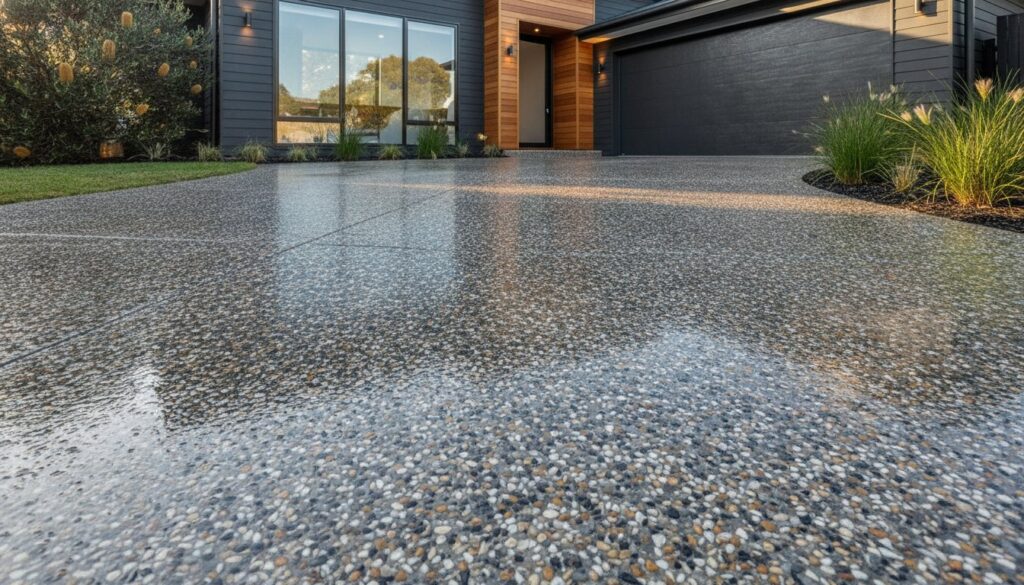
Your driveway’s sealer isn’t just a cosmetic top-coat; it’s the essential chemical binder that prevents your structural investment from literally crumbling under Sydney’s harsh UV rays. It’s frustrating to watch a once-vibrant entrance turn a dull, dusty grey or notice those first few pebbles starting to pluck loose after a summer storm. You shouldn’t have to guess whether those stubborn oil stains mean a total resurfacing job is around the corner.
Understanding exactly how often to seal exposed aggregate driveway surfaces is the difference between simple maintenance and an expensive structural overhaul. While most homeowners wait until the damage is visible, a proactive approach typically requires resealing every 12 to 36 months depending on your specific traffic levels and sun exposure. This 2026 guide provides the exact frequency needed to lock in that refined finish and prevent permanent stone loss. We explore which sealer types offer the longest protection, how to identify the early signs of wear, and the specific steps to maintain that sophisticated “wet look” for years to come.
Key Takeaways
- Determine exactly how often to seal exposed aggregate driveway surfaces to maintain structural integrity, typically ranging from every 2 years for topical acrylics to 10 years for penetrating sealers.
- Learn to identify critical visual cues like fading and “plucking” pebbles before they lead to expensive resurfacing repairs.
- Master the 30-second water test, a simple DIY method to verify if your driveway is still effectively repelling moisture and oils.
- Understand the impact of Sydney’s high UV exposure and traffic levels on your sealer’s lifespan to create a tailored maintenance plan.
- Discover why industrial-grade preparation and professional-grade sealers provide a superior, long-term bond compared to standard retail products.
The Short Answer: How Often Should You Reseal?
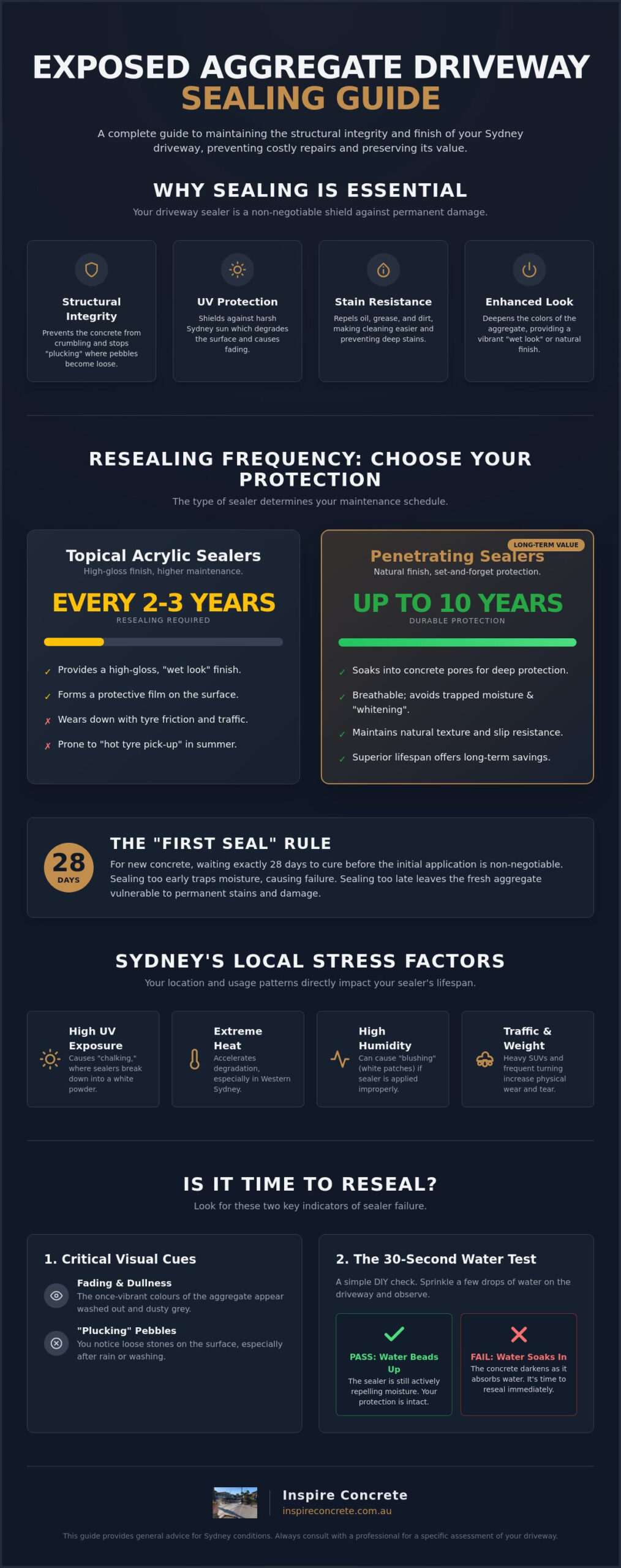
The question of how often to seal exposed aggregate driveway surfaces depends almost entirely on the chemical composition of the sealer you choose. For most residential properties in Sydney, the standard maintenance window is every 2 to 3 years when using topical acrylic sealers. However, the timeline shifts significantly if you opt for advanced penetrating sealers, which can provide robust protection for 7 to 10 years. Regardless of the product, the most vital application is the “First Seal” rule. You must wait exactly 28 days for the concrete to fully cure before the initial application. Sealing too early traps internal moisture, while waiting too long leaves the fresh aggregate vulnerable to permanent staining and pebble loss.
Sydney’s climate plays a decisive role in this schedule. Our intense UV radiation and high summer temperatures act as natural accelerators for sealer degradation. If your driveway lacks shade or serves as a high-traffic entrance for heavy vehicles, you’ll likely need to lean toward the shorter end of the maintenance spectrum to keep the finish looking its best.
The 2-Year Benchmark for Topical Sealers
Topical acrylic sealers are the industry standard for achieving that deep, high-gloss “wet look” that makes the stone colours pop. This aesthetic comes with a trade-off; because the sealer sits as a film on top of the concrete, it bears the direct brunt of tyre friction. A major challenge in warmer climates is hot tyre pick-up. This occurs when heat from your tyres softens the acrylic, causing the sealer to peel away as the vehicle moves. To maintain structural integrity and aesthetic brilliance, residential Sydney driveways using acrylic finishes require a consistent 2-year maintenance cycle.
Penetrating Sealers: The 10-Year Protection
For homeowners who prefer a natural, matte appearance and a “set and forget” strategy, a penetrating Concrete sealer is the superior technical choice. Unlike topical coats, these silane or siloxane-based products soak deep into the concrete pores to create a hydrophobic barrier from within. This chemical bond provides several long-term advantages:
- Extended Lifespan: These barriers typically remain effective for 7 to 10 years before requiring a deep clean and re-application.
- Enhanced Breathability: They allow moisture vapour to escape from the slab, which prevents the cloudy “whitening” effect often seen with trapped moisture.
- Superior Grip: Because no film is formed on the surface, the natural texture of the aggregate provides excellent slip resistance during wet weather.
While the initial cost for professional-grade penetrating sealers is higher, the long-term value is undeniable. You trade the high-gloss shine for a decade of structural certainty and significantly lower maintenance requirements over the life of your driveway.
Factors That Dictate Your Sydney Resealing Schedule
Sydney’s geography dictates your maintenance schedule as much as the sealer itself. While a general timeframe provides a baseline, your specific suburb can either accelerate or decelerate the degradation of your driveway’s protective layer. A home in the Northern Beaches faces constant salt spray and coastal winds, while a property in Penrith or Blacktown deals with extreme thermal expansion from 40-degree summer days. These environmental stressors break down the chemical bonds of the sealer, making the question of how often to seal exposed aggregate driveway surfaces a matter of local conditions rather than just a date on the calendar.
The Impact of Sydney’s UV and Humidity
Our city’s high UV index is the primary enemy of driveway longevity. Intense solar radiation triggers a process called “chalking” in inferior or aged sealers, where the polymers break down into a fine, white powder. This leaves the aggregate exposed and vulnerable to moisture. In Western Sydney, where heat is more stagnant, this process happens faster than in cooler coastal areas. Humidity also plays a technical role; high moisture levels during application or sudden coastal storms can lead to “blushing.” This creates unsightly white patches where moisture is trapped beneath the sealer film. If you live in an area with heavy tree canopy, overhanging branches don’t just provide shade; they drop organic matter that promotes mould growth, which can eat into the sealer’s integrity over time.
Usage Patterns and Surface Wear
The physical demands placed on your driveway are the second major factor in your resealing timeline. Modern residential use often involves heavy SUVs and 4WDs that can weigh well over 2.5 tonnes. Frequent turning, especially with power steering on a stationary vehicle, creates immense friction that grinds away the top layer of resin. You’ll often notice “wear tracks” forming exactly where your tyres travel every day, appearing duller than the surrounding stone.
While it’s tempting to blast away dirt with a domestic pressure washer, excessive high-pressure cleaning can actually strip the protective coating if done too frequently without a follow-up seal. This mechanical wear exposes the “plucking” pebbles mentioned earlier, leading to structural instability. If you’ve noticed the stone colours losing their depth or water no longer beading on the surface, professional concrete cleaning and sealing can restore that refined finish and stop the damage from progressing. Transitioning from a quiet suburban cul-de-sac to a shared commercial driveway can halve your maintenance window, requiring a more aggressive schedule to prevent permanent stone loss.
Penetrating vs. Topical Sealers: Choosing Your Lifespan
Selecting the right sealer is a strategic decision that balances your aesthetic vision with your long-term maintenance commitment. While Section 1 established the general timeframes, the chemistry behind these products determines how they age and interact with your driveway’s surface. Choosing between a topical and a penetrating sealer isn’t just about the finish; it’s about defining your maintenance rhythm for the next decade. To help you decide, we have compared the two most common solutions used in Sydney today.
| Feature | Topical Acrylic | Penetrating Sealer |
|---|---|---|
| Typical Lifespan | 2 to 3 Years | 7 to 10 Years |
| Visual Finish | Glossy “Wet Look” | Natural Matte |
| Slip Resistance | Requires Grit Additive | Inherently High |
| Stone Retention | Excellent (Acts as Glue) | Moderate |
Topical Acrylic Sealers (The 2-3 Year Cycle)
Topical acrylics are the most popular choice across Sydney suburbs because they dramatically enhance the natural colours of the river stones and quartz. Beyond the aesthetics, these sealers act as a high-strength resin “glue” that holds smaller aggregates in place, significantly reducing the risk of plucking. However, because this film sits on the surface, it is prone to mechanical wear. If you miss the window for how often to seal exposed aggregate driveway surfaces, the acrylic can begin to flake or wear thin in high-traffic tyre tracks, leading to a patchy appearance. You must also avoid over-application; layering too much fresh acrylic over old sealer without proper stripping can cause a milky build-up that obscures the stone’s detail.
Penetrating Sealers (The Long-Term Choice)
For those who prefer the rugged, understated elegance of exposed aggregate driveways in their raw state, penetrating sealers are the superior technical option. These products work through a chemical reaction within the concrete pores, making them exceptionally breathable. This breathability is crucial for preventing efflorescence, the white salty residue that often plagues concrete in humid climates. Because they don’t form a surface film, they are the safest choice for Sydney homes with steep gradients or pool surrounds where maximum grip is non-negotiable. While they don’t provide the same “glue” effect for the stones as acrylics, their decade-long protection makes them a sophisticated “set and forget” investment for the modern property owner.
How to Tell if Your Exposed Aggregate Needs a Reseal
Relying solely on a calendar to decide how often to seal exposed aggregate driveway surfaces can lead to either wasted effort or, more commonly, delayed repairs that result in structural damage. While the general benchmarks provide a guide, your driveway will communicate its condition through specific visual and physical cues. Identifying these early warning signs allows you to intervene before a simple maintenance task evolves into a costly resurfacing project. A healthy sealer should act as an impenetrable shield, keeping contaminants on the surface and the aggregate firmly locked in place.
The 30-Second Water Bead Test
This is the most reliable DIY diagnostic tool for assessing the integrity of your driveway’s hydrophobic barrier. To perform the test, choose a dry, clean section of the driveway, ideally in a high-traffic area where wear is most likely. Pour approximately one cup of water onto the surface and observe the reaction for 30 seconds. If the water beads into tight droplets, your sealer is still performing its primary function. However, if the water flattens out and the concrete darkens almost immediately, the sealer has failed. This darkening indicates that moisture is being absorbed into the concrete matrix, which can lead to internal structural degradation over time.
Identifying “Stone Plucking” and Surface Degradation
The most critical sign of a failed sealer is a phenomenon known as “plucking.” This occurs when the resin binder that holds the small decorative stones in place has eroded. If you find loose pebbles in your gutters or notice small gaps where stones used to be, your driveway is no longer protected. Neglecting this stage leads to “pitting,” where water sits in these empty gaps and further weakens the surrounding concrete. High-quality concrete cleaning and sealing can stop this aggregate loss in its tracks by replenishing the chemical bond between the stones and the cement base.
Beyond physical loss, pay close attention to how the surface handles daily spills. If oil drips from a vehicle or a splash of liquid soaks in instantly rather than sitting on top, the pores are open. A dull, chalky appearance or a loss of the original stone “pop” are also clear indicators that the UV polymers have broken down. If your driveway fails the water test or shows signs of plucking, it’s time to book a professional driveway assessment to restore that signature elegance and structural certainty.
The Professional Advantage: Ensuring Your Seal Lasts
While understanding how often to seal exposed aggregate driveway surfaces is a vital first step, the execution of that seal determines whether your investment lasts two years or ten. There is a significant technical gap between retail products found in hardware stores and the high-solids, professional-grade sealers used by specialists. Commercial sealers contain higher concentrations of active resins and advanced UV inhibitors specifically engineered for the Australian sun. These professional formulations create a more resilient bond that resists hot tyre pick-up and chemical staining far more effectively than thinner, off-the-shelf alternatives.
At Inspire Concrete, our approach moves beyond simple utility. We view every maintenance project as an opportunity for aesthetic transformation and structural reinforcement. By utilizing industrial-grade equipment and specialized chemical barriers, we ensure that the “pop” of your aggregate isn’t just a temporary finish, but a durable signature of your property’s value. Achieving this result requires more than just a roller and a bucket; it demands a deep understanding of concrete porosity and chemical adhesion.
Why Professional Prep Beats DIY
The failure of most DIY sealing projects isn’t usually the product, but the preparation. Industrial high-pressure cleaning is required to extract deep-seated oils and environmental contaminants that domestic pressure washers simply cannot reach. We often utilize professional degreasers and light acid etching to open the concrete pores, ensuring the sealer can bite into the surface rather than just sitting on top. One of the most common mistakes is sealing too soon after cleaning or rain. Trapping even a microscopic layer of moisture under the seal leads to delamination, resulting in a cloudy, white finish that is difficult and expensive to strip. Professionals use moisture meters to confirm the slab is technically ready for application, leaving no room for guesswork.
Setting Your 2026 Maintenance Schedule
Precision in maintenance requires documentation. We recommend keeping a digital log of your sealer type, the date of application, and the specific weather conditions during that window. This record helps refine your understanding of how often to seal exposed aggregate driveway sections on your specific property, as every site has unique wear patterns. A professional inspection every 24 months is a proactive way to catch early signs of sealer thinning before aggregate loss begins. This steady, logical rhythm of care ensures your driveway remains a refined highlight of your home’s exterior.
Ready to restore your driveway’s original brilliance and lock in its structural integrity? Get a professional concrete quote from Inspire Concrete and let our master craftsmen transform your entrance with a finish that’s built to endure.
Protecting Your Investment for the Decade Ahead
Maintaining the structural integrity and aesthetic “pop” of your driveway requires a proactive strategy rather than reactive repairs. By understanding how often to seal exposed aggregate driveway surfaces based on your specific Sydney location and usage patterns, you prevent the irreversible damage of pebble plucking and deep-set staining. Whether you opt for the glossy enhancement of a topical acrylic every two years or the decade-long resilience of a penetrating sealer, consistent care remains the hallmark of a sophisticated property.
Don’t leave your home’s entrance to chance. With over 20 years of experience in the Sydney metro area, Inspire Concrete provides the technical expertise and refined craftsmanship required for high-end exposed aggregate finishes. Our fully licensed and insured local concreters handle everything from industrial cleaning to precision application. Request a Professional Cleaning and Sealing Quote to ensure your driveway continues to reflect the quality of your home. Your driveway is the first impression of your creative vision; let’s keep it looking flawless for years to come.
Frequently Asked Questions
Can I seal my exposed aggregate driveway myself?
You can seal your own driveway, but achieving a professional-grade bond requires industrial preparation that most domestic equipment cannot provide. DIY projects often struggle with uneven application and inadequate cleaning, which leads to peeling within months. Hiring a specialist ensures the use of high-solids resins that are far more resilient than retail alternatives found in hardware stores.
What happens if I never seal my aggregate driveway?
Neglecting your driveway leads to structural aggregate loss and deep, permanent staining from oils and organic matter. Without a protective barrier, the cement binder weakens under Sydney’s UV rays, causing the decorative stones to “pluck” out of the surface. This eventually turns a premium finish into a dusty, pitted slab that requires expensive resurfacing later.
How long should I wait to seal a new concrete driveway?
You must wait a minimum of 28 days for the concrete to fully cure before applying any sealer. This window allows internal moisture to evaporate, preventing the common “whitening” effect caused by trapped water vapour. Sealing too early is a technical mistake that can permanently compromise the chemical bond of your first protective coat.
Does sealing make exposed aggregate slippery?
Topical acrylic sealers can become slippery when wet, but this is easily managed with professional anti-slip additives mixed into the resin. Penetrating sealers provide a natural matte finish that maintains the inherent grip of the stone without adding a film. If your driveway has a steep gradient, opting for a penetrating product or a high-grip topical finish is the safest technical choice for your property.
Can you seal over old sealer, or do you have to strip it?
You can often apply a fresh coat of acrylic over existing acrylic if the surface is thoroughly cleaned and free of flaking or delamination. However, if you are switching to a penetrating sealer or if the old coat has turned milky, a full chemical strip is required. Layering too many coats without a clear understanding of how often to seal exposed aggregate driveway surfaces leads to unsightly resin build-up that obscures the stone.
How much does it cost to professionally seal a driveway in Sydney?
Professional sealing costs are calculated based on the total square meterage, the level of cleaning required, and the specific sealer technology selected. While investment levels vary, a professional application prevents the significantly higher costs of aggregate replacement or concrete resurfacing. A master-grade finish provides long-term value and structural certainty that far outweighs the initial expense of the service.
Will sealing my driveway hide existing cracks?
Sealer is a transparent protective layer and will not hide cracks; it may actually make them more visible by deepening the surrounding stone colours. Any structural or hairline cracks must be professionally repaired and colour-matched before the sealing process begins. The sealer’s primary role is to protect the surface from further moisture ingress rather than acting as a structural filler.
What is the best time of year to seal concrete in Sydney?
The ideal time to seal concrete in Sydney is during the mild, dry conditions of Spring or Autumn. You should avoid application on days with high humidity or extreme summer heat, as these conditions can cause the sealer to dry too quickly or trap moisture. Determining how often to seal exposed aggregate driveway sections should also account for the upcoming season to ensure the product cures in stable, predictable temperatures.
