
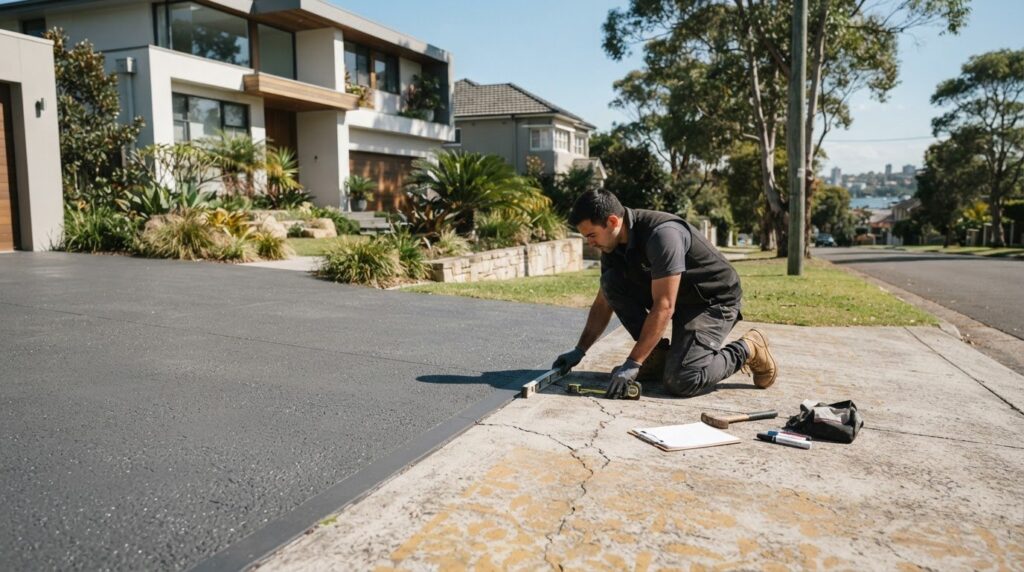
Can you resurface a stencilled driveway without starting from scratch? Often, yes, if the concrete beneath the finish is stable and suitable for resurfacing. If the slab is moving, sinking or badly cracked, a new surface may not address the underlying problem.
The finish you choose matters, too. One option refreshes the surface while retaining some of the stencil detail. Another covers the old pattern with a different look. Neither suits every driveway, and an added layer can affect surface levels, edges and drainage if these aren’t planned carefully.
This guide explains when resurfacing is practical, how pattern-preserving and pattern-changing finishes differ, and when replacement may be the better option. You’ll also learn what an assessment should cover, from the slab and preparation to water flow and access. Inspire Concrete provides concrete resurfacing across Sydney, including the Western Suburbs and Blue Mountains, with more than 20 years of industry experience.
Key Takeaways
- Can you resurface a stencilled driveway? Often, if the concrete beneath it is stable and suitable for a new finish.
- Compare options for keeping the stencil pattern, making it less visible, or replacing the driveway before settling on a look.
- Use a simple site checklist to record cracks, loose areas, water pooling, slope and driveway edges before an assessment.
- Understand how preparation and the selected resurfacing system shape the process and the finished appearance.
- See how Inspire Concrete brings driveway condition, design goals and Sydney site requirements into project planning.
Can you resurface a stencilled driveway? Start with the concrete beneath it
Often, yes. Whether you can resurface a stencilled driveway depends on the stability and condition of the existing concrete. Resurfacing applies a new finish to concrete that has been prepared for the work. It can renew the surface, but it won’t rebuild a structurally failing slab.
The stencil pattern may be retained, softened or concealed, depending on the preparation and finish selected. The right option depends on the concrete’s condition as well as the appearance you want. Patterned concrete techniques create decorative driveway finishes; the Stamped Concrete overview provides background on one related approach.
A durable resurfacing result depends on a stable concrete base, thorough preparation and a finish suited to the driveway’s condition and intended appearance. An assessment needs to look beyond faded colour or worn sealer. A surface can look tired yet be suitable for resurfacing, while a fresh-looking area may still have movement or drainage issues that affect the result.
What condition should a stencilled driveway be in?
Fading, surface wear and minor blemishes are different from recurring cracks, shifting sections or concrete that is deteriorating through its depth. Wear may affect appearance without indicating movement in the slab. Widespread movement or unstable areas, by contrast, can undermine the bond and performance of a new overlay.
Look at the whole driveway, not just its most visible patch. An on-site assessment can identify where the stencil finish is worn, whether defects are isolated or recurring, and whether the concrete provides a sound base. Appearance alone can’t establish whether resurfacing is suitable.
Which warning signs can change the resurfacing decision?
Note any lifting, recurring cracks, uneven sections or water pooling. These are reasons for closer assessment, not a diagnosis on their own. Record where they occur and whether you’ve noticed changes over time. Photos can document what you see, but they can’t reliably establish the condition beneath the surface.
Check the driveway’s slope, edges and connections to adjoining areas. A new layer changes the finished surface level, so the plan needs to account for transitions at garages, paths and boundaries. Existing falls also influence where water flows. If resurfacing could alter drainage, that needs to be considered before work proceeds.
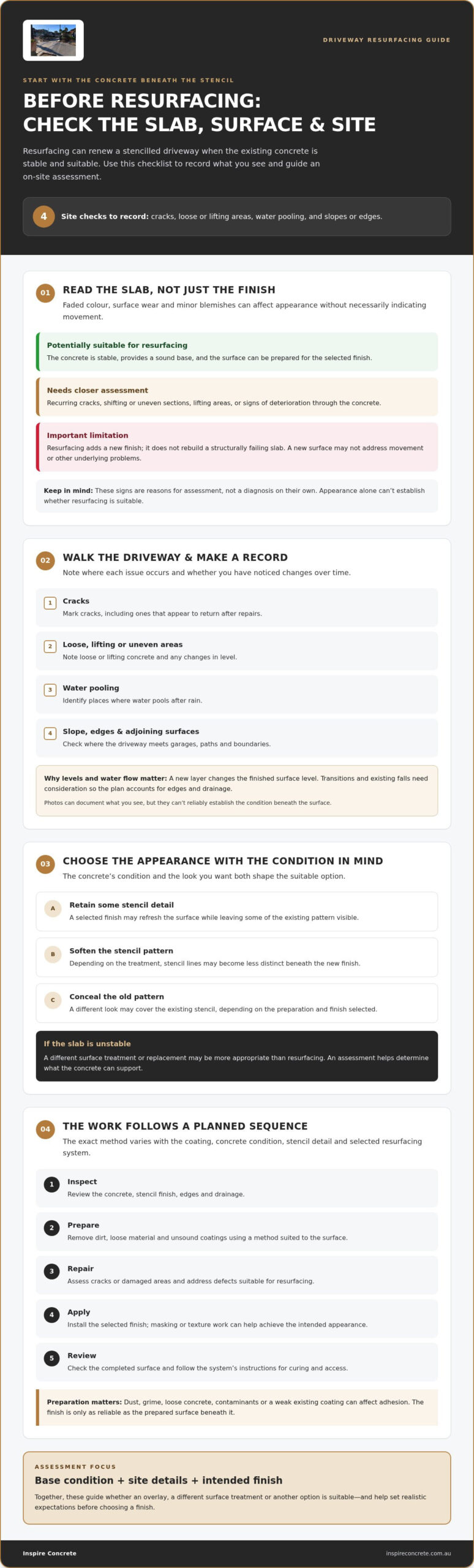
Walk the driveway and make a simple record:
- Mark cracks, including those that appear to return after repairs.
- Note loose or lifting areas and changes in level.
- Identify places where water pools after rain.
- Check slopes and edges where the driveway meets other surfaces.
These observations help guide a project-specific assessment of the concrete, drainage, site conditions and finish you want. The outcome may be an overlay, a different surface treatment or a decision that resurfacing isn’t suitable. A careful assessment sets realistic expectations before you choose a finish.
How stencilled driveway resurfacing works, from preparation to finish
Resurfacing follows a planned sequence, but there isn’t one method for every stencilled driveway. The existing coating, concrete condition, stencil detail and selected resurfacing system all influence the work. A typical process moves from inspection and preparation to suitable repairs, finish application and a final review. Each stage helps match the result to the surface and the look you want.
The finish is only as reliable as the prepared surface beneath it. Rushed or incomplete preparation can compromise adhesion and leave defects visible through the new finish. The aim is to create a clean, sound base and address suitable imperfections before applying the selected treatment.
- Inspect: Review the concrete, existing stencil finish, edges and drainage.
- Prepare: Remove dirt, loose material and unsound coatings using a method suited to the surface.
- Repair: Assess cracks or damaged areas and address defects suitable for resurfacing.
- Apply: Install the selected finish, using masking or texture work to achieve the intended appearance.
- Review: Check the completed surface and follow the system’s instructions for curing and access.
This sequence is illustrative, not a fixed recipe. Product guidance can explain the general principles: Quikrete’s Concrete Resurfacer Application discusses surface preparation, mixing and application for its resurfacer. The suitable materials and process for a particular driveway depend on its condition and the system selected.
Why cleaning and surface preparation matter
Dust, grime, loose concrete and contaminants can interfere with a resurfacing layer. Any existing coating that is no longer sound also needs assessment, since applying a new layer over a weak one can affect the bond. Preparation isn’t just about making the driveway look clean; it creates a more suitable surface for the next stage.
Cracks and damaged patches need attention before the finish goes down. Their location, extent and stability help determine whether they can be addressed during preparation or point to a bigger limitation. Cleaning and repair methods should suit the concrete and resurfacing system, rather than rely on one treatment for every site.
How application affects the final appearance
Masking, application technique, texture and colour all shape the finished look. Depending on the treatment, stencil lines may remain visible or become less distinct beneath the new finish. Discussing the intended appearance before application helps set expectations about how much of the original pattern will show.
Curing and access times vary with the selected system and site conditions, so don’t assume the driveway will be ready on a fixed schedule. The project plan should explain how the work stages fit together and when the surface can be used. For a considered concrete resurfacing project, Inspire Concrete brings finish selection and practical planning together.
Keep the stencil, change the look, or replace the driveway?
Once you understand the driveway’s condition, the next choice is both visual and practical: preserve the stencil, move towards a more uniform finish, or replace the concrete. Can you resurface a stencilled driveway without keeping its original look? Often, yes. Resurfacing changes the surface finish, but it still depends on the slab beneath it. The best option depends on the slab’s condition and the result you want.
| Option | Appearance | Dependence on existing concrete | Scale of work |
|---|---|---|---|
| Retain the pattern | Refreshes the driveway while keeping stencil detail visible to some degree. | Requires a suitable existing surface; pattern clarity depends on its profile and the selected finish. | Resurfacing and preparation, without replacing the slab. |
| Make the pattern less visible | Creates a more uniform look, with the old design softened or concealed. | Still relies on the existing concrete being suitable for an overlay. | Resurfacing with a finish selected to change the appearance. |
| Replace the driveway | Provides a new concrete surface and a fresh starting point for the design. | Doesn’t rely on the old slab as the finished base. | More substantial work involving removal and new concrete. |
When retaining the stencil pattern may suit the brief
Keeping the pattern can suit owners who like the driveway’s existing design and want to renew its surface without losing its character. It may also help maintain visual continuity with paths or other concrete areas. However, an overlay can change how sharply the stencil lines read. The existing surface profile and selected finish influence whether the pattern remains pronounced, becomes softer or varies across the driveway.
Think of the outcome as a refreshed interpretation, not necessarily an exact recreation of the original appearance. A finish applied over existing concrete can change colour, texture and definition. Comparing the current surface with your preferred result helps clarify whether retaining the stencil will achieve the look you have in mind.
When changing the finish or replacing concrete may make more sense
If you’re ready for a different look, a more uniform finish may suit the property better than preserving a decorative pattern. Resurfacing can change the appearance if the concrete is suitable, but the overlay remains dependent on the slab beneath it. It renews the surface; it doesn’t rebuild the structure.
Significant movement or deterioration can make resurfacing unsuitable. Covering the surface may leave the underlying issue unresolved, so more substantial concrete work, potentially including replacement, may need consideration. The distinction matters: surface wear may be addressed through a finish treatment, while an unstable base calls for a different solution. An on-site assessment helps match the option to the driveway’s condition, the appearance you want and the scope of work.
How to assess a stencilled driveway before resurfacing in Sydney
A clear record of the driveway helps make an initial project discussion more useful. If you’re asking, “can you resurface a stencilled driveway?”, note both its visible condition and how you use the space. Photos and practical details won’t determine suitability on their own, but they can help focus attention on areas that need a closer look.
Walk the full driveway and record:
- Where cracks, loose areas or uneven sections appear, and whether cracks seem to have changed over time.
- Where water collects after rain, along with the direction the driveway slopes.
- The condition of edges and transitions where the driveway meets a garage, path, road or other surface.
- Vehicle access needs, including where cars enter, turn or park, and any areas that must remain usable.
- Your preferred outcome: retain the stencil pattern, soften its definition or create a different look.
Photograph the whole driveway from a few angles, then take close-ups of visible defects, edges and pooling. This gives a useful overview, but photos aren’t a diagnosis. Explore Inspire Concrete’s resurfacing service to see how concrete renewal can form part of a planned project.
What to note about the driveway before an assessment
Add context to your photos. For example, note whether a crack is near a driveway edge or crosses an area used by vehicles, and whether pooling happens in one spot or across a broader area. Describe any changes you’ve observed without guessing at the cause. Your notes can guide an on-site review of the concrete, access and finish requirements.
Questions the project scope should resolve
A project scope should connect the appearance you want with the work the site needs. It should clarify which stencil details may remain visible, what alternative finish could suit, and what preparation or repairs are planned. It should also address drainage, surface levels, edges, access arrangements and expected disruption, so the finish is considered alongside how the driveway needs to function.
Sydney site conditions can shape that planning. Exposure to sun and weather, available access, nearby surfaces and existing water flow all inform how work is staged and how the finished surface relates to its surroundings. A sloped entry or narrow access point, for example, may affect sequencing and transitions at the edges.
For broader context on driveway design and practical considerations, the Concrete Driveways in Sydney guide can help frame the wider choices. An assessment brings your site observations together with your preferred finish, giving you a clear basis for deciding what to do next.
How Inspire Concrete approaches stencilled driveway resurfacing
A successful project starts with the driveway as it is, not just the finish you’d like to see. Inspire Concrete is a family-owned Sydney concreting business with more than 20 years of industry experience. For a stencilled driveway, the team considers three things together: the existing concrete, your preferred appearance and the practical requirements of the site.
Resurfacing can renew suitable concrete, but it isn’t a fix for every defect. Inspire Concrete assesses what the surface can support, then plans the work around those findings. This keeps design decisions grounded in the driveway’s condition and how it needs to function.
From driveway condition to a clear project scope
Your goals help shape the plan. You might want to bring out the stencil pattern, make it less prominent or move towards a different finish. Inspire Concrete considers those preferences alongside the assessment, so preparation, finish selection and site planning form one coordinated scope.
The site matters, too. Access, drainage, edges and adjoining concrete can affect how the work is planned. Inspire Concrete works across Sydney Metro, including the Western Suburbs and Blue Mountains, and provides project planning and management to bring the desired outcome and practical requirements into alignment.
What a considered finish should deliver
A renewed appearance should suit the driveway’s condition and account for how water moves across the site. Good planning considers preparation and finish details, along with how the completed surface meets surrounding areas. The aim is a considered result that supports the property’s appearance without treating an overlay as a solution to underlying concrete issues.
For a broader overview of the service, Concrete Resurfacing Sydney: Transform Your Property provides additional context. The next step is a project-specific discussion about what you’ve observed, the look you want and the site’s requirements. That gives you a clearer basis for deciding whether resurfacing is the right direction or another form of concrete renewal is more suitable.
- Existing concrete: What does its condition mean for the project scope?
- Intended appearance: Should the stencil remain visible, become softer or give way to a different look?
- Site planning: How will access, drainage and adjoining surfaces be considered?
Ready to explore the options for your driveway? Discuss your stencilled driveway with Inspire Concrete.
Take the next step towards a driveway that fits your home
The question “can you resurface a stencilled driveway?” is a starting point, not a decision to make from appearance alone. Turn what you’ve noticed into a clear brief: how you’d like the driveway to look, how you use it and which areas need closer attention. This gives the assessment a practical purpose and connects design choices with the concrete beneath them.
You don’t need to have every detail settled. A preference to keep the stencil, soften it or choose a different finish is enough to begin a considered discussion. If your driveway upgrade is part of a broader exterior overhaul, looking to finish and restoration specialists like Crandall Painting & Stucco can provide helpful inspiration for pairing high-end wall and architectural coatings with renewed ground surfaces. From there, the project can be shaped around the driveway’s condition and site requirements, with resurfacing considered alongside other suitable options where needed.
For homeowners across Sydney, Inspire Concrete brings driveway and resurfacing experience to the planning process. Explore your driveway renewal options with Inspire Concrete and take the next step towards a finish that feels right for your property.
Frequently Asked Questions
Can resurfacing fix cracks in a stencilled driveway?
Resurfacing can improve the appearance of some repaired cracks, but it won’t stop cracking caused by ongoing movement. If you’re asking “can you resurface a stencilled driveway” that has cracks, the cause, extent and stability of those cracks need assessment before choosing a finish. Repairs and preparation depend on the surface. If movement continues beneath the overlay, a crack may reappear or show through the new finish.
Will resurfacing make my stencilled driveway slippery?
The finished texture and the driveway’s conditions affect how it feels underfoot, particularly when wet. Consider how the area is used, whether it’s sloped and how exposed it is to weather. For example, a steep section used regularly by pedestrians needs different practical consideration from a level parking area. Inspire Concrete can factor the site’s use into finish planning, but don’t assume a particular slip rating without verified information for the selected system.
How long before I can drive on a resurfaced driveway?
Vehicle access timing depends on the resurfacing system, how it’s applied and conditions at the site, so there isn’t one reliable reopening time for every driveway. Follow the project-specific access guidance rather than judging readiness by whether the surface looks dry. Driving on it too soon can mark or damage the finish. Plan ahead by arranging alternative parking if needed, and keep vehicles off the area until the stated guidance allows access.
Can a new stencil pattern be added when resurfacing an old driveway?
A changed appearance may be possible, but a new stencil treatment depends on the driveway’s condition and the resurfacing method selected. Retaining the current pattern means working with its existing lines and profile; choosing a different look involves a separate finish decision. Consider the surrounding home and concrete areas, then discuss the result you want. The surface assessment helps establish a suitable treatment without promising a specific pattern in advance.
Does resurfacing change the height of a driveway?
It can affect the finished level because resurfacing adds a layer. The change depends on the system and existing surface, and matters at garage entries, door thresholds, adjoining paving and drainage paths. For instance, a raised transition could affect how a vehicle enters or how water flows at the edge. Planning should consider these connections across the site, not just the driveway’s central area, so the new finish works with its surroundings.
Can a stencilled driveway be resurfaced in wet weather?
Suitable application conditions depend on the selected system and its technical requirements. Rain or moisture may affect preparation and finishing, so the work plan needs to account for site conditions and the forecast. There isn’t a universal weather rule for every product or project. Inspire Concrete plans the work around the conditions needed for preparation and a consistent finish.
How should I care for a resurfaced driveway after the work?
Follow the care and access instructions for your specific finish, especially during its initial curing period. Once the driveway is back in use, clear leaves and debris and attend to spills promptly, as residue left on the surface can become harder to remove. Don’t assume every coating suits the same cleaning chemicals or equipment. Any future sealing or maintenance should follow the requirements for the finish applied to your driveway.
