
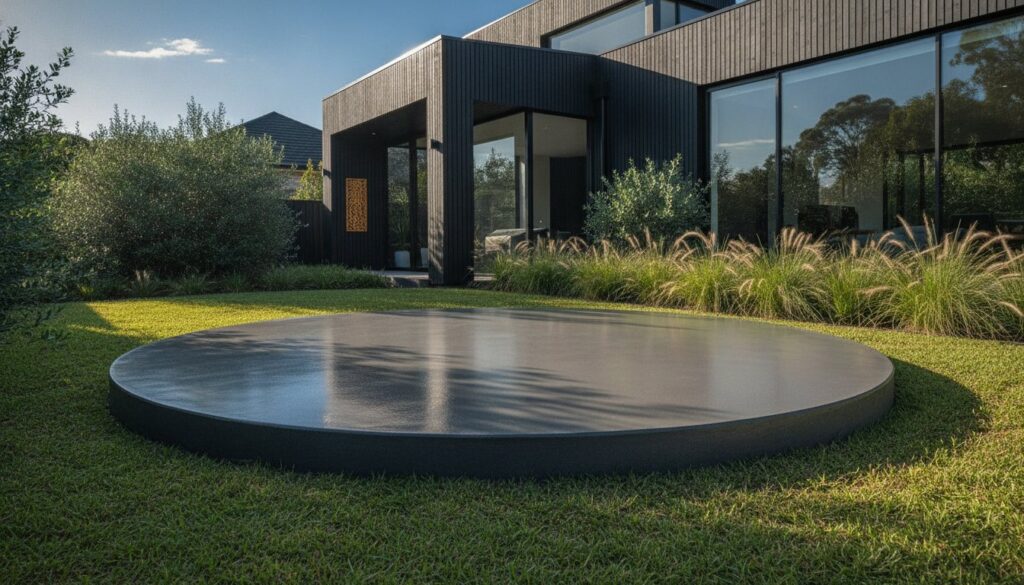
A water tank base isn’t just a simple concrete pad; it’s a high-performance structural foundation that must support several tonnes of “dead weight” without flinching. When you consider that a 10,000-litre tank weighs as much as five SUVs, the fear of your foundation cracking or sinking is entirely valid. Many Sydney homeowners feel caught between conflicting advice about sand bases versus professional concrete slabs, especially when dealing with the notoriously reactive clay soils of Western Sydney. Choosing a professional concrete slab for water tank base projects is the only way to guarantee your infrastructure remains level and leak-free for decades.
You deserve a foundation that protects your investment and satisfies every BASIX requirement without guesswork. This guide explains how to design and install a structural slab that manages the immense pressure of water storage while adhering to AS 3735 standards for liquid-retaining structures. We’ll walk through the technical requirements for concrete strength, the critical role of site preparation, and the specific engineering needed to ensure your tank never tilts or subsides. From initial excavation to the final level finish, you’ll discover how expert craftsmanship transforms a basic utility into a permanent, high-value asset for your property.
Key Takeaways
- Understand the physics of water storage and why a structural slab is the only foundation capable of supporting the massive static weight of a large tank without shifting.
- Discover the exact engineering specifications required for a concrete slab for water tank base, including the necessary MPa strength and thickness for various tank capacities.
- Learn how to mitigate the risks of Sydney’s reactive clay soils, ensuring your foundation remains stable through seasonal expansion and contraction.
- Identify the critical importance of a perfectly level finish to prevent structural instability and potential tank failure caused by even minor tilting.
- Master the professional installation process, from setting up precise formwork to ensuring compliance with local Sydney council and BASIX requirements.
Why a Concrete Slab is the Gold Standard for Tank Bases
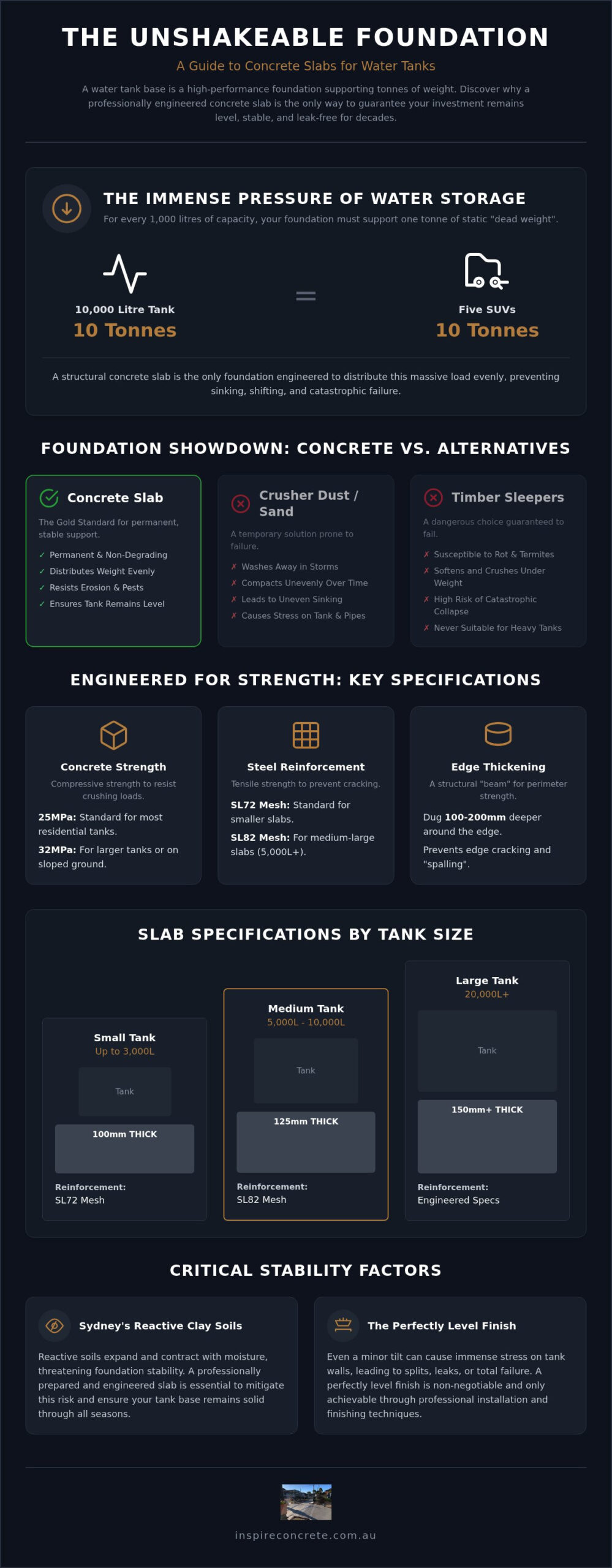
The physics of water storage are unforgiving. Water is heavy. Very heavy. For every 1,000 litres of capacity, your foundation must support one tonne of static weight. A 15,000-litre tank exerts the same pressure as 10 family sedans parked on a tiny footprint. This “dead weight” doesn’t move, and it doesn’t forgive a weak foundation. A professionally poured concrete slab for water tank base projects acts as a common structural element designed to distribute this massive load evenly across the soil. Without this rigid support, the concentrated pressure will inevitably find the weakest point in your yard.
Beyond simple weight distribution, concrete offers structural longevity that other materials can’t match. It provides a permanent barrier against erosion and pests. While sand or gravel might seem like an easy shortcut, they are susceptible to “washout” during Sydney’s intense summer storms. A concrete slab stays put, keeping your tank level and your property looking refined. This is especially critical for BASIX-compliant slimline tanks. These units are often tall and narrow, positioned right against house walls. Even a minor shift in the ground can cause a slimline tank to lean, creating a dangerous hazard and potentially damaging your home’s cladding or brickwork.
The Risks of Inferior Tank Foundations
Choosing an unstable base like sand or loose gravel often leads to uneven sinking. When one side of a tank settles faster than the other, it creates immense stress on the tank walls. This often results in split seams or structural failure, especially in poly or slimline steel tanks. Sydney’s heavy rain can quickly undermine a gravel base, washing away the support from under the edges. This movement is a nightmare for your plumbing. When the base shifts, it puts “shear” stress on your pipes and pump connections. It doesn’t take much movement to snap a PVC fitting or burn out a pump that’s suddenly fighting against misaligned levels.
Concrete vs. Other Materials
- Crusher Dust: This is often marketed as a cheap alternative. It’s a temporary solution at best. In residential Sydney gardens, it eventually migrates or compacts unevenly, leaving your tank unsupported.
- Timber Sleepers: Never use timber for a heavy tank base. Sydney’s climate makes timber a magnet for rot and termites. Once the wood softens, the weight of the water will crush the frame, leading to a catastrophic collapse.
- Concrete: It’s the only choice for tanks over 5,000 litres. It provides a flat, non-combustible, and permanent surface that won’t degrade over twenty or thirty years of service.
Engineering Specs: Thickness, Strength, and Reinforcement
Designing a concrete slab for water tank base stability requires more than just pouring wet mix into a hole. It’s a calculated engineering exercise. For residential projects, we look at the compressive strength of the concrete and the tensile strength of the steel reinforcement. Most standard slabs use 25MPa concrete, but for larger tanks or those situated on steeper grades, 32MPa provides the necessary density to resist crushing under massive static loads. Steel mesh, typically SL72 or SL82, is essential to control shrinkage cracks and hold the slab together as it cures and settles.
We often include edge thickening in our designs. This involves digging the perimeter of the slab deeper, usually an extra 100mm to 200mm, to create a structural “beam” around the edge. This prevents the slab from cracking under the concentrated weight of the tank walls and stops the edges from “spalling” or breaking away over time. Regulatory bodies across the building and plumbing industries emphasize that foundations must be fit for purpose, and this extra reinforcement is what separates a DIY job from a professional structural foundation.
Slab Specifications by Tank Size
The thickness of your slab depends entirely on the volume of water it will hold. For small slimline tanks up to 3,000 litres, a standard 100mm slab with SL72 mesh is usually sufficient. However, as you move into medium-sized storage (5,000L to 10,000L), we increase the thickness to 125mm and upgrade the reinforcement to SL82 mesh. For large rural tanks exceeding 20,000 litres, an engineered slab of 150mm or more is mandatory. These heavy-duty foundations ensure the weight is distributed effectively without stressing the soil below.
Choosing the Right Concrete Mix
Consistency is the hallmark of a quality pour. While hand-mixing bags might work for a small garden path, it’s insufficient for a structural tank base. We use ready-mix concrete from a batching plant to ensure the MPa strength is exact. We also monitor the “slump” of the concrete, which measures its workability and water-to-cement ratio. A mix that’s too wet will be weak and prone to cracking, while a mix that’s too dry won’t finish smoothly. For a result that combines engineering precision with an elegant finish, it’s best to consult with professional Sydney concreters who understand these technical nuances.
Site Preparation for Sydney’s Reactive Soils
Sydney’s geology presents a unique challenge for any structural foundation. While coastal suburbs often sit on stable sandstone or free-draining sand, the vast plains of Western Sydney are dominated by reactive clay. This soil is “active,” meaning it physically expands when it absorbs water and contracts as it dries. Without proper site preparation, a concrete slab for water tank base stability will eventually crack as the ground moves beneath it. We don’t just pour over grass; we engineer the ground to stay still.
Precision at this stage is what defines a project’s lifespan. We start by identifying the specific soil profile of your property. If we’re working in clay-heavy areas like Penrith or Blacktown, the preparation must be more rigorous than a job in Maroubra. The goal is to create a “floating” effect where the slab remains independent of the seasonal soil movements. This requires a meticulous approach to excavation and sub-grade compaction that many general contractors overlook. It’s about creating a predictable environment for the concrete to live in.
Dealing with Clay and Silt in Western Sydney
Simply removing the top layer of grass isn’t enough. For a heavy-duty tank, we excavate deep enough to remove all organic matter and soft silt. We then introduce a 50mm to 75mm layer of DGB20 road-base. This material is mechanically compacted to create a rigid, non-reactive platform. To further protect the concrete, we install a high-impact plastic moisture membrane. This prevents the clay from sucking moisture out of the wet concrete during the pour and stops rising damp from affecting the slab’s longevity. This method aligns with global best practices, such as those found in the Texas Manual on Rainwater Harvesting, which highlights the necessity of a stable, well-drained foundation for any large-scale water storage system.
Drainage and Overflow Management
Water is the primary enemy of soil stability. If your tank overflow isn’t managed, it will “scour” the ground around the slab, eventually undermining the foundation. We ensure the slab itself has a subtle 1:100 fall away from any adjacent house walls to prevent pooling. Every concrete slab for water tank base we install is designed to integrate seamlessly with your existing stormwater infrastructure. This ensures that even during a heavy rain event, the water is directed safely away from the base. Maintaining a dry perimeter is the simplest way to keep the underlying soil’s moisture levels consistent, which is the secret to a slab that doesn’t tilt or sink over twenty years of service.
The Professional Installation Process
Execution is where engineering theory meets physical craftsmanship. A concrete slab for water tank base project begins with a precise marking out phase. We always extend the slab dimensions to allow for a 100mm overhang around the tank perimeter. This margin isn’t just for aesthetics. It ensures the concentrated load of the tank walls sits directly over the reinforced core of the slab. It also creates a stable, mud-free platform for your pump housing and pipework connections, adding long-term value to the installation.
Formwork and Reinforcement Placement
Professional formwork acts as the rigid skeleton for your pour. We secure our forms with deep-driven stakes to ensure they don’t “blow out” under the immense hydraulic pressure of wet concrete. Inside this frame, the placement of steel mesh is the most critical step for durability. We use specialized plastic “chairs” to suspend the mesh, ensuring it sits exactly in the center of the slab. This provides 50mm of concrete cover on all sides, shielding the steel from moisture and preventing the rust that leads to structural cracking. We also meticulously lap the mesh sheets to maintain a continuous web of strength across the entire foundation.
Finishing and Curing for Durability
The pour requires a steady hand and a keen eye for levels. We use a professional screed to strike off the concrete, ensuring the surface is perfectly flat. For tank bases, a wood float finish is usually the preferred choice. It offers a refined, sandy texture that provides better grip for the tank’s bottom surface than a slick steel trowel finish. This prevents micro-movements during the tank’s fill and drain cycles, which can otherwise cause wear on the tank floor over many years.
Patience is the final requirement for a successful build. While concrete feels hard to the touch within hours, it takes days to develop the MPa strength required to support several tonnes of water. Loading a slab too early is a recipe for disaster. We advise clients to follow a strict schedule before the tank is delivered. See our guide on concrete curing times for a detailed breakdown of how concrete gains its structural integrity over time. If you want a foundation that stands the test of time, contact our Sydney experts to discuss your project requirements.
Why Hire Professional Sydney Concreters for Your Tank Base
Precision isn’t just a goal; it’s a structural requirement. A 1% tilt on a 10,000L tank isn’t just a minor eyesore. It shifts the entire center of gravity. This creates uneven pressure on the tank floor and can lead to a catastrophic failure of the base or the tank itself. Achieving a perfectly flat finish on a concrete slab for water tank base requires more than a standard spirit level. It requires the refined touch of an expert craftsman who understands how concrete behaves during the curing process. Professional installers use laser levels to ensure that every square millimetre is perfectly horizontal, protecting your plumbing and your tank’s structural warranty.
Hiring a specialist also streamlines the heavy lifting. Managing a site involves complex logistics, including excavation, soil removal, and the precise timing of the concrete pump. We handle these stages as a single, efficient operation. This project management approach ensures that your yard isn’t left as a construction site for weeks on end. Beyond the immediate utility, a professionally finished slab adds genuine long-term value to your property. It signals to future buyers that the home’s infrastructure was built with a commitment to excellence and durability.
Avoiding Costly DIY Mistakes
The DIY path often presents hidden financial traps. Hiring an excavator and disposing of Sydney’s heavy clay can be surprisingly expensive for an individual. If the sub-base isn’t compacted correctly, even the best concrete will fail under pressure. “Cheap” hand-mixed concrete often lacks the MPa strength verified by a professional batching plant, leading to spider-web cracks and sinking. These issues are incredibly expensive to fix once a full tank is sitting on top. For a deep dive on selecting the right partner for your property, read our Master Guide to Hiring Concreters in Sydney.
Your Next Steps for a Solid Foundation
Inspire Concrete brings over 20 years of Sydney-specific expertise to every structural foundation. We treat every tank base as a critical piece of engineering, ensuring it meets all local council and BASIX requirements. Many homeowners find it cost-effective to combine their tank foundation with other aesthetic transformations. You can easily integrate your slab with new concrete pathways or shed pads during a single site visit. This creates a uniform look that enhances your lifestyle and property appeal. Contact Inspire Concrete for a professional slab quote today to start your project with total certainty.
Build for the Future with a Structural Foundation
Investing in a high-quality water tank is a smart move for sustainability, but that investment is only as secure as the ground it sits on. We’ve explored how a correctly engineered concrete slab for water tank base stability prevents the costly sinking and cracking that often plagues inferior foundations. By prioritizing professional site preparation on Sydney’s reactive clay and adhering to strict MPa strength standards, you ensure your infrastructure remains level for decades.
As a locally owned and operated family business with over 20 years of Sydney experience, Inspire Concrete specializes in high-load structural slabs. We transform basic utility into a permanent asset for your property, ensuring every pour meets our high standards for craftsmanship. Don’t leave your home’s infrastructure to guesswork. Secure your water tank foundation with Inspire Concrete, Get a Quote today. Your property deserves a foundation built with precision and pride.
Frequently Asked Questions
How thick should a concrete slab be for a 5,000-litre water tank?
A 125mm thickness is the professional standard for a 5,000-litre tank foundation. While smaller units might sit on 100mm, the five-tonne weight of a mid-sized tank requires that extra depth to prevent structural failure. We ensure the slab is reinforced with SL82 mesh to handle the static pressure effectively. This thickness provides the necessary rigidity to resist bending or cracking on Sydney’s varied soil profiles, ensuring a foundation that lasts for decades.
Do I need steel mesh in a water tank slab?
Steel reinforcement is non-negotiable for any structural water tank foundation. We use SL72 or SL82 mesh to provide tensile strength, which prevents the slab from pulling apart under heavy loads. Without mesh, the concrete is prone to shrinkage cracks and “shear” failure. We always place the steel on chairs to ensure it sits in the center of the pour, providing a minimum of 50mm of concrete cover to protect against corrosion and rust.
Can I put a water tank on pavers instead of a concrete slab?
Pavers are generally unsuitable for tanks exceeding 2,000 litres. The individual units can shift or sink independently, causing the tank to tilt and eventually fail. Unlike a concrete slab for water tank base stability, pavers don’t distribute weight as a single monolithic structure. Over time, Sydney’s heavy rainfall can wash out the sand bedding beneath pavers, leading to an uneven surface that puts dangerous stress on the tank’s seams and critical plumbing connections.
How long should I wait for the concrete to cure before installing the tank?
You should wait at least seven days before placing an empty tank on the slab, and up to 28 days before filling it to capacity. Concrete gains the majority of its compressive strength within the first week, but full structural integrity takes nearly a month to achieve. Filling a 10,000L tank too early can crush the internal structure of the curing concrete, leading to permanent weakness and premature cracking that compromises the entire structural installation.
Does a water tank slab need to be perfectly level?
A perfectly level surface is critical for the long-term stability of your water storage system. Even a minor 1% tilt can cause the water’s weight to exert uneven pressure on the tank walls, potentially leading to a structural collapse. We use precision laser levels during the screeding process to guarantee a horizontal finish. This accuracy ensures that your tank sits flush against the base, preventing the “tilting” effect that often leads to split seams or broken pipework.
Should the slab be larger than the water tank itself?
We recommend a 100mm overhang around the entire perimeter of the tank. This extra width ensures that the weight of the tank walls is supported by the reinforced core of the slab rather than the very edge, which is more prone to chipping or spalling. A larger slab also provides a clean, stable area for mounting your pump housing and connecting the necessary pipework, protecting these vital components from direct contact with garden soil and moisture.
What is the best concrete strength (MPa) for a tank base?
For most residential applications in Sydney, 25MPa concrete provides the necessary density and strength. However, for tanks exceeding 15,000 litres or those placed in high-traffic areas, we often upgrade to 32MPa. This higher rating offers increased durability and resistance to environmental wear. Using a professional batching plant ensures the mix is consistent, avoiding the structural weaknesses found in hand-mixed bags that often fail to reach these critical structural performance benchmarks.
Do I need a council permit for a water tank slab in Sydney?
Most residential rainwater tanks up to 10,000 litres are considered “exempt development” under NSW state policy, meaning they don’t require a full council permit. However, specific standards regarding height, setbacks from boundaries, and overflow management must be met. We always check local council and BASIX requirements during the project management phase to ensure your concrete slab for water tank base project is fully compliant, avoiding any potential legal issues or fines during future property resale.
