
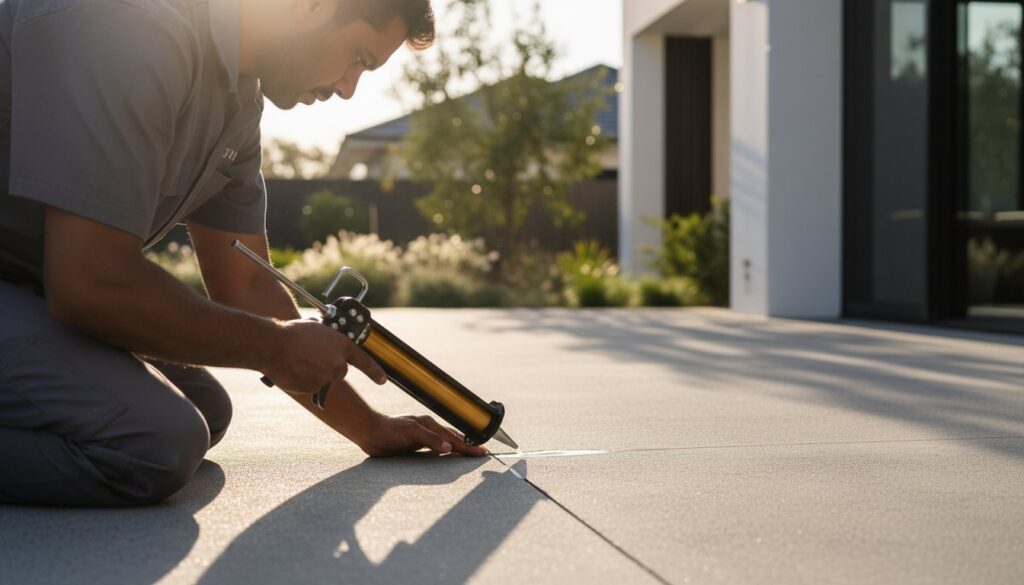
What if that hairline fracture on your alfresco floor isn’t just a cosmetic flaw, but a warning sign from the reactive Sydney soil beneath it? Many homeowners find themselves staring at widening gaps, worried that an unsightly surface will ruin their next summer barbecue or lead to a total slab failure. You’re right to be concerned. In our local climate, repairing cracks in concrete patio areas is less about masking a blemish and more about managing the inevitable thermal expansion and ground movement that defines our landscape. It’s a task that requires more than a random tube of filler from the hardware aisle; it demands a blend of technical precision and the right materials.
We understand the pride you take in your home’s outdoor spaces and the desire for a finish that’s both durable and elegant. This 2026 manual promises to give you the confidence to diagnose damage accurately, prepare the surface like a seasoned tradesman, and achieve a flush, permanent repair. You’ll learn exactly when a DIY approach is sufficient and when the structural integrity of your property requires a professional hand. From understanding Australian Standards like AS 3600 to mastering advanced epoxy injection, we’re providing the roadmap to transform your weathered patio back into a sophisticated centerpiece for your lifestyle.
Key Takeaways
- Identify the critical differences between cosmetic hairline fractures and deeper structural shifts driven by Sydney’s reactive clay soils.
- Select the correct technical materials, from flexible polymer sealants to structural epoxy injections, based on the specific cause of the damage.
- Learn the professional preparation techniques for repairing cracks in concrete patio floors, including the mechanical keying required for a permanent bond.
- Discover why a simple patch is often visible and how professional concrete resurfacing transforms a repaired slab into a seamless, elegant surface.
- Gain clarity on local compliance, including when a repair is considered exempt development and when to engage a structural specialist.
Understanding Why Concrete Patios Crack in Sydney
Sydney’s geology is a silent architect of patio damage. To the untrained eye, a crack is just an eyesore; to a craftsman, it’s a symptom of environmental pressure. Before you begin the process of repairing cracks in concrete patio surfaces, you must identify the catalyst. In our region, the primary culprit is the soil itself. We don’t just build on ground; we build on a living, moving foundation that reacts to every seasonal shift. When you ignore the underlying cause, even the most meticulous repair will eventually fail as the earth continues its inevitable cycle of movement.
Reactive Clay and the Wet-Dry Cycle
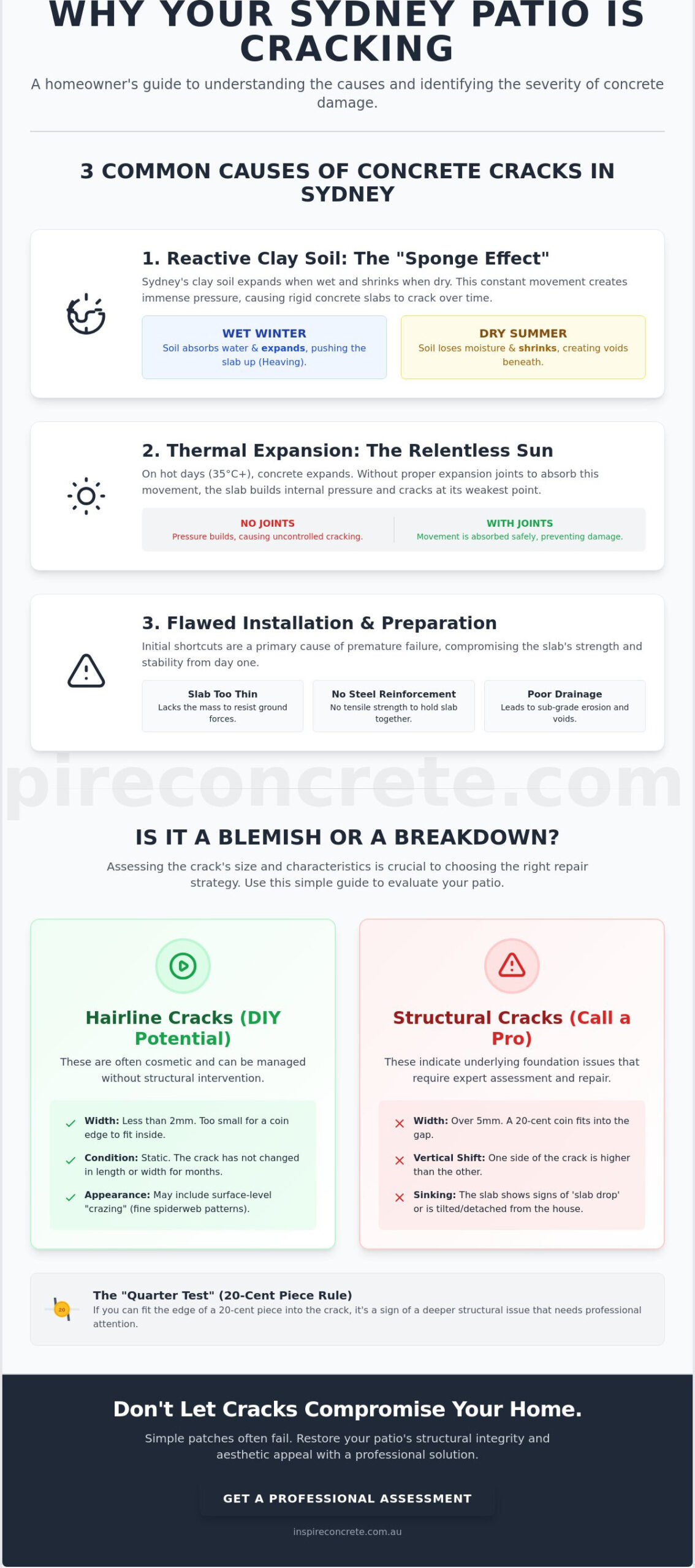
Western Sydney and many coastal pockets are characterized by highly reactive clay soils. These soils act like a sponge. During a wet winter, they absorb moisture and expand, pushing the concrete slab upward in a phenomenon known as heaving. As we move into the dry, scorching summer months, that same soil loses its moisture and shrinks, leaving voids beneath the patio. This constant ‘pumping’ action creates immense tension. A rigid concrete slab can’t flex with this movement, so it snaps. If you’re simply filling a gap without addressing this cycle, you’re fighting a losing battle against nature. Successful remediation requires understanding how these concrete pavement restoration techniques can be adapted to manage localized soil instability.
Thermal Movement and Expansion Joints
The Australian sun is relentless. When temperatures exceed 35 degrees, your concrete patio undergoes significant thermal expansion. Concrete is a dense material that grows as it heats up. If your patio was poured as a single, ‘locked’ slab without sufficient expansion joints, it has no room to breathe. The internal pressure builds until the concrete reaches its breaking point, usually at the weakest junction or around a corner. We often see cracks radiating from house footings where the patio is pinned against a static structure. Without functional joints to absorb this energy, the slab will create its own ‘joints’ in the form of jagged, unpredictable cracks.
Beyond geology and weather, poor initial installation often sets the stage for early failure. We frequently encounter slabs that were poured too thin or, more commonly, lack the necessary steel reinforcement. Rebar and mesh aren’t just optional extras; they provide the tensile strength required to hold a slab together when the sub-grade shifts. Furthermore, poor drainage can lead to sub-grade erosion. When water isn’t directed away from the patio, it washes out the fines in the bedding sand or soil, creating a hollow shell that eventually collapses under its own weight. Identifying these shortcuts is the first step in repairing cracks in concrete patio areas effectively, ensuring that your outdoor space remains a durable, elegant asset for years to come.
Evaluating the Damage: Hairline Cracks vs. Structural Failure
Repairing cracks in concrete patio areas starts with a clinical assessment of the damage. You must determine if you’re looking at a minor blemish or a fundamental failure. A simple rule of thumb for Sydney homeowners is the ‘Quarter Test’. If you can comfortably fit the edge of a 20-cent piece into the gap, you aren’t just dealing with a surface issue. Hairline cracks, typically measuring less than 2mm, are often purely cosmetic results of the concrete’s initial drying phase. However, structural cracks exceeding 5mm, especially those where one side of the slab sits higher than the other, indicate that the foundation has shifted or settled unevenly.
Look closely at the edges of your alfresco area for signs of ‘slab drop’ or sinking. These are clear indicators of sub-grade erosion or poor soil compaction. If the slab has detached from the house footing or shows a visible tilt, simple fillers will fail. These scenarios often require professional intervention to restore the level and safety of your entertaining space. When the integrity of the slab is compromised, the goal shifts from a simple patch to a total aesthetic and structural restoration that ensures long-term value for your property.
When DIY is Appropriate
DIY repairs are perfectly suited for static hairline cracks that haven’t changed in width or length for at least six months. You might also notice surface-level ‘crazing’, which looks like a fine spiderweb across the concrete. This is usually caused by improper curing during the original pour and doesn’t threaten the slab’s integrity. Minor edge spalling, where small chips break away from the perimeter without affecting the load-bearing capacity, can also be handled with a high-quality repair kit if you have a meticulous eye for detail.
When to Call a Professional Concreter
Some damage demands the precision of a master craftsman. If a crack runs through the entire thickness of the slab, it has lost its structural bond. Multiple cracks radiating from a single point suggest a point-load failure, meaning the concrete can no longer support the weight above it. Perhaps most concerning is ‘pumping’, where you see water or mud rising through the crack after a heavy Sydney downpour. This indicates a saturated sub-grade that will continue to undermine your patio regardless of how many times you fill the surface gap. In these instances, repairing cracks in concrete patio floors requires a professional to address the root cause before the damage spreads to adjacent structures.
Choosing the Right Repair Materials for Australian Conditions
Selecting the correct chemistry is paramount when repairing cracks in concrete patio surfaces. A common mistake is treating every fracture with the same generic filler. In reality, your choice of material must align with the diagnosis you made in the previous stage. If you’re dealing with a moving joint, a rigid filler will simply snap within a season. Conversely, using a soft sealant on a structural crack won’t provide the necessary load-bearing support. Success lies in matching the material’s physical properties to the environmental demands of your specific site.
For structural bonding, epoxy injections remain the gold standard. These high-strength resins don’t just fill the gap; they weld the concrete back together, often creating a bond stronger than the original slab. However, for outdoor alfresco areas, UV stability is non-negotiable. Many standard epoxies yellow and become brittle under the harsh Sydney sun. Always specify a product rated for exterior use to ensure the repair maintains its integrity and aesthetic appeal. Matching the filler colour to your existing plain or coloured concrete is equally vital for a sophisticated, seamless finish that preserves your property’s value.
Polyurethane and Silicone Sealants
Flexible sealants are your best defense in areas prone to minor movement, such as expansion joints or perimeter gaps. Polyurethane is particularly favored for its high durability and excellent adhesion to masonry. While these materials offer superior flexibility, they can be difficult to paint over, making colour selection at the point of purchase critical. When dealing with deep cracks, we recommend using a foam ‘backer rod’ first. This prevents the sealant from sinking too deep, saves on material costs, and ensures the product can expand and contract correctly without pulling away from the crack’s edges.
Cementitious Patching Compounds
If you’re repairing static, non-moving cracks in a plain concrete patio, a high-quality cementitious patching compound is often the most effective choice. These products are designed to mimic the texture and strength of the surrounding slab. The secret to a lasting cementitious repair is the use of a dedicated bonding agent, such as an SBR or acrylic liquid. Without this ‘glue’, the new patch will fail to adhere to the old, dry concrete and will eventually pop out. Avoid the temptation to use standard pre-mixed bagged concrete for fine crack repair; these mixes contain large aggregates that are impossible to feather into a smooth, professional finish.
Precision in material selection reflects the craftsmanship we bring to every project. Whether you are restoring a simple pathway or a high-end alfresco area, the right materials ensure your patio remains a durable foundation for your outdoor lifestyle. By choosing technical solutions over quick fixes, you protect the structural integrity of your home while achieving a result that is as beautiful as it is permanent.
Step-by-Step Guide to Repairing Concrete Patio Cracks
Execution is where the distinction between a temporary patch and a permanent restoration becomes clear. When repairing cracks in concrete patio surfaces, your focus must shift toward creating a mechanical bond that resists the environmental pressures discussed earlier. This process requires a disciplined approach, moving from aggressive cleaning to delicate finishing. Every minute spent in the preparation phase saves hours of remedial work in the future. By following a professional methodology, you ensure the final result is flush, durable, and integrated with the existing slab.
The first technical step is mechanical keying. Using a small angle grinder with a diamond blade or a cold chisel, you must widen the crack into a ‘V’ or ‘U’ shape. This creates a larger surface area for the repair material to grip and ensures the filler has enough body to resist cracking itself. Once keyed, the crack needs a thorough cleaning with a wire brush followed by high-pressure water to dislodge deep-seated grit. Before applying any filler, a high-quality concrete bonding adhesive should be brushed into the groove. This primer acts as the bridge between the old and new material, ensuring maximum adhesion. If you find the damage is too extensive for a simple fix, our team specializes in professional concrete repair and resurfacing to restore your patio to its original glory.
The ‘Chase and Clean’ Method
Precision requires you to ‘chase’ the crack to its absolute ends, ensuring no hidden fractures remain beyond the visible repair. You must remove all loose debris, as any crumbling concrete left behind will compromise the entire bond. After the initial scrub, use a heavy-duty vacuum to extract fine dust that a brush might miss. A bone-dry substrate is non-negotiable for epoxy bonding because moisture prevents the resin from penetrating the concrete pores. This level of detail ensures that your efforts in repairing cracks in concrete patio floors aren’t undermined by poor surface preparation.
Curing and Protection
The final phase is a test of patience. Most high-performance repair materials require 24 to 48 hours before they can handle foot traffic. In Sydney’s coastal suburbs, high humidity can often extend these curing times, so it’s best to err on the side of caution. During the first hour of application, you should shield the fresh patch from direct sunlight to prevent it from drying too quickly and pulling away from the edges. When filling the crack, always over-fill slightly to account for the natural shrinkage that occurs as the material cures. Once set, you can feather the edges with a fine-grit sanding block for a transition that feels smooth underfoot.
Beyond the Patch: Professional Resurfacing and Long-Term Protection
Repairing cracks in concrete patio areas is a vital maintenance step, but a patch alone rarely restores the seamless elegance of a high-end outdoor space. Concrete ages uniquely based on its exposure to the Sydney sun and the specific batch used during the original pour. This means a fresh repair compound will almost always stand out against a weathered slab, creating a “patchwork” effect that can detract from your property’s value. For homeowners who demand a sophisticated finish, the repair is only the first half of the process. The second half involves a total aesthetic integration that makes the damage invisible and protects the substrate from future environmental stress.
A comprehensive approach moves beyond utility to focus on transformation. By looking at the slab as a whole rather than a collection of filled gaps, you can ensure your alfresco area remains a durable centerpiece for entertaining. This long-term perspective involves advanced coating technologies and a disciplined maintenance schedule tailored to our local climate. Whether you’re looking to mask past repairs or prevent new ones, the goal is a surface that combines structural stability with refined craftsmanship.
The Invisible Repair: Resurfacing
When a slab is structurally sound but visually compromised by numerous repairs, concrete resurfacing Sydney homeowners trust is the most effective solution. This process involves applying a 3mm polymer-modified overlay across the entire surface, creating a brand-new “skin” that bonds permanently to the old concrete. It’s a high-end alternative to a full patio replacement, offering the opportunity to introduce stencilled or stamped patterns that naturally hide future hairline movement. This overlay doesn’t just cover the damage; it reinforces the surface, providing a uniform, contemporary finish that revitalizes the entire outdoor area without the cost or disruption of a total demolition.
Maintenance Schedules for Sydney Patios
Protection is a continuous commitment. In our coastal environment, professional concrete cleaning and sealing every 2 to 3 years is non-negotiable. A high-quality sealer prevents moisture from penetrating the pores of the concrete, which is the primary cause of the freeze-thaw expansion and sub-grade erosion mentioned in earlier sections. You should also regularly inspect and clear your drainage points to ensure water never pools near the slab’s edge. For those considering a complete upgrade, transitioning to exposed aggregate driveways or patios provides a rugged, textured surface that is exceptionally durable and naturally masks minor imperfections. Ready for a professional transformation? Get a concrete quote from Inspire Concrete and let us realize your creative vision for a lasting, elegant outdoor lifestyle.
Secure the Future of Your Outdoor Entertaining Space
Restoring a damaged slab requires more than a quick patch; it demands a deep understanding of Sydney’s unique environmental pressures. By identifying the root cause of movement and selecting technical, UV-stable materials, you move beyond temporary fixes to lasting structural solutions. Whether you’re repairing cracks in concrete patio areas yourself or preparing for a complete aesthetic transformation, the goal is always to enhance both the durability and the elegance of your property. Precision in the preparation phase ensures that your outdoor foundation remains as resilient as it is beautiful.
At Inspire Concrete, we bring over 20 years of Sydney-specific experience to every project. As a fully licensed and insured family-operated business, we specialize in everything from complex structural slabs to refined architectural finishes. We don’t just fix concrete; we realize your creative vision through meticulous craftsmanship and technical certainty. Transform your cracked patio with Sydney’s expert concreters—Request a quote today! Your outdoor space is a significant investment in your lifestyle. We’re here to ensure it remains a sophisticated, durable backdrop for your family’s most memorable moments.
Frequently Asked Questions
How do I stop my concrete patio from cracking further?
Maintaining consistent moisture levels in the soil and ensuring all drainage points remain clear are the most effective ways to prevent further damage. Water pooling near the slab’s edge leads to sub-grade erosion and soil instability. Professional cleaning and sealing every 2 to 3 years also creates a vital barrier against moisture ingress, which protects the internal reinforcement from corrosion and expansion.
Is it worth repairing a cracked concrete patio or should I replace it?
Repairing is usually the superior choice if the damage is localized and the slab remains level. If more than 20% of the surface is fractured or you notice significant slab drop, a full replacement might be more cost-effective in the long run. Professional resurfacing can often save a weathered slab, providing a brand-new look and enhanced durability at a fraction of the cost of total demolition.
Can I use regular cement to fill cracks in my patio?
No, regular cement lacks the necessary bonding agents to adhere to old, dry concrete. Without an SBR or acrylic additive, a standard cement mix will simply shrink as it cures and pop out within weeks. For successful results when repairing cracks in concrete patio floors, you need a specialized polymer-modified compound or a structural epoxy that creates a permanent weld between the two sides of the fracture.
What is the best crack filler for Sydney’s hot climate?
UV-stable polyurethane or high-grade epoxy resins are essential for resisting the intense Australian sun. These materials are engineered to remain flexible and won’t become brittle or yellow when exposed to high temperatures. Flexible sealants are particularly effective for expansion joints where thermal movement is expected, as they can stretch and compress without losing their bond to the concrete edges.
How much does it cost to professionally repair concrete cracks?
Professional repair costs vary based on the depth and underlying cause of the damage. For minor cosmetic work, industry data suggests material costs can range from $30 to $100 per square meter, though many professional providers have a minimum call-out fee of around $400. Structural repairs involving “concrete cancer” or localized spalling are significantly higher, reflecting the specialized engineering and materials required to restore structural capacity.
Will a repaired crack eventually open up again?
A crack may reappear if the underlying soil movement or thermal pressure isn’t addressed during the repair process. While the repair material itself is often stronger than the surrounding concrete, the slab will always seek its weakest point if the ground continues to heave or sink. This is why we emphasize mechanical keying and the strategic placement of expansion joints to redirect these natural forces.
Can I paint over a concrete crack repair?
You can paint over a repair, but a simple coat of paint rarely hides the visible texture of a patch. For a truly seamless and sophisticated result, a 3mm polymer-modified overlay is the preferred method. This creates a uniform “skin” over the entire patio, ensuring the repair is completely invisible while providing a much more durable finish than standard exterior paving paint.
How do I know if my patio crack is structural?
Structural cracks are typically wider than 5mm and often involve a vertical shift where one side of the crack sits higher than the other. If you can fit the edge of a 20-cent piece into the gap, it’s a sign of a major structural concern. Multiple cracks radiating from a single point or evidence of mud rising through the gap after a Sydney downpour also indicate fundamental failure below the surface.
