
Cutting corners on your foundation today shouldn’t lead to catastrophic structural repair bills tomorrow. In the reactive clay heartlands of Greater Sydney, your choice of slab is the most critical investment you’ll make in your home’s longevity. You likely already know that the waffle pod slab cost sydney varies based on site conditions, but the real concern is whether a lower price tag leads to slab heave and wall cracks five years from now. It’s a stressful balancing act between managing a construction budget and ensuring your family’s long-term safety.
We’re here to provide the clarity you need to move forward with absolute confidence. This guide breaks down the real-world factors driving foundation prices in 2026, from the impact of the National Construction Code 2025 to the specific demands of AS 2870 soil classifications. You’ll discover how to evaluate site-specific price drivers and why engineering precision is the only way to achieve a stable, durable foundation. We’ll explore the technical differences between waffle pods and traditional raft slabs so you can choose a solution that transforms your architectural vision into a lasting, structural reality.
Key Takeaways
- Understand the engineering behind the waffle pod system and how EPS pods create a rigid internal beam grid for superior structural support.
- Learn how to navigate Sydney’s reactive clay soil classifications, from Class M to E, to prevent long-term issues like slab heave and masonry cracking.
- Discover how material efficiency and reduced excavation times influence the waffle pod slab cost sydney compared to traditional raft foundations.
- Identify the 2026 market drivers, including concrete cubic metre rates and steel reinforcement prices, that will shape your final project budget.
- Recognize why meticulous site preparation and specialized drainage are the hallmarks of a foundation built to endure Sydney’s unique environmental demands.
What is a Waffle Pod Slab and Why is it Sydney’s Standard?
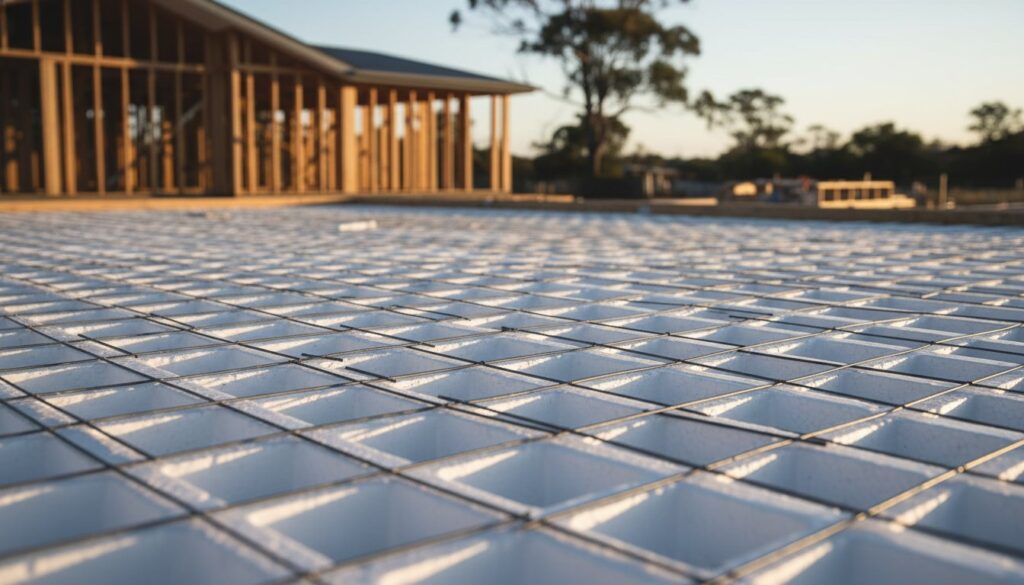
A waffle slab represents a sophisticated evolution in residential engineering. Unlike traditional raft slabs that require extensive trenching deep into the earth, this system is constructed entirely on top of the ground. It utilizes a grid of Expanded Polystyrene (EPS) pods to create a series of reinforced concrete beams. This design yields a high strength-to-weight ratio that is particularly effective for the reactive landscapes found across Greater Sydney. It’s a method that prioritizes structural intelligence over brute force.
Builders across the region have shifted toward this method for its efficiency and predictable performance. It’s not just about speed. The pods provide an inherent thermal break between the ground and the living space. With the National Construction Code 2025 emphasizing increased energy performance, the insulation provided by these pods helps homeowners meet stringent 2026 energy ratings. When evaluating the waffle pod slab cost sydney, it’s vital to view the system as a dual investment in structural integrity and long-term climate control.
The Anatomy of a Waffle Pod Foundation
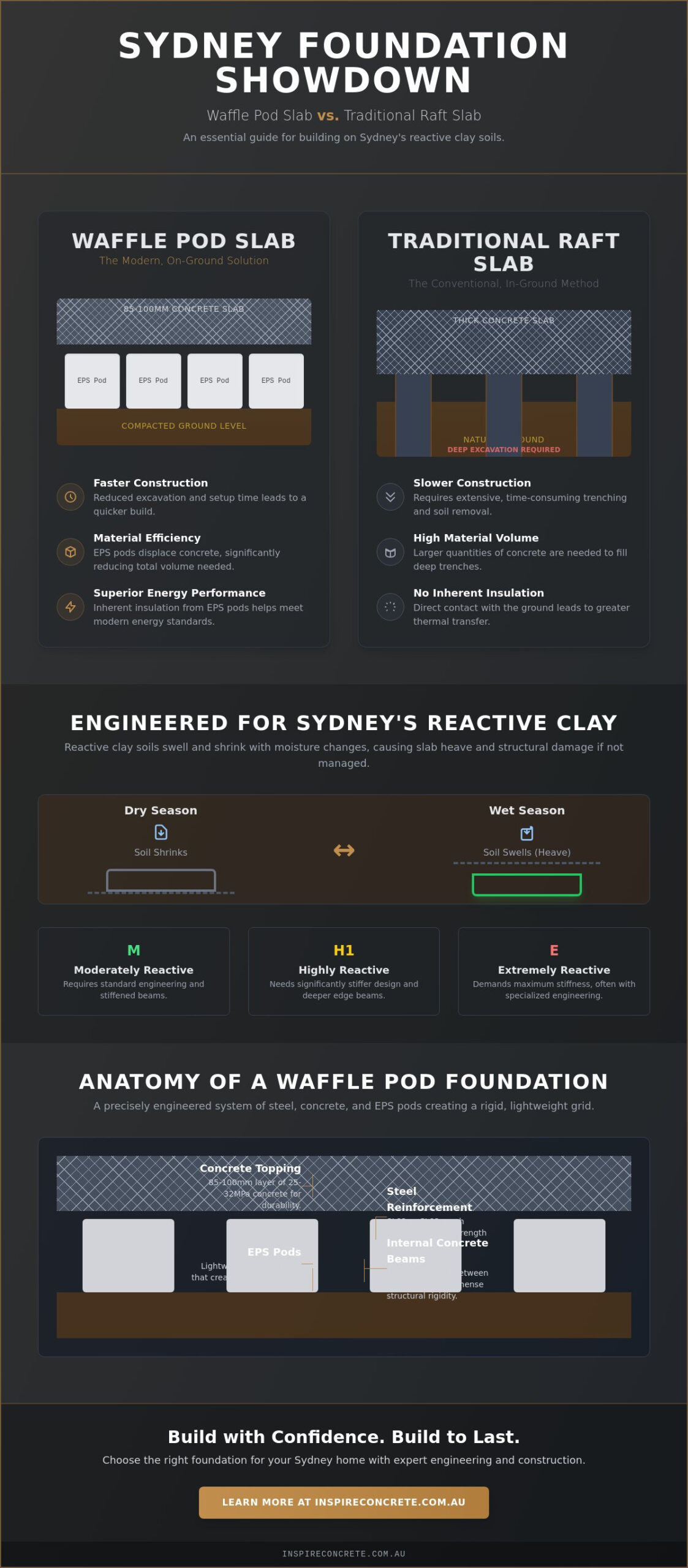
The structure is a carefully balanced assembly of steel, concrete, and air. The EPS pods act as formwork for internal ribs, which are reinforced with steel bars to create a rigid grid. Over the top, a 25MPa or 32MPa concrete layer, usually 85mm to 100mm thick, is poured over SL82 or SL92 mesh. This creates a “box” structure that is incredibly strong but uses less concrete than a traditional solid slab of the same depth. The edge beams are typically wider and deeper to provide the necessary perimeter support for the home’s external walls.
On-Ground vs. In-Ground: The Structural Shift
The structural shift from in-ground to on-ground construction has transformed how we approach site preparation. Because the system sits on a level pad, we minimize the need for deep excavation and the disposal of excess soil. This is a significant advantage for flat or slightly sloping Sydney blocks where site access might be tight. When calculating the waffle pod slab cost sydney, these efficiencies in labor and machine time often become the deciding factor for savvy developers. It allows for a cleaner, more controlled build environment.
Choosing this system means leaning into a method that respects the ground it sits on. It’s a choice for precision. By reducing the reliance on deep trenches, we maintain the natural soil profile, which is crucial for managing moisture levels in reactive clay. This proactive approach ensures your home remains stable and elegant for decades. It’s the difference between simply pouring concrete and crafting a foundation that truly performs.
Sydney Soil Reactivity: Engineering Slabs for Western Sydney Clay
Building in Sydney requires a deep respect for the ground beneath our feet. The Cumberland Plain, stretching across the west, is defined by highly reactive clay that demands precision engineering. These soils are described as “reactive” because they behave like a sponge. They swell significantly when they absorb water during Sydney’s humid summers and shrink as they dry out during the winter months. While homeowners often focus on the initial waffle pod slab cost sydney, the true value lies in how that slab handles this inevitable soil movement. Without a foundation designed for these specific conditions, a house risks structural distress before the paint is even dry.
The concept of “Slab Heave” is a frequent concern for new builders, but it isn’t an unavoidable mystery. It is a predictable consequence of uneven moisture levels in the soil. When one part of the ground under your home stays dry while another becomes saturated, the resulting differential movement can force the slab upward. This leads to the dreaded sight of cracked cornices and sticking doors. Professional engineering prevents this by creating a stiffened structure that moves as a single, cohesive unit. Understanding Sydney’s soil types is the first step in crafting a foundation that remains elegant and level for a lifetime.
Understanding Your Soil Report
Your soil report is the blueprint for your foundation’s design. Suburbs across Western Sydney frequently fall into Class M (Moderate), Class H1 (Highly Reactive), or Class H2 (Extremely Reactive) categories. A Class H1 site requires a much stiffer slab than a Class A or S site, involving deeper edge beams and more intensive steel reinforcement. This engineering requirement is a major driver of the waffle pod slab cost sydney. A structural engineer uses this data to specify the exact grid spacing of your pods and the thickness of the ribs, ensuring the slab can withstand the specific pressures of your block.
Preventing Slab Heave in Sydney Homes
Longevity is won or lost in the details of site drainage. We believe a foundation is only as good as the water management system surrounding it. One of the most effective ways to protect your investment is the installation of a one-metre concrete path around the entire perimeter of the home. This simple addition sheds water away from the footings, keeping moisture levels consistent across the entire footprint. Maintaining this equilibrium is the secret to a stable home. We ensure every site preparation exceeds the minimum requirements of Australian Standard AS 2870. If you’re planning a new build, you can view our house slab services to see how we prioritize these critical structural details.
Waffle Pod vs. Raft Slab: The Real Cost-Benefit Analysis
The choice between a waffle pod and a traditional raft slab is a decision that defines your project’s budget and its long-term structural performance. Efficiency is the primary driver here. A waffle pod system uses significantly less concrete because the EPS pods occupy the volume that would otherwise be filled with solid concrete in a traditional raft design. This reduction in material volume is a major factor in lowering the waffle pod slab cost sydney builders and homeowners must manage. Beyond materials, the labour dynamics shift dramatically. A raft slab requires intensive trenching, often involving days of heavy machinery work and soil removal. A waffle pod layout is a cleaner, more rhythmic assembly process. Once the site is prepared, the pods are positioned with surgical precision, allowing for a faster transition to the pour.
Thermal performance has become a non-negotiable standard for 2026 residential builds. The polystyrene pods act as a sophisticated thermal buffer, providing an inherent R-value that solid concrete lacks. This insulation keeps your home’s internal temperature more stable, reducing the energy required for heating and cooling. Despite these benefits, the waffle system isn’t a universal solution. If your Sydney block features a significant slope or the soil has an extremely low bearing capacity, a raft slab may still be the mandatory engineering requirement. Its deep, in-ground footings provide a level of “grip” and stability on unstable slopes that an on-ground system cannot replicate. We view every site as a unique engineering challenge where the goal is always to balance cost with uncompromising stability.
When to Choose a Waffle Pod Slab
This system is the ideal choice for flat building envelopes and sites with controlled fill. It is particularly effective for projects with tight timelines where speed of construction is a priority. For homeowners looking for cost-effective solutions for granny flat slabs or residential extensions, the waffle pod offers a refined blend of modern engineering and value. It allows for a sophisticated foundation that meets all Australian Standards without the excessive excavation costs associated with older methods.
The Durability Debate: Addressing Homeowner Fears
A common misconception is that a “hollow” slab is somehow less durable than a solid raft. In reality, the stiffness of a foundation comes from the depth of its beams and the reinforcement of its internal ribs, not just its total mass. A correctly engineered waffle pod slab can offer superior stiffness-to-weight ratios compared to a standard raft slab. Ultimately, professional execution matters more than the slab type chosen. A foundation is only as reliable as the team that prepares the site and manages the pour. For a deeper dive into these options, check our Essential Guide to Concrete Slabs in Sydney to see how we approach these structural choices.
Calculating the Cost: 2026 Price Drivers for Sydney Slabs
Understanding the financial landscape of a new build requires a transparent look at the variables behind a quote. In 2026, the waffle pod slab cost sydney homeowners encounter reflects more than just square metre rates. It’s a calculation of fluctuating material markets and the logistical precision required to execute a high-end foundation. Concrete cubic metre rates remain the primary anchor. Because a waffle system uses less volume than a raft slab, it offers a degree of protection against rising material costs. However, this is often balanced by the price of steel reinforcement. The mesh and bars that provide the slab’s tensile strength are non-negotiable components, especially when engineering for the reactive clays of the Cumberland Plain.
Logistics often dictate the final figure in ways many people don’t expect. Consider the physical access to your block. A narrow driveway in an established Western Sydney suburb isn’t just a minor inconvenience; it’s a significant cost driver. If a standard agitator truck can’t reach the pour site, specialized mini-mixers or extended pumping solutions become necessary. These operational hurdles require careful planning to ensure the concrete’s integrity isn’t compromised by delays. We treat every site as a strategic operation where efficiency and quality must coexist perfectly.
Primary Cost Variables
The total footprint and specified thickness of your slab are the starting points for any calculation. A standard 85mm to 100mm top slab is common, but your soil report might mandate a thicker pour for Class H2 or E sites to meet AS 2870 standards. Beyond materials, you must account for specialized equipment. Concrete pump hire is a staple of Sydney construction. While a standard line pump might suffice for some blocks, a long-reach boom pump is often required to navigate over existing structures or difficult terrain. These choices impact the daily labour rate, as a specialized crew must manage the flow and finish with absolute precision.
Site-Specific Add-ons
- Benching and Levelling: Creating a perfectly flat “pad” is essential for pod placement. If your block has even a slight gradient, the time spent on earthworks and benching will increase the total investment.
- Bored Piers: This is a common “hidden” cost in Sydney. If your soil report indicates that the upper layers of clay are too unstable, we must drill piers down to stable rock or deeper soil strata to ensure the slab doesn’t move.
- Compliance and Inspections: Council-specific requirements for sediment control and mandatory engineering inspections ensure the build meets the National Construction Code 2025, but they do add to the administrative budget.
Gaining a clear understanding of these variables allows you to plan your project with certainty rather than guesswork. A foundation is a permanent investment in your property’s value and your family’s safety. To get a clear picture of how these factors apply to your specific project, you can request a detailed house slab quote from our expert team. We focus on providing a comprehensive breakdown that leaves no room for unexpected surprises during the build.
The Inspire Concrete Difference: Foundations Built for Sydney
Experience isn’t just a number. It’s the difference between a home that stands the test of time and one that succumbs to the elements. For over two decades, we’ve navigated the specific challenges of Sydney’s geological landscape. We understand that while the waffle pod slab cost sydney homeowners calculate is important, the true value of a foundation is measured over decades of stability. Our approach moves beyond simple utility. We treat every project as a partnership, ensuring that the engineering backbone of your home is as refined as the architecture it supports.
Our commitment to excellence begins long before the first agitator truck arrives on site. We manage the entire lifecycle of the foundation, from the initial site scrape and architectural drafting to the final, meticulous pour. This comprehensive project management ensures that site drainage and preparation aren’t just checked off a list, but are integrated into a holistic structural strategy. We don’t just pour concrete. We transform a basic structural requirement into a durable platform for your creative vision and lifestyle. The result is a foundation that provides absolute certainty for your investment.
Our Precision Pour Process
Precision is the hallmark of our craft. We utilize advanced laser-level technology to ensure every waffle pod layout is accurate to the millimetre. This attention to detail prevents uneven slab thickness and ensures a perfectly level surface for your future flooring. During the pour, our crews maintain rigorous quality control over the concrete slump and vibration. This ensures maximum density around the internal ribs and edge beams, eliminating voids that could compromise the slab’s integrity. It’s this level of technical groundedness that has established us as leading Concreters Sydney residents trust for high-end residential work.
Ready to Start Your Build?
Planning a new home or granny flat requires certainty in your budget and your builder. We provide clear, fixed-price quotes that account for the specific variables of your Sydney block, from soil reactivity to site access. As preferred house slab builders in Western Sydney, we pride ourselves on a transparent process that leaves no room for guesswork. Managing the waffle pod slab cost sydney is easier when you have a partner who understands the engineering required for local clay. Whether you are building a modern architectural masterpiece or a functional backyard addition, we are ready to bring our expertise to your site. Contact Inspire Concrete today for a consultation and discover how we can elevate your next project from the ground up.
Build Your Future on a Foundation of Certainty
Investing in a home foundation is about more than just managing the initial waffle pod slab cost sydney. It’s about ensuring your structure remains elegant and crack-free through decades of seasonal clay movement. By prioritizing precision engineering and meticulous site drainage, you protect your architectural vision from the risks of slab heave. Whether you’re navigating the complexities of the National Construction Code 2025 or decoding a Class H soil report, the right partnership transforms a technical requirement into a lasting asset.
We bring over 20 years of Sydney experience to every project. Our team is licensed and fully insured, providing the expert architectural drafting and project management needed to transition from a site scrape to a perfect pour. We don’t just meet Australian Standards; we set them. Request a Precision Quote for Your Sydney House Slab today and start your build with absolute confidence. Your dream home deserves a foundation that is as ambitious as your vision.
Frequently Asked Questions
How much does a waffle pod slab cost per square metre in Sydney?
The waffle pod slab cost sydney homeowners encounter fluctuates based on site-specific engineering requirements rather than a fixed market rate. Your final investment is driven by the soil reactivity class, the volume of concrete required, and current steel reinforcement prices. It is best to check with a specialist for a detailed quote that accounts for your specific block’s topography and access challenges.
Is a waffle pod slab better than a raft slab for reactive clay?
Both systems are engineered to handle Sydney’s reactive soils, but they serve different site conditions. Waffle pods are an excellent, cost-effective choice for moderately reactive Class M sites because they sit on the ground and move as a single unit. For extremely reactive Class E sites or blocks with significant slopes, a raft slab might be the mandatory engineered solution to provide deeper structural “grip.”
Do waffle pod slabs attract termites or rodents?
No, the Expanded Polystyrene (EPS) pods used in the foundation aren’t a food source for pests. While the pods create a void, modern building regulations require integrated termite management systems. We install physical barriers and termite collars around all pipe penetrations to ensure your home remains compliant with Australian Standard AS 3660.1. These measures prevent pests from using the slab as a pathway into your structure.
Can I use a waffle pod slab on a sloping block?
Waffle pods are most effective on flat or slightly graded building envelopes. While they can be used on slopes, the site must first be “benched” to create a level pad for the pods to sit on. If the gradient is too steep, the cost of excessive earthworks and retaining walls often makes a traditional raft slab or a split-level foundation a more practical and stable choice for the project.
How long does it take to pour a waffle pod slab?
The process is remarkably fast once the site is prepared and levelled. A professional crew can typically lay the pods, internal ribs, and steel reinforcement in a single day. The concrete pour usually takes place the following day, provided council or private certifications are in place. This efficiency is one of the reasons the waffle pod slab cost sydney is often lower than more labour-intensive foundation types.
What is the main cause of cracking in waffle pod slabs?
Most structural cracking is caused by moisture imbalance in the reactive clay beneath the slab. If water pools against one side of the foundation while the other remains dry, the soil swells unevenly, leading to slab heave. This isn’t a failure of the slab itself but a failure of site drainage. Maintaining consistent moisture levels through proper landscaping and perimeter paths is the best way to prevent these issues.
Does a waffle pod slab provide better insulation for my home?
Yes, the air-filled EPS pods act as a sophisticated thermal break between the earth and your floor. This provides an inherent R-value that solid concrete slabs cannot match. This insulation helps regulate your home’s internal temperature, which is a significant advantage for meeting the strict energy efficiency requirements of the National Construction Code 2025. It’s a foundation that works for your comfort and your energy bills.
Will I need bored piers with my waffle pod foundation?
Bored piers are only required if your soil report identifies unstable ground or if you are building near a sewer easement. Piers act as stilts that anchor the slab to stable rock or deeper soil layers. While they add to the initial complexity, they provide essential security on sites where the upper layers of clay are too soft to support the weight of a new home or granny flat.
