
A concrete driveway isn’t a “set and forget” feature. It’s a high-performance surface that demands a strategic approach to survive Sydney’s volatile environment. Between the intense UV index and the relentless movement of reactive clay soils, even the most beautifully crafted exposed aggregate or stencilled surface can succumb to structural stress without the right care. You’ve likely felt the frustration of seeing a new crack form or felt overwhelmed by the technical debate between solvent and water-based sealers. It’s a common concern for homeowners who value both the utility and the aesthetic elegance of their property.
We believe that your driveway should be a lasting testament to quality craftsmanship rather than a source of maintenance anxiety. This guide provides the definitive concrete driveway maintenance schedule tailored specifically for the unique conditions of New South Wales. You’ll discover exactly how to navigate the physical demands of cleaning, when to apply specialized finishes to prevent “blushing,” and how to maximize the 30-year lifespan of your installation. We’re moving beyond basic utility to provide a clear, actionable roadmap that transitions your driveway from a simple path into a durable, high-value asset for your Sydney home.
Key Takeaways
- Learn how Sydney’s reactive clay soils and intense UV exposure accelerate wear and why a proactive plan is the only way to safeguard your investment.
- Implement a professional-grade concrete driveway maintenance schedule to effectively manage immediate spills and conduct the monthly inspections required to prevent structural failure.
- Discover specialized care techniques for exposed aggregate and stencilled finishes to ensure dirt doesn’t accumulate in textures and patterns don’t lose their definition.
- Understand the critical role of perimeter hydration and thermal management in protecting your concrete during extreme 40°C Western Sydney summers.
- Identify the exact moment when routine maintenance is no longer enough and professional concrete resurfacing or multi-coat sealing is required to restore your property’s aesthetic value.
The Lifespan of Sydney Driveways: Why a Maintenance Schedule is Essential
Sydney’s environment is a master at testing structural limits. A concrete driveway maintenance schedule is much more than a cleaning checklist; it’s a meticulously designed preventative plan to mitigate environmental wear and neutralize structural stress before it becomes irreversible. For homeowners in the Greater Sydney region, the ground beneath your feet is often as volatile as the weather above. We view every project through the lens of longevity, ensuring that the precision of our initial pour is matched by a commitment to ongoing care. This isn’t just about utility; it’s about preserving a creative vision for your property.
The financial logic of proactive care is undeniable. Investing a small amount in specialized sealants and routine inspections can prevent the catastrophic failure of the slab. While a full replacement represents a significant capital outlay, consistent maintenance keeps that value locked into your home. It’s the difference between a high-performance asset and a mounting liability. By following a structured approach, you ensure your driveway remains as durable as it was on the day of the final trowel finish.
Understanding Sydney’s Environmental Impact on Concrete
Western Sydney is famous for its extreme temperature swings. In mid-summer, surface temperatures on a plain or coloured concrete driveway can soar, causing significant thermal expansion. When the inevitable cool change hits, the concrete contracts rapidly. This cycle creates internal pressure that leads to cracking if not managed. Humidity also plays a role, as moisture-related degradation can soften the surface if the sealer has failed. In areas like the Blue Mountains or the Western Suburbs, reactive clay soils expand and contract with rain and drought. This movement puts immense pressure on the sub-grade, making vigilance essential to ensure the driveway doesn’t shift or pull away from the main house slab.
The Difference Between Surface Care and Structural Integrity
Maintaining your driveway requires a dual approach that balances aesthetics with engineering. Aesthetic care involves high-pressure cleaning to remove debris from the nooks of an exposed aggregate finish. However, functional maintenance is where the real protection happens. This includes applying high-grade sealers and utilizing concrete pavement restoration techniques to address hairline fractures before they widen. A robust concrete driveway maintenance schedule identifies these vulnerabilities early. Beyond the technical benefits, a pristine entry significantly boosts curb appeal. A well-maintained driveway signals that the entire property, including foundations and alfresco areas, has been treated with professional care.
Your 2026 Concrete Driveway Maintenance Calendar
Precision in care mirrors precision in construction. To protect the aesthetic transformation of your property, you need a concrete driveway maintenance schedule that functions like a well-oiled machine. This isn’t about guesswork; it’s about executing specific tasks at the right intervals to ensure your driveway remains a durable, high-value asset. We’ve structured this 2026 calendar to guide you from immediate reactions to long-term structural preservation.
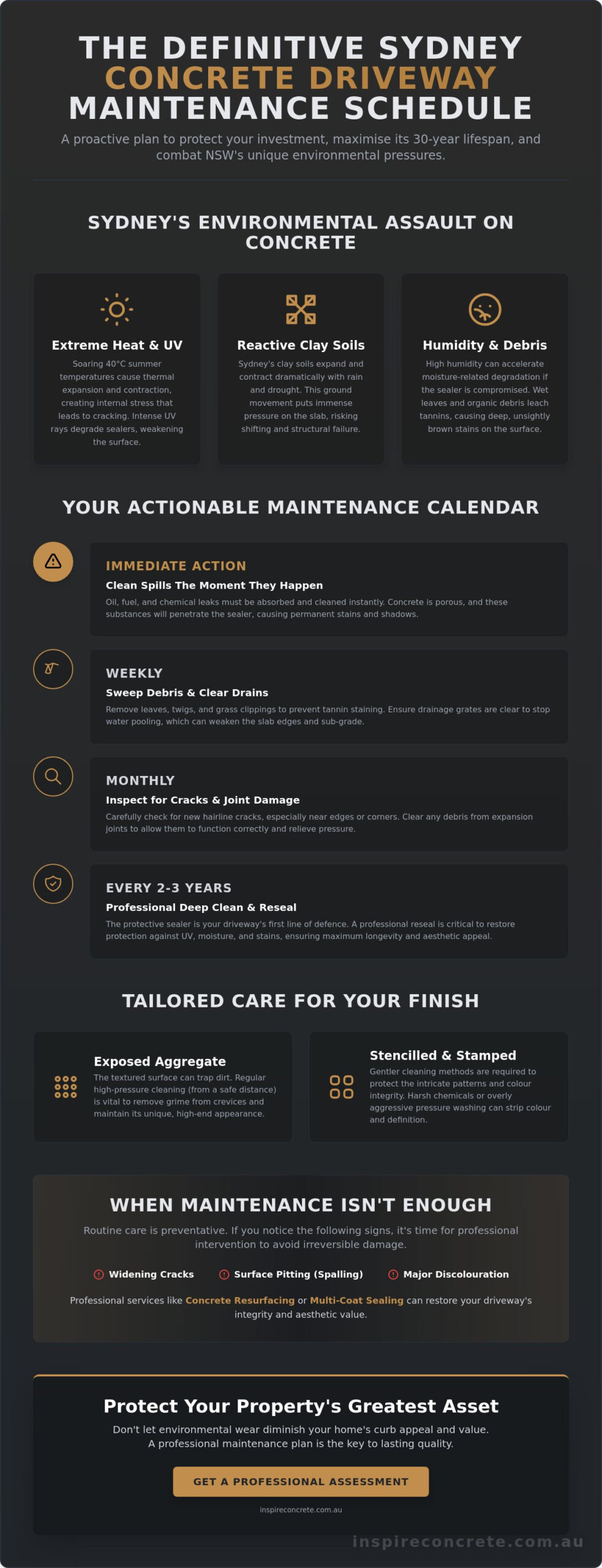
Some tasks require an instant response to prevent permanent damage. Oil spills and chemical leaks from vehicles should be managed the moment they are spotted. Concrete is naturally porous, and if these fluids are left to sit, they can penetrate even high-quality sealers, leaving stubborn shadows on your plain or coloured concrete. On a monthly basis, shift your focus to structural indicators. Inspect expansion joints for debris and look for hairline warnings. Catching a minor fracture early allows for simple intervention before it requires more intensive routine maintenance guidelines or professional repair.
Weekly and Monthly Routine: The Bare Minimum
Organic debris is a silent enemy of a pristine finish. Leaves, twigs, and grass clippings carry tannins that, when wet, leach into the surface and create unsightly brown stains. This is especially critical for lighter finishes or detailed stencil and stamped concrete patterns. Ensure your drainage grates are clear; water pooling at the edge of the slab can saturate the sub-grade and lead to soil movement. It’s a fact that properly designed concrete driveways require less frequent intervention, but basic monthly vigilance remains the homeowner’s best tool for long-term health.
Annual and Multi-Year Professional Milestones
Every twelve months, you should perform the “Water Test” to assess your driveway’s defenses. Pour a cup of water onto different areas of the slab. If the water beads on the surface, your sealer is intact. If it soaks in and darkens the concrete, the protective barrier has worn thin and is no longer shielding the aggregate from the elements. Spring is the ideal time for a deep, high-pressure clean to strip away winter mould and grime that accumulates in the textures of exposed aggregate. By the 24 to 36-month mark, Sydney’s high UV index typically necessitates a professional reseal. This milestone is vital for maintaining the vibrancy of your finish and ensuring the concrete remains impervious to moisture. If you notice the “beading” effect has vanished across the majority of the surface, it may be time to book a professional concrete cleaning and sealing service to restore that original luster.
Specific Care for Different Concrete Finishes
Every masterpiece requires a specific preservation technique. While your core concrete driveway maintenance schedule provides the structural foundation for care, the aesthetic finish of your driveway dictates the finer details of the process. We don’t believe in a one-size-fits-all approach. The precision required for stencilled patterns is vastly different from the rugged requirements of an exposed aggregate surface. Understanding these nuances is the key to ensuring your driveway remains a high-value asset for decades to come.
Maintaining Exposed Aggregate in Sydney
Exposed aggregate driveways are celebrated for their texture and durability, but those same “nooks and crannies” can become traps for dirt and organic silt. Maintaining exposed aggregate driveways in Sydney requires the use of high-solids solvent-based sealers. These products provide a thicker protective film that prevents contaminants from lodging between the decorative stones. When cleaning, avoid aggressive, pinpoint pressure washing that can dislodge the aggregate. Instead, use a wide-fan nozzle to sweep away debris. Watch for “hot tire pick-up.” This is a phenomenon where warm tires bond to the sealer. High-quality, professional-grade sealants are engineered to resist this, but keeping the surface clear of grit reduces the friction that causes it.
Protecting Stencilled and Coloured Surfaces
Stencilled and stamped concrete rely on a surface pattern for their visual impact. Protecting this pattern from abrasive wear is paramount. On high-traffic turn points, such as where vehicles pivot to enter a garage, “ghosting” or premature pattern wear can occur. To mitigate this, we integrate anti-slip additives into the sealer. These additives provide essential traction for Sydney’s wet days while acting as a sacrificial layer against friction. For coloured concrete, UV-induced fading is the primary threat. Sydney’s high UV index can bleach concrete oxides if left unprotected. Specialized UV-resistant sealers act as a sunscreen for your driveway, locking in the pigment. Never use harsh acidic chemicals on these surfaces. They can react with the oxides and cause permanent discolouration.
Even plain concrete deserves a meticulous approach. Without consistent cleaning, plain slabs can quickly adopt a dull, industrial appearance. This detracts from your home’s elegance. Regular pressure washing at a moderate setting prevents the build-up of grey fungal growth. It ensures the entry remains bright and welcoming, reflecting the same pride you take in the rest of your property. By treating each finish with the respect its craftsmanship deserves, you ensure the longevity of both the material and the design.
Managing Sydney-Specific Threats: Heat, Humidity, and Clay
Sydney’s geography is as varied as its architecture. From the salt-heavy air of the Eastern Suburbs to the scorching 40°C heatwaves of the Western Plains, your concrete driveway maintenance schedule must adapt to these localized pressures. It isn’t enough to follow a generic guide; you need a strategy that respects the unique geology and climate of New South Wales. We approach every maintenance plan with the same precision we bring to a new pour, ensuring your driveway survives the elements.
Western Sydney homeowners face the “Heatwave Effect.” During extreme summer days, concrete reaches temperatures far exceeding the ambient air, leading to massive thermal expansion. If your expansion joints are clogged with debris or the filler has hardened, the slab has nowhere to go but up, resulting in buckling. Similarly, coastal properties must contend with salt spray. While concrete itself is resilient, salt can penetrate microscopic pores and reach internal steel reinforcement if the sealer has degraded. This leads to internal corrosion that compromises the slab’s integrity. Managing runoff during Sydney’s heavy storm events is also vital; clear drainage prevents water from undermining the sub-grade.
Cracks and Soil Movement: The Sydney Homeowner’s Reality
Distinguishing between different types of fractures is a core part of being a project partner in your home’s upkeep. Settlement cracks occur when the ground beneath the slab sinks, often due to poor compaction or erosion. Shrinkage cracks, however, typically appear early in the concrete’s life or during rapid temperature drops. Reactive soil is a type of clay-heavy earth that expands significantly when wet and contracts when dry, serving as the primary cause of driveway heaving and structural shifting across Sydney’s West. Keeping the perimeter of your driveway hydrated during drought prevents the soil from pulling away and causing the edges to drop. Using high-quality flexible joint fillers allows the concrete to move with the earth’s natural rhythm.
UV Protection and Surface Scalping
Sydney’s high UV index acts as a solvent on inferior products. Standard acrylic sealers often break down within 12 to 18 months under the Australian sun, leading to a phenomenon known as “scalping.” This is where the surface layer of the sealer begins to peel or flake away, leaving the concrete vulnerable to moisture and oil. You’ll spot this early as white, cloudy patches or a loss of “wet-look” sheen. By choosing a professional-grade UV-stable sealer, you ensure the chemical bonds remain intact despite the radiation. This level of protection is essential for maintaining the vibrant tones of coloured or stencilled surfaces. If you notice early signs of surface peeling, it is time to consult a professional for specialized cleaning and sealing to prevent deep-seated damage.
Professional Restoration: When Maintenance Isn’t Enough
A time comes when the pressure washer and stiff-bristle brush no longer yield the results they once did. Even the most disciplined concrete driveway maintenance schedule cannot entirely halt the slow march of three decades of Sydney weather. When surface staining becomes permanent or hairline fractures begin to widen into structural concerns, the focus must shift from routine care to professional restoration. We don’t just see an old slab; we see a foundation for a creative rebirth that restores both the structural integrity and the aesthetic elegance of your property.
Identifying the threshold between maintenance and restoration is critical. If your driveway exhibits significant “spalling” (where the top layer of concrete flakes away) or if large cracks have caused the slab sections to settle at different heights, a simple clean and seal is no longer sufficient. At this stage, a structural assessment from a licensed concreter is vital. We evaluate the sub-grade stability and the health of the reinforcement to determine if the surface can be saved. For many 20-year-old driveways, this is the moment to transition to concrete resurfacing rather than opting for a costly and disruptive total replacement.
The Resurfacing Option for Aged Concrete
Resurfacing is a sophisticated transformation process. We apply a high-strength, polymer-modified coating over your existing slab, effectively hiding deep-seated stains and minor surface imperfections. This provides a cost-effective alternative to demolition while allowing you to choose a completely new modern finish. You can transition an old, tired plain slab into a vibrant stencil or stamped pattern that aligns with contemporary design trends. It’s an investment in your home’s curb appeal that utilizes the existing structural mass of your driveway while providing a fresh, durable wear layer.
Why Hire a Professional for Sealing?
While DIY kits are available, professional application is where the craftsmanship truly shines. One of the most common failures in amateur maintenance is “sealer blush.” This occurs when moisture is trapped beneath the coating, resulting in unsightly white, cloudy patches that are difficult to remove. Our professional process involves a deep acid wash to open the concrete pores, followed by precise neutralization and a multi-coat application of commercial-grade solvent sealers. We also integrate specialized slip-resistance additives that provide essential safety without compromising the finish’s clarity. This level of precision ensures your driveway remains a high-performance asset rather than a DIY headache. Ready to renew your home’s curb appeal? Get a professional concrete maintenance quote from Inspire Concrete and let us restore the pride in your property’s entry.
Protecting Your Property’s Premier Entry
Your driveway is the first impression of your home and a vital structural component. By implementing a disciplined concrete driveway maintenance schedule, you’ve moved beyond basic utility to ensure long-term value. You now understand how to navigate Sydney’s extreme heatwaves, manage the movement of reactive clay soils, and select the right protective treatments for specialized decorative finishes. This proactive approach prevents environmental wear from turning into a costly structural failure.
With over 20 years of Sydney concreting experience, we bring a master craftsman’s eye to every restoration and maintenance project. We specialize in the precision required for exposed aggregate and decorative patterns, ensuring they remain as vibrant as the day they were poured. Our deep understanding of local soil conditions means we don’t just treat the surface; we protect the integrity of the entire slab. Secure your driveway’s future with a professional cleaning and sealing quote from Inspire Concrete. Let’s transform your entry into a durable, high-end asset that reflects the pride you take in your home.
Frequently Asked Questions
How often should I seal my concrete driveway in Sydney?
You should reseal your decorative concrete driveway every 24 to 36 months to combat Sydney’s high UV index. This timeframe ensures the protective barrier remains intact against oil penetration and surface wear. If water stops beading on the surface, it’s a clear sign that your concrete driveway maintenance schedule requires a professional reseal to maintain the slab’s aesthetic and structural integrity.
Can I use a pressure washer on my stencilled concrete driveway?
Yes, you can use a pressure washer on stencilled concrete, provided you use a wide-fan nozzle rather than a concentrated pinpoint jet. High-pressure pinpoint streams can catch the edges of the pattern or the sealer, leading to surface damage or flaking. Keep the nozzle at a consistent height and move it in steady, sweeping motions to ensure an even clean without compromising the decorative finish.
What is the best way to remove oil stains from an aggregate driveway?
The most effective way to remove oil from an exposed aggregate driveway is to apply a specialized concrete degreaser immediately after the spill occurs. Use a soft-bristle brush to work the solution into the nooks and crannies of the stones before rinsing with warm water. Once oil penetrates the porous concrete beneath the aggregate, it becomes significantly harder to remove without professional-grade chemical treatment.
Why is my concrete driveway peeling or turning white?
Turning white, often called “blushing,” usually indicates that moisture was trapped beneath the sealer during application. Peeling is typically the result of UV degradation or applying a new coat over an incompatible old sealer. These issues highlight why professional application is vital; we use moisture-testing and compatible solvent-based products to ensure a flawless, durable bond that resists the elements.
How long do I need to wait to drive on my driveway after it has been sealed?
You can typically walk on the surface 24 hours after the final coat is applied, but you must wait at least 72 hours before driving a vehicle onto it. This period allows the sealer to reach full chemical hardness and bond deeply with the concrete. Driving too early can cause “hot tire pick-up,” where the warm rubber bonds to the fresh sealer and pulls it away from the surface.
Are cracks in my concrete driveway always a sign of structural failure?
Not all cracks indicate a structural catastrophe. Hairline shrinkage cracks are common and often surface-level, while movement cracks caused by Sydney’s reactive clay soils are part of the ground’s natural rhythm. However, if cracks are wider than a few millimeters or if the slab sections are no longer level, you should seek a structural assessment to prevent further degradation of the house slab or driveway.
Does sealing my driveway make it slippery when wet?
High-gloss sealers can become slippery when wet, but we mitigate this by integrating commercial-grade anti-slip additives into the mixture. These fine, transparent granules provide essential traction for sloped driveways and pool surrounds without dulling the finish’s clarity. It’s a critical safety step that transforms a beautiful surface into a functional, secure entry for your family and visitors.
Can I maintain my driveway myself, or do I need a professional?
While routine sweeping and light washing are perfect DIY tasks, the application of chemical sealers and structural repairs requires a professional touch. Professionals have access to high-solids solvent sealers and specialized equipment that standard retail kits lack. Engaging an expert ensures your concrete driveway maintenance schedule is executed with the precision needed to maximize the 30-year lifespan of your investment.
