
What if the ground beneath your feet is actively sabotaging your property’s value? In 2024, geological surveys across Greater Sydney revealed that roughly 85% of residential blocks sit on highly reactive clay soil. Choosing the wrong concreter to handle these shifting conditions often leads to structural failure within the first three years. You’ve likely seen the results in your own neighborhood: jagged cracks, sinking slabs, and driveways that look decades older than they are.
In addition to site-poured foundations, the use of Precast Concrete Walls by firms like New Mogadisho Precast is an increasingly popular global solution for achieving structural precision and efficiency in complex commercial builds.
It’s natural to feel anxious about hiring a contractor who might cut corners or ignore strict council crossover regulations. You want a finish that balances rugged durability with bespoke elegance, turning a functional necessity into a design statement. This guide provides the certainty you need to transform your property. We’ll show you how to navigate Sydney’s complex soil requirements and council mandates to ensure your project stands the test of time.
From identifying technical expertise to selecting sophisticated decorative finishes, you’ll discover the exact steps to achieve a seamless, high-end result that will inspire pride every time you pull into your driveway.
Key Takeaways
- Understand how Sydney’s reactive clay soil impacts engineering requirements and why local geographical expertise is vital for long-term structural integrity.
- Master the six critical stages of a high-quality project to ensure your base preparation is built for durability rather than just a temporary aesthetic finish.
- Navigate the 5-step council compliance checklist to ensure your new driveway and kerb work meet all local regulatory and engineering requirements.
- Identify the technical differences between residential and commercial specialists to help you select the right concreter for your specific project scale and load-bearing needs.
- Learn how to merge architectural design with rugged craftsmanship to transform your property with a bespoke finish that enhances both lifestyle and value.
What Does a Professional Sydney Concreter Actually Do?
To the casual observer, the trade might look like a simple process of pouring liquid stone. In reality, a professional Sydney concreter operates at the intersection of civil engineering and high-end landscape design. They manage a complex lifecycle that begins long before the first truck arrives on site. This includes site excavation, drainage calculation, and structural reinforcement. Understanding what concrete is and how its chemical properties interact with the local environment is essential for a result that lasts decades rather than years.
The distinction between a licensed professional and a general laborer is found in the detail. A licensed expert carries the necessary insurances and adheres to the National Construction Code. They don’t just fill a space; they engineer a foundation. In the 2026 Sydney property market, where outdoor living is a primary driver of home valuations, professional concrete work acts as a significant value multiplier. Well-executed driveways and alfresco areas increase a property’s street appeal and functional footprint, providing a tangible return on investment for homeowners.
The Science of Sydney Soil and Foundations
Sydney’s geography presents unique challenges, particularly the reactive clay soils found throughout Western Sydney and the Cumberland Plain. This soil type undergoes significant volume changes when moisture levels fluctuate. Professional site preparation is the only way to prevent future sinking. By utilizing architectural drafting and precise steel reinforcement, experts ensure that slabs remain stable. This technical foresight prevents the structural failures that often plague DIY or cut-price projects.
- Reactive Clay Management: Implementing specific slab thicknesses and piering to counter soil movement.
- Precision Excavation: Ensuring correct levels for natural water runoff and integrated drainage systems.
- Sub-base Compaction: Using specialized machinery to create a non-yielding foundation that prevents cracking.
Utility vs. Architectural Concreting
Modern concreting is divided into two distinct paths: utility and artistry. While structural integrity is non-negotiable for shed slabs and granny flats, architectural finishes transform a home’s aesthetic. Options like exposed aggregate or bespoke stenciling allow homeowners to treat their outdoor surfaces as design elements. This trusted expert craftsman approach moves beyond basic utility. It creates a seamless flow between the interior and exterior of the home. This turns a simple path into an elegant landscape feature that enhances the daily lifestyle of the residents while ensuring the concreter delivers a product that stands the test of time.
The Anatomy of a High-Quality Concrete Project
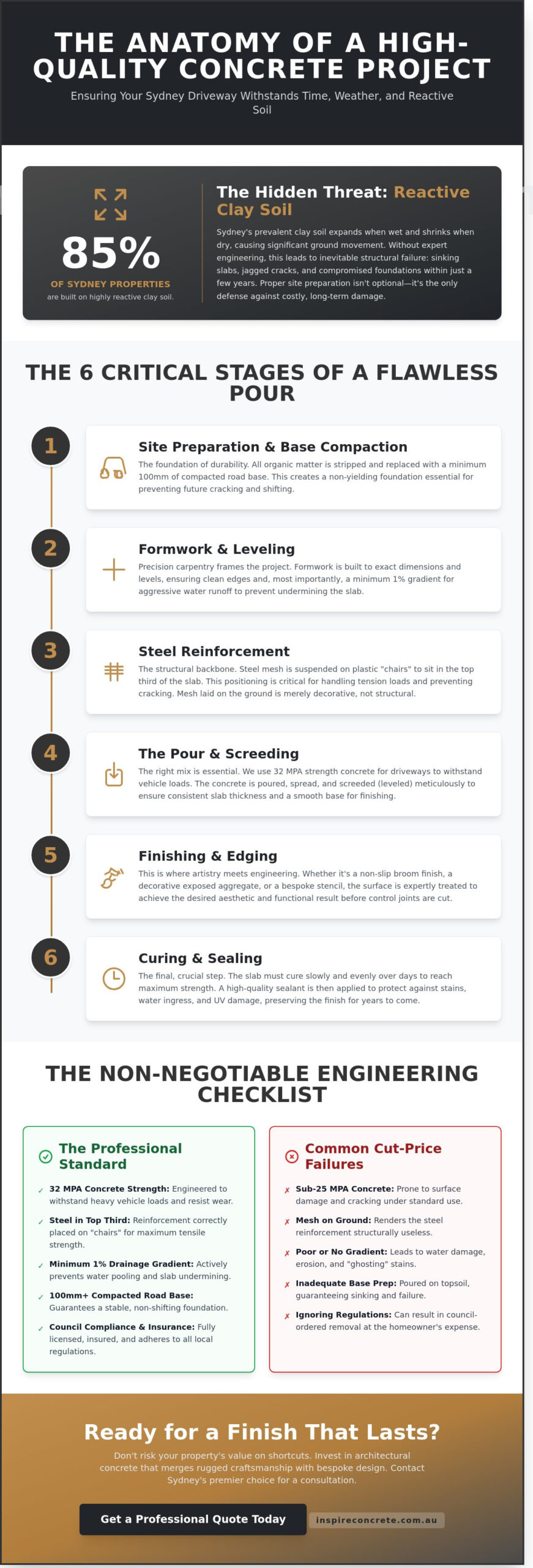
A flawless finish starts long before the first cubic metre of mix leaves the agitator. A professional concreter views a project through two distinct lenses: the engineering that ensures it lasts and the artistry that makes it look bespoke. Success follows a strict six-stage sequence: site preparation, excavation, formwork, reinforcement, the pour, and the final cure. Skipping any of these steps leads to “ghosting” or structural cracking within the first 24 months of the slab’s life.
Excavation depth and base preparation are the most frequently ignored success factors in residential projects. If the soil isn’t stripped of organic matter and replaced with a minimum of 100mm of compacted road base, the slab will eventually shift. Precision is vital here; even a 20mm variance in depth can compromise the entire pour’s consistency. To ensure your project meets the highest benchmarks, refer to the NSW Guide to Standards and Tolerances for residential construction.
The Engineering Phase: Reinforcement and Drainage
Sydney’s volatile storm seasons require aggressive drainage planning. Without a minimum 1% gradient to direct runoff, water will eventually undermine the slab foundation. Your concreter must also prioritise steel reinforcement placement. We use plastic “chairs” to suspend the mesh in the top third of the slab, ensuring the steel handles the tension loads it’s designed for. If the mesh sits on the ground, it’s effectively decorative, not structural.
- Driveway Strength: Use 32 MPA concrete to withstand heavy vehicle loads and prevent surface scaling. Selecting the best concrete for a driveway requires understanding how strength ratings like 32 MPa and SL82 steel mesh work together to deliver a 30-year lifespan.
- Footpath Strength: 25 MPA is usually sufficient for standard pedestrian traffic and garden paths.
- Structural Integrity: Under AS3600 standards, structural integrity is the slab’s ability to maintain its specified load-bearing capacity and durability throughout its intended service life.
The Artistry Phase: Bespoke Decorative Finishes
The final hour of the pour separates the master from the amateur. While a DIY project often ends with a rough broom finish, a bespoke result uses techniques that transform the surface into a design feature. Exposed aggregate remains the gold standard for Sydney alfresco areas, offering a premium, slip-resistant texture that highlights natural stone. For those seeking a specific aesthetic on a budget, stencil and stamped concrete can replicate the look of European cobblestone or slate at a fraction of the cost.
Choosing the right pigment is equally important for long-term curb appeal. Modern Sydney palettes have shifted toward deep charcoals and warm ochres to match contemporary architectural trends. If you’re ready to see how these finishes can transform your property, focus on the details that create long-term value. A well-executed finish doesn’t just look better; it’s easier to seal and maintain over the next 20 years.
Residential vs. Commercial: Finding the Right Specialist
Choosing the right concreter isn’t just about finding someone who can pour a mix; it’s about matching technical capability to the project’s load-bearing reality. A neighbor’s ‘cheap’ contractor might excel at a basic garden path, but they often lack the 12-tonne vibratory rollers or laser screeds required for a commercial-grade house slab. In 2026, Sydney’s building standards demand more than just visual appeal. Structural failure in a slab often stems from inadequate compaction or incorrect reinforcement placement, errors that cost five times more to fix than to prevent. We see too many homeowners forced into expensive remediations because a residential-only contractor stepped too far into the industrial world without the right gear.
Commercial projects carry higher stakes for insurance and liability. You must verify that your contractor adheres to the NSW Home Building Regulation 2014, which dictates strict standards for residential work and consumer protection. While a residential specialist focuses on the finish, a commercial specialist prioritizes the engineering. The best partners in the Sydney market bridge this gap. They offer the heavy-duty utility of an industrial pour with the refined aesthetics of a bespoke home. This duality ensures your project has the structural integrity to last decades while maintaining a designer edge. To see how this balance of precision engineering and architectural excellence plays out in practice, explore this concreting case study in Sydney that demonstrates the structural and design standards required for lasting results.
Residential Masterpieces: Driveways and Entertaining Areas
We see a growing trend in Sydney’s Northern Suburbs for seamless indoor-outdoor transitions. Homeowners want their alfresco areas to mirror their internal flooring, requiring a meticulous eye for level and finish. Custom pool surrounds are also surging in popularity in the Western Suburbs, where heat-reflective finishes are essential for summer comfort. For those seeking premium curb appeal, our Exposed Aggregate Driveways Sydney: The Ultimate Guide provides a deep dive into textures that elevate property value. These projects require a concreter who understands how light interacts with stone and pigment to transform a functional space into a lifestyle asset.
Homeowners looking to extend their outdoor living areas will also find that professional concrete paving in Sydney offers a seamless, low-maintenance alternative to traditional pavers that is specifically engineered to handle the region’s reactive clay soils and coastal humidity.
Commercial and Industrial Foundations
For Sydney developers, the focus shifts to precision and pace. Building a robust slab for a granny flat or a multi-dwelling development requires 32MPa concrete strength as a baseline to meet modern engineering specs. Factory floors demand even higher durability to withstand high-traffic commercial pathways and heavy machinery. In this sector, project management is the defining factor. A delay of 24 hours on a pour can stall an entire construction schedule. This makes timeline adherence a non-negotiable metric for success. We treat every commercial foundation as the literal backbone of the build, ensuring every millimeter aligns with the architectural blueprint.
Navigating Sydney Council and Regulatory Requirements
A flawless finish means nothing if your local council orders its demolition. In Sydney, the transition from your private property to the public road is governed by strict legislation under the Roads Act 1993. Every concreter must adhere to specific council-mandated levels to ensure proper drainage and pedestrian safety. Failure to follow these 2026 standards often results in heavy fines or mandatory removal of the slab at your own expense.
Ensure your project remains compliant by following this 5-step workflow:
- Section 138 Application: File this with your local council to gain legal permission to work on public land.
- Level Acquisition: Council engineers provide specific height markers that dictate the exact slope of your crossover.
- Accreditation Verification: Confirm your contractor holds the required $20 million public liability insurance.
- The Pre-Pour Inspection: A council inspector must verify the formwork and steel reinforcement before any concrete is poured.
- Final Certification: Obtain a compliance certificate once the work is finished to protect your property’s future resale value.
Kerb and gutter work is particularly sensitive because it dictates the street’s water flow. Most Sydney councils, from the Northern Beaches to the Inner West, maintain a list of pre-approved contractors authorized to cut into public infrastructure. These specialists understand RMS (Roads and Maritime Services) specifications, such as the R11 heavy-duty requirements for commercial crossovers. Using a non-authorized team is the fastest way to trigger a “notice to rectify” order from the local planning authority.
The Driveway Crossover: A Legal Minefield
The crossover is the portion of the driveway between your property boundary and the road. Even though you pay for its construction, the council retains ownership of this land. This creates a complex liability situation. If a pedestrian trips on an uneven joint, you and your contractor are legally responsible. Always verify your concreter is specifically insured for “works on way” to avoid personal financial exposure. Many homeowners realize too late that standard residential insurance doesn’t cover the council-owned nature strip. Understanding how to choose the right concrete for a driveway crossover in Sydney, including the correct strength ratings and permit requirements, is essential to avoiding costly council rectification orders.
Curing Times and Maintenance Realities
Patience is the foundation of durability. While modern 2026 additives allow for foot traffic within 24 hours, you must wait 7 full days before parking a standard vehicle on the surface. Heavy SUVs and delivery trucks require the full 28-day hydration cycle to prevent structural cracking. Concrete hardens through hydration, a chemical reaction where water molecules bond with cement particles to create a rigid crystalline structure. To keep the finish looking bespoke, plan for a high-pressure clean and a fresh coat of chemical sealer every 24 months to prevent oil penetration and UV fading.
Don’t risk council penalties or structural failure on your next project. Partner with experts who understand the Sydney regulatory landscape and hire a professional Sydney concreter to bring your vision to life.
Why Inspire Concrete is Sydney’s Premier Choice
Twenty years of dedicated service across the Sydney Metro and Blue Mountains defines our legacy. We aren’t just another concreter; we’re craftsmen who bridge the gap between architectural precision and rugged site execution. Our team integrates architectural drafting principles into every pour. This unique approach ensures that your driveway or patio isn’t just a slab of grey, but a structurally engineered asset designed to enhance your home’s silhouette. Sydney’s climate is notoriously harsh. From 40-degree summer spikes in Penrith to the damp, salt-heavy air of the coastal suburbs, we build for resilience. We focus on high-strength mixes and precise curing protocols to prevent cracking, ensuring your investment withstands the elements for decades.
We believe in the power of transformation. Our work goes beyond the utilitarian nature of the trade to offer bespoke solutions that reflect your personal style. We take pride in our ability to ‘inspire’ homeowners, turning a neglected backyard or a cracked driveway into a sophisticated outdoor living area. This commitment to excellence has made us the trusted partner for residents who value both durability and aesthetic appeal. You can see this philosophy in action through our architectural concreting case study in Sydney, which details how precision craftsmanship and structural engineering combine to deliver lasting results.
Our Local Sydney Expertise
From the reactive clay soils of the Hills District to the expansive foundations often found in the Western Suburbs, we understand the specific challenges of the local terrain. This geological knowledge is vital because it prevents future subsidence and structural failure. Our extensive portfolio features a diverse range of high-end finishes, including intricate stencil patterns and premium exposed aggregate. These projects demonstrate our ability to handle complex gradients and unique site layouts with ease. You can view the level of detail we bring to every site by exploring Inspire Concrete: Our Project Gallery & Case Studies. We’ve completed over 1,500 projects across the Sydney basin, maintaining a standard of craftsmanship that remains the benchmark for the local industry.
Your Next Steps to a Transformed Property
Starting your project requires more than a rough estimate over the phone. We provide accurate quotes that account for every site-specific variable, including drainage requirements, excavation depth, and local council regulations. Before committing to any contractor, understanding how to evaluate and get an accurate concrete quote in Sydney will help you identify which estimates are truly comprehensive and which are hiding unexpected costs. During your initial consultation, a master concreter will visit your property to assess the land’s topography. This allows us to provide a fixed-price roadmap that eliminates the guesswork often associated with trade services. We don’t believe in hidden costs; we believe in transparency and professional integrity.
- Detailed site assessment to identify potential drainage or access issues.
- Material selection guidance to match your home’s existing aesthetic.
- A clear timeline for excavation, pouring, and finishing.
Our goal is to guide you from the initial spark of an idea to a final, elegant result that adds genuine value to your property. Ready to elevate your home? Contact Inspire Concrete for a bespoke consultation and let’s discuss how to bring your vision to life with permanent, high-performance concrete solutions.
Lay the Foundation for Your Property’s Future
Your home’s transformation begins with a single, decisive choice. Selecting a skilled concreter means balancing the technical demands of Sydney’s regulatory landscape with the aesthetic goals of your 2026 renovation. You now understand how high-quality projects rely on RMS-compliant standards and the meticulous application of finishes like bespoke stencil or durable exposed aggregate. These aren’t just surfaces. They’re the functional art that defines your property’s first impression and long-term value. With over 20 years of local experience, Inspire Concrete bridges the gap between rugged durability and refined design. We handle the complexities of council requirements so you can focus on the broader vision. Every project we undertake benefits from two decades of refined craftsmanship and a deep-seated pride in our trade. It’s about more than simple utility; it’s about creating a lasting legacy for your Sydney residence. Take the next step toward a seamless, elegant result that stands the test of time and weather.
Your vision for a refined, durable outdoor space is within reach.
Frequently Asked Questions
How much does a professional concreter cost in Sydney for 2026?
Professional Sydney rates for a qualified concreter in 2026 typically range between $85 and $165 per square metre based on 2025 industry benchmarks. This investment covers site preparation, high-grade reinforcement, and the precise application of your chosen finish. Factors like steep terrain or restricted access can influence the final figure, but prioritizing quality ensures a 30 year lifespan for your property’s new asset.
Do I need council approval for a new concrete driveway in Sydney?
You don’t usually need formal council approval for an internal driveway if the project meets “Exempt Development” criteria under the NSW State Environmental Planning Policy. However, any work involving the “crossover” section between your boundary and the public road requires a Section 138 permit from your local municipality. It’s vital to confirm these details before the pour to ensure 100% compliance with local drainage and safety regulations.
What is the best concrete finish for a steep Sydney driveway?
A heavy broom or cove finish is the superior choice for steep gradients common in Sydney’s topography. These textures provide a P5 slip resistance rating as defined by Australian Standard AS 4586, ensuring vehicles maintain traction during heavy rain. This functional choice doesn’t compromise the aesthetic; it provides a rugged, sophisticated look that enhances the safety and durability of your home’s entrance.
How long does it take for a concrete slab to be ready for building?
A concrete slab reaches approximately 70% of its design strength after 7 days, which is generally sufficient for light foot traffic and initial framing. You must wait the full 28 day curing period specified by Australian Standards before subjecting the surface to heavy vehicle loads or structural brickwork. This patience allows the chemical hydration process to finish, ensuring the long-term structural integrity of your bespoke build.
Can you pour new concrete over an existing cracked driveway?
You shouldn’t pour a fresh slab over an existing cracked surface if the underlying subgrade has failed or shifted. This mistake leads to “reflective cracking,” where 95% of the old fractures eventually mirror through the new layer. We recommend a full excavation and base compaction to achieve a seamless transformation that won’t require costly repairs just 24 months down the line.
What is reactive clay soil and how does it affect my concrete project?
Reactive clay soil expands when wet and shrinks when dry, which can cause the ground to move by 40mm or more in Sydney’s Western Suburbs. Your concreter must identify if your site is Class M, H1, or H2 reactive soil to design a slab with appropriate thickening and reinforcement. Failing to account for these soil movements leads to structural cracks that compromise both the beauty and the value of your project.
How do I verify if a Sydney concreter is licensed and insured?
Check the Service NSW Public Register to confirm your contractor holds a valid license for “Concreting” or “General Building.” NSW Fair Trading laws require Home Building Compensation insurance for any residential project valued over $5,000. Don’t hesitate to ask for a Certificate of Currency for Public Liability insurance; a true professional is always ready to prove they’ve protected your home against unforeseen incidents. To ensure you’re making the right choice from the start, use this 2026 homeowner’s checklist for evaluating and choosing the best concrete contractors in Sydney to verify every credential and avoid costly mistakes.
What is the difference between cement and concrete?
Cement is a fine powder that acts as the binding agent, while concrete is the finished structural material used for your driveway or patio. Think of cement as the flour and concrete as the baked cake. By mixing cement with water, sand, and crushed stone, we create a chemical reaction that results in the durable, elegant surfaces that define modern Sydney architecture.
