
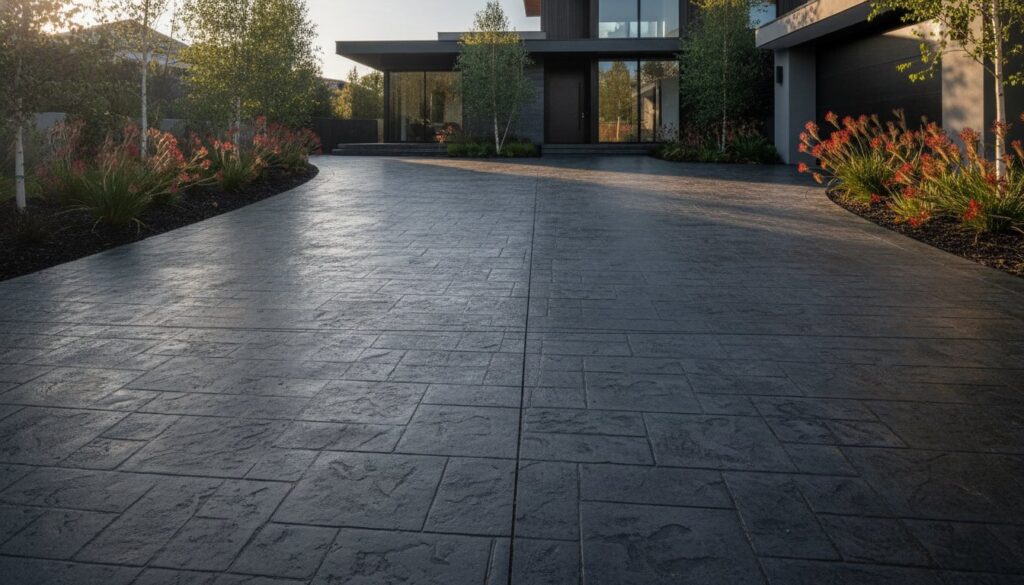
Is your driveway a 25-year structural asset or a five-year aesthetic liability? Most Sydney homeowners love the refined look of textured stone but fear the inevitable cracking caused by our reactive clay soils and intense UV exposure. When considering how long does stamped concrete last, you’ve likely heard conflicting reports about fading and durability. The reality is that longevity is not a fixed number; it’s a result of precise engineering and a commitment to craftsmanship that goes beyond the surface level. A properly installed driveway should provide decades of service while maintaining its sophisticated character.
We’ll show you exactly how to achieve that result. You’ll discover the maintenance secrets to making your stamped concrete last 25 years or more, even in the harshest Australian conditions. We’ll explore the critical role of subgrade preparation, the necessity of P-rated slip resistance for pool surrounds, and the specific 2026 sealing schedules that prevent your investment from losing its lustre. By the end of this guide, you’ll have the technical knowledge to ensure your property’s transformation is both beautiful and permanent.
Key Takeaways
- Learn exactly how long does stamped concrete last when engineered for Sydney’s unique conditions, targeting a structural lifespan of 25 to 30 years.
- Understand why subgrade preparation and concrete mix strength are the true foundations of a driveway that resists structural cracking in reactive clay soils.
- Compare decorative finishes to see how stamped surfaces eliminate the shifting and weed growth common with traditional pavers.
- Master the maintenance roadmap, from choosing mild detergents over high-pressure water to identifying early signs of surface wear.
- Discover why professional engineering prevents common failures like shallow “ghosting” patterns and ensures long-term aesthetic value.
The Lifespan of Stamped Concrete: What to Expect in Sydney
When property owners evaluate the feasibility of a high-end driveway, the central question is usually how long does stamped concrete last before the aesthetic loses its edge. In the specific context of the Sydney basin, a professionally engineered slab provides a structural service life of 25 to 30 years. It’s vital to distinguish between the concrete’s structural integrity and the longevity of the decorative finish. While the slab remains a heavy-duty asset for decades, the stamped concrete pattern is a surface treatment that relies on advanced chemistry to maintain its refined character.
By 2026, the industry has transitioned to sophisticated concrete mix additives that offer superior UV resistance compared to traditional methods. An Inspire Concrete installation utilizes these modern standards to ensure the driveway survives the harsh Australian elements. A neglected or poorly installed slab might show signs of surface erosion within a decade. Conversely, a driveway built to our master craftsman standard remains a premium property feature for a generation, successfully balancing rugged durability with an elegant, stone-like finish that doesn’t fade into obscurity.
Year 1 to Year 25: The Lifecycle of a Stamped Surface
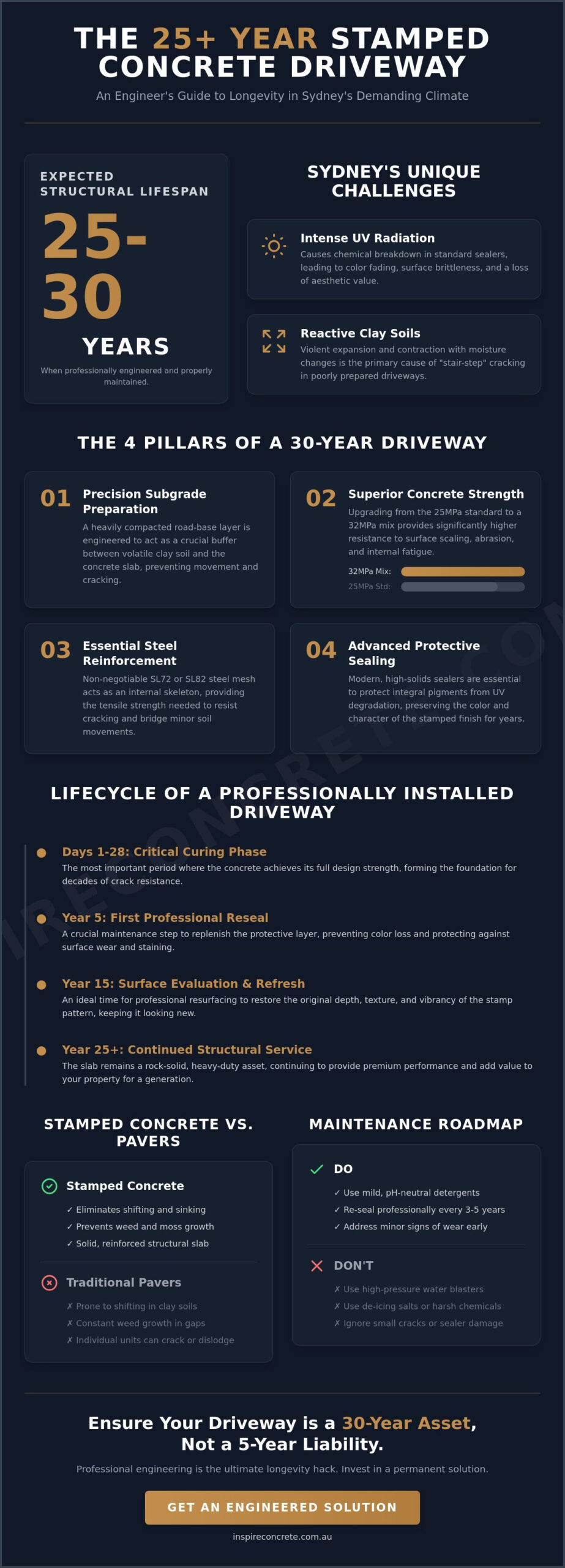
The first 28 days of your project determine the slab’s ultimate strength. This curing phase is the most critical period; it’s when the concrete achieves its design capacity and resists future structural cracking. As you reach the 5-year mark, your driveway will typically require its first major professional reseal to prevent colour loss and surface wear. By the 15-year milestone, we recommend a thorough evaluation of the surface texture. While the slab remains rock-solid, this is the ideal time for professional resurfacing to restore the original depth and vibrancy of the stamp pattern, ensuring it looks as impressive as the day it was poured.
Why Sydney’s Climate Demands More from Your Concrete
Sydney’s climate presents unique challenges that standard concrete mixes simply cannot handle. The intense UV radiation in New South Wales can rapidly bleach integral pigments if they aren’t protected by modern, high-solids sealers. Along with high heat, our local humidity cycles cause constant expansion and contraction within the decorative slab, requiring precise engineering to avoid surface failure. UV degradation in the context of decorative concrete sealers is the chemical breakdown of the molecular bonds within the protective coating caused by prolonged solar exposure, leading to surface brittleness and aesthetic fading. We mitigate these risks through technical precision and a deep commitment to long-term value.
Critical Factors That Determine How Long Your Concrete Lasts
The longevity of your driveway isn’t decided when the concrete is poured; it’s determined weeks earlier during the excavation phase. When homeowners ask how long does stamped concrete last, they are often looking for a number, but the answer is actually a reflection of engineering quality. A slab is only as stable as the ground beneath it. If the subgrade isn’t prepared with technical precision, even the highest grade of concrete will eventually succumb to structural failure. We focus on creating a rock-solid foundation that ensures your investment remains level and intact for decades.
Concrete mix design plays a pivotal role in residential durability. While a 25MPa mix is often the industry standard, moving to a 32MPa strength provides significantly higher resistance to surface scaling and abrasion. This higher density, combined with the right reinforcement, creates a slab capable of withstanding heavy vehicle traffic without internal fatigue. For Sydney driveways, SL72 or SL82 steel mesh is non-negotiable. This internal skeleton holds the slab together during the natural curing process and provides the tensile strength needed to bridge minor soil movements. This focus on the Durability of Concrete Paving Mixtures ensures that the structural integrity matches the refined aesthetic of the finish.
Sydney Soils: Managing Reactive Clay and Subgrade Stability
Western Sydney is notorious for reactive clay soils that expand and contract violently with moisture changes. This movement is the primary cause of “stair-step” cracking in poorly built driveways. To combat this, we implement a heavily compacted road-base layer that acts as a buffer between the volatile soil and your concrete. Proper preparation is the difference between a driveway that shifts and one that stays put. For a deeper look at how we engineer these foundations, see The Essential Guide to Concrete Slabs in Sydney. Understanding these geological factors is the first step toward a permanent property transformation.
The Role of Sealant in Preserving Structural Integrity
Control joints are another essential element of our craftsmanship. We strategically “tell the concrete where to crack” by placing deep grooves that allow for natural shrinkage without disrupting your decorative pattern. Once the slab is set, the sealant becomes the final line of defence. High-quality acrylic sealers prevent water from penetrating the pores of the concrete, which is vital for preventing surface erosion. The sealant acts as a sacrificial wear layer for the concrete surface, absorbing the brunt of friction and UV energy so the underlying decorative pattern remains untouched. If you’re ready to build a driveway that combines this level of engineering with high-end design, partnering with a specialist team ensures every technical detail is mastered from day one.
Stamped Concrete vs. Alternatives: A Durability Comparison
Choosing a driveway material involves balancing immediate aesthetics with long-term resilience. When asking how long does stamped concrete last compared to traditional pavers, the answer lies in the monolithic nature of the slab. Unlike pavers, which often shift over time or allow invasive weed growth between joints, a stamped surface provides a continuous, reinforced barrier. While individual pavers are easier to replace if damaged, a professionally engineered concrete slab is significantly harder to compromise in the first place. This makes it a superior choice for high-traffic Sydney properties where structural stability is the priority.
When we look at other decorative finishes like exposed aggregate driveways, the comparison shifts toward texture and slip resistance. Exposed aggregate offers an inherently high-grip surface due to the protruding stones, whereas stamped concrete relies on the depth of its imprinted pattern and the quality of the final sealing coat. Both options provide exceptional longevity, but stamped concrete offers a level of design flexibility that mimics premium stone or slate without the maintenance headaches of individual units. It’s a sophisticated solution for those who refuse to settle for basic utility.
Stamped vs. Stencil Concrete: Which Fades Slower?
Longevity isn’t just about structural integrity; it’s about colour retention. Stencil concrete often utilizes dry-shake colour hardeners that sit on the surface. In contrast, high-end stamped concrete frequently employs integral liquid colours that permeate the entire mix. This means as the surface naturally wears over 10 to 15 years, the colour remains consistent. The deep texture of a stamp also protects the pigment within the “valleys” of the pattern, whereas the flatter surface of stencil concrete is more susceptible to uniform abrasion from vehicle tyres and foot traffic. For a typical Sydney suburban driveway, the depth of a stamped finish generally provides a more enduring aesthetic.
The “Slippery” Myth: Safety and Longevity
A common concern with decorative finishes is their performance in the wet, particularly around pool surrounds or steep inclines. Safety and longevity go hand-in-hand here. We ensure BCA compliance by integrating specialised anti-slip additives into the final sealing coat. This creates a high-friction surface that doesn’t compromise the elegant finish. It’s vital to maintain this sealer; a worn-down texture can lead to safety issues later in the slab’s life. By adhering to a disciplined maintenance schedule, you ensure the surface remains as safe as it was on day one. This proactive approach transforms a potential liability into a long-term safety asset for your home.
The Maintenance Roadmap to a 30-Year Driveway
The definitive answer to how long does stamped concrete last is found in your willingness to protect the surface from environmental wear. While the structural slab is designed for decades of service, the aesthetic finish requires a disciplined maintenance cycle to remain vibrant. Longevity is not a matter of luck; it is a result of proactive care. By following a structured roadmap, you ensure your driveway transitions from a simple utility to a permanent property asset that maintains its “new” look for over 25 years.
Routine care begins with annual inspections. Identifying hairline cracks early allows for minor repairs before they evolve into structural failures or allow moisture to compromise the subgrade. You can easily monitor the health of your surface by performing the “water bead” test. Simply pour a small amount of water onto the pattern; if it forms tight droplets on the surface, your sealer is intact. If the water soaks into the concrete and darkens the texture, the protective barrier has reached its limit and requires a refresh. For homeowners seeking professional restoration, our Concrete Cleaning and Sealing service provides the technical precision needed to restore the original lustre of your investment.
How to Clean Stamped Concrete Without Damaging the Sealer
Daily care should focus on mild detergents rather than aggressive high-pressure water, which can prematurely erode the protective sealer. Harsh acids or industrial degreasers are particularly dangerous for decorative finishes, as they can strip the pigment and leave the surface vulnerable to UV damage. For oil spills or stubborn tyre marks, use a soft-bristled broom and a pH-neutral cleaner to lift the residue without compromising the chemical bond of the acrylic coating. Many of these principles are shared with other decorative surfaces; you can find more detail in our guide on how to clean and maintain exposed aggregate concrete to ensure consistent results across all your outdoor areas.
Resealing 101: Timing, Products, and Techniques
Timing is everything when it comes to preserving the depth of your stamped pattern. In the Sydney climate, a professional reseal is typically required every 2 to 4 years. It is vital to remember that “more is not better” when applying sealer. Excessive layers lead to whitening and unsightly peeling as moisture becomes trapped beneath the dense film. We utilize high-solids, solvent-based sealers that meet the 2026 standards for UV resistance and durability. For the best results, ensure the sealer is applied when the surface temperature is between 15 and 28 degrees Celsius to prevent bubbling or flash-drying. This technical attention to detail ensures the finish remains clear, resilient, and sophisticated for the long haul.
Why Professional Installation is the Ultimate Longevity Hack
Professionalism is the invisible reinforcement that determines how long does stamped concrete last. While a DIY project might look passable on day one, the technical complexities of Sydney’s environment often expose amateur mistakes within the first few seasons. At Inspire Concrete, we bring over 20 years of Sydney-specific engineering experience to every project. This longevity isn’t accidental; it’s the result of rigorous project management that prevents the costly errors common with “solar cowboys” who prioritize speed over structural integrity.
One of the most frequent failures in non-professional installations is “ghosting.” This occurs when the stamp pattern is too shallow or applied at the wrong stage of the curing process, causing the texture to effectively vanish within five years. True craftsmanship requires an understanding of architectural drafting to ensure correct drainage and runoff. Without precise levels, water pools in the depressions of the pattern, leading to accelerated sealer degradation and potential subgrade saturation. Our team manages these variables with a level of certainty that leaves no room for guesswork.
From Drafting to Pour: Our Precision Process
Our methodology is built on technical certainty and a passion for the craft. We calculate the exact water-to-cement ratio required for the specific weather conditions on the day of the pour, ensuring the mix reaches its maximum design strength. The timing of the stamp is a high-stakes window where minutes matter; apply it too early, and the pattern loses crispness; too late, and the concrete won’t take the impression. We exclusively use premium, UV-stable pigments that are chemically bonded to the mix, providing a finish that resists the harsh Australian sun far better than standard retail alternatives.
Transform Your Property with a Master Craftsman
Choosing a professional partner means moving beyond simple utility toward a genuine aesthetic transformation. A high-end stamped driveway adds significant market value to Sydney homes, reflecting a level of detail that generic finishes simply cannot match. As a licensed, family-owned contractor, we provide the peace of mind that your project is handled with a meticulous eye for detail and a deep commitment to excellence. We don’t just pour concrete; we realize a creative vision that enhances your lifestyle for decades.
Ready for a driveway that stands the test of time? Request a professional concrete quote from Inspire Concrete and let us realize your creative vision with engineering precision.
Engineering Your Property’s Long-Term Transformation
A driveway is more than just a place to park; it’s a foundational element of your home’s aesthetic and structural value. By mastering the synergy between technical subgrade preparation and a consistent sealing cycle, you ensure your investment remains a high-end asset for decades. Understanding how long does stamped concrete last allows you to move beyond the fear of cracking or fading, focusing instead on the long-term value provided by a master craftsman. With the right engineering, a 30-year lifespan isn’t just a goal; it’s the expected result of professional execution.
At Inspire Concrete, we bring over 20 years of Sydney experience to every project. As licensed and fully insured craftsmen, we specialize in high-durability decorative finishes that withstand the unique challenges of our local climate. We pride ourselves on transforming basic utility into refined artistry that stands the test of time. Ready to begin your property’s transformation? Get a Professional Quote for Your Stamped Concrete Project today. We look forward to partnering with you to create a durable, sophisticated result that enhances your lifestyle and property value for a generation.
Frequently Asked Questions
Does stamped concrete crack easily?
Stamped concrete does not crack more easily than standard concrete if the subgrade is correctly engineered and control joints are placed with precision. Cracking is usually a symptom of poor soil preparation or skipping essential reinforcement like SL72 mesh. By directing natural shrinkage into pre-cut joints, we ensure the decorative pattern remains intact and structurally sound for decades of heavy use.
How often do I really need to reseal my stamped concrete in Sydney?
To maximize how long does stamped concrete last, you should reseal the surface every 2 to 4 years. Sydney’s intense UV radiation and humidity cycles eventually break down the acrylic coating, leaving the porous concrete vulnerable to moisture and stains. Performing the “water bead” test annually is the most reliable way to determine if your slab requires a refresh before environmental wear reaches the decorative pattern itself.
Will the colour of my stamped concrete fade over time?
Surface fading is largely preventable through the use of integral liquid pigments and high-solids sealers. While cheap dry-shake hardeners can wear down and look patchy, our modern standards for UV-resistant additives ensure the pigment remains deep within the slab. Regular maintenance prevents the solar bleaching that often affects neglected or poorly installed decorative surfaces, keeping the aesthetic vibrant and sophisticated.
Can I put stamped concrete over my old, existing driveway?
We do not recommend pouring a new stamped slab directly over an old driveway, as any existing cracks or movement will quickly telegraph through to the new surface. For existing concrete that is structurally sound, a specialized concrete resurfacing service is the correct technical approach. This allows you to achieve the refined stamped look without the height issues or structural risks associated with a double-pour.
Is stamped concrete more expensive to maintain than plain concrete?
Maintaining a stamped finish is slightly more involved than plain concrete due to the requirement for periodic resealing. While plain concrete is often left untreated, the protective layer on a stamped surface is essential for preserving the intricate pattern and colour. This small investment actually helps determine how long does stamped concrete last by preventing the surface erosion that typically ages unsealed slabs much faster.
How long do I have to wait to drive on my new stamped concrete?
You can typically walk on the surface after 24 to 48 hours, but you must wait at least 7 days before driving a standard passenger vehicle on the slab. Concrete takes a full 28 days to reach its design strength. Rushing this timeline can lead to structural damage or permanent tyre marks in the fresh sealer, compromising the long-term value and professional finish of your project.
Is stamped concrete too slippery for a pool surround?
Stamped concrete is an excellent choice for pool surrounds when finished with the correct anti-slip additives. We integrate these specialized materials into the final sealing coat to meet Australian safety standards for wet areas. This provides a high-friction surface that remains safe for families while maintaining the elegant look of natural stone or slate, ensuring your entertaining area is both beautiful and secure.
Can hairline cracks in stamped concrete be repaired invisibly?
Hairline cracks can be professionally filled and colour-matched, making them nearly invisible to the untrained eye. Because concrete is a natural material that breathes and moves, a perfect 100% invisible repair is rare. The key is using specialized colour-matched resins during the resealing process to blend the repair into the existing texture and pigment, maintaining the overall aesthetic transformation of your property.
