
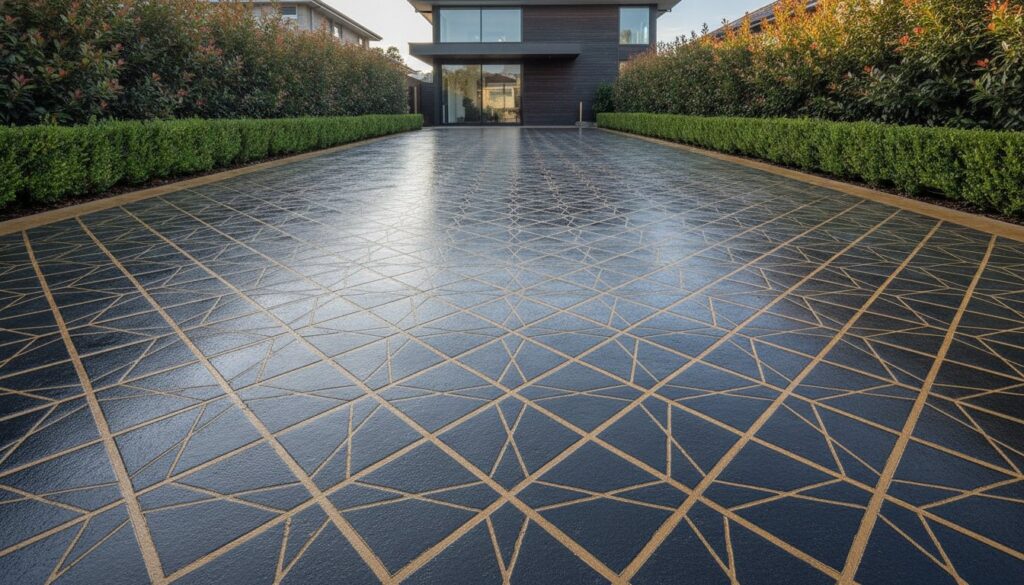
Your driveway is the first thing visitors notice, yet Sydney’s relentless UV rays can turn a vibrant stencilled masterpiece into a faded, peeling eyesore in just a few seasons. It’s a common sight across our coastal suburbs; once-bold patterns lose their depth while oil stains and previous poor sealer choices create a messy, slippery finish. You’ve likely felt the frustration of watching a significant investment lose its luster under the harsh Australian sun.
Restoring that original brilliance requires a blend of technical precision and high-end craftsmanship. We’ve developed this guide to help you master cleaning and sealing stencil concrete using the latest 2026 restorative standards. You’ll learn how to navigate Sydney Water’s strict usage guidelines and choose between high-performance water-based or solvent sealers that actually last. We’re showing you how to move beyond basic maintenance to achieve a durable, “wet look” transformation that protects your property’s structural integrity and significantly boosts its market value.
Key Takeaways
- Understand how Sydney’s intense UV radiation degrades older sealers and why deep decontamination is the critical first step in preserving your concrete’s polymer structure.
- Master the technical requirements for cleaning and sealing stencil concrete, including the professional use of high-pressure equipment to remove stubborn laitance and failing coatings.
- Compare the performance and aesthetic finishes of traditional solvent-based acrylics against modern, low-VOC water-based solutions to determine the best fit for your home’s environment.
- Identify the common pitfalls of DIY applications, such as moisture entrapment and “blushing,” and learn how professional techniques ensure a flawless, long-lasting bond.
- Follow a strategic five-year maintenance roadmap to protect your investment and recognize the specific signs that indicate your driveway needs resurfacing instead of a standard re-seal.
Why Cleaning and Sealing Stencil Concrete is Essential for Sydney Homes
Maintaining a high-end property in Sydney requires more than just a quick hose down. Think of professional maintenance as a precise, two-stage engineering project: decontamination and preservation. Without regular cleaning and sealing stencil concrete, your driveway or alfresco area becomes vulnerable to the elements. This isn’t just about appearances; it’s about protecting the structural investment you’ve made in your home.
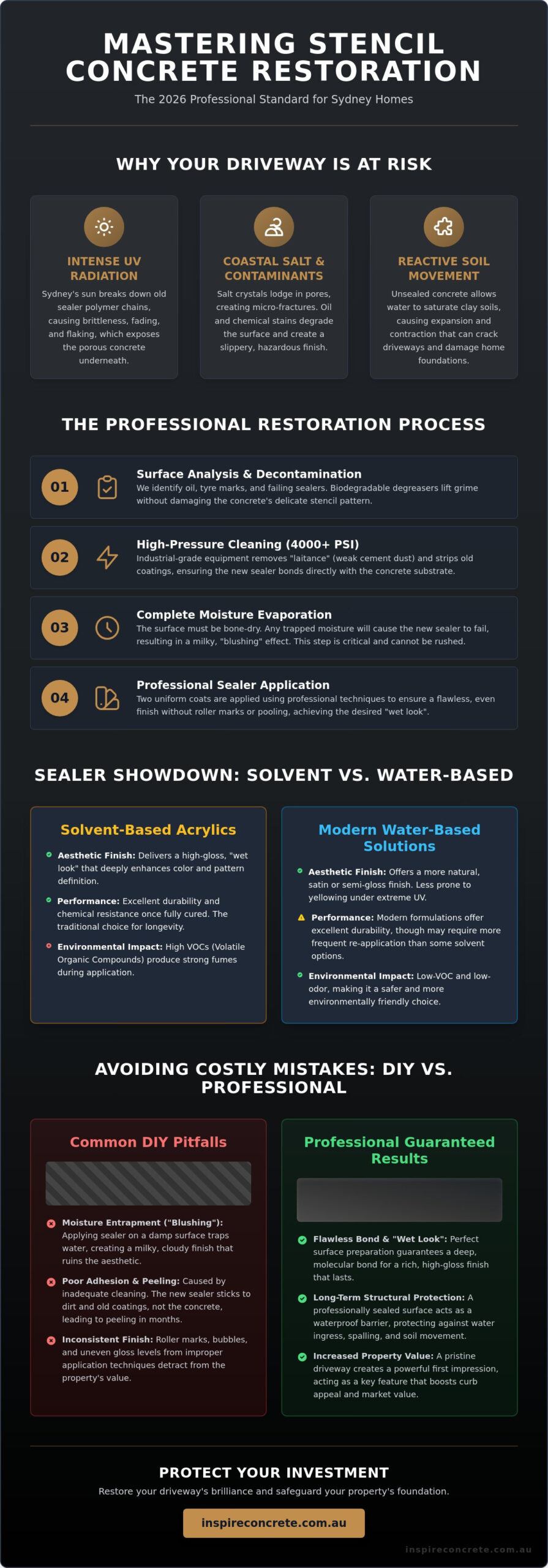
Sydney’s intense summer radiation is a silent destroyer of outdoor surfaces. It physically breaks down the polymer chains in older, neglected sealers. Once these chains snap, the sealer becomes brittle and flakes away, leaving the porous concrete beneath exposed to moisture, oils, and chemicals. This exposure eventually leads to “spalling,” where the top layer of the concrete begins to flake or pit, signaling the start of irreversible surface erosion.
In competitive real estate markets like the Hills District, a pristine driveway acts as a visual handshake. It signals a well-maintained home and adds tangible value to the property’s appraisal. A restored finish transforms a tired utility space into a design feature that complements your home’s architecture.
The Impact of UV and Coastal Salt on Stencilled Patterns
The iron-oxide pigments used during the stenciling process are exceptionally durable, but they aren’t invincible. UV rays act as a powerful bleaching agent, slowly draining the life from deep charcoals or warm terracottas. Suburbs near the coast face an added threat: salt air. Salt crystals can lodge in the concrete’s pores, expanding as they dry and creating microscopic fractures that invite further damage. In 2026, high-performance acrylic sealers must meet strict UV-stability standards to ensure they don’t yellow or degrade under 40-degree heat.
Preventing Structural Damage in Reactive Clay Soils
Many Sydney homes, particularly in the Greater West, sit on reactive clay soils. These soils expand and contract dramatically based on moisture levels. A neglected, unsealed driveway allows water to seep through cracks and saturate the ground directly beneath the concrete. This localized moisture can trigger significant soil movement, which often leads to cracks in the driveway or even affects the stability of adjacent concrete slab foundations. By maintaining a waterproof barrier through proper sealing, you’re doing more than preserving a pattern; you’re protecting the structural integrity of your entire property.
The Professional Cleaning Process: Decontaminating the Stencil
Successful cleaning and sealing stencil concrete begins with a clinical approach to decontamination. You aren’t just washing away dirt; you’re removing “laitance”—a weak, milky layer of cement dust—and stripping back failing sealer that has lost its bond. If these contaminants remain, your new coating will simply sit on top of the debris rather than fusing with the substrate. This technical precision is what separates a professional restoration from a temporary cosmetic fix.
Our team utilizes industrial-grade equipment, specifically 4000+ PSI pressure washers equipped with turbo nozzles and surface cleaners. While a standard garden hose or an electric DIY unit might clear surface dust, they lack the mechanical force to penetrate the microscopic pores of the concrete. This deep-cleansing stage is a core tenet of concrete pavement preservation, ensuring the surface is chemically receptive to the upcoming sealer application.
We prioritize biodegradable degreasers over harsh acid etching for stencilled surfaces. Acid can be too aggressive, potentially eating into the delicate patterns and altering the texture of the “grout” lines. A pH-neutral, professional-grade emulsifier is far more effective at lifting deep-seated grime without compromising the concrete’s structural integrity. Once the cleaning is complete, the surface must be left to become bone-dry. Even a hint of residual moisture trapped beneath a new sealer can cause the entire application to fail within weeks.
Step 1: Removing Oil, Tyre Marks, and Organic Growth
Stubborn oil leaks and dark tyre marks require more than just water. We apply professional emulsifiers that break down the molecular bond between the oil and the concrete. In shaded Sydney alfresco areas, mould and lichen are common intruders. These organic growths must be completely eradicated at the root level; otherwise, they will continue to grow under the new sealer, causing unsightly green or black patches. Precision is vital here. Uneven cleaning leads to “shadowing,” where ghost-like stains become permanently visible once the gloss of the sealer is applied. For those who want to ensure every stain is properly addressed, our specialist cleaning and sealing services provide the thorough decontamination required for a flawless finish.
Step 2: Pressure Washing Techniques for Stencil Integrity
The technique used during the high-pressure phase is just as important as the equipment. We use a consistent “fan pattern” to sweep across the surface, which prevents the water from pitting the concrete or blowing out the edges of the stencilled pattern. DIY electric pressure washers often hover around 1500 to 2000 PSI, which is rarely enough to strip away old, oxidized polymers. Furthermore, operating 4000 PSI machinery in residential areas requires strict safety protocols. The force is strong enough to cut through skin or damage adjacent landscaping if not handled with a craftsman’s steady hand.
Choosing the Right Sealer: Solvent vs. Water-Based Solutions
Selecting the right protective coating is the most critical decision in the cleaning and sealing stencil concrete process. It’s the difference between a surface that merely looks clean and one that radiates a deep, gallery-quality finish. Most Sydney homeowners choose between high-gloss, semi-gloss, or matte finishes. While high-gloss creates a vibrant, “wet look” that makes stencilled patterns pop, matte finishes are increasingly popular for modern architectural homes where an understated, natural stone appearance is desired.
The chemistry behind these products determines their performance. Solvent-based acrylics utilize a chemical carrier that evaporates, leaving behind a hard-wearing resin. Their greatest advantage is a property known as “re-wetting.” When applied over an existing stencil, the solvent actually re-dissolves the previous sealer layer, allowing the new and old coats to fuse into a single, seamless barrier. This prevents the delamination issues often seen with inferior products. For technical specifics on resin types and bond strength, the ASCC Sealer Selection & Application Guide remains the industry benchmark for professional standards.
Eco-friendly water-based sealers have improved significantly by 2026. They offer lower VOC levels and minimal odor, making them ideal for high-density residential areas or enclosed alfresco spaces. Regardless of the carrier liquid, you must prioritize the “solids content.” This refers to the amount of resin left on the driveway after the liquid evaporates. A high-solids sealer provides a thicker protective film, ensuring your stencil withstands heavy tyre traffic and Sydney’s UV exposure for years longer than budget alternatives.
Solvent-Based Acrylics: The Professional Standard
We typically recommend solvent sealers for restoring faded stencils because they penetrate deep into the concrete’s profile to revive the original iron-oxide pigments. Achieving a uniform finish requires a professional spray application. While rolling is common in DIY kits, it often leaves “lap marks” or uneven thick spots that can eventually peel. In tight Sydney streets, we manage the strong odor and drying times by scheduling applications during specific weather windows to ensure the product cures perfectly before the afternoon sea breeze kicks in.
Safety First: Anti-Slip Additives and R-Ratings
A fresh coat of sealer can be incredibly slippery when wet. We solve this by integrating anti-slip additives like crushed glass or specialized polymer grit directly into the final coat. This is a non-negotiable step for pool surrounds and entertaining areas where foot traffic is high. According to Australian Standards, steep driveways must achieve a minimum P4 or P5 slip resistance rating to ensure pedestrian safety and vehicle traction during Sydney’s sudden downpours.
DIY vs. Professional Sealing: Avoiding Costly Mistakes
A weekend DIY project sounds appealing until you’re staring at a cloud of white spots on your driveway. The most common objection we hear is that a hardware store kit is the same as a professional service. In reality, retail products are often diluted to be “user-friendly,” meaning they have lower resin density and lack the advanced UV blockers found in industrial formulations. When cleaning and sealing stencil concrete, the margin for error is razor-thin. Professional results aren’t just about the product; they’re about the precision of the application environment.
The most devastating DIY failure is “blushing.” This occurs when moisture is trapped beneath the sealer, creating unsightly white, milky patches that obscure the pattern. Because retail sealers often lack the breathability of professional-grade resins, even a microscopic amount of residual moisture from a morning dew can trigger a total bond failure. If a DIY application fails, you can’t simply apply another coat to hide the mistakes. You’re faced with the grueling, expensive task of chemically stripping the failed layer back to the bare concrete before starting over. We utilize trade-only chemicals and high-volume spray equipment to ensure the sealer penetrates the substrate correctly, avoiding the surface-level peeling common with roller-applied DIY kits.
Common DIY Failures and How to Fix Them
In the high-heat environments of Western Sydney, DIYers often face “bubbling.” This happens when the sealer is applied to a hot surface, causing the solvent to “flash off” too quickly and trap air in the film. Fixing uneven streaks or bubbles usually requires a solvent wash or a complete re-strip. The cost of professional stripping often exceeds the price of getting the job done right the first time. If your surface is already showing signs of significant wear or loss of texture, you may need to consider if professional concrete cleaning and sealing is enough or if a full restoration is required.
The Value of a Professional Warranty
A professional application typically lasts three to five years, whereas a DIY coat often begins to degrade within twelve months. This longevity provides essential peace of mind, especially for complex properties featuring exposed aggregate and stencil combinations that require different grip additives. Furthermore, hiring a licensed concreter in NSW ensures that your project meets Australian Standards for slip resistance and structural protection. We stand behind our craftsmanship, transforming your driveway from a maintenance chore into a long-term asset that maintains its “wet look” brilliance year after year.
Maintenance Schedules and Restoring Your Sydney Driveway
Precision in cleaning and sealing stencil concrete doesn’t end once the final coat of sealer cures. To protect your investment against Sydney’s volatile climate, you need a proactive strategy. A well-executed maintenance plan prevents the accumulation of abrasive grit and chemical contaminants that prematurely wear down protective resins. By adhering to a disciplined schedule, you ensure your driveway remains a high-value asset rather than a deteriorating liability.
You can easily verify the integrity of your sealer with a simple “water bead test.” Pour a small amount of water onto various sections of the stencil, particularly in high-traffic areas. If the water beads and sits on the surface, your protection is intact. If it soaks into the concrete and darkens the color within seconds, the sealer has been compromised. In these instances, immediate action is required to prevent moisture from reaching the substrate. However, if you notice the stencilled pattern is physically worn down or the surface is riddled with structural cracks, your driveway may require concrete resurfacing rather than a simple re-seal.
Timing is everything in Sydney. We recommend scheduling major maintenance during the stable weather windows of Autumn (March to May) or Spring (September to October). These months offer the mild temperatures and lower humidity required for sealers to bond correctly without the risk of “flashing off” in summer heat or being ruined by winter rain.
The 5-Year Stencil Care Roadmap
A structured approach ensures no detail is overlooked. We recommend the following milestones for every Sydney homeowner:
- Annual Soft-Wash: Use a pH-neutral detergent and a soft-bristle broom to remove organic matter and salt spray. This prevents the growth of lichen that can root into the sealer; for a complete exterior maintenance routine, House Washing Heroes provides expert guidance on keeping your home’s facade free from dust and debris.
- Bi-Annual Inspection: Check the “grout” lines of your stencil for hairline cracks. Addressing these early with professional-grade fillers prevents water ingress and soil movement.
- 3-5 Year Professional Re-seal: Depending on traffic volume and UV exposure, a full professional cleaning and re-application of a high-solids sealer is necessary to restore the “wet look” and UV barrier.
Ready for a Transformation? Next Steps
Restoring a stencilled surface to its original glory is a job for a project partner who understands the engineering behind the artistry. At Inspire Concrete, we provide comprehensive site assessments to determine the exact chemical and mechanical needs of your property. Before our crew arrives, we ask that you clear the area of vehicles and potted plants to ensure we can achieve a seamless, edge-to-edge finish. If you are ready to elevate your home’s curb appeal with a durable, sophisticated finish, Contact Inspire Concrete for a professional quote and let us realize your creative vision.
Elevate Your Property’s Potential with Professional Restoration
Your stencilled concrete is more than just a functional surface; it’s a significant design element that defines your home’s aesthetic. By mastering the balance between deep decontamination and high-performance preservation, you ensure your driveway withstands Sydney’s relentless UV cycles. We’ve explored how the right chemistry prevents structural decay and why a professional touch eliminates the risks of moisture entrapment and peeling.
Choosing professional cleaning and sealing stencil concrete services means investing in longevity and refined craftsmanship. Our team brings over 20 years of Sydney concreting expertise to every project, utilizing specialized UV-stable industrial sealers that retail products simply cannot match. As licensed NSW contractors, we prioritize both the engineering of the substrate and the artistry of the finish, ensuring every application meets rigorous Australian Standards.
Don’t leave your property’s curb appeal to chance with a weekend DIY kit. Restore your driveway today with Inspire Concrete’s professional sealing services. Let’s transform your weathered surfaces into a durable masterpiece that enhances your lifestyle and property value for years to come.
Frequently Asked Questions
How long does stencil concrete sealer take to dry in Sydney weather?
Most professional sealers are touch-dry within two to four hours under typical Sydney conditions. You can usually walk on the surface after 24 hours, but we recommend waiting a full 72 hours before driving vehicles onto the driveway. High humidity or coastal dampness can extend these windows, so it’s vital to monitor the local forecast before application.
Can I change the colour of my stencil concrete during the sealing process?
Yes, you can revitalize or slightly shift the tone of your driveway by using tinted sealers. These products contain translucent pigments that enrich the existing iron-oxide colours and can help mask minor imperfections or fading. While a tinted sealer won’t transform a charcoal driveway into a cream one, it’s an excellent tool for restoring the original vibrancy of cleaning and sealing stencil concrete projects.
Why is my stencil concrete turning white or cloudy after rain?
A cloudy or white appearance, known as “blushing,” indicates that moisture has become trapped between the sealer and the concrete surface. This usually happens if the concrete wasn’t bone-dry before sealing or if the sealer has lost its bond with the substrate. Resolving this often requires a professional solvent wash to re-release the trapped moisture or, in severe cases, a complete strip and re-application.
How often should I professionally clean and seal my driveway?
In the Sydney climate, most stencilled surfaces require professional maintenance every three to five years. Properties with high vehicle traffic or those in exposed coastal areas may need attention closer to the three-year mark to maintain the UV barrier. Regular inspections and the water bead test mentioned earlier will help you identify when the protective film is beginning to thin.
Will sealing my stencil concrete make it slippery?
High-gloss sealers can become slippery when wet if they are applied without the correct additives. We mitigate this risk by integrating specialized anti-slip grit or crushed glass into the final coat. This ensures the surface meets Australian Standards for slip resistance, providing essential traction for both pedestrians and vehicles during heavy rain.
Can I seal over old, peeling sealer or do I need to strip it?
You should never apply a new coat over old sealer that is already flaking or peeling. The new product will only bond to the failing layer, causing the entire finish to lift away within months. If the existing coating is compromised, we perform a full chemical strip to return the concrete to a clean, porous state before applying a fresh, durable barrier.
What is the best time of year to seal concrete in Sydney?
Spring and Autumn are the ideal seasons for cleaning and sealing stencil concrete because the temperatures are moderate and predictable. We avoid mid-summer applications when the concrete surface temperature can exceed 50 degrees, which causes the sealer to “flash dry” and bubble. Similarly, the frequent rain and high humidity of winter can interfere with the curing process.
How much does professional concrete cleaning and sealing cost per square metre?
The investment for a professional service depends on several technical variables rather than a flat rate. Factors such as the total square meterage, the current condition of the concrete, and whether old sealer needs to be stripped will influence the final scope. We also consider the type of sealer required, such as high-solids solvent acrylics or eco-friendly water-based options, to provide an accurate assessment for your specific property.
