
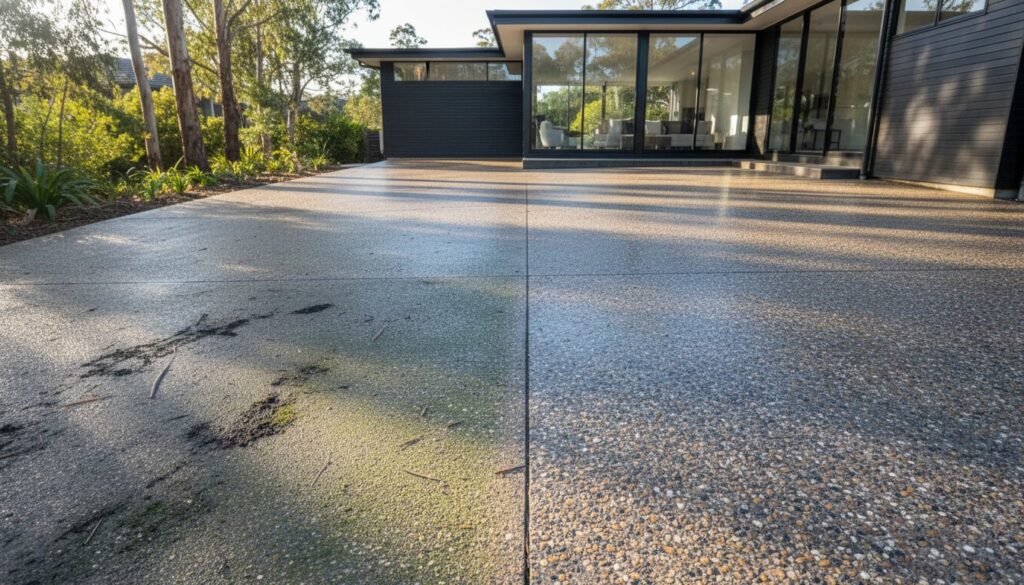
Your driveway is more than a utility surface; it’s a high-end architectural feature that defines your home’s character. However, if you’re staring at stubborn oil marks or Sydney’s persistent moss growth, you likely worry that a heavy hand might dislodge the very stones that give it beauty. Knowing how to clean exposed aggregate concrete requires a delicate balance between raw power and refined technique. It’s a common frustration to see a premium investment lose its luster under layers of environmental grime and chemical stains.
You deserve a restoration process that prioritizes structural integrity while delivering a visual transformation. We’ll show you how to master the art of maintaining that textured elegance using professional-grade methods and specific sealing secrets. Precision matters here. This guide breaks down the essential two-stage approach of chemical neutralization followed by protective sealing. You’ll discover the safest ways to lift deep-seated contaminants and apply the right finishes to ensure your outdoor spaces remain a point of pride for years to come.
Key Takeaways
- Learn why a meticulous “Dry Clean” phase is the non-negotiable first step to preventing surface abrasion during the restoration process.
- Discover the professional secrets of how to clean exposed aggregate concrete by identifying the specific chemistry of organic versus inorganic stains.
- Understand the critical role of sealer breathability and how to choose between “Wet Look” and “Natural” finishes to protect your architectural investment.
- Master the poultice method for extracting deep-set oil and rust without compromising the structural integrity of the surrounding stones.
- Identify when to transition from DIY maintenance to professional restoration techniques like acid washing and tinted sealing to revive sun-bleached surfaces.
Understanding Exposed Aggregate: Why Cleaning is Critical for Longevity
Exposed aggregate concrete is a sophisticated architectural finish that elevates the aesthetic of any modern home. By stripping away the top layer of cement to reveal natural stones, you get a rugged, non-slip surface that’s as durable as it is beautiful. However, this textured profile requires a specific maintenance mindset. In Sydney, the combination of intense UV radiation and heavy rainfall can lead to “chalking,” where the surface develops a white, powdery residue. This happens when the protective resins break down, leaving the concrete vulnerable. Learning how to clean exposed aggregate concrete isn’t just a weekend chore; it’s a vital part of preserving your property’s value.
There’s a significant difference between a quick rinse for looks and a deep clean for structural health. Regular maintenance removes the acidic contaminants and environmental pollutants that slowly eat away at the concrete matrix. This proactive approach directly impacts the lifespan of your sealer. When the sealer remains intact, it prevents moisture from seeping into the pores, which stops chemical erosion from within. A clean surface ensures the protective barrier can do its job, preventing the stones from becoming loose or pitted over time.
The Anatomy of Your Aggregate Surface
Your driveway’s strength lies in the “matrix,” which is the specialized concrete blend that holds every decorative stone in place. Because exposed aggregate driveways have a high-relief profile, they naturally trap more debris than plain slabs. Dirt, sand, and grit don’t just sit on the surface; they act as microscopic abrasives. When cars drive over a dirty surface, these particles grind against the stones and the matrix, slowly wearing them down. This abrasive wear is why aggregate requires more frequent attention than smooth concrete finishes. Without regular cleaning, you’re essentially letting a layer of sandpaper erode your investment every time you pull into the garage.
Sydney’s Climate Challenges for Concrete
The local environment presents unique hurdles for homeowners. Sydney’s high humidity often leads to rapid mould and lichen growth in shaded zones. These organic invaders do more than just stain; they hold moisture against the surface and can secrete acids that etch the concrete. If you live near the coast, salt air adds another layer of complexity. Salt crystals can lodge in the aggregate’s texture, causing sub-surface pressure that leads to scaling. Additionally, the reactive clay soils found in many Sydney suburbs can impact surface drainage. Poor drainage allows tannin-rich water from leaf litter to pool, creating deep-set stains. Mastering how to clean exposed aggregate concrete helps you combat these localized stressors, ensuring your outdoor spaces remain resilient and refined.
The Step-by-Step Guide to Routine DIY Cleaning
Before you reach for the hose, clear your workspace entirely. Move vehicles, potted plants, and outdoor furniture away from the area to ensure an unobstructed path. It’s equally vital to protect your surrounding landscape. Thoroughly saturate any adjacent lawn or garden beds with fresh water before you begin. This simple step dilutes any runoff, preventing cleaning solutions from scorching your delicate greenery. When figuring out how to clean exposed aggregate concrete, the sequence of operations is just as important as the tools you use.
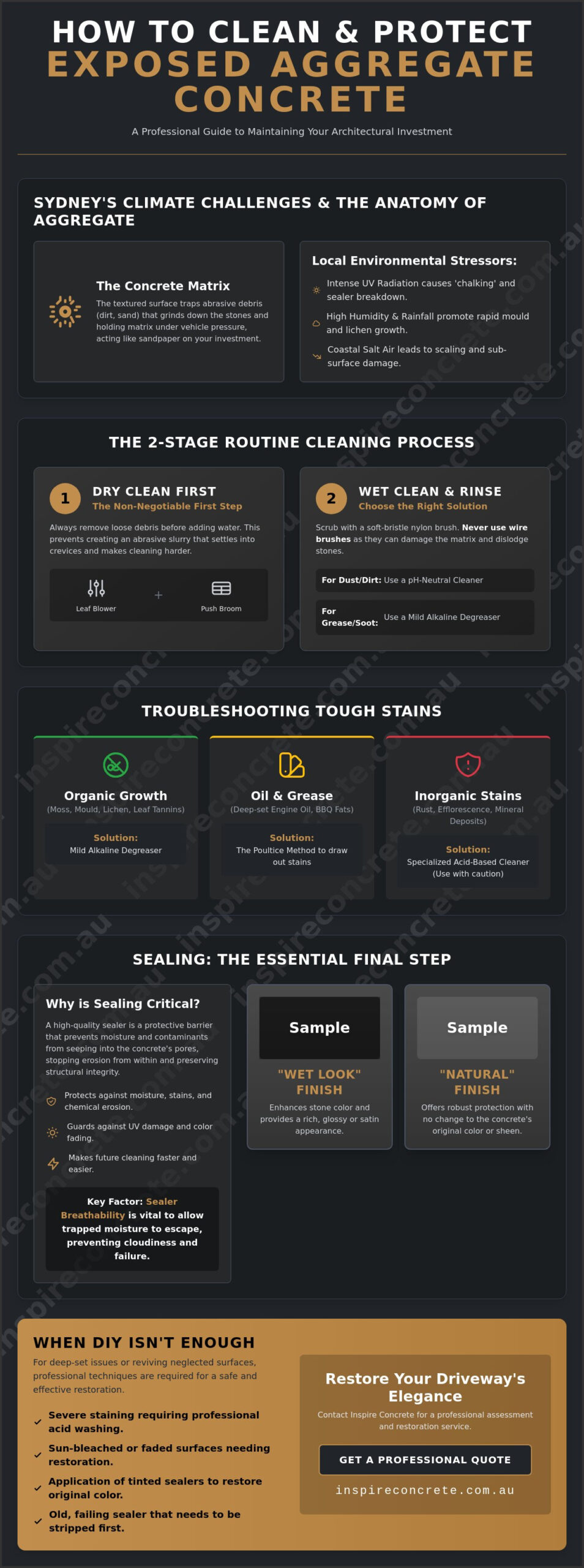
The “Dry Clean” phase is your first line of defense. Use a high-powered leaf blower or a wide push broom to remove loose grit, sand, and organic debris. Skipping this step is a mistake; adding water to loose dirt creates a slurry that settles deep into the textured crevices, making the job twice as hard. Once the surface is clear, choose your detergent based on the task at hand. For routine dust, a pH-neutral cleaner works best. If you’re dealing with grease or heavy soot, a mild alkaline degreaser is necessary. Industry experts often highlight the importance of cleaning and resealing exposed aggregate using solutions that won’t strip the existing finish prematurely.
Equipment Checklist for Homeowners
Precision requires the right kit. You’ll need a soft-bristle nylon push broom; never use stiff wire brushes, as they can scratch the stones or gouge the concrete matrix. A standard garden hose with a high-quality spray nozzle is sufficient for monthly maintenance. If your surface requires more than a routine refresh, professional concrete cleaning and sealing can restore that original luster with industrial precision. Always wear sturdy gloves and eye protection, even when using mild household detergents, to guard against splashes during the scrubbing process.
Pressure Washing: The Golden Rule of PSI
Power is a double-edged sword. To protect your driveway, keep your pressure washer settings within the safe range of 1500 to 2500 PSI. Exceeding this limit can “pop” the decorative stones right out of their sockets, leaving unsightly pits in your finish. Use a 25-degree or 40-degree fan nozzle and maintain a consistent 45-degree angle to the surface. This technique shears off the dirt without driving water directly into the pores. Maintain a minimum distance of 12 inches between the wand tip and the concrete surface to prevent permanent etching or stone loss. Work in small, overlapping sections to ensure a uniform finish without leaving “tiger stripes” behind.
Troubleshooting Tough Stains: Oil, Rust, and Organic Growth
Identifying the specific nature of a blemish is the first step in successful restoration. Organic growth, such as the persistent “Sydney Moss” found in shaded corners, requires a biological strike. Inorganic stains, including oil leaks or rust, demand a chemical intervention. When you’re learning how to clean exposed aggregate concrete, you’ll find that organic stains often respond well to biodegradable biocides. These solutions kill the spores without harming your garden, providing a long-term barrier against the humid Sydney climate. Tannins from fallen eucalyptus leaves or organic mulch are another local headache. These leave stubborn brown shadows that a simple rinse won’t touch. A specialized tannin remover or a mild, diluted bleach solution usually lifts these organic pigments without damaging the stone matrix.
For deep-set oil that has bypassed your sealer, the poultice method is the gold standard. You create a thick paste by mixing a professional concrete degreaser with an absorbent powder like diatomaceous earth or even unscented kitty litter. Spread this over the stain, cover it with plastic wrap to slow evaporation, and let it sit for 24 hours. As the paste dries, it draws the oil out of the concrete’s pores and into the absorbent material. This process is far more effective than surface scrubbing, which often just pushes the oil deeper into the textured finish.
Eliminating Oil and Grease Marks
Commercial degreasers are essential for driveway “hot spots” where cars frequently park. To treat hardened grease, use boiling water to help emulsify the lipids before applying your cleaning agent. This heat breaks the bond between the oil and the stone, allowing the degreaser to penetrate much deeper. If you’re dealing with tyre scrub marks, don’t reach for harsh solvents that might strip the surface pigment. Instead, use a citrus-based cleaner and a medium-stiff nylon brush. This lifts the rubber residue while keeping the underlying colour of your aggregate intact.
Managing Rust and Efflorescence
Efflorescence appears as a white, powdery residue on the surface. It’s caused by mineral salts migrating through the concrete’s pores. You can often neutralize this with a mild vinegar solution or a dedicated efflorescence remover. Rust is more aggressive, often bleeding from metal furniture or iron-rich fertilizers. These chemical challenges are frequent for concrete driveways in Sydney because of the high salt content in coastal air and mineral-heavy local soils. Knowing how to clean exposed aggregate concrete involves recognizing these specific reactions before they become permanent fixtures of your landscape.
Sealing: The Essential Final Step for Total Protection
Once you have mastered how to clean exposed aggregate concrete, applying a high-performance sealer is the definitive act of preservation. This isn’t merely an aesthetic choice; it’s a structural necessity. You generally have two paths: a “Wet Look” or a “Natural Finish.” Solvent-based acrylic sealers provide that deep, high-contrast gloss that makes the natural stones pop, essentially highlighting the craftsmanship of the original pour. Conversely, penetrating water-based sealers offer a natural, matte finish that protects the matrix without altering the visual profile. Regardless of the finish, modern sealers must prioritize breathability. A breathable sealer allows internal moisture vapor to escape, which prevents the “clouding” or “blushing” effect that can ruin the appearance of a driveway when moisture becomes trapped beneath the surface.
Testing your surface’s current resilience is straightforward with the “Water Bead Test.” Pour a small amount of water onto various sections of your driveway. If the water beads up and sits on the surface, your protection is intact. If it absorbs quickly and darkens the concrete, the pores are open and vulnerable. Professional application requires a two-coat standard. We apply the first coat to saturate the pores and a second to create a uniform protective barrier. Timing is critical. You should only apply sealer when the temperature is between 10 and 30 degrees Celsius and humidity is low. Applying sealer in the midday Sydney heat can cause it to dry too quickly, leading to bubbling and a compromised bond.
Penetrating vs. Topical Sealers
Topical solvent-based acrylics are favored for their durability and gloss, but they can be slippery on the steep gradients common in Sydney suburbs. For sloped driveways, we integrate slip-resistance additives into the final coat to ensure safety during wet weather. Penetrating sealers are often easier for DIY enthusiasts to apply as they don’t form a film that can peel. Even in Australia’s milder climate, sealing is vital as it prevents the microscopic expansion of moisture that causes freeze-thaw damage during cold winter nights.
When to Re-seal Your Aggregate
The standard rule for maintenance is every 24 to 36 months. However, this timeline shifts based on vehicle traffic and direct UV exposure. Signs of sealer failure are often obvious; look for peeling edges, a chalky appearance, or areas where the stone colors look dull and bleached. If your existing sealer is flaking or cloudy, it must be chemically stripped before a new layer is applied. Applying a fresh coat over a failing one will only trap the damage. For a flawless finish that lasts, professional concrete cleaning and sealing ensures the old resins are removed and the new bond is absolute.
Professional Restoration: When DIY Isn’t Enough
While routine maintenance preserves the surface, certain environmental conditions demand a level of intervention that goes beyond consumer-grade equipment. If your driveway has suffered from years of neglect, an “Acid Wash” might be the only way to reveal the original stone brilliance. This process involves using a diluted hydrochloric acid solution to etch away the top layer of cement paste. It’s a high-stakes procedure that should be left to licensed professionals. Handling these chemicals requires strict adherence to safety protocols and environmental regulations regarding runoff. When considering how to clean exposed aggregate concrete that has become severely weathered, professional restoration offers a reset button for your property’s aesthetic.
Colour restoration is another area where professional expertise shines. Sun-bleached aggregate can look washed out and tired, even after a thorough scrub. We use high-performance tinted sealers to infuse life back into the stones, reviving the deep ambers, charcoals, or quartz highlights that have faded under Sydney’s intense UV cycle. Beyond aesthetics, we address structural concerns like hairline cracks or “popped” stones. While a single missing stone is cosmetic, a cluster of them indicates a failing matrix that needs professional binding. Choosing a specialized concrete cleaning and sealing service ensures these minor issues are stabilized before they evolve into costly structural failures.
The Benefits of Expert Equipment
The difference between a DIY effort and a professional result often comes down to the machinery. We utilize industrial rotary surface cleaners that provide a uniform, deep-tissue clean without the “tiger striping” caused by standard pressure wands. These tools are paired with commercial-grade degreasers and neutralisers that aren’t available at retail hardware stores. These solutions emulsify deep-set contaminants while safely balancing the concrete’s pH levels. Our precision application of high-solids sealers ensures a thicker, more durable protective film, providing a finish that stays resilient long after a standard DIY coat would have worn thin.
Investing in Property Value
Your driveway is the first thing guests and prospective buyers see. A professionally restored entrance adds significant curb appeal, often reflecting positively on the overall valuation of Sydney homes. It’s a strategic investment in your property’s long-term health and visual narrative. By opting for an expert maintenance contract, you move into a “set and forget” mindset, knowing your outdoor spaces are being cared for by craftsmen who understand the engineering behind the elegance. If your surface needs more than a simple rinse, it’s time to elevate your home’s exterior. Contact Inspire Concrete for a professional restoration quote and let us transform your basic utility into a realized creative vision.
Secure the Legacy of Your Stone Surfaces
Maintaining a high-end driveway is a commitment to both engineering and artistry. You now understand that knowing how to clean exposed aggregate concrete involves more than a simple rinse; it requires a strategic approach to chemical neutralization and moisture protection. By mastering routine debris removal and identifying the specific needs of Sydney’s unique climate, you ensure your home’s entrance remains a statement of refined craftsmanship. Your proactive care prevents costly structural pitting and preserves that signature textured beauty for years to come.
When the task requires industrial precision or a complete aesthetic revival, trust the experts who specialize in these complex finishes. Restore your driveway’s elegance with Inspire Concrete. With over 20 years of Sydney concreting expertise, our licensed and insured craftsmen bring a meticulous eye for detail to every restoration. We’re ready to help you transition from basic utility to a lasting architectural transformation. Your aggregate was built to endure; let’s make sure it continues to shine as a point of pride for your property.
Frequently Asked Questions
Can I use bleach to clean my exposed aggregate driveway?
You can use diluted bleach to target organic growth like mould or algae, but you must use it with caution. A ratio of one part bleach to ten parts water is generally effective for sanitising the surface without causing immediate damage. Never allow the solution to dry on the concrete, as this can lead to unsightly whitening or “blushing” of the sealer. Always perform a thorough fresh-water rinse to neutralise the area and protect your adjacent garden beds.
How often should I pressure wash my aggregate concrete?
A deep pressure wash is typically only required once or twice per year. While it’s tempting to blast the surface frequently, excessive high-pressure cleaning can prematurely wear down your protective sealer and eventually weaken the cement matrix. For standard maintenance, a weekly sweep and a monthly low-pressure rinse with a garden hose are sufficient to keep debris from becoming embedded in the textured profile.
Will cleaning my aggregate remove the ‘wet look’ shine?
Routine cleaning with pH-neutral detergents won’t strip away a “wet look” finish, as the shine is a property of the topical sealer rather than the concrete itself. However, using aggressive solvents or highly acidic cleaners can dull the resin over time. If your driveway looks dull after a wash, it’s usually a sign that the sealer has naturally eroded due to UV exposure and requires a fresh application rather than a deeper clean.
What is the best way to remove oil stains from an old aggregate driveway?
The most effective method for how to clean exposed aggregate concrete with deep-set oil is the poultice technique. By mixing a professional-grade alkaline degreaser with an absorbent powder, you create a paste that draws the oil out from the porous matrix. This is far more effective for older driveways than surface scrubbing, which often fails to reach the contaminants that have migrated beneath the stone level.
Is it safe to use a wire brush on exposed aggregate?
You should never use a wire brush on your aggregate surfaces. Steel bristles can snap off and become lodged in the concrete’s texture, leading to permanent rust spots that are incredibly difficult to remove. Additionally, the harsh metal can scratch the decorative stones and gouge the concrete matrix. Stick to stiff nylon-bristle brushes, which provide enough agitation to lift dirt without compromising the structural integrity of the finish.
Can I clean my aggregate concrete if it hasn’t been sealed yet?
Cleaning unsealed aggregate is possible, but you must be extremely careful with moisture and chemicals. Without a sealer, the concrete is highly absorbent, meaning dirty water and detergents can soak deep into the slab and cause internal staining. Use minimal water and avoid heavy degreasers. It’s critical to seal the surface as soon as it’s clean and dry to prevent immediate re-soiling.
How long should I wait after cleaning before I can re-seal the surface?
You must wait at least 24 hours of clear, dry weather before applying any sealer. The concrete matrix needs to be completely free of moisture to ensure a successful bond. In Sydney’s more humid coastal areas, waiting 48 hours is often the safer professional standard. If you apply sealer to a damp surface, you risk trapping moisture, which results in a cloudy, white film that requires chemical stripping to fix.
What happens if I use too much pressure when cleaning?
Using excessive pressure can cause irreversible damage to your driveway’s aesthetic and structure. High PSI settings can “pop” the stones out of their sockets or etch permanent “tiger stripe” patterns into the concrete. It can also strip the protective sealer in uneven patches, leaving the surface vulnerable to stains. Always maintain a safe distance and keep your equipment within the recommended 1500 to 2500 PSI range for a controlled, even clean.
