
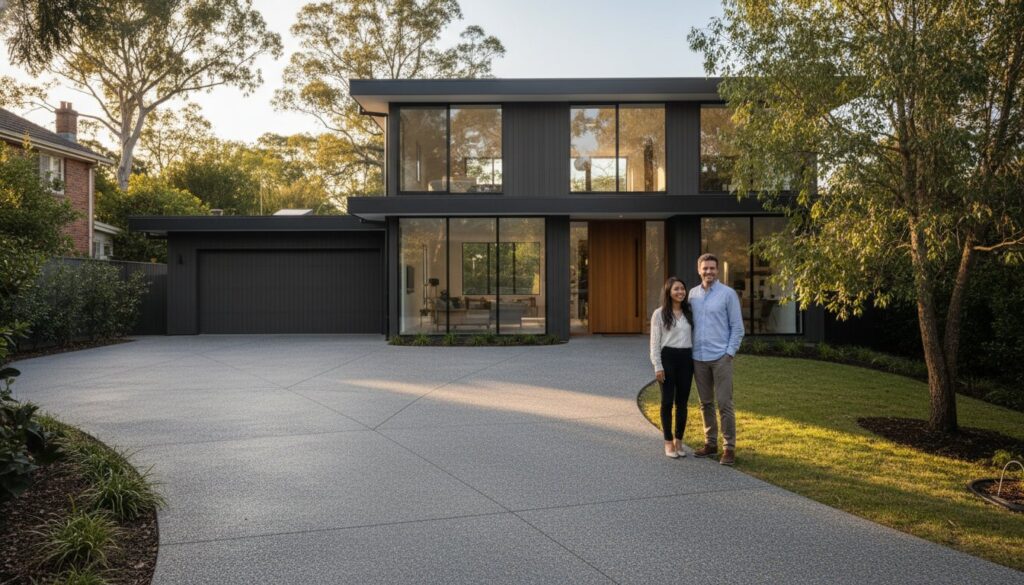
Most homeowners view a driveway as a simple utility, but in Sydney’s punishing reactive clay, it’s actually a high-performance structural element that is constantly under pressure. If you are tired of digging weeds out of paver joints or watching asphalt soften and scuff during a 40-degree January heatwave, you aren’t alone. You deserve a “set and forget” entrance that maintains its integrity without demanding your entire weekend for upkeep. Achieving a genuine low maintenance concrete driveway sydney residents can trust requires a precise blend of rugged engineering and refined craftsmanship.
We understand that a driveway should be a lasting investment in your property’s value, not a recurring chore. This guide promises to show you how to select materials and finishes specifically engineered to thrive in our local climate while resisting oil stains and UV fading for over 20 years. We will preview the most durable decorative options, from exposed aggregate to specialized sealants, and explain the essential sub-grade preparations needed to prevent cracking in Sydney’s unique soil conditions. It’s time to transform your home’s approach from a basic necessity into a lasting statement of quality and effortless curb appeal.
Key Takeaways
- Learn why specific decorative finishes like exposed aggregate outperform asphalt and gravel in Sydney’s high-heat and high-humidity environment.
- Discover how a low maintenance concrete driveway sydney homeowners invest in uses the “camouflage effect” to hide tyre marks and dust, keeping your curb appeal high with minimal effort.
- Identify why structural integrity begins beneath the surface, specifically how to engineer for Western Sydney’s reactive clay soils to avoid common cracking issues.
- Differentiate between “no maintenance” myths and “low maintenance” realities to ensure your surface remains pristine for over 20 years.
- Understand how custom concrete blends and architectural drafting can transform a standard driveway into a sophisticated design element that adds significant property value.
Defining ‘Low Maintenance’ for the Sydney Climate
True low maintenance isn’t a happy accident; it’s an engineering choice. For many homeowners, the dream of a low maintenance concrete driveway sydney project is driven by a desire to reclaim their weekends from the endless cycle of weeding, patching, and scrubbing. However, we must first dismantle the “zero maintenance” myth. No external surface exposed to the elements is entirely maintenance-free. Instead, a high-performance driveway is one that minimizes intervention by utilizing materials that naturally reject oil stains, inhibit weed growth, and maintain structural integrity against Sydney’s shifting soils. By choosing the right driveway materials from the outset, you transform a basic utility into a long-term asset that boosts property value for decades.
Sydney’s Weather Challenges: Heat, Rain, and Salt
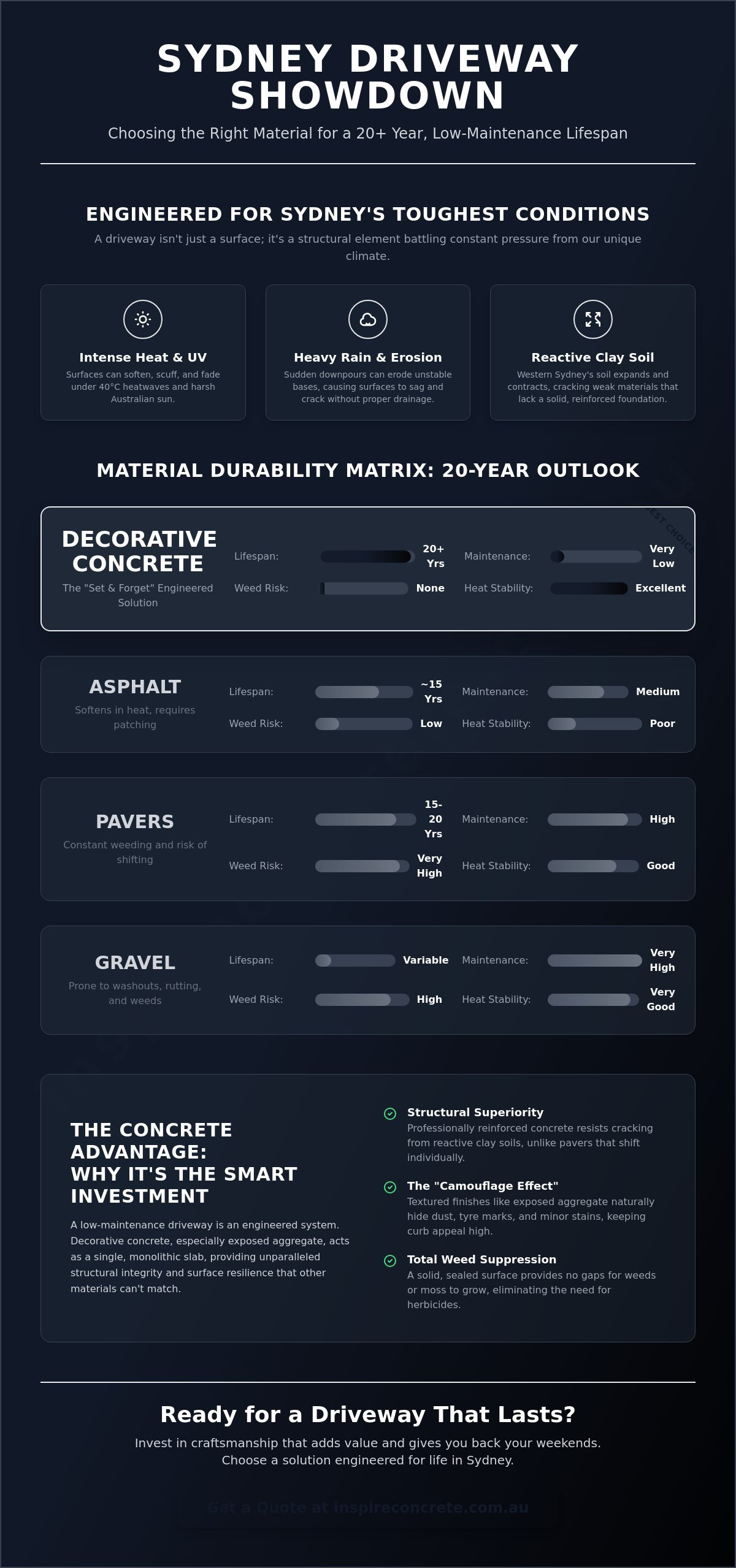
Our local climate is uniquely aggressive. During summer, intense UV radiation can cause inferior unsealed surfaces to fade and become brittle. When temperatures hit 40 degrees, lower-grade materials like asphalt often soften, leading to unsightly scuffing from power steering. We also face heavy coastal rain events that can dump significant volume in minutes. If a driveway isn’t engineered with a stable base and proper drainage, this water pressure erodes the sub-grade and causes the surface to sag or crack. A professional low maintenance concrete driveway sydney solution accounts for this thermal expansion and moisture movement, ensuring the surface remains flat and functional regardless of the season.
The True Cost of ‘Cheap’ vs. ‘Low Maintenance’
It’s easy to be seduced by a lower initial quote, but the total cost of ownership over 20 years tells a different story. “Cheap” options often come with hidden time costs. You might save money today, but you’ll spend it later on herbicides for weeds growing through paver joints or cold-patch kits for crumbling asphalt edges. These materials rarely survive the pressure of Western Sydney’s reactive clay soils without significant intervention.
In contrast, investing in high-end decorative concrete provides a “set and forget” solution. Experienced concreters Sydney residents trust will prioritize a reinforced slab that acts as a single, monolithic unit. This prevents the individual shifting that plagues paved surfaces. When you calculate the hours saved on maintenance and the lack of repair bills, the premium choice becomes the most economical one. The criteria for success are simple:
- Structural Stability: Resistance to cracking in reactive clay.
- Surface Density: Rejection of oil, grease, and tyre marks.
- UV Resilience: Colours that stay vibrant under the Australian sun.
- Weed Suppression: A solid surface that leaves no room for opportunistic seeds.
Comparing Popular Sydney Driveway Options
Selecting a surface for your home involves more than picking a colour from a brochure. It’s a strategic decision that dictates how much of your future free time you’ll spend on maintenance. While several options exist, they aren’t created equal when subjected to the Sydney environment. Many homeowners initially consider asphalt because it’s fast to lay, but it remains a flexible petroleum product. In the peak of a Sydney summer, this flexibility becomes a liability. The surface softens under 40-degree heat, leading to ruts, power-steering scuffs, and crumbling edges that require frequent patching.
Gravel and decomposed granite offer a rustic, high-end aesthetic, yet they are deceptively high-maintenance. They require constant raking to level out washouts after heavy rain and act as a magnet for airborne weed seeds. Similarly, brick and stone pavers are often marketed as a versatile choice. However, every gap between pavers is a potential home for weeds and moss, especially in Sydney’s humid coastal air. For a truly low maintenance concrete driveway sydney project, you need a material that acts as a single, unyielding unit rather than a collection of moving parts.
The Material Durability Matrix
When we look at the 20-year horizon, the performance gap between materials becomes undeniable. A standard asphalt surface typically reaches the end of its functional life at the 15-year mark, often appearing grey and brittle. A high-quality concrete installation easily exceeds 30 years with minimal intervention. Maintenance for concrete is predictable, usually requiring a professional clean and reseal every five years to maintain its lustre. Conversely, gravel and pavers demand annual attention to keep them looking presentable. On steep Sydney blocks, concrete provides superior traction and controlled water runoff that loose-fill materials simply cannot match.
The Failure Points of Traditional Paving
Traditional paving often fails because it ignores the reality of Western Sydney’s reactive clay. This soil expands and contracts with moisture changes, causing individual pavers to tilt or sink. This creates uneven surfaces and trip hazards. Additionally, the porous nature of paver joints invites moisture to sit, which encourages the growth of slippery moss and mould. A seamless concrete driveway eliminates these vulnerabilities. By creating a monolithic slab reinforced with steel mesh, the weight of your vehicle is distributed evenly. This prevents the “sinkholes” common in segmented systems. If you’re ready to move beyond the frustration of shifting pavers, a professional site assessment can reveal the best low maintenance concrete driveway sydney solution for your specific property layout.
The King of Low Maintenance: Exposed Aggregate & Decorative Concrete
While we’ve established that concrete is the superior structural choice, not all concrete finishes offer the same ease of care. In the pursuit of a truly low maintenance concrete driveway sydney homeowners can rely on, exposed aggregate driveways sit at the top of the hierarchy. This finish is achieved by removing the top layer of cement paste to reveal natural stones, pebbles, or crushed basalt. This isn’t just an aesthetic choice; it’s a functional one. The multi-tonal surface creates a “camouflage effect” that effectively hides the everyday dust, tyre marks, and minor oil drips that would be glaringly obvious on a plain grey slab. This means your home maintains its high-end curb appeal for weeks between washes without looking neglected.
For those who prefer the look of traditional stone or brick without the structural headaches of individual pavers, stencil and stamped concrete provide a sophisticated alternative. These methods allow us to replicate complex patterns while maintaining the monolithic strength of a single reinforced slab. Crucially, we utilize integral pigment technology for these designs. Unlike surface-applied paints that can chip or peel under the harsh Australian sun, integral colour is mixed through the entire depth of the concrete batch. If the surface ever sustains a minor chip, the colour remains consistent throughout, ensuring the visual integrity of your driveway stays intact for decades without the need for touch-ups.
Why Exposed Aggregate Wins on Maintenance
Exposed aggregate is inherently more durable than standard smooth-finished concrete. The natural stones on the surface are significantly harder and more wear-resistant than the cement paste itself. This makes the surface nearly immune to the “polishing” effect often seen in high-traffic areas where tyres repeatedly travel over the same path. Additionally, the texture provides permanent, built-in slip resistance. You don’t need to worry about adding abrasive sand or grit to your sealer every few years to keep the surface safe during a Sydney downpour. It is a rugged, hardworking finish that rewards the homeowner with effortless elegance and long-term value.
2026 Sealing Technology: Protecting Your Investment
The secret to a “set and forget” driveway in 2026 lies in the latest advancements in chemical sealing. While older topical sealers acted like a plastic film that could yellow or peel, modern penetrating sealers chemically bond with the concrete capillaries. These UV-stable resins are specifically engineered for the Sydney climate, preventing the chalking effect caused by extreme heat. By creating a hydrophobic barrier, these sealers ensure that oil, grease, and tannin stains from fallen leaves cannot penetrate the pores. This makes high-pressure cleaning up to 50% faster, as dirt sits on the surface rather than becoming embedded. Investing in a high-grade sealer today means your driveway won’t just last; it will look brand new with a simple annual rinse.
Structural Integrity: Why Maintenance Starts Below the Surface
A high-end surface is worthless if the foundation fails within three years. While many believe that all concrete eventually cracks, the truth is that structural failure is almost always a result of poor engineering rather than a flaw in the material itself. Achieving a truly low maintenance concrete driveway sydney residents can rely on starts with understanding the ground we build on. Western Sydney is notorious for its highly reactive clay soils. This soil acts like a sponge; it expands significantly when wet and shrinks during long dry spells. Without proper sub-grade preparation, this constant movement puts immense pressure on the concrete, leading to the deep, structural cracks that every homeowner fears.
To combat this, we focus on the invisible features that define longevity. This includes specifying a concrete thickness of 100mm to 125mm using N25 or N32 grade concrete, reinforced with SL72 or SL82 steel mesh. These specifications aren’t just suggestions; they are the backbone of a slab that remains level and intact for over 20 years. We also integrate strategic expansion joints. These allow the slab to “breathe” during Sydney’s extreme temperature swings, preventing the internal stress that causes uncontrolled cracking. By managing these forces below the surface, we ensure your driveway remains a “set and forget” asset.
Soil Analysis and Sub-Grade Preparation
Every successful low maintenance concrete driveway sydney project begins with the earth. A standard concrete slab requires a perfectly compacted base to prevent “hollow spots” from forming. If the soil is loose or poorly drained, water can seep underneath and wash away the sub-grade. This leads to sagging and eventual breakage. Our standard involves rigorous base density testing and moisture control. We ensure the ground is stabilized before a single litre of concrete is poured, creating a platform that resists the shifting nature of Sydney’s reactive clay. If you are planning a project on a site with challenging soil, you can request a site-specific structural assessment to ensure your foundation is built to last.
Cracking vs. Crazing: Understanding Concrete Behaviour
It’s vital for homeowners to distinguish between different types of surface changes. Structural cracks are deep, wide gaps that indicate a failure in the sub-grade or reinforcement. These are the expensive failures we work to prevent through superior engineering. In contrast, “crazing” refers to fine, hairline surface checks that sometimes appear during the curing process. These are typically aesthetic and don’t compromise the slab’s strength. By following professional placement and curing protocols, such as controlled hydration, we significantly reduce the risk of both. Choosing a quote based solely on the lowest price often means sacrificing these critical curing steps, leading to much higher maintenance costs in the future.
The Inspire Concrete Approach: Longevity Through Craftsmanship
Building a high-performance entrance is an exercise in precision that extends far beyond the surface. When we deliver a low maintenance concrete driveway sydney homeowners can rely on, we are blending architectural drafting with over 20 years of hands-on site experience. This localized expertise allows us to anticipate how a specific slope or soil type will behave over decades. Our end-to-end process is meticulous, managing everything from expert excavation and sub-grade compaction to the application of the final chemical seal. This holistic control ensures that the structural integrity of your slab is never compromised by third-party guesswork.
We recognize that not every project requires a completely new pour. For properties with structurally sound but aesthetically dated slabs, concrete resurfacing Sydney residents often select can be a transformative solution. This specialized process applies a high-strength, polymer-modified coating over your existing concrete, providing a fresh decorative finish that is engineered to resist UV fading and tyre scuffing. Whether we are starting from bare earth or revitalizing an old surface, the goal remains the same: creating a “set and forget” result that reflects your pride in your home.
Design-Led Durability
True luxury lies in the details. We offer custom aggregate blends that allow you to hand-pick stone colours and sizes that complement your home’s specific architectural style. This isn’t just about looks; it’s about matching textures to the functional needs of your property. For instance, we integrate drainage solutions like subtle spoon drains or decorative grates so they function as premium design features rather than afterthoughts. One project we completed in Western Sydney over 10 years ago stands as a testament to this approach. Despite a decade of heavy vehicle traffic and extreme heat, the surface remains free of structural repairs, proving that superior craftsmanship is the ultimate maintenance-saver.
Getting Your Project Started
The journey toward a master-crafted driveway begins with a professional on-site consultation. This is where we assess the technical realities of your block, including slope, drainage, and soil reactivity. We also guide you through the complexities of local regulations. In New South Wales, constructing or modifying a driveway crossover typically requires Section 138 approval from your local council. We help you navigate these requirements to ensure your low maintenance concrete driveway sydney project complies with Australian Standard AS/NZS 2890.1:2004. To move beyond the frustration of high-maintenance surfaces and realize a creative vision that lasts for 20+ years, contact Inspire Concrete to book your assessment.
Secure Your Property’s Future with Expert Engineering
Your driveway is the first thing guests see and the last thing you should worry about. We have explored how the right material choice, such as exposed aggregate, combined with rigorous sub-grade engineering, provides the only real defense against Sydney’s reactive clay and intense UV cycles. By prioritizing structural integrity and modern sealing technology, you aren’t just buying a slab; you are investing in two decades of reclaimed weekends and sustained property value. It’s the difference between a temporary utility and a permanent architectural asset.
Achieving a genuine low maintenance concrete driveway sydney residents can take pride in requires a partner who understands the intersection of trade expertise and design vision. As licensed and insured master concreters with over 20 years of Sydney industry experience, we specialize in high-durability decorative finishes that stand the test of time. It’s time to move beyond the cycle of constant repairs and choose a surface that reflects the quality of your home. Transform your property with a low-maintenance masterpiece from Inspire Concrete. Our team is ready to help you realize a creative vision that remains pristine for years to come.
Frequently Asked Questions
What is the absolute lowest maintenance driveway material in Sydney?
Exposed aggregate concrete is widely considered the absolute lowest maintenance option for Sydney properties. Its multi-tonal stone surface naturally camouflages tyre marks and dust, while the monolithic concrete slab prevents the weed growth common in paved systems. Unlike asphalt which requires patching or pavers that shift over time, a well-engineered aggregate driveway remains functional and visually striking for over 20 years with only periodic cleaning and sealing.
How often do I need to seal an exposed aggregate driveway?
You should generally plan to reseal your exposed aggregate surface every 3 to 5 years. This timeframe ensures the protective barrier remains effective against oil penetration and UV-induced fading. High-traffic areas or driveways with full northern sun exposure might require attention closer to the 3-year mark, while shaded residential paths often maintain their lustre for the full 5-year cycle without intervention.
Can I make my existing concrete driveway low maintenance?
Yes, you can significantly reduce the upkeep of an existing slab through professional concrete resurfacing. If your current driveway is structurally sound but looks tired, applying a high-strength decorative coating creates a non-porous surface that rejects stains. For slabs in good condition, a professional deep clean followed by the application of a modern penetrating sealer will prevent dirt from embedding in the concrete pores.
Does asphalt or concrete last longer in the Sydney heat?
Concrete is the clear winner for longevity in the intense Sydney heat. While asphalt is a flexible petroleum product that can soften and rut when temperatures exceed 35 degrees, concrete is a rigid structural material that remains stable. This heat resistance prevents power-steering scuffs and surface deformations, ensuring your low maintenance concrete driveway sydney investment maintains its flat, even profile for decades longer than asphalt alternatives.
How do I prevent weeds from growing in my driveway?
The most effective way to prevent weeds is to install a solid, reinforced concrete slab rather than segmented pavers or loose gravel. Weeds thrive in the sand-filled joints of pavers and the gaps in stone. By choosing a seamless decorative finish, you eliminate the environment where seeds can germinate. If you have existing concrete, ensuring that any expansion joints are correctly filled with flexible mastic will further block opportunistic growth.
Is exposed aggregate more expensive to maintain than plain concrete?
Maintaining an exposed aggregate surface is often simpler than caring for plain concrete. While both require similar sealing intervals, the textured, multi-coloured finish of aggregate is far superior at hiding everyday grime and minor spills. Plain concrete shows every tyre mark and oil drip, often requiring more frequent high-pressure washing to look presentable. In the long term, the “camouflage” effect of aggregate saves you significant cleaning time.
Will my driveway crack if I have reactive clay soil?
Cracking is not inevitable in reactive clay, provided the driveway is engineered for those specific conditions. We prevent structural failure by using thicker slabs, increased steel mesh reinforcement, and a perfectly compacted sub-base. These invisible features allow the slab to move as a single unit or flex at controlled expansion joints, protecting your low maintenance concrete driveway sydney from the ground movement typical in Western Sydney and coastal areas.
How long after pouring a low-maintenance driveway can I drive on it?
You can typically walk on your new concrete surface within 24 to 48 hours after the pour. However, you must wait at least 7 to 10 days before driving a standard passenger vehicle onto the slab. Concrete takes 28 days to reach its full design strength, so avoiding heavy loads during the first week is critical to prevent early-stage structural stress or surface marking while the material cures.
