
The most affordable quote for your new entrance might actually be the most expensive mistake you’ll make this decade. It’s a common dilemma for Sydney homeowners who find themselves caught between the timeless texture of stone and the structural versatility of modern concrete. You’re likely weighing the pavers vs concrete driveway cost sydney market rates while worrying about Western Sydney’s reactive clay soils causing unsightly cracks. We understand that frustration. You want a surface that survives the heat and enhances your home’s silhouette without becoming a maintenance nightmare.
This guide provides a definitive breakdown of how these materials perform under real-world conditions. We’ll explore the upfront investment required for various finishes, from sophisticated exposed aggregate to traditional paving, while addressing the long-term reality of weed growth and structural shifts. You’ll gain a clear understanding of which choice delivers the best curb appeal for future resale and how to navigate the 2026 council regulations for a seamless transformation. By the end, you’ll have the technical certainty needed to choose a driveway that balances refined craftsmanship with lasting value.
Key Takeaways
- Identify the true financial breakdown of pavers vs concrete driveway cost sydney by evaluating excavation needs and narrow-site access challenges.
- Learn why concrete slabs offer superior load distribution and stability against Western Sydney’s notorious reactive clay soils.
- Compare the long-term maintenance demands of each material, including the impact of Sydney’s humidity on mould growth and joint integrity.
- Discover how modern finishes like exposed aggregate provide the aesthetic elegance of natural stone with the structural performance of concrete.
- Determine the “Best Value” winner for your property based on traffic volume, resale goals, and specific architectural styles.
Upfront Installation Costs: Pavers vs Concrete in Sydney
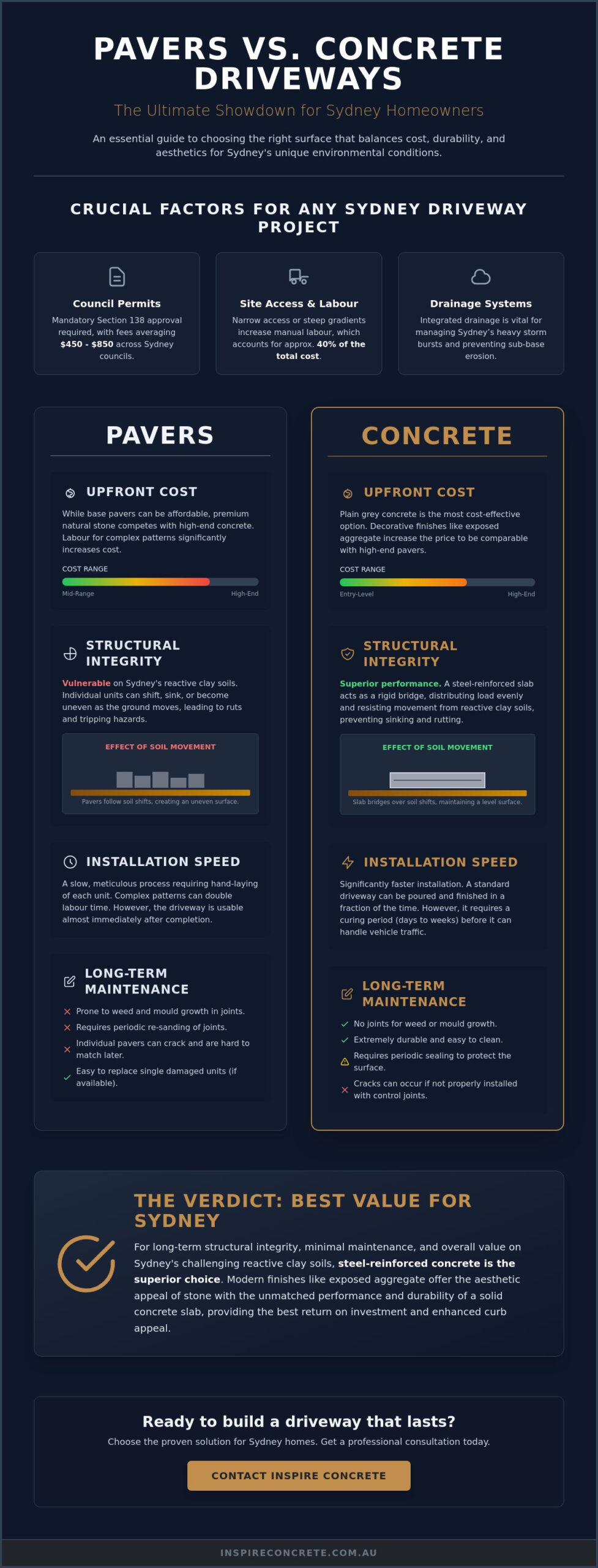
Budgeting for a new driveway in Sydney requires more than just a glance at material tags. You’re investing in a structural asset that must withstand the city’s unique geographical demands. Labor typically accounts for approximately 40% of your total project cost, covering the intensive work of excavation and sub-base preparation. In suburbs with narrow street access or steep gradients, these costs can shift quickly. If machinery can’t easily reach your backyard or side passage, the manual labor required to move materials increases the timeline and the quote. Understanding the pavers vs concrete driveway cost sydney landscape means looking at the total package, including the mandatory Section 138 approval from your local council. These permit fees currently average between $450 and $850 across major Sydney metropolitan councils, a necessary step before any work begins on the verge or vehicle crossing.
Many homeowners fall for the price parity myth, assuming concrete is always the budget choice while pavers are exclusively premium. The reality is more nuanced. While plain concrete represents the most cost-effective entry point, high-end decorative finishes often sit in the same investment bracket as quality brick or stone pavers. When evaluating your options, consider the base requirements. A poured concrete base for a 50sqm site is a more significant upfront investment than a crushed rock base, yet it provides the rigid foundation necessary to prevent sinking. While some may consider alternatives like What is Asphalt Concrete? for large-scale commercial areas, residential projects in Sydney thrive on the durability and aesthetic flexibility of reinforced concrete and stone.
The Price Per Square Metre Breakdown
Pricing follows a clear hierarchy based on the complexity of the finish and the preparation involved. Plain concrete remains the baseline for level surfaces, while sloping sites require additional structural considerations that increase the rate. Coloured and stamped options sit in the mid-tier, providing a significant aesthetic lift for a moderate increase in material cost. At the premium end, exposed aggregate driveways and natural stone pavers like granite or bluestone offer the highest level of refinement. Don’t forget to account for “hidden” essentials such as SL72 steel reinforcement and integrated drainage systems, which are vital for managing Sydney’s heavy storm bursts.
Labour and Time: Which Installation is Faster?
Efficiency is where these two materials diverge most sharply. A professional concrete team can pour and finish a standard residential driveway in a fraction of the time it takes to hand-lay thousands of individual pavers. Concrete is a continuous, action-oriented process, though it’s at the mercy of Sydney’s weather. Rain can delay a pour, and the surface requires a specific curing window before it’s ready for vehicle traffic. Paving is a game of manual precision. Complex patterns, such as herringbone or basketweave, can effectively double the labor component of your quote compared to a simple stretcher bond. While pavers are ready for use almost immediately after the joint sand is swept, the weeks of meticulous labor required for large areas often make concrete the faster path to a finished transformation.
Structural Integrity: Sydney’s Reactive Clay and Soil Movement
Sydney’s geological profile presents a significant hurdle for any driveway project. While homeowners often focus on the aesthetic pavers vs concrete driveway cost sydney debate, the real battle happens beneath the surface. Western Sydney is dominated by reactive clay soils. These soils behave like a sponge, expanding significantly when saturated and contracting during intense summer dry spells. This constant shifting creates immense pressure on your driveway. A rigid concrete slab acts as a unified bridge, distributing the weight of your vehicles across a wider area. In contrast, individual pavers rely entirely on the sub-base to remain level. When the clay beneath moves, pavers often follow, leading to uneven surfaces and unsightly rutting where your tyres frequently travel.
When researching concrete driveway costs, it’s vital to factor in the engineering required to counter this soil movement. The choice between materials often comes down to how you prefer to handle failure. Concrete is designed to resist movement. If it does fail, it typically shows as a crack. However, modern techniques using expansion joints and steel reinforcement significantly mitigate this risk. Pavers fail by sinking or spreading. While you can lift and relay them, the labor cost often rivals the original installation. Ensuring your project begins with a professional site assessment is the first step toward a durable concrete transformation that stands the test of time.
Managing Soil Movement in Western Sydney
Local builders understand that stability starts with the foundation. Much like constructing house slabs, a driveway requires a meticulously compacted sub-base to survive reactive clay. While some argue that pavers self-heal by shifting without cracking, this movement often results in trip hazards and pooling water. A professionally installed concrete driveway utilizes strategically placed expansion joints. These gaps allow the material to breathe and move during Sydney’s 40 degree days without losing structural integrity or causing the surface to buckle.
Load Bearing Capacity for Modern Families
Today’s driveways carry more weight than ever before. With the rise of heavy Electric Vehicles (EVs) and large family SUVs, the load bearing capacity of your surface is non-negotiable. The Sydney standard for residential durability is 100mm of reinforced concrete. This thickness, combined with internal steel mesh, provides a high PSI rating that individual pavers struggle to match over time. While high density pavers are strong in isolation, they lack the monolithic strength of a slab, making them more prone to sinking under the concentrated pressure of heavy vehicle axles.
Maintenance and the 10-Year Ownership Cost
The initial quote for your driveway is only the first chapter of its financial story. Over a decade, the “invisible” costs of upkeep can significantly alter the pavers vs concrete driveway cost sydney comparison. While pavers offer a modular charm, they demand consistent intervention to remain pristine. In contrast, a monolithic concrete surface is engineered for a “set and forget” lifestyle. Adhering to the CCAA residential pavement guidelines ensures your installation minimizes these long-term burdens by specifying correct drainage and jointing from day one. By 2036, the difference in maintenance hours and professional cleaning fees often makes the choice clear for the time-poor Sydney homeowner.
Total cost projections must account for the reality of Sydney’s climate. Our city’s high humidity and intense storm cycles act as catalysts for wear. Pavers are notoriously susceptible to joint erosion, where the sand between the blocks washes away, requiring periodic re-sanding to prevent the units from shifting. Concrete avoids this structural vulnerability. While a concrete driveway typically lasts 25 to 30 years compared to the potential 50-year lifespan of high-end pavers, the effort required to reach that half-century mark with pavers involves significantly more manual labor and recurring expenses. Choosing concrete is an investment in your weekends as much as your property value.
The Battle Against Weeds and Pests
Paver joints are essentially small ecosystems. They trap organic matter and moisture, inviting weeds and ant colonies that can eventually undermine the sub-base. This leads to an endless cycle of spraying and pulling. A single, continuous concrete slab provides no foothold for pests or vegetation. It delivers a clean, architectural finish that stays sharp without chemical intervention. For those seeking a sophisticated look with minimal fuss, a sealed concrete surface offers the perfect balance of aesthetic transformation and rugged durability.
Cleaning and Resurfacing Options
Maintenance isn’t just about repairs; it’s about preserving the creative vision of your home. Professional concrete cleaning and sealing every few years protects the surface from oil stains and UV degradation. This process is far more efficient than pressure washing individual pavers, which can accidentally dislodge the jointing sand and create more work. If you’re looking to refresh an older property, concrete resurfacing in Sydney offers a cost-effective way to modernize your curb appeal without a full tear-out. Patching a concrete crack is a precise, technical procedure that maintains the slab’s integrity, whereas replacing broken pavers often results in a mismatched “patchwork” look due to different weathering patterns between old and new batches.
Aesthetic Value: Curb Appeal and Property Resale
A driveway is often the first architectural element a visitor or potential buyer notices. In the competitive Sydney property market, your choice significantly impacts the final valuation. While homeowners frequently focus on the immediate pavers vs concrete driveway cost sydney, the long-term return on investment (ROI) through curb appeal is where the real value lies. Real estate professionals across the North Shore and the Hills District increasingly favor modern concrete finishes for their ability to create a seamless, high-end look that complements contemporary Australian architecture. Unlike traditional paving, which can feel cluttered or dated, concrete allows for fluid curves and expansive, unbroken transitions that lead the eye toward the home’s entrance.
This architectural flexibility is a primary reason why many choose reinforced slabs over modular blocks. You can customize the texture and tone to match your home’s facade perfectly, whether you’re aiming for a minimalist modernist aesthetic or a more textured, organic feel. A well-executed driveway doesn’t just provide utility; it acts as a frame for your entire property. If you’re ready to elevate your home’s exterior, exploring a custom concrete transformation ensures your property stands out in any streetscape.
Modern Concrete Finishes
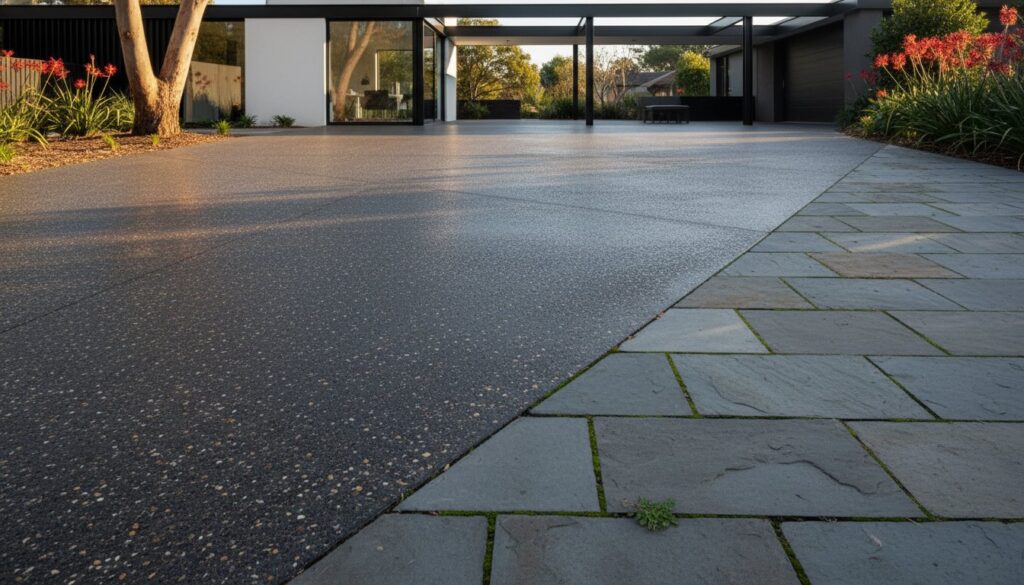
- Exposed aggregate: These exposed aggregate driveways offer a premium “stone” aesthetic by revealing the natural beauty of internal stones and pebbles. It provides the texture of natural stone with the structural permanence of a single slab, removing the risk of loose stones.
- Stencil and stamped concrete: These techniques allow you to mimic the intricate patterns of slate, cobblestone, or brick. You gain the classic visual appeal without the risk of individual pieces shifting or weeds invading the joints as discussed in previous sections.
- Coloured concrete: Integrating charcoal, sand, or deep earth tones directly into the mix ensures a consistent finish. It’s a popular choice for modernizing older Sydney homes, providing a sleek, monochromatic base that resists the “patchy” look of weathered budget pavers.
Paver Design Patterns
Paving offers a different set of design rules, primarily dictated by the “lock” of the pattern. Herringbone is the gold standard for structural integrity in driveways, as the interlocking angles prevent pavers from moving under the torque of turning tyres. Stretcher bond is simpler but lacks this mechanical bond, often leading to shifting over time. For luxury residential properties, a “French Pattern” utilizes mixed sizes to create a sophisticated, old-world look. The primary aesthetic challenge with pavers remains the potential for colour fading in budget concrete versions. While natural stone maintains its hue, lower-tier pavers can lose their vibrancy within a few years, potentially detracting from your home’s resale value compared to the enduring finish of high-quality decorative concrete.
The Verdict: Choosing the Right Surface for Your Sydney Home
Deciding on the ultimate surface for your entrance requires a balance of financial logic and architectural vision. When evaluating the pavers vs concrete driveway cost sydney, the “Best Value” winner for high-traffic family homes is undeniably reinforced concrete. Its ability to act as a monolithic slab ensures it remains level under the weight of multiple SUVs and EVs, especially in Western Sydney’s reactive clay zones where individual pavers often succumb to soil movement. For luxury residential properties in the Hills District or the North Shore, the “Aesthetic” winner is often exposed aggregate. It provides the sophisticated, multi-tonal texture of natural stone while retaining the structural permanence and low-maintenance profile of a professional concrete pour.
Your specific suburb’s soil profile should be the deciding factor in this transformation. While heritage suburbs with stable sandstone foundations might accommodate the shifting nature of pavers, the shifting clays of the Sydney Basin demand the rigidity of a slab. Before you sign any contract, use this final checklist when interviewing concreters in Sydney to ensure your investment is protected:
- Does the quote include the mandatory Section 138 council permit fees and application assistance?
- What grade of steel reinforcement is specified to handle your specific vehicle loads?
- How will the drainage plan manage Sydney’s heavy storm bursts to prevent sub-base erosion?
- If your block is sloped, does the design adhere to the 25% maximum gradient specified in Australian Standard AS 2890.1?
When to Choose Concrete
Professional concrete driveways are the standard for modern Sydney new builds for several reasons. They are the superior choice for sloped blocks where water runoff can easily dislodge the bedding sand of pavers. If you prefer a “set and forget” lifestyle, concrete’s resistance to weeds and pests makes it the logical path. It offers a clean, seamless transition that enhances contemporary facades and provides a durable surface that can last 30 years with minimal intervention beyond periodic sealing.
When to Choose Pavers
Pavers remain a classic choice for heritage Sydney suburbs where maintaining a traditional aesthetic is paramount. They offer a unique “Permeable” advantage for sensitive sites that require natural water infiltration to manage runoff. The primary functional benefit of pavers is utility access; if you have underground pipes or cables that may require future maintenance, you can lift and relay individual units without leaving a visible scar. While they require more frequent attention to manage joint sand and weeds, natural stone pavers provide a timeless elegance that some homeowners find worth the extra labor.
Secure Your Property’s Future with a Master-Built Entrance
Your choice between materials defines more than just the look of your home; it dictates the structural legacy of your property. We’ve explored how the pavers vs concrete driveway cost sydney debate shifts when you factor in Western Sydney’s reactive soils and the hidden maintenance of porous joints. While pavers offer a modular look, high-performance concrete delivers a seamless, architectural finish that effectively eliminates the battle against weeds and sinking. Investing in a reinforced slab is a commitment to long-term value and structural certainty that withstands the city’s unique environmental challenges.
With over 20 years of Sydney industry experience, our team of licensed and insured local craftsmen specializes in transforming basic utility into refined artistry. We are specialists in architectural exposed aggregate, ensuring your new surface provides both rugged durability and sophisticated elegance. We take pride in every pour, balancing technical engineering with a meticulous eye for detail. Request a professional concrete quote for your Sydney driveway and take the first step toward a lasting transformation. Your home deserves a foundation built on precision and passion. Let’s build a result that withstands the elements and enhances your lifestyle for decades to come.
Driveway Selection: Frequently Asked Questions
Is a concrete driveway cheaper than pavers in Sydney for 2026?
Plain concrete remains the most cost-effective starting point for Sydney homeowners. While the pavers vs concrete driveway cost sydney comparison shows that basic concrete is typically more affordable upfront, premium decorative finishes like stencilled or exposed aggregate often align with the price of high-quality pavers. The total investment depends heavily on your choice of finish and the complexity of your site’s excavation needs.
Can I lay pavers over an existing concrete driveway to save money?
You can lay pavers over existing concrete, but it’s rarely the most efficient solution for long-term value. This method increases the driveway’s height, which often creates structural issues with garage thresholds and surface water drainage. A more durable transformation involves professional concrete resurfacing or a complete replacement to ensure the foundation is structurally sound for another thirty years.
Which driveway material handles the Sydney summer heat better?
Natural stone pavers and lighter-toned decorative concrete are the best performers in the intense Sydney summer. Darker materials absorb more UV radiation, becoming uncomfortable underfoot during 40-degree days. Exposed aggregate is a particularly effective choice; the varied textures of the embedded stones help dissipate heat more efficiently than a solid, dark-coloured pavement.
Do pavers add more value to a house than an exposed aggregate driveway?
Modern exposed aggregate driveways frequently rival or exceed the resale value added by traditional pavers. Sydney real estate agents value the clean, architectural lines and low-maintenance appeal of high-end concrete. While stone pavers offer a heritage charm, the “set and forget” nature of a sealed, reinforced slab is a major selling point for contemporary buyers seeking curb appeal without the constant weeding.
How long does a concrete driveway last compared to a paved one in Sydney?
A professionally installed concrete driveway typically lasts between 25 and 30 years, while a well-maintained paver driveway can exceed 50 years. However, this longevity comes with a trade-off. Reaching the half-century mark with pavers requires regular re-sanding and weed management, whereas concrete provides a reliable, structurally stable surface for decades with significantly less manual intervention.
What is the best driveway for Western Sydney’s reactive clay soil?
Reinforced concrete slabs are the gold standard for navigating Western Sydney’s reactive clay soils. The monolithic nature of a 100mm reinforced slab allows the driveway to bridge soil movement, distributing heavy vehicle loads evenly. Individual pavers are far more susceptible to the expansion and contraction of the clay, which often results in uneven surfaces and trip hazards over time.
Does a concrete driveway require council approval in Sydney?
Yes, you must obtain council approval before starting any driveway construction or modification in Sydney. This is typically a Section 138 approval from your local council or Transport for NSW. This process ensures your driveway meets safety standards for gradients and sight lines, and it’s required regardless of whether you choose pavers or concrete.
How often do I need to seal my driveway in the Sydney climate?
We recommend sealing your driveway every 2 to 3 years to combat Sydney’s humidity and intense UV exposure. Regular sealing protects your investment from oil penetration, tyre marks, and mould growth. This simple maintenance step preserves the vibrant colour and structural integrity of your surface, ensuring your creative vision remains sharp year after year.
