
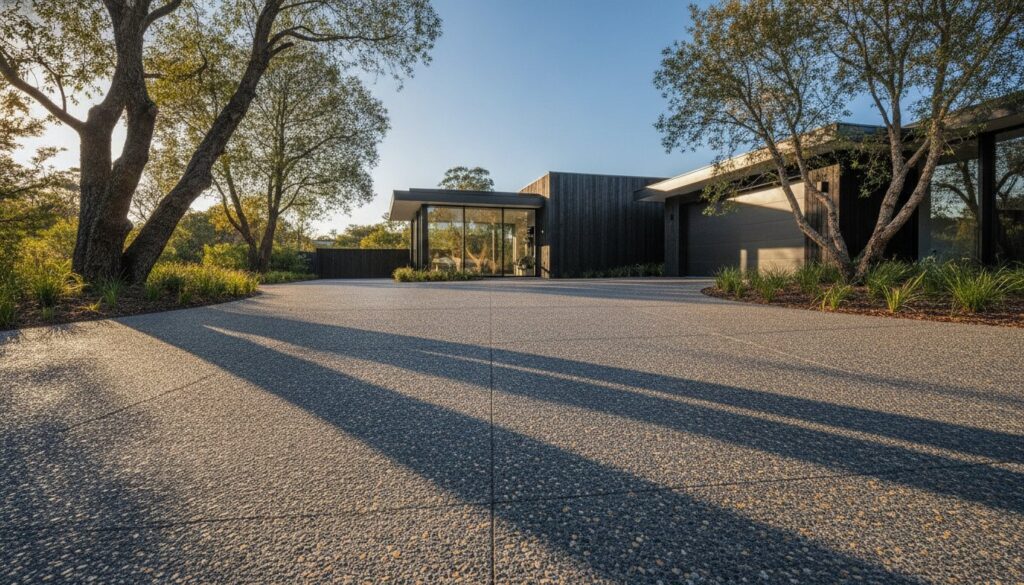
A driveway isn’t just a functional path for your vehicle. It is a structural foundation that must survive Sydney’s aggressive reactive clay soils and punishing UV exposure every single day. Many homeowners invest heavily in their property only to watch their entryways succumb to deep cracks or heat induced softening within a few short years. If you are searching for the most durable driveway material sydney can provide, the answer lies in a blend of high grade engineering and refined craftsmanship. We know you want a result that adds genuine property value while remaining structurally sound for over two decades.
We believe a driveway should be a permanent asset, not a recurring maintenance bill. This 2026 longevity guide identifies the most resilient materials capable of withstanding Sydney’s unique environmental pressures without structural failure. You’ll learn why 32MPa concrete is the professional standard for stability and how expert sub-grade preparation prevents shifting. We will also explore why finishes like exposed aggregate offer the perfect intersection of rugged durability and sophisticated design, ensuring your home’s first impression remains flawless for 20 plus years.
Key Takeaways
- Understand how Sydney’s reactive clay soils and intense UV exposure demand specific engineering to prevent structural failure.
- Identify reinforced concrete as the most durable driveway material sydney offers for those seeking a 20 plus year structural lifespan.
- Learn why 32MPa concrete strength and strategic steel reinforcement are the non-negotiable standards for resisting heavy vehicle loads.
- Discover why exposed aggregate is the premier choice for combining high slip resistance with a resilient, UV stable finish.
- Gain insights into the critical role of expert sub-grade preparation in protecting your property’s long term value.
Why Sydney Soil and Climate Dictate Your Driveway’s Durability
Sydney’s landscape presents a unique set of challenges that can destroy a standard driveway in less than a decade. For a surface to be considered the most durable driveway material sydney homeowners can rely on, it must withstand intense environmental pressure. Durability isn’t just about surface hardness; it is the structural capacity to resist cracking, abrasion, and subsidence for 20 plus years. In our region, this means surviving the constant push and pull of the earth itself while maintaining a pristine aesthetic.
Coastal properties face the added burden of salt air, which can accelerate the degradation of certain driveway materials and internal steel reinforcements if not managed correctly. Meanwhile, the “Heat Island” effect in Western Sydney regularly pushes summer temperatures above 40 degrees Celsius. These extreme conditions cause significant thermal expansion, forcing materials to grow and shrink rapidly. Without the right engineering and material choice, this cycle leads to permanent structural damage and costly repairs.
Sydney’s Reactive Clay Soil: The Silent Driveway Killer
Reactive clay is a dominant feature of the Sydney basin, particularly in the western and northern suburbs. This soil acts like a sponge; it expands significantly during heavy rain cycles and contracts during dry spells. This constant movement creates “voids” or hollow pockets beneath the pavement. If a driveway lacks the structural integrity to bridge these voids, it will inevitably sag, shift, and snap under the weight of a vehicle.
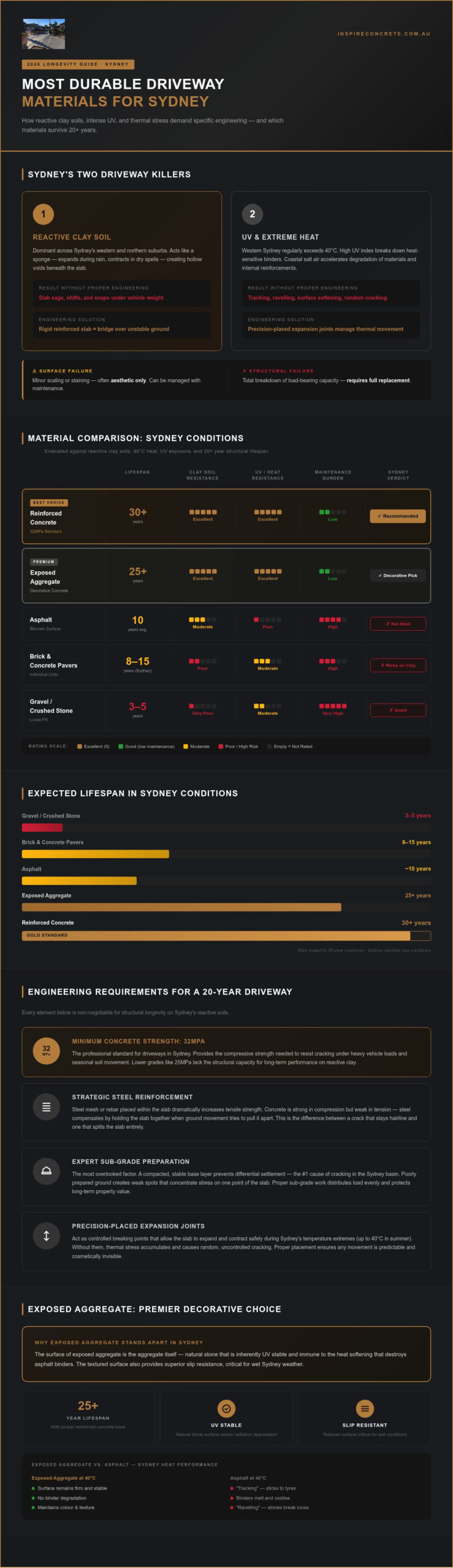
There is a critical distinction between surface failure and structural failure in Sydney homes. Surface failure might involve minor scaling or staining, which is often aesthetic. Structural failure is a total breakdown of the slab’s load-bearing capacity. To prevent this, we prioritise rigid, reinforced slabs that distribute weight evenly. This engineering approach ensures the driveway remains a stable asset regardless of what the soil is doing underneath, effectively turning your driveway into a bridge over unstable ground.
UV Resistance and Thermal Expansion
Sydney’s high UV index is a primary enemy of long term longevity. In petroleum-based materials like asphalt, intense radiation breaks down the binders that hold the aggregate together. This leads to “tracking,” where the surface softens in the heat and sticks to tyres, or “ravelling,” where the stones begin to break loose and wash away. This degradation is why many asphalt driveways in Sydney require resurfacing far sooner than their concrete counterparts.
Concrete offers a superior alternative because it doesn’t rely on heat-sensitive binders that melt or oxidise. However, large pours require precision-placed expansion joints to manage thermal movement. These joints act as controlled breaking points, allowing the slab to expand during a 40-degree January day without cracking randomly. Reactive soil is the primary cause of driveway failure in Sydney. By choosing the most durable driveway material sydney conditions demand, you ensure your investment survives both the scorching sun and the shifting soil.
Comparing the Most Durable Driveway Materials for 2026
Selecting the right surface requires looking beyond immediate kerb appeal. It demands a material that can bridge the volatile movement of Sydney’s earth while resisting the intense degradation of our climate. When evaluating the most durable driveway material sydney can offer, we must measure performance against structural longevity, maintenance cycles, and total cost of ownership. While several options exist, they don’t all possess the engineering profile required to survive 20 plus years on reactive ground.
Reinforced concrete remains the undisputed gold standard for structural integrity. Unlike flexible pavements, a properly engineered slab acts as a single, rigid unit that distributes vehicle loads across a wider area. This is essential for preventing the subsidence common in suburbs with heavy clay deposits. Asphalt, while popular for its lower initial cost and rapid installation, is a thermoplastic material. This means it softens during Sydney’s 40 degree summer days, leading to “tracking” and permanent deformation under the weight of parked cars.
Brick and concrete pavers provide a classic aesthetic, but they often fail in the Sydney basin because they lack a continuous structural backbone. In reactive soil, these individual units shift independently as the ground breathes, leading to uneven surfaces, trip hazards, and persistent weed growth between joints. Gravel and crushed stone are the least durable options; they lack any structural load-bearing capacity and require constant replenishment as they wash away during heavy East Coast Low rain events.
The Structural Performance Matrix
To understand long term value, you must compare how these materials age over decades rather than months. A high quality most durable driveway material sydney solution should require minimal intervention to maintain its structural and aesthetic properties. Adhering to NSW driveway construction standards ensures that your choice meets the necessary safety and engineering benchmarks for residential use.
- Reinforced Concrete: 25 to 30+ year lifespan. Requires occasional sealing but maintains structural levels.
- Asphalt (Bitumen): 10 to 15 year lifespan. Susceptible to UV oxidation and requires periodic resurfacing.
- Pavers: 15 to 20 year lifespan. Prone to individual unit shifting and requires regular re-sanding of joints.
- Gravel: 1 to 3 year lifespan. High maintenance with no resistance to erosion or heavy loads.
Total Cost of Ownership Over 20 Years
Smart property owners look at the “price per year” rather than just the initial quote. Investing in a premium concrete driveway might carry a higher upfront cost, but it eliminates the need for the expensive resurfacing cycles that asphalt requires every decade. It also avoids the labour intensive repairs needed to level sunken pavers. In the Sydney real estate market, a pristine, structurally sound driveway is a significant asset that directly influences property resale value. If you’re ready to transform your entry with a permanent solution, our team can help you design a custom engineered slab tailored to your site’s specific soil profile.
Why Exposed Aggregate is Sydney’s Most Durable Decorative Option
Exposed aggregate is widely regarded as the most durable driveway material sydney homeowners can choose when balancing high-end aesthetics with raw performance. While we have established that reinforced concrete provides the necessary structural backbone, the finish itself dictates how the surface handles daily abrasion. By stripping away the top layer of cement paste to reveal natural river stones or quartz, we create a surface that is significantly harder than plain concrete alone. These natural aggregates act as a shield, absorbing the friction of heavy vehicle tyres and resisting the “scaling” that can occur on inferior surfaces over time.
The secret to this longevity lies in the cement matrix. In high-quality exposed aggregate driveways, the stones are deeply embedded in a 32MPa concrete mix, ensuring they remain locked in place for decades. This texture also provides superior slip resistance, a critical safety factor during Sydney’s intense rain cycles. Unlike smooth finishes that can become hazardous when wet, the multi-dimensional surface of aggregate offers consistent grip for both vehicles and pedestrians, even on steep Sydney driveways.
Structural Integrity Meets High-End Design
The exposed stones serve as a sacrificial wear layer. In multi-car households with heavy SUVs, the constant turning of tyres can “polish” or wear down standard coloured concrete or stencil patterns. Natural stone is virtually immune to this type of mechanical wear. These stones are naturally UV-stable; the deep charcoals, earthy tans, or coastal whites you select won’t fade or peel like paint-based coatings. This permanence transforms your driveway from a basic utility into a permanent architectural feature that enhances your home’s creative vision and lifestyle.
Maintaining the ‘Day One’ Look
Preserving this finish requires understanding Sydney’s environmental chemistry. Our city frequently experiences acidic rain and high humidity, which can penetrate unsealed surfaces and cause internal mesh corrosion. We apply high-quality chemical sealers to create an impermeable barrier, preventing oil stains and tyre marks from bonding with the concrete matrix. A simple routine of pressure washing and periodic resealing is usually enough to keep the aggregate looking as vibrant as the day it was poured. This steady, logical approach to maintenance ensures your property value remains protected without the need for frequent, costly repairs.
The Engineering Requirements for a 20-Year Driveway
A 20 year lifespan isn’t a happy accident; it is the direct result of precise engineering and uncompromising material standards. While we have identified reinforced concrete as the most durable driveway material sydney homeowners can invest in, the slab is only as good as the technical specifications behind the pour. True durability requires a holistic approach that manages weight distribution, internal tension, and environmental protection. Without these foundational elements, even the most expensive finish will eventually fail under the pressure of Sydney’s shifting landscape.
Sub-grade preparation is the first and most critical step in this process. We ensure the earth is excavated to the correct depth and replaced with a high quality road base, which is then compacted to create a non-yielding foundation. This layer acts as a buffer between the reactive clay and your new slab. Additionally, we design integrated drainage solutions to prevent water from undermining the foundation during Sydney’s notorious East Coast Lows. If water is allowed to pool beneath the concrete, it will eventually wash away the sub-grade and lead to structural subsidence.
MPa and Steel: The Science of Strength
MPa, or Megapascals, is the metric used to measure the compressive strength of concrete. While many residential contractors use 20MPa or 25MPa to save on costs, we insist on a 32MPa pour for every driveway project. This higher density provides the necessary resistance against heavy vehicle loads and surface abrasion. A 100mm thickness is the minimum for a durable Sydney driveway. This depth ensures the slab has enough mass to remain stable without cracking under the weight of modern SUVs or delivery vehicles.
Steel reinforcement acts as the “backbone” of the structure, providing the tensile strength that concrete lacks on its own. We utilise SL72 or SL82 steel mesh to hold the slab together as the ground beneath it moves. This reinforcement doesn’t just prevent cracks; it ensures that if a hairline fracture does occur, the two sides of the concrete remain locked together. This prevents “stepping,” where one side of a crack sinks lower than the other, creating a permanent trip hazard and a point of structural failure.
The Importance of Professional Sealing
Once the engineering is complete, the surface must be protected from the elements. Penetrating sealers are essential for preventing water ingress and protecting the internal steel mesh from corrosion. For properties in the Blue Mountains, this sealing is critical for resisting “freeze-thaw” damage during cold winter nights. We generally recommend solvent-based sealers for their superior bond strength and UV resistance in Sydney’s harsh climate. Regular concrete cleaning and sealing is the single most effective way to preserve the structural bond of your aggregate and maintain that “day one” aesthetic for decades. If you want a driveway built to these exacting standards, contact our team to discuss your project engineering today.
The Inspire Concrete Standard: Durable Solutions for Sydney Homes
The choice to install a new driveway is a significant investment in your property’s future. At Inspire Concrete, we don’t just pour surfaces; we engineer long term assets designed to withstand the unique pressures of the local landscape. With over 20 years of experience, we’ve established ourselves as the concreters Sydney families turn to for certainty. We understand that finding the most durable driveway material sydney requires a contractor who manages the entire lifecycle of the project. Our team handles everything from initial architectural drafting and council permits to the final high pressure seal.
Compliance is a cornerstone of our service. Navigating Sydney’s local council requirements for kerb and guttering or driveway crossovers can be complex. We ensure every project meets or exceeds these regulations, protecting you from future legal or structural complications. By using 32MPa concrete as our absolute baseline, we provide a level of structural integrity that many standard contractors simply don’t offer. This commitment to quality ensures your driveway remains resilient against the reactive soil cycles discussed throughout this guide, providing a steady and logical path to a permanent result.
Aesthetic Transformation and Structural Peace of Mind
We believe that high end engineering should never come at the expense of elegance. Our expertise allows us to blend technical precision with sophisticated finishes like stencil or stamped concrete, creating an entryway that reflects your personal style. Whether we are pouring foundational concrete slabs for a new build or a decorative driveway for a renovation, the focus remains on longevity. We have successfully completed durable transformations across the North Shore and Western Sydney, proving that a well engineered slab can survive any soil profile while enhancing your home’s creative vision and lifestyle.
Start Your Durable Driveway Project
Every property has a different story, and every soil profile requires a specific engineering response. We provide professional quotes that account for your site’s specific compaction needs and drainage requirements. Our service area spans from the Hills District to the Inner West, bringing elite craftsmanship to residential and commercial clients across the region. We pride ourselves on being a project partner rather than a mere contractor, showing a deep commitment to excellence in every pour. If you are ready to transition from a basic utility to a creative vision that lasts, Contact Inspire Concrete for a durability-focused consultation. We are here to ensure your home’s first impression remains its strongest for decades to come.
Secure Your Property’s Future with a Permanent Foundation
Choosing the right entryway is about more than just immediate kerb appeal; it is about engineering a legacy for your home. We’ve explored how Sydney’s reactive clay and harsh UV demand a superior structural response that standard materials simply can’t provide. You now know that 32MPa reinforced concrete stands as the most durable driveway material sydney homeowners can rely on for absolute stability. By prioritising expert sub-grade preparation and high-performance finishes like exposed aggregate, you transform a basic utility into a resilient architectural asset that resists cracking and wear for 20 plus years.
With 20 plus years of industry experience, we specialise in 32MPa reinforced concrete solutions that leave no room for guesswork. As licensed and insured Sydney concreters, we manage every detail from the initial drafting to the final seal, ensuring your project meets the highest standards of craftsmanship. We take pride in delivering results that blend rugged durability with refined elegance, providing you with total peace of mind. Request a quote from Sydney’s durability experts at Inspire Concrete today. Let’s build a foundation that enhances your lifestyle and protects your property value for decades to come.
Frequently Asked Questions
What is the most durable driveway material for Sydney homes?
Reinforced concrete, specifically 32MPa strength combined with SL72 or SL82 steel mesh, is the most durable driveway material sydney homeowners can choose. It provides the rigid structural integrity needed to bridge shifting reactive clay soils without snapping. Unlike flexible pavements like asphalt, a reinforced slab doesn’t soften in the heat or allow individual units to sink, ensuring a functional lifespan of 20 to 30 plus years.
How long does a concrete driveway typically last in Sydney?
A professionally engineered and poured concrete driveway typically lasts between 25 and 30 years in Sydney’s climate. This longevity depends heavily on the quality of sub-grade compaction and the use of high-strength 32MPa concrete. Regular maintenance, such as professional cleaning and resealing every few years, ensures the surface remains resistant to abrasion and chemical staining throughout its entire functional life.
Does asphalt or concrete last longer in Sydney’s summer heat?
Concrete significantly outlasts asphalt in Sydney’s extreme summer heat because it is a rigid, non-thermoplastic material. Asphalt relies on petroleum-based binders that soften when temperatures exceed 35 degrees, leading to permanent tyre indentations and surface “tracking.” Concrete maintains its structural shape and surface hardness regardless of the temperature, making it a much more reliable long-term investment for properties in Western Sydney.
Will my driveway crack if I have reactive clay soil in Western Sydney?
Cracking is a high risk on reactive clay soil unless the driveway is engineered with a thick road-base and adequate steel reinforcement. We use SL72 or SL82 mesh to provide the tensile strength necessary for the slab to move as a single unit as the ground breathes. Strategic expansion joints are also critical; they act as controlled break points that manage thermal movement and prevent random structural fractures.
Is 32MPa concrete necessary for a residential driveway?
Yes, 32MPa concrete is the professional standard for ensuring long-term durability against Sydney’s unique environmental stresses. While 25MPa is often used for light footpaths, the higher density of 32MPa provides the essential resistance required for heavy modern SUVs and delivery vehicles. This increased strength also protects the surface from scaling and helps maintain the structural bond in decorative finishes like exposed aggregate.
How often should I seal my driveway to ensure its durability?
You should seal your concrete driveway every 2 to 3 years to maintain its protective barrier against intense UV rays and moisture. High-quality solvent-based sealers prevent water from penetrating the porous concrete and reaching the internal steel reinforcement. This simple maintenance step is vital for preventing internal corrosion and keeping the aesthetic finish looking vibrant and new for decades.
Are pavers more durable than a reinforced concrete slab?
No, pavers are generally less durable than reinforced concrete slabs in Sydney because they lack a continuous structural backbone. Individual pavers frequently shift and sink as the underlying reactive clay expands and contracts with rain cycles. A reinforced slab acts as a bridge over these soil fluctuations, providing a much more stable and permanent surface that won’t become uneven or create trip hazards over time.
What is the best way to prevent weeds from ruining my driveway’s durability?
Choosing a continuous reinforced concrete slab is the most effective way to prevent weed growth from compromising your driveway’s integrity. Weeds thrive in the sand joints between pavers or in the cracks of degraded asphalt. By installing a solid, high-strength concrete surface and maintaining a professional seal, you eliminate the gaps where organic matter accumulates and allow root systems to take hold.
