
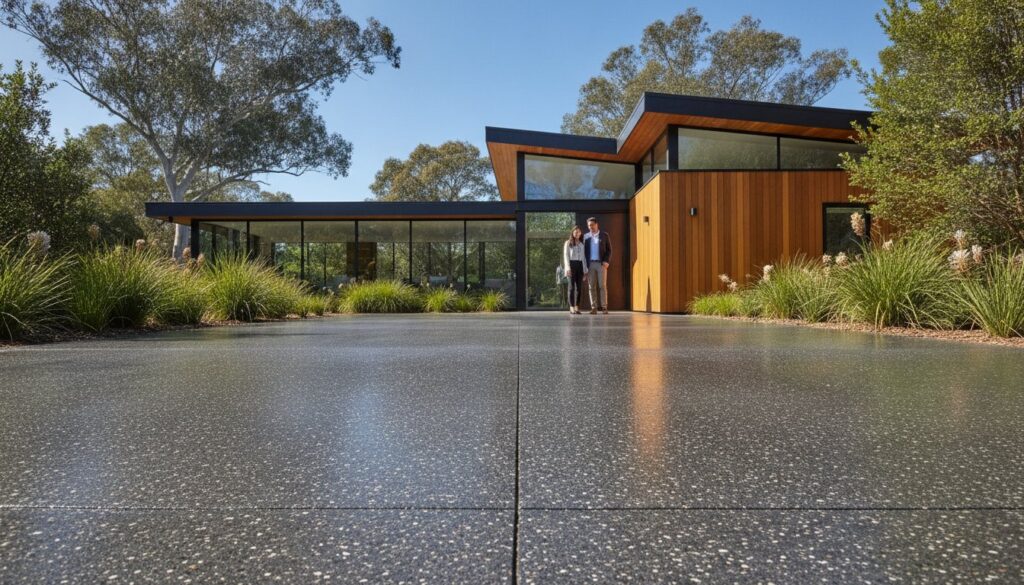
In the relentless Australian sun, an unsealed driveway isn’t just a surface; it’s a ticking clock for structural degradation. You’ve likely watched with frustration as the intense UV radiation in New South Wales turns a vibrant, architectural finish into a faded, dusty grey in just a few short seasons. It’s a common pain point for many homeowners who find themselves battling stubborn oil leaks and permanent tyre marks that refuse to budge. Realising the long-term benefits of sealing concrete driveway sydney wide is the first step toward transforming your property’s entrance from a basic utility into a lasting asset.
We agree that your home deserves a finish that reflects the quality of the craftsmanship beneath it. This 2026 guide provides the definitive professional framework for selecting, applying, and maintaining the best concrete sealer for our harsh climate. You’ll discover how to navigate the confusion between solvent and water-based chemicals to achieve a surface that’s easy to clean and protected against structural cracking. We’re going to break down the technical requirements for slip resistance and the specific needs of Western Sydney’s reactive soils to ensure your driveway remains a masterpiece for years to come.
Key Takeaways
- Identify why a high-grade chemical barrier is your primary defence against Australia’s extreme UV index and structural degradation.
- Learn the technical differences between penetrating and topical sealers to select the right technology for your specific aesthetic and functional goals.
- Maximise the long-term benefits of sealing concrete driveway sydney by matching specialised high-solids sealers to architectural finishes like exposed aggregate.
- Discover why professional-grade surface preparation, including moisture testing and acid etching, is essential to prevent delamination and ensure a lasting bond.
- Master the 2-5 year maintenance cycle to preserve your driveway’s transformation and protect your property’s structural value for decades.
Why Sealing is Essential for Australian Driveways in 2026
Concrete is often perceived as an indestructible slab of stone, yet at a microscopic level, it’s a highly porous matrix. Without a professional-grade chemical barrier, your driveway acts like a sponge, absorbing moisture, salts, and oils that lead to premature failure. In the context of 2026, where we face increasingly volatile weather patterns, the benefits of sealing concrete driveway sydney projects provide go far beyond simple aesthetics. A high-quality sealer functions as a sacrificial layer, shielding the underlying structure from environmental stressors that would otherwise cause the surface to crumble and erode.
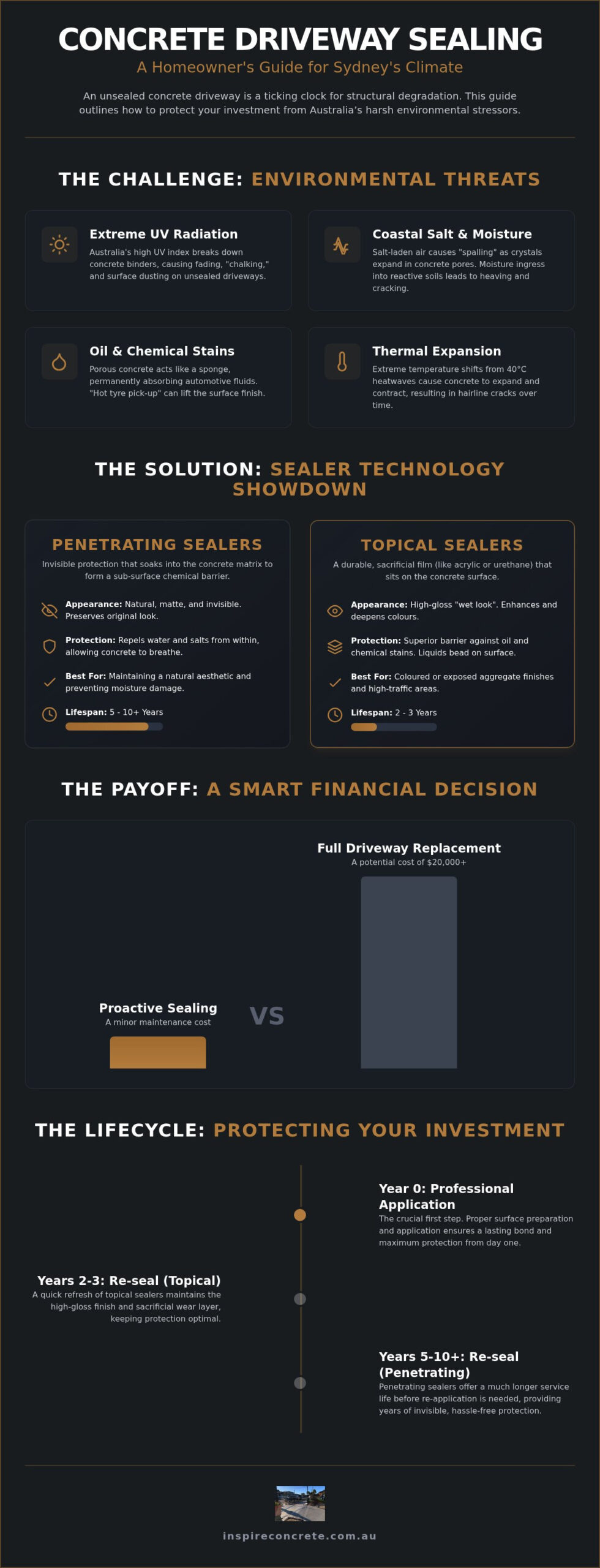
The Australian UV index is among the highest in the world, and its impact on unsealed concrete is devastating. Intense solar radiation doesn’t just fade the colour; it breaks down the chemical bonds within the concrete binder, leading to “chalking” and surface dusting. For those living in coastal Sydney suburbs, the salt-laden air introduces a secondary threat known as spalling. This occurs when salt crystals expand within the pores, eventually blowing the face off the concrete. By applying the correct Concrete sealer types, you create a hydrophobic shield that prevents these contaminants from gaining a foothold. From a financial perspective, the logic is undeniable. A few hundred dollars in maintenance today can easily prevent a full driveway replacement that could cost upwards of $20,000 in the near future.
Combatting Sydney’s Reactive Clay Soils and Thermal Expansion
Western Sydney is notorious for Bringelly Shale and reactive clay soils that expand and contract violently based on moisture content. When an unsealed driveway allows water to penetrate through the slab and into the subgrade, it triggers localized soil movement that causes the concrete to heave or sink. Sealing the surface effectively manages this moisture ingress, providing a stable environment for the slab to rest upon. Thermal expansion is the primary cause of hairline cracks in AU driveways as the concrete physically grows and contracts with extreme temperature shifts. During a 40°C Sydney heatwave, a sealed driveway reflects more energy and manages thermal shock better than a raw, heat-absorbing surface.
Protection Against Oil, Tyres, and Chemical Staining
Modern driveways face a constant barrage of automotive fluids and rubber compounds. A professional sealer creates a “beading effect,” where liquids sit on the surface rather than soaking into the concrete matrix. This is particularly vital for preventing “hot tyre pick-up,” a phenomenon where warm tyres bond to low-quality or unsealed surfaces and pull away chunks of the finish as the vehicle moves. High-end sealers are engineered to withstand these temperatures, ensuring your investment remains pristine. We also see a significant reduction in organic growth; by cutting off the moisture supply, you stop mould and mildew from colonising the shaded or damp sections of your property, keeping the area safe and slip-resistant.
Penetrating vs. Topical: Choosing the Best Concrete Sealer Technology
Selecting the right chemical technology is a critical decision that dictates both the aesthetic character and the longevity of your investment. It’s not a one-size-fits-all approach. One technology provides a vibrant, high-gloss finish, while the other offers a silent, invisible guard. Understanding these structural differences is key to unlocking the full benefits of sealing concrete driveway sydney residents value, especially when dealing with high-traffic zones and intense UV exposure.
Topical sealers, including acrylics and urethanes, function by forming a physical film on the surface. They act as a sacrificial wear layer, taking the brunt of tyre friction and environmental abrasion. In the high-traffic context of Australian driveways, solvent-based sealers generally outperform water-based alternatives. They offer superior adhesion and a more robust finish. While a topical sealer typically requires a refresh every 2 to 3 years under AU conditions, the level of surface protection they provide against oils and chemicals is unmatched.
Topical Acrylic Sealers: The High-Gloss Aesthetic Choice
Acrylic sealers are the industry standard for enhancing coloured concrete driveways. They provide that sought-after “wet look” that saturates the pigments and brings out the architectural depth of the finish. Solvent-based acrylics remain the gold standard because they penetrate slightly deeper into the surface than water-based options, resulting in a richer colour. Professional application is vital here to ensure breathability. If a sealer doesn’t allow moisture vapour to escape from the slab, you’ll end up with white, cloudy patches where water is trapped beneath the film.
Penetrating Sealers: The Invisible Structural Shield
If you prefer the raw, natural look of your concrete slabs, penetrating sealers are the superior choice. These silane or siloxane-based chemicals don’t form a film. Instead, they penetrate the concrete pores and chemically react to create a hydrophobic barrier. They repel water from the inside out without changing the surface texture or slip resistance. This technology is particularly effective for coastal Sydney properties where salt air corrosion is a constant threat. Because they reside within the concrete matrix, penetrating sealers are not subject to UV degradation or tyre wear in the same way as topical coatings, often lasting 5 years or more. If you’re weighing up these options for your property, our team can guide you through a professional concrete cleaning and sealing strategy tailored to your specific finish.
Matching Sealers to Your Specific Driveway Finish
Every driveway has a unique architectural DNA that requires a tailored chemical approach. Applying a generic product without considering the texture and composition of the slab is a common mistake that leads to peeling or aesthetic failure. When you understand the specific benefits of sealing concrete driveway sydney projects offer, you realize that the sealer acts as the final brushstroke in a masterwork of construction. It’s about more than just a coating; it’s about locking in the structural integrity of your chosen finish while elevating its visual impact.
For stamped and stencilled concrete, the sealer is the primary tool used to highlight intricate architectural patterns and protect the grout lines from moss or dirt ingress. Without this protection, the contrast between the base colour and the accent highlights quickly muddies under the sun. Similarly, plain and coloured concrete surfaces are prone to a “faded grey” look over time. High-quality, UV-stable coatings act as a sunscreen for your slab, keeping the pigments vibrant and preventing the surface from becoming chalky or brittle under the intense New South Wales sky.
Sealing Exposed Aggregate for Longevity
The most popular choice for modern homes, exposed aggregate driveways Sydney wide require a specific high-solids sealer to perform correctly. Unlike smooth finishes, aggregate surfaces rely on the sealer to physically lock the stone matrix into the cement paste. A professional-grade sealer prevents “stone pop-outs,” which occur when the surrounding binder weakens due to water penetration. By opting for a high-gloss or “wet look” finish, you make the natural variations of the river stones or crushed quartz pop against the cement base, creating a high-end, sophisticated entrance that remains structurally sound for decades.
Anti-Slip Additives and Safety Standards
Safety is a non-negotiable factor, particularly for driveways with significant gradients. A common concern with high-gloss sealers is that they can become slippery when wet, but this is easily managed through professional precision. We utilize specialized anti-slip additives, such as shark grip or glass beads, which are mixed directly into the sealer during the application process. These micronized polymers provide a fine, sandpaper-like texture that is invisible to the eye but essential for traction.
Adhering to the Australian Standard AS 4586 for slip resistance is a core part of our framework. Achieving a compliant rating requires an even distribution of these additives, something that is difficult to replicate with DIY methods. When we apply these agents, we ensure the driveway remains safe for both pedestrians and vehicles, regardless of the weather. This meticulous attention to detail ensures your property isn’t just beautiful, but also meets the rigorous safety requirements expected of a premium residential asset.
Professional Application vs. DIY: Avoiding Costly Sealing Mistakes
While the local hardware store might suggest that a weekend and a roller are all you need, the reality of high-performance chemical application is far more complex. The true benefits of sealing concrete driveway sydney homeowners expect are only realized when the chemical bond between the sealer and the slab is absolute. This requires more than a quick sweep. Professional preparation involves industrial-grade degreasing and a meticulous acid etching process to open the concrete pores. This ensures the resin anchors deep into the matrix rather than sitting precariously on the surface where it will eventually peel.
Moisture is the silent killer of many ambitious DIY projects. Even a driveway that looks bone-dry can hold significant vapour within its core. Sealing over this hidden moisture leads to delamination, where the sealer eventually lifts away in unsightly flakes. Professionals use a specific moisture test to verify the slab’s readiness before a single drop of chemical is applied. Environmental timing is equally critical in the Sydney climate. Applying sealer in the direct midday sun causes the solvent to flash off too quickly. This results in permanent bubbling and a ruined finish that is difficult to rectify.
The re-sealing trap is another area where many go wrong. If your driveway has been sealed previously, the new product must be chemically compatible with the old layer. We perform a Xylene test to determine if the existing sealer is solvent or water-based. Applying the wrong chemistry can lead to a sticky, gummy mess that never cures properly, necessitating an expensive and time-consuming stripping process.
The Professional Sealing Process at Inspire Concrete
Our approach is rooted in technical precision and rugged professionalism. We utilize commercial-grade resins that offer significantly higher solids content than retail products, providing a thicker, more durable wear layer. Our team focuses on the finer details, such as precision “cutting in” around edges to protect your home’s foundations and surrounding landscaping from overspray. From the initial industrial degreasing to the final uniform spray application, every step is designed to maximize the lifespan of your surface.
Common DIY Pitfalls and How to Fix Them
We frequently encounter “blooming,” which presents as white, cloudy patches caused by trapped moisture or applying the product too thickly. Roller marks and uneven sheen levels also occur when the product isn’t applied with consistent pressure and speed. If you’ve encountered these issues, it often requires a professional concreter to chemically strip the failed layer and start fresh. To avoid these costly setbacks, it’s best to partner with experts who understand the chemistry of a perfect finish. Reach out to the team at Inspire Concrete to ensure your driveway transformation is handled with master-level precision.
Maintenance and Re-sealing: Protecting Your Investment for Decades
Concrete is a long-term investment, but its endurance depends on a proactive maintenance strategy. The benefits of sealing concrete driveway sydney homeowners enjoy aren’t permanent without occasional intervention. Most professional-grade sealers operate on a 2 to 5 year cycle. High-traffic areas, such as the entrance to a double garage or a steep incline where tyres frequently scrub the surface, will naturally wear faster than shaded, low-use sections. Under the intense New South Wales sun, keeping a close eye on this timeline ensures the underlying slab never faces direct exposure to the elements.
Identifying when your protective barrier has been compromised is a straightforward process. We recommend performing a “bead test” every six months. Simply splash water onto various sections of the driveway. If the water beads and rolls off, your sealer is intact. If the concrete darkens immediately as it absorbs the moisture, the matrix is exposed. This is a clear signal that your chemical shield has worn thin and requires a professional refresh to prevent deep-seated staining or structural dusting.
Daily care is remarkably simple once a high-quality sealer is in place. You don’t need harsh chemicals; a regular sweep to remove abrasive grit and a quick hose-down is usually sufficient. For stubborn organic debris or bird droppings, a mild pH-neutral detergent and a soft-bristled broom will do the job without stripping the resin. If a driveway has been left unsealed for too long and shows significant surface wear, concrete resurfacing can often save the slab by providing a fresh decorative layer that we then lock down with a premium sealer.
The Long-Term Value of a Maintenance Schedule
For Sydney residents looking to maximise property value, a pristine driveway is a critical component of curb appeal. Beyond the aesthetics, a consistent maintenance schedule keeps the concrete matrix hydrated and protected from the internal pressures of thermal expansion. A well-maintained sealer can extend a driveway’s lifespan by up to 15 years. This structural longevity is especially important in Western Sydney, where reactive soils demand that the concrete remains as stable and moisture-resistant as possible to avoid expensive cracking.
Transforming Your Property with Inspire Concrete
We view professional sealing as the final touch of refined craftsmanship that separates a standard driveway from a high-end architectural feature. Our team treats every project as a partnership, ensuring the transition from basic utility to a creative vision is seamless and durable. We invite you to view our gallery of transformed Sydney driveways to see the difference that professional precision makes. To secure your property’s future and elevate its aesthetic standing, Book a professional concrete sealing consultation today and experience the certainty that comes with expert trade execution.
Secure Your Property’s Entrance with Professional Precision
Choosing the right sealer is the final step in transforming a standard slab into a high-end architectural asset. We’ve explored how matching chemical technology to your specific finish and adhering to a strict maintenance cycle prevents the structural decay caused by Australia’s extreme UV levels. The long-term benefits of sealing concrete driveway sydney homeowners value most are achieved through a deliberate balance of aesthetic enhancement and rigorous asset protection. From managing reactive clay soils to ensuring slip-resistance compliance, every detail matters in the pursuit of excellence.
Don’t leave your property’s first impression to guesswork or retail-grade products that often fail under the summer heat. With 20+ years of Sydney Metro experience, our licensed and insured expert craftsmen specialize in the intricate needs of both decorative and structural maintenance. We provide the certainty that your driveway meets the highest standards of durability and safety. It’s time to realize your creative vision with a result that stands the test of time. Request a Professional Sealing Quote from Sydney’s Concrete Experts and let us help you protect your investment for decades to come.
Frequently Asked Questions
How long does concrete sealer take to dry in Sydney’s climate?
Concrete sealer typically takes 2 to 4 hours to become touch-dry in Sydney’s temperate conditions, but full curing requires more time. You should wait at least 24 hours before allowing foot traffic and a minimum of 72 hours before driving vehicles onto the surface. High humidity or unexpected coastal showers can extend these windows, so we always monitor the local forecast to ensure the resin sets without interference.
Will sealing my driveway make it slippery when it rains?
A professionally applied sealer won’t make your driveway dangerously slippery if the correct anti-slip additives are used. We integrate micronized polymers or glass beads into the final coat to meet Australian Standards for slip resistance. This is a vital part of the benefits of sealing concrete driveway sydney homeowners expect, ensuring the surface remains safe for pedestrians and cars during a heavy downpour.
Can I seal a brand-new concrete driveway immediately after it’s poured?
You must wait at least 28 days for the concrete to finish its hydration process and reach its design strength before sealing. Sealing too early traps moisture inside the slab, which leads to blooming or white cloudy patches as the vapour tries to escape. Allowing the slab to cure fully ensures the chemical barrier can bond permanently to the concrete matrix without risk of delamination.
What is the difference between a ‘wet look’ and a ‘natural look’ sealer?
The wet look is achieved with topical acrylic sealers that saturate the pigments and leave a glossy or semi-gloss finish on the surface. In contrast, a natural look is provided by penetrating sealers that soak into the pores without changing the appearance or texture. Both options offer high-level protection, but the choice depends on whether you want an architectural statement or an invisible structural shield.
How much does professional concrete driveway sealing cost in Australia?
The cost for professional concrete driveway sealing in Australia generally ranges between A$25 and A$35 per square metre for the service. For a standard double-car driveway of approximately 50 square metres, you can expect a total investment between A$1,000 and A$1,750 depending on the condition of the slab. These rates cover the high-quality resins and technical precision required to ensure a result that lasts for several years.
Can I use a sealer to fix cracks that have already appeared in my concrete?
Sealer is a protective coating, not a structural repair material, so it won’t fix existing cracks in your concrete. While it can prevent new hairline cracks by managing moisture and thermal expansion, existing fissures must be professionally filled or repaired before the sealing process begins. Applying sealer over a crack without treatment will only highlight the defect rather than hiding it.
Is it better to spray or roll on a concrete sealer for a driveway?
High-pressure spraying is the preferred professional method for driveways because it delivers a more uniform and consistent finish than rolling. Spraying allows the sealer to reach deep into the texture of finishes like exposed aggregate without leaving the lap marks or pooling common with rollers. Rolling is typically reserved for smaller pathways or areas where overspray would be impossible to contain.
How do I remove old, peeling sealer before applying a new coat?
Old or peeling sealer must be removed using a chemical stripper or high-pressure water blasting before a new coat is applied. If you apply new product over a failing layer, the new finish will only be as strong as the peeling one beneath it. Our team uses specialized solvent-based strippers to dissolve old acrylics, ensuring the new application has a clean, porous surface to anchor into and maximise the benefits of sealing concrete driveway sydney projects provide.
