
The most striking driveway in Sydney is a costly liability if it fails to clear the legal hurdle of the nature strip. Your property might end at the boundary, but the transition to the street is public land governed by the Roads Act 1993. Securing council approval for driveway crossover nsw is the only way to protect your investment from heavy fines or the heartbreaking sight of a jackhammer removing fresh concrete. It’s common to feel caught between a builder’s casual advice and the rigid demands of local government, especially when you’re trying to distinguish between a DA and a Section 138 permit.
We understand that you want a seamless entry to your home without the bureaucratic headache. This guide provides a clear roadmap for the 2026 approval process, detailing the technical specifications required to satisfy council inspectors. You’ll learn how to navigate lodgement fees, understand typical approval timelines of two to six weeks, and identify the right contractor to manage the documentation. By aligning engineering precision with your aesthetic vision, you can ensure your new crossover is a permanent asset rather than a temporary fixture.
Key Takeaways
- Understand why the Roads Act 1993 classifies the nature strip as public land, making a Section 138 permit a non-negotiable legal requirement for every crossover.
- Distinguish between a standard Development Application and the specialized council approval for driveway crossover nsw to ensure your project remains compliant from start to finish.
- Gain clarity on technical blueprints and standard drawings to ensure your crossover’s width and placement align perfectly with local engineering mandates.
- Master the 2026 digital lodgement process via the NSW Planning Portal to streamline your application and avoid costly rectification orders.
- Learn why councils require licensed contractors with specific public liability insurance to perform any structural work within the road reserve.
Table of Contents
- Understanding the Driveway Crossover and the Section 138 Requirement
- Navigating the NSW Approval Hierarchy: DA, CDC, and Section 138
- Standard Drawings and Specifications: What Sydney Councils Demand
- The Step-by-Step Approval and Construction Process
- Why Professional Concreters are Essential for Crossover Compliance
Understanding the Driveway Crossover and the Section 138 Requirement
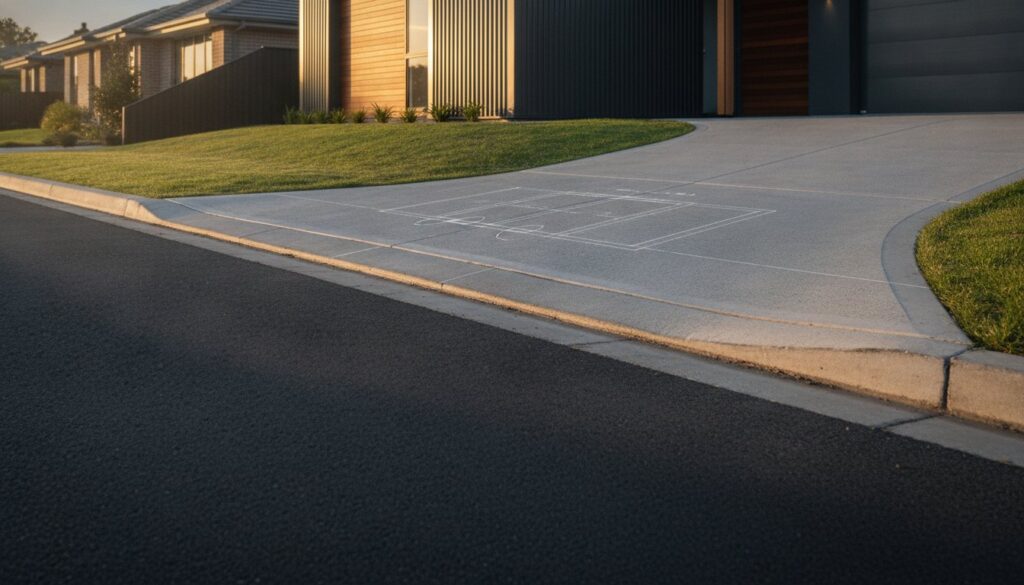
A driveway crossover is the structural bridge between your private property and the public road. Legally referred to as a Vehicle Access Crossing (VAC), this piece of infrastructure must handle the weight of daily traffic while maintaining the integrity of the streetscape. Obtaining council approval for driveway crossover nsw is a mandatory requirement because the land between your boundary and the road belongs to the local government. Even though you pay for the construction, the nature strip remains public land governed by the Roads Act 1993.
The “Ownership Gap” is a source of confusion for many homeowners. You’re financially responsible for the build, yet you have no legal ownership of the finished product. This is why a standard Development Application (DA) or Complying Development Certificate (CDC) isn’t enough to start pouring concrete. Those approvals cover the work inside your property line, but a Section 138 permit is specifically required for any activity within the road reserve. Proceeding without this separate approval invites significant risk. Councils can issue rectification orders, forcing you to remove the concrete at your own expense, and you could face substantial fines or personal liability if an unapproved crossover causes a public safety hazard.
Crossover vs. Internal Driveway: The Legal Difference
Your internal driveway is your personal canvas where design freedom prevails, but the crossover is an extension of the public road network. On your side of the boundary, you control the aesthetic and material choices. Once you cross that line, strict council engineering specifications dictate everything from the concrete grade to the reinforcement mesh. Understanding the Driveway Crossover helps clarify why these rigid standards exist for the safety of all road users. The layback is the specifically engineered transition point where the street kerb is lowered to allow vehicles to move smoothly from the road onto the crossover.
The Role of the Roads Act 1993 in 2026
In 2026, the Roads Act continues to serve as the legal backbone for Sydney’s infrastructure, protecting the vital web of underground services like gas, water, and high-speed telecommunications. Councils use the Section 138 process to ensure your crossover doesn’t crush these assets or disrupt the suburb’s natural drainage flow. This oversight prevents localized flooding and ensures the street remains safe for pedestrians. Beyond the build, having the correct council approval for driveway crossover nsw is essential for your property’s long-term value. A non-compliant crossover can prevent you from obtaining a final occupation certificate or stall a property sale when a building inspector identifies the lack of legal permits.
Navigating the NSW Approval Hierarchy: DA, CDC, and Section 138
A common misconception in Sydney construction is that a Development Application (DA) approval grants you the right to build your driveway all the way to the asphalt. It doesn’t. Your DA covers the dwelling and internal works, but the “Separate Approval” rule dictates that any work on the road reserve requires a Section 138 permit. By 2026, the workflow for obtaining council approval for driveway crossover nsw has shifted almost entirely to the NSW Planning Portal. This digital system streamlines the interaction between you and the local government, but it requires precise documentation and architectural drawings to avoid immediate rejection.
You’ll deal with two distinct authorities during this phase. Your Principal Certifier (PC) oversees the construction of your home and internal driveway, ensuring it meets the Building Code of Australia. However, they have no jurisdiction over the nature strip. That power lies solely with the Council Asset Officer. This officer is responsible for protecting public infrastructure and will be the one to inspect your crossover formwork and reinforcement before the concrete is even mixed. Coordination between these two roles is vital for a smooth project handover and a final sign-off.
When to Apply for Your Crossover Permit
Precision timing is the hallmark of a professional build. The ideal window for application is immediately after your DA is determined but well before you schedule any excavation. In high-growth areas like Western Sydney, waiting until the house is finished can lead to project-halting delays. You must also manage the “Notice of Commencement” specifically for the crossover works. This is a separate notification from your main building start date, and failing to lodge it can result in council refusing to recognize the completed work.
Section 138 Approvals for Complying Development (CDC)
Complying Development Certificates (CDC) present a unique challenge for homeowners. Because a private certifier handles the approval, council oversight is often non-existent until the very end of the project. Many homeowners fall into the “final sign-off” trap, discovering they cannot move into their new home because the Section 138 permit was never secured or the crossover fails to meet council engineering standards. If you want to avoid these bureaucratic hurdles, partnering with experts in Sydney concrete driveway solutions ensures your paperwork and your pavement are both managed with professional mastery. Ensuring your private certifier has verified the Section 138 permit early is the only way to guarantee a seamless transition from construction to occupation.
Standard Drawings and Specifications: What Sydney Councils Demand
Every Sydney council maintains a library of Standard Drawings. These aren’t suggestions; they are the rigid engineering blueprints that dictate the exact geometry of your vehicle crossing. Obtaining council approval for driveway crossover nsw requires more than a simple sketch; it demands strict adherence to these documents. These drawings specify the required widths, which typically range between 3 and 6 metres, and mandate boundary offsets to ensure your driveway doesn’t crowd your neighbour’s property or interfere with street trees and utility pits. Proximity to intersections is another non-negotiable factor. If your crossover is too close to a corner, council will reject the application to prevent traffic safety hazards.
The “Plain Concrete” mandate is a frequent point of friction for homeowners. When you apply for council approval for driveway crossover nsw, you’ll find that most local governments mandate plain, broom-finished concrete for the portion on public land. This ensures that if a utility provider needs to dig up the nature strip to repair a water main or fiber optic cable, the patch-back is consistent and cost-effective. Managing the kerb and gutter profile is equally technical. Depending on your street, you may need to construct a layback transition, modify an upright kerb, or integrate with a roll-top profile. Each of these requires specific formwork precision to ensure road drainage remains uninterrupted.
Material Specifications and Durability Standards
Strength matters. Councils demand concrete with a minimum compressive strength of 25 MPa for standard residential use, often increasing to 32 MPa or higher for heavy-duty commercial crossings. The reinforcement mesh is equally critical. While SL72 might suffice for a garden path, crossovers typically require SL82 mesh and a slab thickness of at least 125mm to 150mm. This extra depth prevents the concrete from cracking under the weight of delivery trucks or waste collection vehicles. A non-slip broom finish is mandatory. This texture provides essential grip for pedestrians using the footpath in wet weather, fulfilling council’s public safety requirements.
Integrating Exposed Aggregate with Council Specs
If you’ve invested in a premium exposed aggregate driveway, the property boundary becomes a critical design junction. Most Sydney councils insist that the decorative finish stops at your gate, transitioning into plain concrete for the crossover. We manage this by installing a clean expansion joint at the property line. This creates a structural break that separates your private design from the public infrastructure. In certain high-end Sydney heritage zones, we can sometimes negotiate “matching” finishes or subtle charcoal tints, but these require detailed discussions with the Council Asset Officer before the first barrow of concrete arrives.
The Step-by-Step Approval and Construction Process
Transforming a vision into a durable, compliant entrance requires a disciplined sequence of actions. Securing council approval for driveway crossover nsw involves moving through five distinct phases, each designed to protect both the homeowner and the public infrastructure. While the process is standardized across the state, local nuances exist. For instance, Blacktown City Council emphasizes straightforward fee structures, whereas the Northern Beaches Council often applies intense scrutiny to environmental factors like street trees and natural features. Following this roadmap ensures you don’t skip the critical checkpoints that lead to a final sign-off.
- Step 1: Site Survey and Architectural Drafting. A precise plan is created showing the crossover’s relationship to your property and the street.
- Step 2: Lodgement of the Section 138 Application. This is submitted via the NSW Planning Portal, the centralized digital hub for 2026.
- Step 3: The Pre-Approval Inspection. A council officer visits the site to identify potential conflicts with trees, utility pits, or existing services.
- Step 4: Construction and the Pre-Pour Inspection. After formwork is set but before concrete is poured, council must verify the engineering.
- Step 5: Final Sign-off. Once the concrete is cured and the site is restored, the damage deposit is returned to the applicant.
Preparing Your Site Plan for Success
Precision is paramount during the drafting phase. Your site plan must clearly illustrate property boundaries, power poles, water meters, and any street trees within the vicinity of the proposed works. Accuracy in the layback position is the primary reason for application rejection; even a minor misalignment can disrupt the street’s drainage flow or create a traffic hazard. You must initiate a Dial Before You Dig (DBYD) inquiry to map the hidden network of utility lines before any excavation begins. This proactive step prevents accidental damage to fiber optic cables or gas lines, which can lead to massive repair bills and project delays. If you’re feeling overwhelmed by these technical demands, Inspire Concrete can handle the entire architectural drafting and council liaison process for you.
Managing Inspections and Council Sign-offs
The pre-pour inspection represents the point of no return. You cannot pour concrete until a council officer has physically inspected the site and given their approval. They will check that the reinforcement mesh is correctly chaired and that the formwork levels match the approved drawings. If an officer requests a change on the day, you must be prepared to adjust the formwork immediately to avoid a failed inspection and a rescheduled pour. Once the work is complete, securing the Certificate of Compliance is the final hurdle. This document closes out your Section 138 permit and triggers the release of your damage deposit, officially confirming that your council approval for driveway crossover nsw has been successfully fulfilled.
Why Professional Concreters are Essential for Crossover Compliance
Engaging with the public road reserve is a high-stakes environment that demands more than just trade skill. It requires a specific legal and insurance framework that most homeowners and unlicensed builders simply don’t possess. To secure council approval for driveway crossover nsw, you must appoint a contractor who carries substantial public liability insurance, often required at a minimum of $20 million for works within the road reserve. Councils refuse to issue permits to anyone who can’t prove this coverage, as any incident on public land becomes a massive liability for the local government. Professional teams bring a level of technical rigor that ensures every millimeter of your crossover aligns with the architectural drafting and the rigid boundary markers of your Sydney property.
The Inspire Concrete approach is built on over 20 years of local experience. We don’t just pour the mix; we act as your project partner, managing the end-to-end bureaucracy of the NSW Planning Portal and local asset officers. This comprehensive service removes the stress of technical rejections and ensures your Sydney concrete driveway solutions are built to last. By handling the drafting and the liaison, we ensure the physical work mirrors the approved plans perfectly, leaving no room for the guesswork that often leads to council disputes.
Avoiding the Pitfalls of DIY or Unlicensed Work
The temptation to save on costs by attempting a DIY crossover or hiring an unlicensed worker often leads to the dreaded Rectification Order. If a council inspector finds that your crossover fails to meet MPa strength requirements or disrupts street drainage, they have the legal power to force you to jackhammer the new concrete at your own expense. Beyond the physical cost, unlicensed work on the road reserve can void your home insurance policy and complicate your property warranty. For those looking to navigate the selection process safely, consulting our Master Guide to Hiring Concreters is an essential first step for any Sydney resident who values their investment.
Long-Term Value and Street Appeal
A perfectly executed crossover does more than provide vehicle access; it frames your entire property. It’s the first thing visitors see and the final detail that completes a high-end residential aesthetic. By ensuring proper drainage gradients and seamless transitions, we prevent the erosion and water pooling that often plague poorly constructed nature strips. Whether you’re laying a new concrete slab for a granny flat or a full-scale residential driveway, compliance is the key to property value. A fully documented Section 138 approval positions your home for a premium sale, providing future buyers with the certainty that every element of the property is legally sound and expertly crafted. This commitment to excellence ensures your council approval for driveway crossover nsw is a permanent asset to your lifestyle and your equity.
Secure Your Property’s Future with a Compliant Entrance
Your driveway is more than just a path; it’s a legal and structural commitment to the Sydney streetscape. Navigating the complexities of council approval for driveway crossover nsw ensures that your entrance remains a permanent asset rather than a costly liability. By respecting the distinction between your property line and the public road reserve, you protect your investment from the stress of rectification orders and the risks of unapproved works. Every millimeter of concrete must align with the vision you’ve for your home and the engineering standards the community demands.
Precision in the planning stage leads to excellence in the final result. With over 20 years of Sydney experience, our team bridges the gap between your design aspirations and rigid local regulations. We manage the entire council liaison process, providing the licensed expertise and comprehensive insurance coverage essential for work on public land. Request a Compliant Crossover Quote from Inspire Concrete today to transform your property’s entrance with total certainty. Your home deserves a foundation that reflects both master craftsmanship and absolute compliance.
Frequently Asked Questions
What is a Section 138 permit and why do I need it in NSW?
A Section 138 permit is a mandatory legal authorization required under the Roads Act 1993 for any construction activity within the public road reserve. You need it because the land between your property boundary and the asphalt belongs to the local council. This permit ensures that your crossover doesn’t damage hidden underground services or create safety hazards for pedestrians and drivers using the public nature strip.
How much does council approval for a driveway crossover cost in Sydney?
Application fees vary across Sydney local government areas and are typically updated on July 1 each year. For instance, Blacktown City Council charges approximately $340 for a standard Section 138 application as of April 2026. In other regions, such as Goulburn Mulwaree, the rural addressing fee for 2025/2026 is $142. You should always verify the current 2026/27 pricing on your specific council’s website before lodging through the NSW Planning Portal.
Can I build my own driveway crossover if I am a capable DIYer?
No, you cannot legally construct a driveway crossover yourself unless you’re a licensed concreter with specific insurance credentials. Local authorities mandate that only insured professionals work on the road reserve to mitigate public liability risks. Most Sydney councils require contractors to hold a minimum of $20 million in public liability insurance before they’ll grant council approval for driveway crossover nsw.
How long does it take for a Sydney council to approve a crossover application?
The approval process for a standard driveway crossover application generally takes between two and six weeks. This timeline can extend if your site involves heritage considerations, requires the removal of street trees, or has complex drainage issues. Lodging your application as early as possible in your construction timeline prevents the crossover from becoming a bottleneck for your final occupation certificate.
What happens if I build a crossover without council approval?
Constructing a crossover without a permit often leads to heavy fines and formal rectification orders. Council has the legal authority to force you to remove the non-compliant concrete and restore the nature strip at your own expense. An unapproved crossover can also void your home insurance and prevent you from receiving a final sign-off, which complicates property sales and refinancing.
Do I need a Section 138 permit for a simple driveway repair or resurfacing?
Any structural work or replacement of the crossover portion on public land requires a Section 138 permit. While you don’t usually need council intervention for aesthetic resurfacing on your private internal driveway, any modification to the public nature strip must be approved. It’s vital to consult with your local asset officer before starting any work that touches the road reserve to ensure council approval for driveway crossover nsw is maintained.
What are the standard dimensions for a residential driveway crossover in NSW?
Standard residential crossovers in NSW typically measure between 3 and 6 metres in width at the property boundary. Engineering specifications usually demand a concrete thickness of 125mm to 150mm with a minimum compressive strength of 25 MPa. These dimensions vary between local councils, so you must refer to the specific Standard Drawing provided by your authority to ensure your formwork passes the pre-pour inspection.
Who is responsible for maintaining the driveway crossover after it is built?
The property owner is legally responsible for the ongoing maintenance and repair of the driveway crossover. Although the structure sits on public land, it exists solely to provide access to your private property. If the concrete becomes cracked or creates a trip hazard, council will issue a notice requiring you to repair the structure to their current engineering standards at your own cost.
