

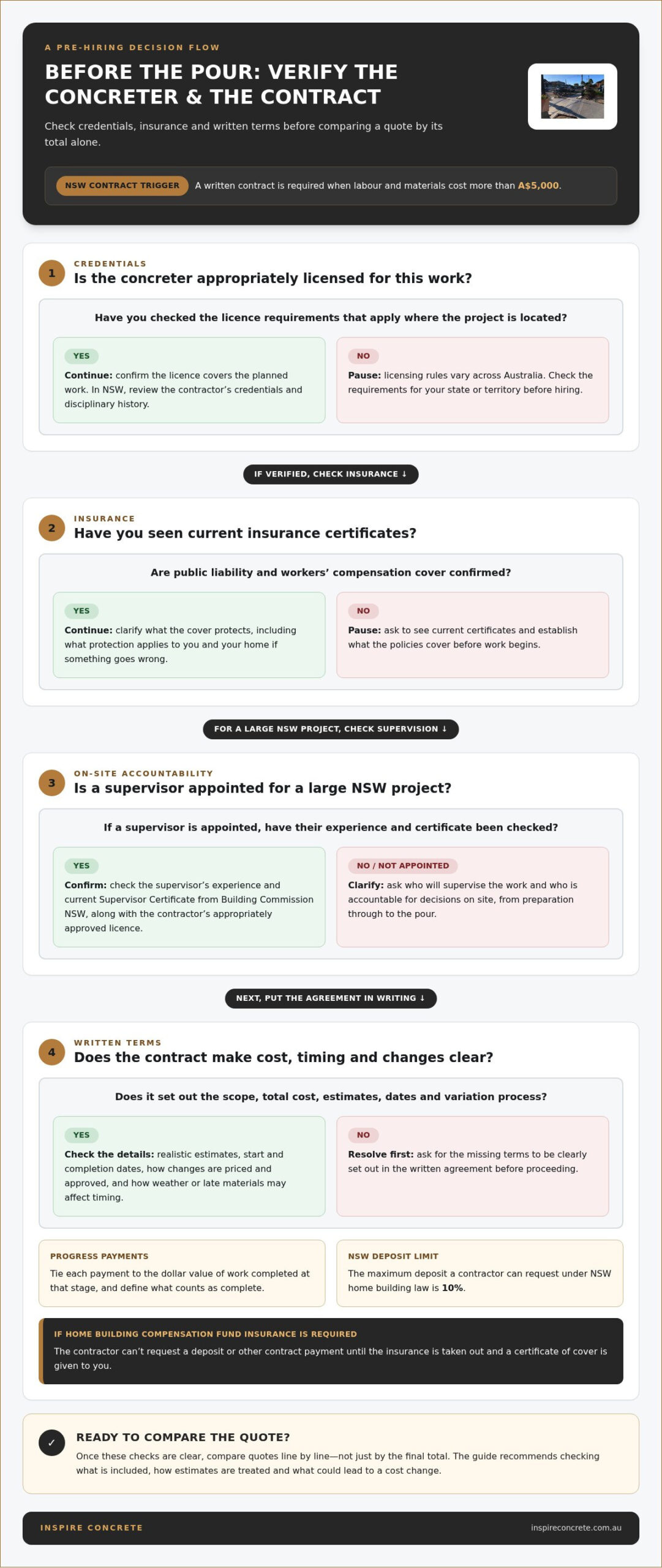
Before comparing prices, confirm a concreter is properly licensed and insured, and understand exactly what the quote includes. The most useful questions to ask before hiring a concreter cover those essentials, and in NSW, a written contract is required when labour and materials cost more than A$5,000.
A low quote can look appealing, but the details behind it matter. Site preparation, drainage, materials and clean-up all affect the finished result. Use this guide to compare quotes and ask about licences, similar projects, past work, timelines and possible cost changes. You’ll also learn how to discuss site conditions and drainage before work begins, so you can make an informed choice for a concrete surface that suits your Sydney property.
Key Takeaways
- Review a concreter’s licence, credentials and insurance before work begins, and make sure the agreement clearly sets out responsibilities.
- Compare experience on projects like yours and clarify start dates, completion dates, progress updates and how delays will be handled.
- Read quotes line by line to see what’s included, how estimates are treated and what could lead to a cost change.
- Use recent project examples, testimonials and references to assess workmanship, communication and how issues were handled.
- Discuss ground conditions, preparation, drainage and site clean-up before the pour to help set clear expectations for the finished surface.
1. Are You Licensed and Insured?
Ask for the concreter’s licence details and check that the licence covers the work planned at your property. NSW consumers should review the contractor’s credentials and disciplinary history before hiring. Licensing requirements differ across Australia, so confirm the rules that apply in your state or territory. Ask to see current public liability and workers’ compensation insurance certificates, and clarify what cover protects you and your home if something goes wrong.
For a large NSW project, ask who will supervise the work. If a supervisor is appointed, check their experience and current Supervisor Certificate from Building Commission NSW, as well as the contractor’s appropriately approved licence. These details help establish who is accountable for decisions on site, from preparation through to the pour.
What qualifications and licences does a concreter need in Australia? Requirements vary by state and territory, so there isn’t one licensing rule for every Australian job. In NSW, check that the contractor holds an appropriate licence, then review their credentials and any disciplinary history.
Ask about the current workload, too. Find out who will be on site, whether the same team will manage preparation and placement, and how existing bookings affect your proposed start date. A clear answer helps you judge whether the schedule allows time for careful work rather than rushed handovers.
Put the scope, total cost, realistic estimates, start and completion dates, and variation process in a written contract. In NSW, a written contract is legally required when labour and materials cost more than A$5,000. Progress payments should reflect the dollar value of work completed at each stage. The maximum deposit a contractor can request under NSW home building law is 10%. Where a job requires Home Building Compensation Fund insurance, the contractor can’t request a deposit or other contract payment until the insurance is taken out and a certificate of cover is given to you.
How are variations, delays and payment stages handled in a concreting contract? The contract should explain how changes are priced and approved, set realistic start and completion dates, and state how weather or late materials could affect timing. Tie each progress payment to the value of completed work, and define what counts as complete.
Ask how quality control covers site preparation, reinforcement inspections, concrete placement and curing. For a slab, ask whether a plastic membrane is included, as it helps control dampness coming through concrete. Confirm how the crew will manage curing and protect the fresh surface, since these steps affect the finished work.
Do council rules or permits apply to residential concreting in my Australian state or local area? Permit requirements can depend on the work and local rules. Before work starts, establish which approvals apply and how the project will meet council requirements.
2. What’s Your Experience with Similar Projects?
Ask for examples of work that match your project’s scale and finish. A concreter experienced with residential driveways may understand access, levels and runoff, while a commercial structural slab calls for different planning. Ask what challenges arose on comparable jobs and how the team handled them. Specific examples reveal more than broad claims of experience. Look for details about preparation, placement and the finished surface.
Project photos can help you assess workmanship, but ask what each image shows. A close-up may demonstrate a neat edge or consistent finish; a wider view can show how the concrete sits beside the house. If you’re considering a patterned or coloured surface, compare examples of that type of finish. Explore concrete driveway finishes to see which look suits your plans.
Discuss scheduling before agreeing on a start date. Ask for the proposed start and completion dates, plus a timeline covering preparation, the pour and final clean-up. Concrete projects may take several weeks to complete, depending on the scope and sequence of work. A clear breakdown helps you understand what happens between site preparation and handover, rather than treating the pour as the entire project.
Weather and late material supply can affect a schedule. Ask how the contractor will communicate delays, revise dates and keep you informed if the sequence changes. A NSW building contract should include realistic start and completion dates and account for possible bad-weather delays and late material supply. Make sure the schedule identifies key stages, so a change to one activity doesn’t leave you guessing about the rest.
Clarify who your main point of contact will be and how you’ll receive updates. Agree on how the team will communicate progress, scheduling changes and variations. For example, if site preparation uncovers an issue that changes the planned sequence, you should know who will explain the impact and discuss next steps. Clear communication keeps decisions connected to the work and its timeline.
Ask for references from clients whose completed projects resemble yours. Recent work can show current attention to detail, while a reference can explain how the project ran day to day. Ask whether the work finished on time, stayed close to the quoted cost, was properly supervised, and whether defects were fixed promptly. Find out whether communication was good and if the client would recommend the concreter. Together, project photos and direct feedback provide a fuller picture of workmanship and reliability.
3. Quotes, estimated costs and potential cost changes
Use the questions to ask before hiring a concreter to compare the scope, not just the final total. A clear written quote should identify labour, materials, permits, potential add-ons and GST. Ask whether the total is fixed or includes estimates that may change. In NSW, the contract should state the total cost, identify realistic estimates, and explain how and why costs could change. This makes each figure easier to assess before you commit.
Check that each quote covers the same work stages. Look for excavation, reinforcement, formwork, concrete supply, pump hire, waste removal and site clean-up. If one quote leaves out excavation or rubbish removal, its lower total may not reflect the full scope. Ask for excluded work to be recorded, so you compare equivalent deliverables rather than assumptions.
Pay close attention to site preparation. Include questions to ask before hiring a concreter about whether sand fill or minus fines fill is included, supplied by the contractor, or treated as a variation for you to organise. Difficult ground or solid rock can increase preparation costs. If preparation appears as a provisional cost item, the final amount may change according to the builder’s actual expenses. Ask what work and evidence will determine any adjustment.
Review materials and optional items as separate quote lines. A stronger concrete mixture costs the contractor more per cubic metre, so ask which mix is specified and why it suits the project. For a driveway, compare the reinforcement, formwork and concrete quantities shown. This helps distinguish a genuine difference in scope from an unexplained change in the quoted total.
Ask how variations are approved before extra work begins. The contract should explain the reason for a change, how its cost is calculated, and how it affects the schedule. For example, if excavation reveals solid rock, clarify how the added preparation will be documented. Keep the revised scope and amount in writing, then compare them with the original estimate before approving the change.
Payment terms also belong in the comparison. In NSW, a contractor’s maximum deposit under home building law is 10%. Progress payments should reflect the dollar value of work completed at each stage. Where Home Building Compensation Fund insurance applies, the contractor must take out the insurance and give you its certificate before requesting a deposit or other contract payment. Match each payment request to the stated stage and completed work.
Finally, compare what each quote promises at handover. Confirm that clean-up is included, and ask what the contractor considers complete. A cost estimate is useful when its assumptions, exclusions, potential changes and final deliverables are clear. That detail lets you weigh value against scope, rather than simply choosing the smallest number on the page.
4. Do You Have References or a Portfolio of Previous Work?
Useful questions to ask before hiring a concreter include requests for recent project photos and references from customers with comparable work. A driveway, pathway and entertaining area each have different details to assess. In photos, look at edges, joints and transitions to adjoining surfaces. Ask what each example involved, so you can judge whether it reflects the finish and scope you have in mind.
Look beyond polished close-ups. Ask for wider views showing how the concrete fits the property, as well as details of edges, falls and connections. If you’re considering a decorative finish, compare examples with a similar pattern or colour. Ask when the work was completed and what the contractor was responsible for. This context helps you make a more informed comparison than images alone.
Testimonials can highlight a customer’s overall impression, while a direct reference can answer specific questions about the working relationship. Ask for contacts whose projects resemble yours, then ask what communication was like during the work. For instance, find out how the contractor explained a change in the plan and whether the customer knew who to speak with. Practical details help you understand the process behind the finished surface.
Use questions to ask before hiring a concreter to assess how well their past work matches your needs. Ask references whether the project was properly supervised, whether agreed dates were met, and whether any defects were addressed promptly. You can also ask if the customer would recommend the contractor and what they’d want clarified before starting a similar project. Their answers can reveal useful details that photographs can’t show.
For local references, ask whether the job was completed in Sydney and involved similar access or site conditions. A narrow entry, sloping ground or nearby structures can shape how a project is organised. Ask the customer how the crew managed those constraints and kept the work area orderly. A relevant local example gives you a clearer basis for judging how the contractor approaches conditions like yours.
Compare each reference with the portfolio and project scope you’re considering. If a photo shows a patterned finish, ask how the design was carried through the edges and adjoining areas. If a reference describes a schedule change, ask how updates were communicated. These follow-up questions to ask before hiring a concreter connect visual evidence with the customer’s experience, helping you assess both workmanship and communication.
Take brief notes as you review examples and speak with references. Record which projects match your intended finish, what each customer valued, and any details you want clarified before choosing. A consistent set of observations makes it easier to compare contractors fairly and decide which portfolio shows the most relevant completed work.
5. Site preparation and drainage
Ask how the concreter will assess the ground before construction starts. The plan should explain excavation, removal of loose material, base preparation and how levels will be set. These steps shape the surface and its drainage. For example, a driveway should direct runoff away from the house, not towards a doorway or garage. Discuss where water should flow before formwork is installed.
Walk the site together and identify existing conditions that could affect preparation. Point out garden edges, retaining walls, downpipes, drains and low spots. Ask how the proposed concrete level will meet each feature, and how water will move across the finished area. A clear site discussion can uncover conflicts early, such as a planned surface blocking an existing drainage path.
Clarify who handles excavation spoil, broken concrete and other debris. Ask whether removal and disposal are included, and where materials will be placed during the job. For example, a narrow side access may limit where excavated soil can sit. Agree on how the crew will keep walkways and access points usable during preparation and pouring.
Include site cleaning in the written agreement. NSW homeowners should agree on regular site cleaning in the contract, so the project doesn’t leave the property messy or dangerous. Define what that means for your job: clearing loose offcuts, keeping access routes orderly and removing waste at the agreed stages. Confirm who is responsible for each area, including the driveway or path used by workers.
Ask how the concreter will protect nearby surfaces during construction. A project beside a house may need clear arrangements for equipment movement, material storage and keeping concrete splashes off adjacent areas. Agree where tools and supplies can be placed, and how the crew will manage access during the pour. These details reduce confusion for residents and visitors while work is underway.
Before work begins, review the preparation sequence with the person supervising the job. Confirm when levels and drainage paths will be checked, how the base will be prepared, and when you can review the site before concrete placement. If the finished surface connects to an existing path, check the transition and runoff direction together. Record agreed cleaning, debris removal and drainage responsibilities in writing.
Thoughtful preparation helps align drainage, access and the intended finish from the outset. To discuss the preparation needs of your concrete project, plan your concreting project.
Inspire Concrete: Exposed Aggregate Driveways
Inspire Concrete can help turn a practical driveway into a considered part of your property’s design with an exposed aggregate finish. It’s a natural next step if you’ve clarified your project scope, compared quote inclusions and are ready to discuss the look and function you want.
For a different finish, Inspire Concrete also offers stencil, stamped and coloured concrete driveways. Consider how the surface will complement your home and outdoor areas, then discuss project details, including site preparation and drainage, as part of planning.
To discuss your driveway plans, contact Inspire Concrete.
Shape the next stage of your project
The right choice brings your practical requirements and design vision together. Use the questions to ask before hiring a concreter to guide a clear conversation about the finish you want and how it should work with your property.
For a driveway, Inspire Concrete offers exposed aggregate, stencil and stamped concrete finishes. Consider which look best complements your home, then discuss how the project can be planned around your site and intended use. A considered choice can help create an entrance that feels cohesive with the rest of your property.
Contact Inspire Concrete today to discuss your driveway plans and explore a finish that suits your vision. Take the next step with a clear idea of what you want to achieve.
Frequently Asked Questions
Are You Licensed and Insured?
In NSW, check that the contractor holds an appropriate licence for the work and ask for current public liability and workers’ compensation certificates. Make sure the business name and licence details match the agreement. For a larger job with an appointed supervisor, review their current certificate and the contractor’s approved licence. These checks help you understand who is responsible for the work and what insurance cover is in place.
How much will it cost?
The cost depends on your project’s dimensions, access, site preparation, materials and chosen finish. Inspire Concrete provides a free, no-obligation quote from a qualified estimator, with no hidden or extra charges. Share your plans and site details so the estimate can reflect the work required. For a Sydney driveway, for example, the proposed finish and amount of excavation can affect the project scope.
What Concrete Mix Will You Use?
Ask for the specified mix and why it suits the intended use. A 20/20mpa mixture is normally standard, while 25/20mpa is stronger and costs more per cubic metre for the contractor to buy. The right specification depends on the project’s requirements, so compare the mix named in the quote rather than assuming two quotes include identical concrete. Also ask how the mix relates to the specified reinforcement.
What Warranty Do You Offer?
Concrete work warranties in the industry are usually 1 to 5 years, while Inspire Concrete provides a 10-year workmanship warranty. Ask what workmanship is covered, how to report an issue and what records you should keep after completion. Keep the written warranty with your contract and project documents. That way, you can refer to the actual coverage and process rather than relying on a verbal description.
What’s Your Experience with Similar Projects?
Look for experience relevant to the scale and type of work you need, rather than relying on a general claim. Inspire Concrete has 24 years of construction experience across over 600 completed projects, including 14 years of concreting experience and 4 years of architectural drafting expertise. Ask how that background applies to your design, site constraints and chosen finish, especially if the project involves detailed planning.
Can You Give Local References?
Ask for references from Sydney customers whose completed projects resemble yours, then ask about the experience beyond the finished surface. For instance, find out whether the team kept the property orderly, explained decisions clearly and responded constructively to concerns. Inspire Concrete has completed over 600 projects, but a reference relevant to your project type can help you understand what the working process was like for a customer.
Do You Handle Permits and Inspections?
Permit and inspection requirements depend on the project and its location. Before work starts, establish which approvals apply to your Sydney property, who will arrange them, and whether inspections form part of the schedule. If a lender requires an inspection before a progress payment, allow for that step in the project plan. Keep approval responsibilities and inspection stages clear in the written agreement.
Do You Have Licences and Certifications?
Ask for the contractor’s licence details and check that they’re appropriate for the work. In NSW, if a supervisor is appointed to a large job, review their experience and current Supervisor Certificate from Building Commission NSW, along with the contractor’s appropriately approved licence. Treat licences and certificates as separate credentials: ask what each covers and who holds it, so you know which person is authorised to supervise the work.
