
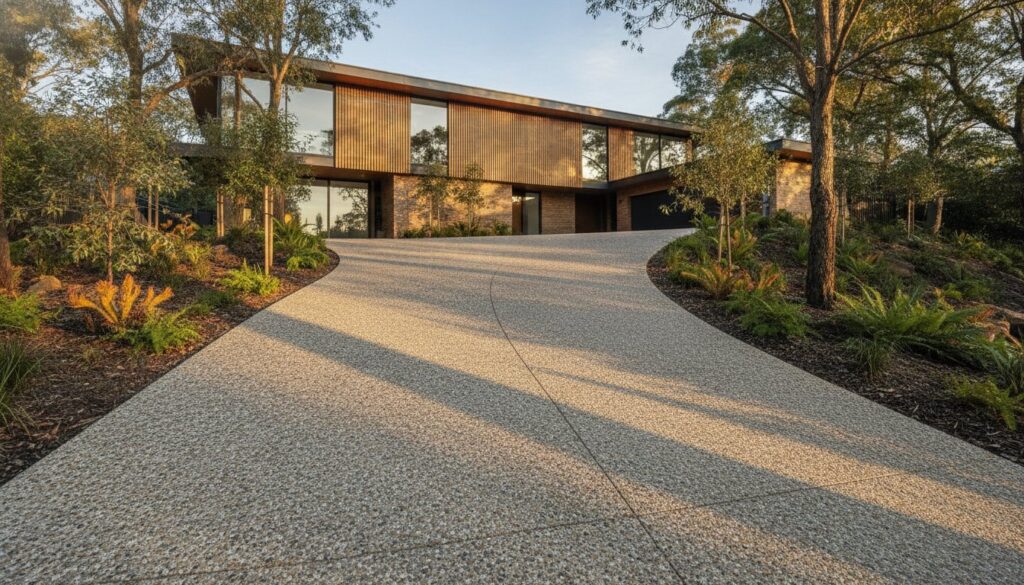
What if the steep incline that currently makes you cringe every time you pull into your garage became the most striking architectural feature of your home? For many property owners, a vertical site feels like a constant battle against gravity, especially when you’re worried about cars bottoming out at the kerb or water runoff eroding your landscape during a heavy Sydney downpour. It’s a stressful way to arrive home, but it doesn’t have to be your reality.
This guide, from Inspire Concrete, delivers the comprehensive sloping block driveway solutions Sydney homeowners require to master even the most intimidating terrain. We promise to help you navigate the complexities of 2026 engineering standards, ensuring your driveway is safe, council-compliant, and visually stunning. You’ll learn how to achieve zero car scraping through precise 12.5% transition grades and how to manage high-volume water flow with sophisticated drainage systems. We also preview the latest high-traction finishes, such as exposed aggregate, that provide the essential P4 slip rating while transforming your entrance into a refined statement of craftsmanship.
Key Takeaways
- Learn how to eliminate vehicle damage by mastering transition grades and the “1 in 4” gradient rule specified in Australian Standards.
- Discover why advanced hydro-management and heavy-duty reinforcement are critical to preventing garage flooding and site erosion on steep inclines.
- Explore the most effective sloping block driveway solutions sydney has to offer, prioritising high-traction finishes like exposed aggregate for wet-weather safety.
- Understand the 2026 council regulations and excavation limits to ensure your project moves from architectural drafting to completion without legal hurdles.
- See how a project partner approach turns a challenging site into a functional asset that significantly enhances your home’s market value.
Navigating Sydney’s Hilly Terrain: The Challenges of Sloping Block Driveways
Sydney’s iconic topography, stretching from the sandstone ridges of the Northern Beaches to the rugged inclines of the Blue Mountains, presents a unique set of challenges for homeowners. Building on these grades isn’t just about aesthetics; it’s a complex engineering feat. Standard driveway materials and construction methods often fail here because they don’t account for the sheer force of gravity and the specific physics of vehicular movement on a steep pitch. A vertical site demands a level of precision that goes far beyond basic paving.
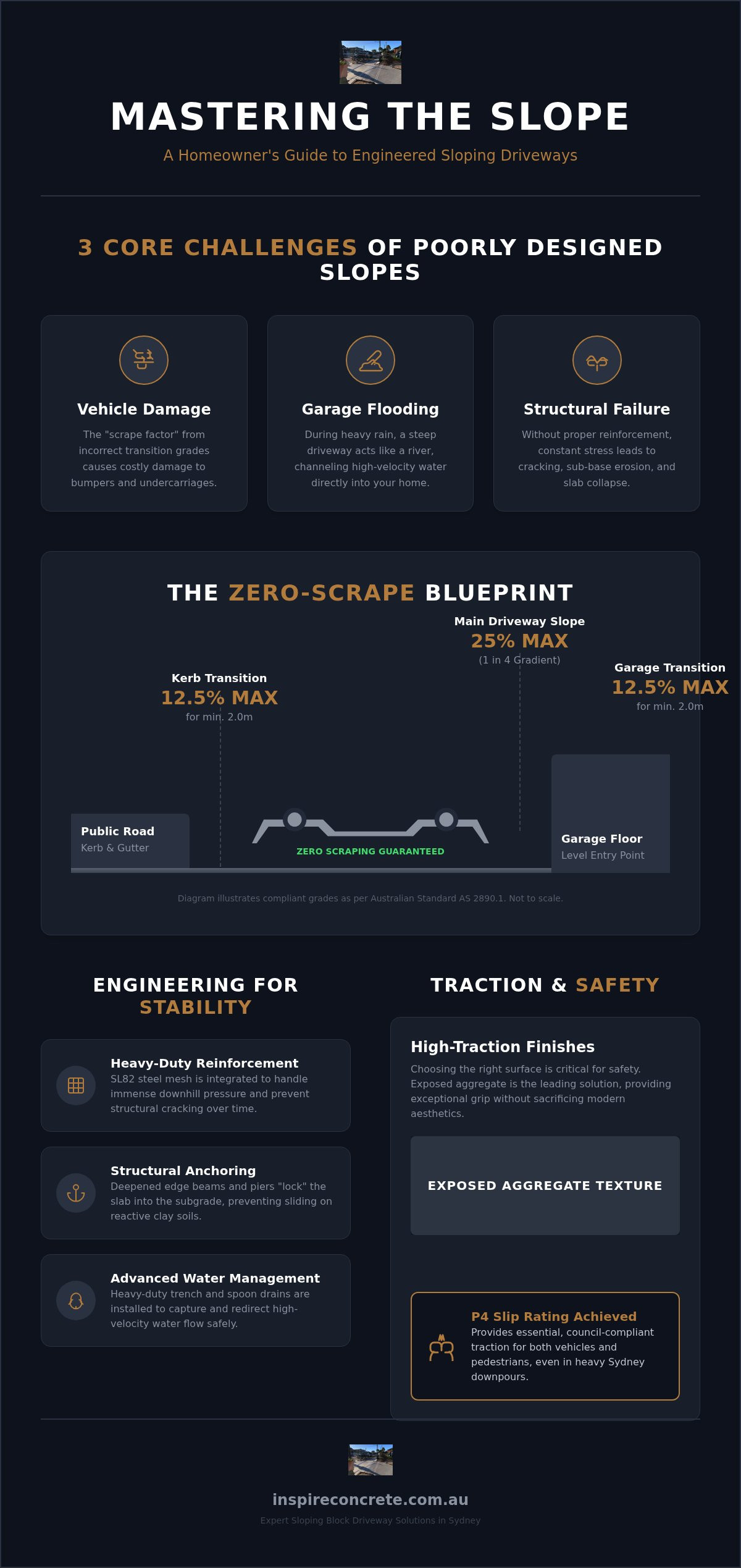
The “Scrape Factor” is the most immediate frustration for residents. This occurs at critical transition points where the driveway meets the council kerb or the garage floor. Without precise vertical curves, cars with standard ground clearance will inevitably bottom out. Effective sloping block driveway solutions sydney designers implement rely on transition grades of 12.5% or less for at least 2.0 metres at these junctions. This prevents the costly damage to bumpers and undercarriages that plagues poorly planned builds.
Hydro-dynamics also play a massive role. During Sydney’s intense wet seasons, a steep driveway effectively becomes a high-velocity river. If the surface isn’t engineered to intercept and redirect this energy, water will flood garages or undermine the entire structure. This is compounded by Sydney’s reactive clay soils, which expand and contract significantly. On a slope, this movement puts immense downhill pressure on the concrete, requiring specialized foundations to prevent the slab from creeping or sliding over time.
Common Risks of Poorly Designed Steep Driveways
A driveway that lacks professional engineering is a liability. Without heavy-duty reinforcement like SL82 steel mesh, the constant stress of heavy vehicles on an incline leads to structural cracking. Water often finds its way beneath the slab, washing away sub-base materials and creating dangerous hollow spots that eventually lead to collapse. Beyond the structural integrity, safety is a primary concern. Smooth finishes become skating rinks in the rain, making it nearly impossible for vehicles to gain traction or for pedestrians to walk safely on the incline.
The Critical Role of Professional Site Assessment
Precision is everything. A professional assessment starts with measuring the exact percentage of the slope to ensure it stays within the AS 2890.1 limit of 25%. We evaluate existing drainage paths and council-controlled kerb outlets to design a system that manages runoff without violating local regulations. In many cases, unstable ground requires deep piers or reinforced footings. These elements anchor the driveway to the bedrock, providing a permanent solution rather than a temporary fix. It’s about building a foundation that lasts for decades, not just until the next storm.
Engineering Stability: Advanced Drainage and Structural Solutions
Gravity is relentless. On a steep Sydney block, your driveway isn’t just a path; it’s a structural element holding back the earth. Standard surface sloping won’t suffice when thousands of litres of rainwater gain velocity down a 25% gradient. We prioritise engineering stability by treating every pour as a foundation project. This involves integrating heavy-duty SL82 mesh reinforcement to handle the immense downhill pressure and prevent structural failure. This level of reinforcement ensures the concrete remains a single, cohesive unit despite the massive forces acting upon it.
To stop a slab from “sliding” over time, we employ the “Anchor” effect. This is achieved through deepened edge beams that bite into the subgrade, effectively locking the concrete in place against the natural pull of the slope. We also calculate precise expansion joint placement to manage thermal movement. On long, sun-drenched slopes, concrete expands significantly; without these relief points, the pressure leads to unsightly buckling. These are the technical details that define high-end sloping block driveway solutions sydney residents can trust for long-term durability.
Hydro-Management: Drains, Grates, and Kerb Transitions
Water management is about redirection, not just collection. We install heavy-duty trench drains at the garage threshold and mid-slope to catch high-velocity runoff before it enters your home. Spoon drains are another effective tool, subtly diverting water into garden beds or council infrastructure. Managing the kerb-to-boundary transition is vital to ensure street water stays on the road where it belongs, adhering to the Australian Standard AS/NZS 2890.1 for stormwater compliance. These systems work in tandem to keep your garage dry and your site stable.
Retaining Walls and Structural Reinforcement
On extreme slopes, a single continuous pour isn’t always the best path. We often integrate retaining walls to create a levelled approach or tiered sections that make the gradient more manageable. These walls must have independent drainage, such as ag-lines, to prevent hydrostatic pressure from causing a structural collapse. Utilizing professionally poured concrete slabs within a tiered design provides a stable, flat landing for vehicles. If you’re ready to transform your site, our team can help you design a driveway that balances rugged engineering with refined craftsmanship.
Traction and Safety: Selecting the Best Concrete Finishes
Safety is the non-negotiable foundation of any steep build. While a smooth, steel-trowelled finish might look sleek on a flat suburban lot, it’s a liability on a 20% gradient. These surfaces are dangerous and non-compliant for sloping block driveway solutions sydney homeowners need. In wet conditions, smooth concrete lacks the necessary tyre coefficient of friction to allow a vehicle to stop or start safely. This is especially critical during high-torque movements, such as when a heavy SUV attempts to climb an incline from a stationary position. Without surface “bite,” tyres will spin, causing surface delamination and safety risks.
We balance aesthetic transformation with technical necessity. Every finish we select must meet a P4 or P5 slip rating to ensure the driveway remains functional in all weather. This isn’t just about the concrete itself; it’s about how the surface interacts with rubber under pressure. A well-chosen texture provides the mechanical grip required to counteract the natural pull of gravity, ensuring your vehicle stays exactly where you parked it. Choosing the right finish is the difference between a driveway that adds value and one that creates a daily hazard.
Exposed Aggregate: The Gold Standard for Steep Slopes
For most steep Sydney sites, exposed aggregate driveways are the superior choice. By removing the top layer of cement paste to reveal the internal stone, we create a natural, high-friction surface. We typically recommend a pebble size between 3mm and 7mm. This range provides optimal tyre grip without making the surface uncomfortable for bare feet. Beyond safety, aggregate is incredibly durable. It hides the minor scuffs from high-torque tyre wear and is more forgiving of the microscopic structural shifts that occur on sloping ground.
Alternative Finishes: Stencil, Stamp, and Cove
If aggregate doesn’t fit your vision, other high-traction options exist. A cove or broom finish is a cost-effective method where we pull a specialised tool across the wet concrete to create a textured “sawtooth” profile. While functional, it lacks the premium feel of decorative options. Stencilled patterns offer a refined look, provided we incorporate anti-slip additives into the final sealer. However, we generally advise against stamped concrete on steep slopes. The deep “valleys” in many stamped patterns can trap water or oil, creating hidden slippery patches that compromise safety. Our goal is always to deliver a result that looks sophisticated while functioning flawlessly under pressure.
Design Compliance: Meeting Sydney Council and Australian Standards
Compliance isn’t just about avoiding fines; it’s about ensuring your vehicle actually reaches the garage without a trip to the smash repairer. In Sydney, the definitive benchmark for any steep build is AS 2890.1. This standard dictates that the maximum allowable gradient for a residential driveway is 25%, or a 1 in 4 ratio. While this might sound like a simple limit, achieving it on a vertical site requires meticulous architectural drafting. If your design fails these standards, you’ll likely end up with a driveway that council rejects and that standard passenger vehicles simply cannot use.
The technical “Scrape Factor” mentioned in earlier sections is solved through the science of vertical curves. These are the calculated transitions between different gradients. A “Crest” curve prevents the middle of your car from high-centring at the top of a hill, while a “Sag” curve ensures your front bumper doesn’t dive into the concrete at the bottom. To remain compliant and functional, these transition zones must be at least 2.0 metres long with a grade of 12.5% (1 in 8). This gradual change accommodates the wheelbase of most modern cars, providing a smooth entry and exit regardless of the overall steepness. Without these curves, even the most expensive sloping block driveway solutions sydney residents invest in will fail to provide safe access.
The Science of Vertical Curves and Transitions
Designing the perfect transition requires a deep understanding of “Change of Grade” calculations. We don’t just pour concrete; we map the trajectory of a vehicle’s undercarriage. By implementing 2-metre transition zones at both the top and bottom of the grade, we eliminate the jarring impact of a sudden incline change. This engineering-first approach ensures that low-clearance vehicles can navigate the slope with zero scraping. It’s a level of precision that separates a basic contractor from a dedicated project partner.
To achieve this level of precision, many homeowners work with specialists like JSK Design Services to provide the civil and engineering expertise required for complex infrastructure and land development.
Navigating Council Approval in 2026
Any modification to the layback or the kerb entry requires a Section 138 application under the Roads Act. This is a mandatory legal requirement for any work within the public road reserve. In 2026, Sydney councils are increasingly strict regarding stormwater runoff and the protection of street trees. Applications must include detailed site plans and levels to prove the new driveway won’t negatively impact the surrounding infrastructure or heritage overlays. Navigating these bureaucratic hurdles can be a significant headache for homeowners.
This is where professional concreters in Sydney become essential. We handle the technical drawings, council liaisons, and permit applications on your behalf. We ensure your project meets every local regulation, from Blacktown’s specific permit fees to the environmental protections of the Northern Beaches. By managing the paperwork, we allow you to focus on the aesthetic transformation of your property. Ready to secure your council approval? Contact our expert team to start your architectural drafting today.
The Inspire Concrete Approach: Transforming Difficult Slopes
We don’t just pour concrete; we engineer outcomes. For more than two decades, our team has refined a process specifically designed to handle the most restricted-access and challenging sites across the Greater Sydney region. Our approach begins with a deep dive into your site’s unique geology. We specify 25MPa to 32MPa concrete for all steep applications to ensure the slab possesses the compressive strength required to withstand high-torque vehicular use. Using these higher-grade mixes, combined with SL82 reinforcement, provides a foundation that won’t succumb to the downhill pressures or reactive soil movements common in our local landscape.
A well-engineered driveway is a significant value add that transforms your property’s marketability. In a city where vertical blocks are common, a property with a safe, scrape-free, and aesthetically refined entrance commands a premium. It changes a perceived topographical weakness into a sophisticated architectural feature. We take pride in this transformation, moving beyond simple utility to realize a creative vision that enhances your lifestyle and long-term property value. This commitment to excellence is why we are the preferred choice for sloping block driveway solutions sydney homeowners trust for complex builds.
End-to-End Project Management and Drafting
Providing detailed plans that satisfy both structural engineers and local councils is the first step in our partnership. We manage the logistical hurdles of complex excavations and soil removal, which is often the most stressful phase on tight Sydney blocks. Project management acts as the essential bridge between a creative vision and a compliant concrete driveway that stands the test of time. Our team ensures every level is shot accurately and every drainage channel is positioned for maximum efficiency before the first truck arrives, delivering the comprehensive sloping block driveway solutions sydney residents need for a seamless experience.
Long-Term Maintenance for Steep Surfaces
Protecting your investment against the harsh Sydney elements requires a proactive maintenance strategy. High-pressure cleaning is essential for steep surfaces; it removes the build-up of organic matter and road grime that can compromise your P4 slip rating. We recommend using a high-quality penetrative sealer rather than a topical film, as penetrative sealers protect the concrete from within without creating a slippery high-gloss layer. During your annual inspections, we suggest focusing on three key areas:
- Expansion Joints: Ensure they are free of debris and haven’t pulled away from the slab.
- Drainage Efficiency: Clear all trench drains and grates of leaf litter to prevent overflow during storms.
- Surface Integrity: Check for any moss or algae build-up that could create a slip hazard in wet weather.
This steady, logical approach to maintenance ensures the durable result we promise remains a functional, safe, and beautiful asset for your home for decades to come.
Build Confidence on Every Incline
Transforming a vertical site into a functional masterpiece requires more than just pouring concrete; it demands a fusion of rigorous engineering and refined design. We’ve explored how mastering the 12.5% transition grade and implementing advanced hydro-management systems can eliminate the daily stress of vehicle scraping and garage flooding. By choosing high-traction finishes like exposed aggregate, you ensure your property meets the essential P4 safety ratings while significantly boosting its market appeal. These are the definitive sloping block driveway solutions sydney homeowners rely on for long-term stability and style.
Navigating council regulations and complex excavations shouldn’t be a solo journey. With 20+ years of Sydney experience, our licensed and insured concreters provide full architectural drafting services to ensure your project is compliant from the first sketch. We act as your dedicated project partner, managing every technical hurdle to turn your challenging terrain into a durable asset. Ready to realize your vision? Get a Professional Quote for Your Sloping Driveway Solution and start your property’s transformation today. Your perfect entrance is closer than you think.
Frequently Asked Questions
What is the maximum gradient allowed for a driveway in Sydney?
The maximum allowable gradient for a residential driveway in Sydney is 25%, which is a 1 in 4 ratio according to Australian Standard AS 2890.1. However, this steepness is only permitted if the design includes mandatory transition grades. These transition zones must be at least 2.0 metres long with a gradient of 12.5% or less at the top and bottom. This ensures the compliant sloping block driveway solutions sydney homes require for safe access.
How do I stop my car from scraping on a steep driveway?
To prevent your car from scraping, you must implement precisely engineered vertical curves known as transition zones. By designing a 2.0-metre long section at a 12.5% grade where the driveway meets the road and the garage, you create a gradual change that accommodates the vehicle’s wheelbase. This prevents the front bumper or the undercarriage from making contact with the concrete, ensuring a smooth entry and exit on even the steepest inclines.
Is exposed aggregate better than pavers for a sloping block?
Exposed aggregate is generally superior to pavers for steep inclines because it forms a monolithic slab that won’t shift under pressure. Pavers can become loose over time due to the constant downhill force of braking vehicles. In contrast, exposed aggregate provides consistent, stone-based traction and structural integrity. It’s one of the most reliable sloping block driveway solutions sydney homeowners can choose for long-term safety and aesthetic appeal.
How much does a sloping driveway cost compared to a flat one in Sydney?
Sloping driveways typically require a larger investment than flat ones due to extensive earthworks and specialized equipment. You’ll need to account for third-party costs such as concrete pumping, which typically ranges from $1,200 to $2,000 per pour on steep sites. Additionally, excavation and soil removal costs vary significantly depending on the volume of earth shifted. These factors, combined with enhanced structural reinforcement, reflect the complexity of engineering a safe incline.
Do I need council approval to change the slope of my driveway?
Yes, council approval is mandatory for any works modifying the layback or the connection between your property and the public road. This is usually managed through a Section 138 application under the Roads Act. In areas like Blacktown, council permit fees start at approximately A$340. Professional site plans and architectural drafting are required to ensure your driveway gradient doesn’t negatively impact street infrastructure, adhering to the strict standards set by local authorities.
Can I use plain concrete on a steep slope, or will it be too slippery?
Plain concrete can be used on a steep slope, but it must never have a smooth or steel-trowelled finish. To ensure safety, plain concrete requires a heavy broom or cove finish to provide the necessary traction. However, for maximum grip in Sydney’s wet seasons, we recommend decorative options like exposed aggregate. These finishes naturally achieve the P4 slip rating required for steep residential gradients without compromising the aesthetic value of your property.
What drainage is best for a driveway that slopes toward the garage?
The most effective solution for driveways sloping toward a garage is a combination of heavy-duty trench drains and spoon drains. A high-capacity trench drain should be installed across the full width of the garage threshold to intercept high-velocity runoff. Additionally, spoon drains can be used mid-slope to divert water into garden beds or council stormwater systems. This prevents the garage from flooding during the intense downpours common in the Sydney region.
How long does it take to install a reinforced concrete driveway on a slope?
Installing a reinforced concrete driveway on a slope generally takes between five and ten working days. This timeline includes site assessment, council-compliant drafting, earthworks, and the final pour. Once the concrete is laid, it requires a curing period before it can support vehicle weight. We manage this entire process to ensure the transition from a difficult slope to a durable result is seamless and efficient for our clients.
