
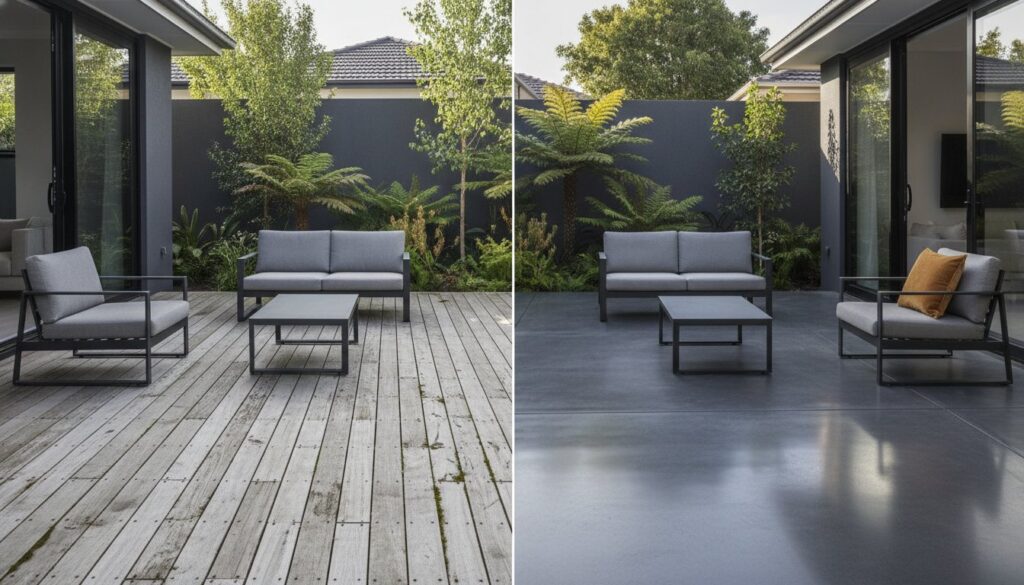
That traditional timber deck you think is saving you money today is likely the most expensive asset on your property by 2030. While the warm aesthetic is tempting, the reality of Sydney’s high humidity and the constant threat of termites in Western Sydney can quickly turn a weekend retreat into a permanent maintenance burden. When calculating the timber deck vs concrete patio cost sydney homeowners must look past the initial invoice to see the true price of long-term upkeep.
You deserve an outdoor space that reflects your lifestyle and adds genuine resale value without demanding your entire weekend for repairs. It’s a choice between a structure that requires constant intervention and one that offers a sophisticated, low-maintenance foundation for your family’s memories. This guide promises to clarify the total cost of ownership, balancing the immediate allure of timber against the rugged craftsmanship and structural ROI of a decorative concrete solution.
We’ll preview the impact of 2026’s 4.8% building cost escalation and how Sydney’s reactive clay soils dictate your project’s engineering needs. You’ll also find clarity on council permit thresholds for raised structures so you can plan your transformation with total confidence.
Key Takeaways
- Understand the initial investment gap between high-end timber and structural concrete, including why specialized carpentry often commands a higher premium than professional pouring.
- Evaluate the true timber deck vs concrete patio cost sydney by factoring in the relentless cycle of oiling, sanding, and termite protection required for wood in our humid climate.
- Learn how Sydney’s reactive clay soils impact long-term structural integrity and why precision engineering is vital to prevent shifting or cracking over time.
- Explore how modern architectural finishes like exposed aggregate and stencilled patterns create a seamless indoor-outdoor flow that significantly enhances property resale value.
- Discover the specific site conditions where a concrete patio becomes the undisputed winner for homeowners seeking a durable, low-maintenance entertaining area.
The Upfront Investment: Timber Deck vs. Concrete Patio Costs in Sydney
Securing an accurate quote for your outdoor renovation requires looking beyond the raw materials. The financial foundation of your project starts with understanding that timber is an additive process while concrete is a structural one. When weighing the timber deck vs concrete patio cost sydney residents often see a lower entry point for basic treated pine, yet the labour intensity of carpentry quickly narrows the gap. A deck requires a tiered skeleton of bearers and joists, each meticulously levelled and fixed. In contrast, a concrete patio relies on the precision of the formwork and the efficiency of the pour.
Skilled labour in New South Wales carries a significant price tag. Before you begin, it’s vital to understand what is a timber deck in terms of structural complexity. Deck builders generally operate at a higher hourly rate than concreters because of the technical joinery involved. However, concrete projects often involve high-cost equipment like line pumps and excavators. Sydney’s unique geography adds another layer of complexity. The cost of transporting materials through narrow suburban streets and the high fees for waste removal at local transfer stations can create a “Sydney Premium” that catches many off guard.
Initial Material and Labour Breakdown
For timber, your primary cost drivers are the species and the sub-structure. Hardwood boards offer elegance but require robust, expensive framing. Concrete costs are driven by several technical factors:
- Reinforcement: Steel mesh provides the tensile strength needed for longevity in Sydney’s shifting ground.
- Pump Hire: Essential for sites with restricted access or long distances from the street.
- Finish Complexity: Choosing an exposed aggregate finish bridges the gap between utility and luxury.
While plain concrete provides functional utility, these decorative options offer a textured, slip-resistant surface that rivals the aesthetic of premium timber without the same labour-intensive installation over time.
The Impact of Site Slope on Your Budget
Terrain is the ultimate decider for your budget. On steep gradients, timber is often the pragmatic choice. It allows us to build out from the house using stumps and posts without massive earthworks. For flat ground or existing alfresco extensions, a concrete slab is almost always more cost-effective. If your block has a moderate slope, you’ll need to account for “cut and fill” costs. This involves excavating one side and reinforcing the other to create a level base. This process ensures structural stability and prevents future movement in Sydney’s challenging soil conditions.
Beyond the Quote: Maintenance and the Total Cost of Ownership
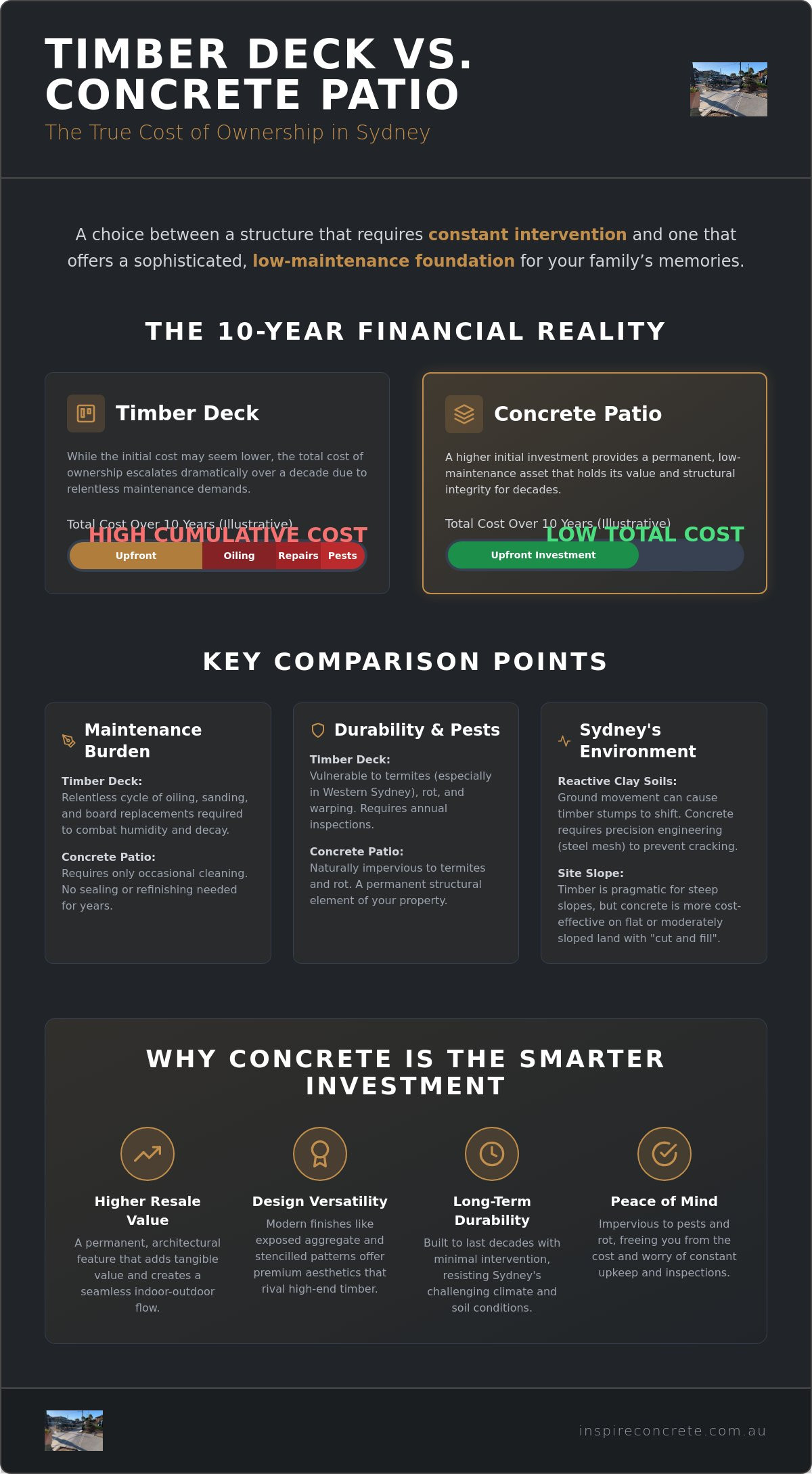
The initial quote for your outdoor space is only the first chapter of its financial story. When analyzing the timber deck vs concrete patio cost sydney homeowners often overlook the cumulative expenses that accrue over a decade. While timber offers an organic warmth, it demands a disciplined maintenance schedule to survive the harsh Australian elements. A high-quality concrete slab, by contrast, acts as a permanent architectural feature that resists the relentless cycle of decay. Over a ten year period, the cost of professional oiling and board replacements can easily exceed the original installation price of a concrete alternative.
Pest management is another critical factor for Sydney residents, particularly in the Western suburbs. Termites pose a constant threat to timber structures, necessitating annual inspections and chemical barriers that add to your yearly outgoings. Concrete is naturally impervious to these pests, providing a sense of certainty that timber simply cannot match. When you consider the Design Versatility of modern materials, it’s clear that choosing a durable foundation is as much a financial decision as it is an aesthetic one.
The Timber Maintenance Schedule
Sydney’s intense UV exposure and coastal humidity are the natural enemies of wood. You will likely find yourself in a cycle of sanding and oiling every 12 to 18 months just to prevent the boards from greying and splintering. After five years, even the best-maintained decks often require professional restoration to address structural degradation. Rot, warped joists, and loose fixings aren’t just unsightly; they represent ongoing liabilities that drain your time and budget.
The Concrete Maintenance Reality
Concrete is the undisputed champion of longevity. It doesn’t rot, it doesn’t host termites, and it doesn’t warp under the Western Sydney sun. Maintenance is remarkably straightforward, usually requiring nothing more than a seasonal pressure wash to keep the surface looking pristine. To preserve the specialized finishes and protect against staining, we recommend professional concrete cleaning and sealing every two to three years. This simple step ensures your entertaining area remains a high-value asset. For coastal properties, concrete’s resistance to salt air makes it the superior choice, as it won’t corrode or degrade like the metal fixings and organic fibres found in traditional decking.
Structural Engineering in Sydney’s Reactive Clay Soils
The ground beneath your feet dictates the longevity of your outdoor investment more than any surface material ever could. In the Sydney Basin, our geology is defined by reactive clay soils. Reactive clay is soil that significantly expands and contracts with moisture changes. When examining the timber deck vs concrete patio cost sydney homeowners must account for this subterranean movement. Without precise engineering, the shifting ground can cause timber posts to sink or heave, leading to an unlevel deck. For concrete, this same movement can result in unsightly structural cracks if the slab hasn’t been designed to withstand the pressure of the earth below.
Our approach at Inspire Concrete focuses on neutralizing these environmental variables through superior engineering. While a timber deck relies on isolated bored piers that must reach stable depths, our slabs utilize thickened edges and integrated footings to distribute weight evenly. We prioritize heavy-duty reinforcement and meticulous base preparation to ensure your alfresco area remains a permanent part of your home’s footprint. This level of structural integrity is what separates a basic trade job from a master-built architectural feature.
Understanding Soil Classification (Class M to H2)
Western Sydney homeowners frequently deal with Class M (Moderate) to Class H2 (Highly) reactive sites. On these blocks, the soil movement is aggressive. To counter this, we increase slab thickness and utilize higher grades of steel reinforcement mesh. This creates a rigid “raft” that moves as a single unit, preventing the differential settlement that often plagues poorly constructed timber footings. By engineering for the specific reactivity of your block, we eliminate the guesswork and provide a foundation that supports your creative vision for decades.
Drainage and Sub-floor Ventilation
Water is the primary catalyst for soil movement and the greatest threat to your structure’s health. Poor drainage leads to pooling, which causes clay to swell and timber to rot from the underside. While decks require significant sub-floor clearance to allow for ventilation and moisture escape, concrete patios utilize integrated surface drains and strategic falls to direct runoff away from the house. Professional concreters in Sydney design these systems to handle 100-year storm events. This proactive water management protects your slab from hydrostatic pressure and ensures your entertaining area remains dry and stable, regardless of the season.
For homeowners who choose timber, managing this airflow is vital for longevity. Subfloor Ventilation Sydney offers specialized systems to ensure that moisture does not accumulate beneath your deck or home, preventing the dampness that leads to premature wood rot.
Design Versatility: Matching Your Outdoor Area to Sydney Home Styles
Sydney architecture has moved far beyond the utilitarian backyards of the past. Today, homeowners demand a seamless transition between their living rooms and their landscapes. When evaluating the timber deck vs concrete patio cost sydney, the aesthetic potential of the material is often the deciding factor. While natural timbers like Spotted Gum and Blackbutt offer undeniable warmth for traditional designs, modern concrete technology has bridged the visual gap. We can now create flush-threshold slabs that sit perfectly level with your internal flooring, erasing the physical and visual barriers that traditional raised decks often create.
Thermal performance is another vital consideration for our climate. Concrete possesses high thermal mass, meaning it absorbs the day’s heat and releases it slowly as the evening cools. This makes a patio a comfortable space for late-night entertaining. Timber decks, while cooler under the direct midday sun because they don’t store heat, can often feel flimsy or hollow compared to the solid, permanent feel of a structural slab. This sense of permanence is a hallmark of refined craftsmanship that elevates the entire property’s presence.
Decorative Concrete vs. Natural Timber
The “grey and boring” stereotype of concrete is a relic of the past. Professional exposed aggregate finishes allow us to reveal natural stones and river pebbles, achieving a high-end look that rivals expensive stone paving. For those who still crave specific patterns, stencil concrete or stamped concrete can mimic the appearance of slate, brick, or even timber grain. This provides the visual texture of organic materials without the susceptibility to rot or the need for constant staining. By using specialized oxides, we can match your new entertaining area to your home’s existing brickwork or render, creating a unified architectural statement.
Resale Value and Market Appeal
In the competitive Sydney real estate market, low-maintenance living is a premium commodity. Buyers are increasingly wary of “project homes” that come with a list of chores. A professionally installed alfresco and entertaining area built on a stable concrete foundation signals quality and longevity. It provides the necessary structural support for heavy outdoor kitchens, pizza ovens, and built-in seating. When a prospective buyer sees a concrete patio, they see a permanent asset. When they see a timber deck, they often see a future maintenance bill. This shift in perception makes a durable slab the undisputed winner for long-term property ROI.
Ready to transform your backyard into a high-value asset? Explore our range of custom alfresco and entertaining areas to find the perfect fit for your Sydney home.
Making the Choice: Why a Concrete Patio Is the Smarter Sydney Investment
The final choice between materials often comes down to the specific geometry of your land and your appetite for ongoing labour. When evaluating the timber deck vs concrete patio cost sydney, timber remains a viable option for properties with extreme slopes where the cost of retaining walls and bulk excavation might outweigh the price of a sub-floor. It’s also the necessary choice for certain Heritage Conservation Areas where council regulations mandate specific period-correct materials. However, for the vast majority of Sydney residential blocks, a concrete patio stands as the undisputed winner for long-term value and structural ROI.
The “Inspire Difference” is built on 20 years of engineering expertise across the Sydney Metro area. We understand that your outdoor area isn’t just a slab; it’s a structural extension of your home’s creative vision. Moving from a basic backyard to a refined architectural entertaining area requires a partner who treats the pour with the same precision as a fine furniture maker treats a joint. We focus on the engineering required for our local climate, ensuring your investment remains as stable and elegant in a decade as it is on the day we finish the pour.
The Decision Framework
Before you commit to a quote, run your project through this final checklist to determine which material aligns with your lifestyle:
- Slope: Is the ground flat or moderately sloped? Concrete is your most stable foundation.
- Budget: are you looking at the 2026 invoice alone, or the cumulative 10-year total cost?
- Maintenance Tolerance: Do you want to spend your weekends oiling timber or relaxing?
- Style: Does your home demand a modern, flush-threshold indoor-outdoor flow?
Concrete offers the ultimate “set and forget” solution for busy Sydney families. It provides a durable, slip-resistant surface that handles the high-traffic demands of kids, pets, and heavy outdoor furniture without the risk of splinters or structural rot. Consulting with a licensed professional ensures you avoid common DIY pitfalls like poor drainage or insufficient reinforcement in our reactive clay soils.
Next Steps for Your Sydney Project
Transforming your backyard starts with an accurate, site-specific assessment. While generic online calculators give a rough idea of the timber deck vs concrete patio cost sydney, they can’t account for your specific soil classification or site access requirements. For complex outdoor areas, architectural drafting is often essential to ensure your new alfresco area integrates perfectly with your existing home and meets all council exempt development criteria for area and height.
You can Contact Inspire Concrete for a professional site assessment today. We’ll help you navigate the technical requirements and design choices needed to realize your creative vision and enhance your lifestyle with a result that is built to last.
Elevate Your Lifestyle with a Foundation Built to Last
Deciding on the right outdoor material requires a balance of immediate vision and long-term financial clarity. While timber offers a classic warmth, the timber deck vs concrete patio cost sydney homeowners face over time reveals that durability is the ultimate luxury. By engineering for Sydney’s reactive clay and choosing architectural finishes, you replace a cycle of sanding and oiling with a permanent, sophisticated entertaining area. To truly complete this space, many homeowners integrate premium shading and weather protection from Best Outdoor Blinds, ensuring the area remains functional year-round. It’s about moving away from high-maintenance chores and toward a space that genuinely serves your family for decades.
At Inspire Concrete, we bring over 20 years of Sydney-specific experience to every project. As licensed and insured master concreters, we specialize in high-end exposed aggregate and refined architectural finishes that transform basic backyards into high-value assets. We take pride in the precision of our craft, ensuring every slab is a masterwork of both engineering and artistry. Transform your backyard with a custom concrete patio. Get a professional quote from Inspire Concrete today. Your vision deserves a foundation that stands the test of time.
Frequently Asked Questions
Is a concrete patio cheaper than a timber deck in Sydney?
A concrete patio is generally more cost-effective when you evaluate the total 10-year timber deck vs concrete patio cost sydney. While basic treated pine might seem comparable at the initial quote, the intricate labour required for a deck’s sub-structure and the rising cost of premium hardwoods often make structural concrete the more affordable long-term investment. Concrete provides a permanent foundation that doesn’t require the expensive recurring material costs associated with timber upkeep.
How long does a concrete patio last compared to a timber deck?
A professionally engineered concrete patio can last 30 to 50 years, whereas a timber deck typically reaches the end of its functional life within 15 to 20 years. Even with high-end hardwoods, the organic nature of wood means it eventually succumbs to rot or structural fatigue in Sydney’s humidity. Concrete remains a permanent architectural feature of your property that doesn’t warp, splinter, or lose structural integrity over the decades.
Do I need council approval for a concrete patio or timber deck in Sydney?
You often don’t need a full Development Application if the structure meets “Exempt Development” criteria, such as being under 25 square metres and less than 1 metre above ground. However, decks higher than 600mm or projects in Heritage Conservation Areas almost always require a Complying Development Certificate or council approval. It is vital to verify your specific site plan against current NSW planning standards before starting any construction.
Can I build a concrete patio on a sloping block?
Yes, you can build a concrete patio on a slope by utilizing retaining walls and “cut and fill” excavation techniques. While timber decks are often the default for steep gradients to avoid earthworks, a tiered concrete patio provides a much more stable and durable entertaining area. This approach creates a solid foundation that won’t bounce or shift like a raised timber platform, ensuring your furniture and outdoor kitchen remain perfectly level.
Which adds more value to a Sydney home: a deck or a patio?
A decorative concrete patio typically adds more long-term resale value because Sydney buyers prioritize low-maintenance lifestyles and durability. While a new deck looks beautiful, savvy purchasers recognize the future cost of oiling and repairs. A high-end finish like exposed aggregate signals quality and permanence, making it a more attractive asset during a property appraisal compared to a timber structure that may already show signs of weathering.
Is concrete or timber better for termite-prone areas in Western Sydney?
Concrete is the undisputed choice for termite-prone regions because it offers no food source for pests. Timber decks, even those using treated materials, require ongoing chemical barriers and annual inspections to prevent infestation. Choosing a concrete slab eliminates this risk entirely, providing peace of mind and reducing your annual property maintenance expenses. It’s a “set and forget” solution that protects your home’s structural perimeter from subterranean threats.
How much maintenance does a decorative concrete patio actually need?
Maintenance is remarkably low, requiring only a seasonal pressure wash and professional resealing every two to three years. This simple process preserves the colour and protects the surface from oil or food stains. Unlike timber, there is no need for sanding, staining, or replacing warped boards. This allows you to spend your time enjoying your outdoor space rather than working on it, which is the ultimate goal of a modern Sydney lifestyle.
Can you pour concrete over an existing timber deck?
No, you should never pour concrete directly over a timber deck. The wood will eventually rot underneath the slab, causing the concrete to crack and fail as the support structure collapses. The correct method involves removing the old deck, preparing the subgrade, and engineering a proper base. This ensures your new patio remains structurally sound and prevents the costly repairs associated with a failed foundation.
