

Have you ever wondered why that expensive stone path you installed three years ago is already a tripping hazard of uneven edges and weeds? In Sydney, where reactive clay soil can shift by several millimetres during a single seasonal cycle, a standard DIY approach often leads to heartbreak and wasted investment. Choosing a professional concrete pathway installer isn’t just about pouring a slab; it’s about engineering a solution that respects the local geography while elevating your home’s aesthetic.
You deserve a side access that stays dry during a February storm and a front entrance that makes a lasting impression on every guest. We agree that your home should be a sanctuary of safety and style, free from the frustration of muddy shoes and cracked surfaces. This article reveals how we combine structural integrity with bespoke finishes to transform your outdoor space into a durable masterpiece that can increase property appeal by up to 15 percent. We will walk you through the latest 2026 design trends, the science of soil preparation, and how to inspire a complete property transformation with a single, expertly crafted walkway.
Key Takeaways
- Learn how to select bespoke finishes that harmonize with Sydney’s diverse architectural eras, from heritage Federation to contemporary coastal designs.
- Understand the critical engineering techniques used to navigate Sydney’s reactive clay soils and prevent structural cracking in your new walkway.
- Discover the essential safety P-ratings and local council regulations required to ensure your project is both compliant and slip-resistant.
- Identify how an expert concrete pathway installer can transform neglected outdoor zones into seamless, elegant spaces that add significant property value.
- Master the planning process to move beyond high-maintenance pavers toward a durable, low-maintenance solution built for the Australian climate.
Enhancing Your Sydney Property with Professional Concrete Pathways
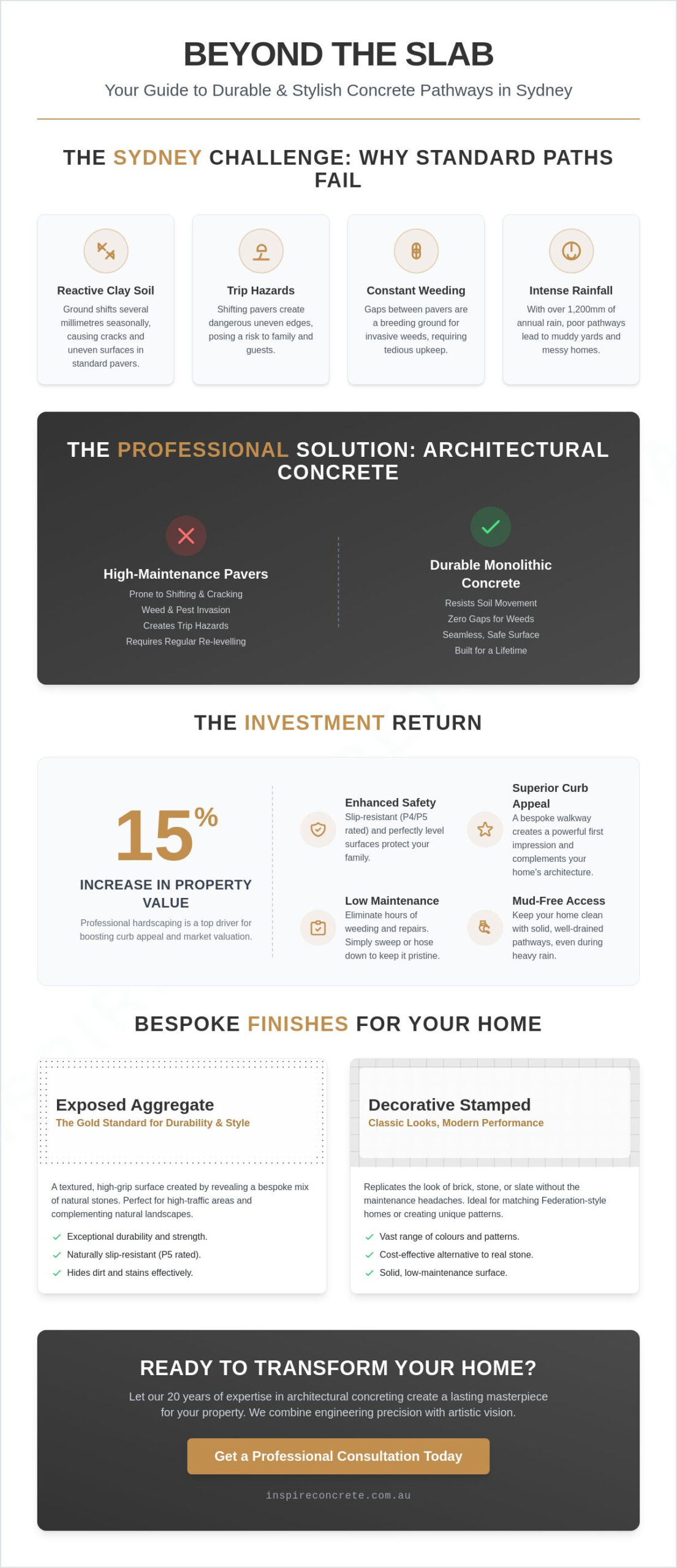
A pathway is far more than a simple strip of stone or cement. It acts as the connective tissue of your landscape, guiding the eye and the feet through your outdoor environment. In Sydney’s competitive property market, where first impressions dictate market interest, a well-designed walkway serves as a critical design feature. Many homeowners are now moving away from traditional pavers in favor of seamless concrete. Pavers often shift over time, creating trip hazards and allowing invasive weeds to take root. A professional concrete pathway installer provides a monolithic, durable surface that resists the movement common in Sydney’s clay-heavy soils.
Investing in high-quality walkways significantly boosts curb appeal and overall property valuation. Industry research indicates that professional landscaping and hardscaping can increase a home’s value by as much as 15%. This isn’t just about utility. We categorize our work as “Architectural Concreting” rather than standard utility pours. While a basic path provides access, an architectural path complements the home’s facade, using color and texture to create a cohesive aesthetic. It’s the difference between a functional slab and a curated design element that defines the character of your residence.
Functional Benefits: From Mud-Free Yards to Safety
Sydney’s weather cycles are often intense, with average annual rainfall exceeding 1,200mm. Without proper infrastructure, garden beds and lawn edges quickly turn into mud pits that residents track into their homes. A solid concrete path eliminates this mess entirely. Safety is another primary driver for this upgrade. We prioritize level, slip-resistant surfaces that provide security for young children and elderly family members alike. Because concrete is a continuous surface, it removes the maintenance burden of weeding between joints, keeping your garden looking sharp with minimal effort.
The Inspire Difference: Where Engineering Meets Artistry
Our team brings 20 years of hands-on experience to projects across the Sydney Metro area and the Blue Mountains. We don’t just pour liquid stone; we manage complex residential projects with the precision of licensed project managers. This ensures every pour meets strict Australian Standards for structural integrity. As a specialist concrete pathway installer, we take a bespoke approach to every site. We analyze your home’s existing architecture to match textures and tones perfectly. Whether it’s a sleek contemporary finish or a rugged exposed aggregate, we ensure the result feels like a natural extension of your lifestyle.
Inspiring Design Examples: Choosing the Right Finish for Your Home
Selecting the perfect finish isn’t just about picking a colour from a brochure. It’s a strategic design solution that bridges the gap between your home’s architecture and the natural Sydney landscape. A professional concrete pathway installer views your walkway as a permanent asset that must balance aesthetics with rigorous safety standards. In Sydney, this means adhering to the AS 4586:2013 slip-resistance classifications. We typically recommend a P4 or P5 rating for outdoor slopes and stairs to ensure your family remains safe during intense summer storms.
Your home’s era dictates the direction of the finish. Federation-style homes in suburbs like Haberfield benefit from the classic textures of stencilled brick, while contemporary builds in the Hills District often require the sleek, industrial look of honed charcoal slabs. We focus on creating a seamless flow that enhances property value by at least 5% to 10% through improved curb appeal. This transformation turns a simple utility into a premium architectural feature.
Exposed Aggregate: The Gold Standard for Sydney Gardens
Exposed Aggregate is the premier choice for Sydney garden paths because it combines raw structural strength with a sophisticated, textured surface. By stripping away the top layer of cement paste, we reveal a bespoke mix of river pebbles, quartz, or basalt. This finish provides exceptional visual depth and naturally hides dirt or leaf stains from overhanging gum trees. It’s the most durable option for high-traffic side-access paths where longevity is non-negotiable. You can explore how this aesthetic translates to larger surfaces on our Exposed Aggregate Driveways Sydney pillar page.
Decorative Stamped and Stencilled Concrete
If you love the look of traditional materials but hate the maintenance, decorative concrete is your answer. We use precision mats and stencils to emulate slate, cobblestone, or reclaimed brick. Unlike individual pavers, a continuous concrete slab prevents weed growth and ensures the surface won’t shift or sink over time. For homes near the coast or the CBD, we often use specific colour-matching techniques to complement the iconic Sydney sandstone features found in local retaining walls and garden edging.
Modern Minimalism: Honed and Coloured Finishes
Contemporary Western Sydney builds are currently dominated by charcoal, smoke, and off-white tones. Honed concrete offers a smooth, matte finish that feels premium underfoot, making it ideal for alfresco-to-pathway transitions. Many homeowners who invest in a premium pathway also extend their vision to a concrete patio in Sydney to create a fully cohesive outdoor living space. To achieve a high-end look, a skilled concrete pathway installer uses deep saw-cut joints. This technique creates a large-format tile aesthetic without the risk of cracked grout lines. It’s a clean, architectural approach that turns a simple walkway into a design statement. If you’re ready to upgrade your exterior, inspire your next project with a consultation from our design team.
Built for Sydney: Navigating Reactive Clay Soils and Drainage
The most common question we hear from homeowners is simple: “Will my new pathway crack within a year?” In Sydney, that concern is valid. Our region is defined by highly reactive clay soils that expand and contract aggressively as moisture levels change. Without an expert concrete pathway installer who understands this geological volatility, even the most beautiful finish will eventually fail. We don’t just pour concrete; we engineer a foundation that survives the seasonal shift from bone-dry summers to torrential East Coast Lows.
Structural integrity begins beneath the surface. We excavate to a precise depth and replace unstable topsoil with a high-quality road base, compacted to 98% density to create a rigid platform. Proper steel reinforcement is non-negotiable for Sydney pathways because it provides the tensile strength required to resist the ground’s natural heave. By treating the sub-base with this level of technical rigor, we ensure your investment remains level and intact for decades.
The Science of Sydney Soil: Preventing Cracks
In regions like Western Sydney and the Hills District, soil reactivity is often classified as Class H1 or H2, meaning the ground can move up to 75mm during wet and dry cycles. We address this by increasing slab thickness to 125mm for heavy-duty paths and utilizing expansion joints every 2.4 to 3 metres. These joints allow the concrete to breathe and move independently, preventing the internal pressure that leads to unsightly surface fractures. Our installers calculate these load-bearing requirements based on the specific AS 2870 standards to guarantee a bespoke solution for your property’s unique footprint. If you’re also planning a new build in the region, understanding how house slab builders in Western Sydney engineer foundations for these same reactive H1 and H2 soils is essential reading before you commit to any concrete work on your property.
Intelligent Drainage Solutions for Sloping Blocks
Sydney’s undulating topography means water management is just as critical as the concrete itself. Poorly planned paths often act as dams, trapping water against house foundations and causing rising damp or structural rot. We integrate sophisticated drainage systems into our designs to protect your assets. Every project considers the following essentials:
- Precision Grading: We maintain a minimum 1:100 fall to ensure surface water moves efficiently away from the building.
- Strip Drains: Discreet, high-capacity channels installed at the base of slopes or near doorways to capture runoff.
- Stormwater Pits: Strategic collection points that connect directly to your existing infrastructure to prevent pooling.
Choosing a professional concrete pathway installer means you’re investing in a system that protects your entire home. We transform your outdoor space by blending these technical necessities with an elegant finish that will inspire pride every time you walk to your front door.
Planning Your Project: Council Regulations and Installation
Executing a flawless concrete project requires more than just technical skill; it demands a strategic approach to local compliance and site preparation. Your journey begins by identifying the exact location of the work. If the path stays within your property boundaries, you have more creative freedom. However, if the design extends toward the public verge or nature strip, you are interacting with council assets. This distinction is the first step in ensuring a seamless installation process.
Second, you must verify the specific codes for your Local Government Area (LGA). For example, Blacktown City Council and the City of Parramatta maintain distinct specifications for footpath thickness and reinforcement that differ from Sydney City requirements. Third, safety is a non-negotiable priority. Every professional concrete pathway installer must lodge an enquiry with Before You Dig Australia (BYDA). This identifies the location of underground electricity, gas, and telecommunications 100 percent of the time before any excavation begins. Finally, select a finish that adheres to the AS 4586:2013 slip-resistance standards. This ensures your elegant walkway remains safe during Sydney’s intense summer storms.
Understanding Sydney Council Requirements
Navigating the intersection of private property and public infrastructure is a specialized task. If your path connects to the street or affects the “Kerb and Gutter,” you are dealing with public assets. You will likely need a Section 138 permit under the Roads Act 1993 if the work involves a “Vehicular Crossing” near your driveway. Boundary lines are equally vital. Discuss side-access paths with your neighbours early to ensure the project respects shared easements and drainage patterns. This proactive communication prevents disputes and ensures the structural integrity of the boundary remains intact.
What to Look for in a Licensed Sydney Installer
Quality craftsmanship starts with legal compliance. Always verify that your contractor holds a valid NSW Fair Trading licence for concreting. Under the Home Building Act 1989, any residential work exceeding A$5,000 requires specific insurance and a written contract. Demand a detailed, fixed-price quote. This document should outline excavation depths, steel reinforcement grades, and the exact decorative finish to prevent unexpected costs. Review their local Sydney portfolio to ensure their aesthetic matches your vision for a bespoke outdoor space. A true concrete pathway installer will provide references from projects completed within the last 12 months to prove their current reliability.
Transforming Your Outdoor Space with Inspire Concrete
Choosing a professional concrete pathway installer is about more than just laying a slab; it’s an investment in your home’s flow and functionality. At Inspire Concrete, we view every project as a lifestyle transformation. We specialise in reclaiming those neglected “dead zones” along the side of your house or through your garden, turning muddy tracks into elegant, structural assets. Our team bridges the gap between rugged trade expertise and refined design, ensuring your new walkway serves as a seamless extension of your architecture.
A well-designed path does more than provide a dry place to walk. It defines the boundaries of your landscape and increases the usable square footage of your property. By integrating high-end finishes with structural integrity, we help you create an environment that feels finished and intentional. Many of our clients choose to complement their new pathway with a professionally designed concrete patio installation in Sydney to complete their outdoor transformation. You can explore our Project Gallery to see how we have transformed local Sydney residences with bespoke concrete solutions.
Our End-to-End Pathway Process
We manage every technical detail so you don’t have to. Our process begins with a detailed consultation and architectural drafting of the pathway layout. We don’t just follow the dirt; we plan for optimal drainage and aesthetic alignment. Following the design phase, we move into precision excavation. Using specialised, low-impact equipment, we prepare the site to exact specifications, ensuring the sub-base is compacted and ready for longevity. The final pour and finish are executed with a meticulous eye for detail, resulting in a high-end surface that stands the test of time.
Long-Term Maintenance for Sydney Pathways
Sydney’s climate presents unique challenges for outdoor surfaces. The intense UV radiation can cause pigments to fade if the concrete isn’t properly protected. To maintain the vibrant colour and structural surface of decorative concrete, we recommend a professional reseal every 24 to 36 months. This protective layer acts as a barrier against the elements and prevents moisture from penetrating the pores of the slab.
- Eucalyptus Sap: Sydney’s native trees often drop sap that can leave stubborn marks. It’s best to wash these away with warm soapy water before they bake into the surface.
- Red Dust: During dry spells, red dust from inland can settle on your paths. A simple high-pressure rinse once a month keeps the finish looking crisp.
- General Debris: Keep the edges of your pathway clear of soil and mulch to prevent organic staining over time.
Maintaining your investment ensures that your walkway remains a highlight of your property for decades. If you’re ready to upgrade your home’s exterior, Get a professional concrete quote for your Sydney home today. As a dedicated concrete pathway installer, we’re here to bring your vision to life with precision and passion.
Elevate Your Sydney Curb Appeal With Precision Engineering
A well-designed walkway does more than connect two points; it anchors your home’s aesthetic while navigating the challenges of Sydney’s reactive clay soils. We’ve explored how technical drainage solutions and council compliance form the backbone of a successful installation. Choosing a high-end finish like exposed aggregate adds immediate market value and sophisticated texture to your outdoor areas. With over 20 years of dedicated experience in the Sydney region, our team brings a refined eye for detail to every project. We’re licensed and insured NSW contractors who treat every pour as a work of art. Hiring an expert concrete pathway installer ensures that your investment remains crack-free and beautiful for decades to come. It’s time to move beyond basic utility and embrace a bespoke entrance that truly reflects your lifestyle. We’re ready to bring your vision to life with the precision and passion that defines our craft.
Inspiration starts here, get your free Sydney pathway quote from Inspire Concrete.
Frequently Asked Questions
Do I need council approval for a concrete pathway in Sydney?
Most residential garden paths fall under Exempt Development in NSW, so you likely won’t need a formal application. According to the State Environmental Planning Policy 2008, paving is exempt if it’s for a single dwelling and doesn’t interfere with heritage zones or protected trees. It’s best to check your specific Sydney council’s local environmental plan if the path covers a large percentage of your property’s permeable surface.
How much does a concrete pathway installer cost per square metre?
Hiring a professional concrete pathway installer in Sydney typically costs between A$65 and A$150 per square metre. These rates vary based on whether you choose a basic grey finish or a premium decorative option like honed aggregate. Industry data from 2024 trade benchmarks suggests that site access and slope also play a major role in the final price of your project.
How long does it take for a new concrete path to cure before I can walk on it?
You can walk on your new concrete path 24 to 48 hours after the pour is completed. While the surface feels hard quickly, the internal chemical reaction continues for weeks. It takes 7 days to reach 70 percent of its strength and a full 28 days to achieve maximum durability. Avoid dragging heavy furniture or equipment over the surface during this first month.
What is the best way to prevent my new pathway from cracking?
Installing expansion joints at intervals of 2 to 3 metres is the most effective way to control where concrete shrinks and moves. We use SL72 steel mesh reinforcement and a 100mm thick pour to ensure structural integrity. Proper sub-base compaction is also vital. A well-prepared 50mm layer of road base prevents the ground from shifting, which is the leading cause of unsightly surface cracks.
Can you install a concrete pathway over an existing old path?
No, a professional concrete pathway installer won’t recommend pouring new concrete directly over an old, cracked surface. Any movement or existing cracks in the original path will eventually reflect through to the new layer. We prefer to excavate the old material and start with a fresh, compacted base. This meticulous approach guarantees a seamless finish and protects the long-term value of your home.
Is exposed aggregate concrete too rough for bare feet around a pool path?
Modern exposed aggregate is perfectly comfortable for bare feet if you select a rounded pebble mix rather than crushed stone. We use a light exposure technique that reveals the stone’s texture without creating sharp edges. This provides an elegant, non-slip surface that achieves a P4 or P5 slip rating. It’s a sophisticated choice for Sydney pool areas where safety and style are equally important.
How wide should a standard residential garden pathway be?
A standard residential garden path should be at least 900mm wide for single-person access. If you want a more luxurious feel or need space for two people to walk side-by-side, 1200mm is the ideal width. This extra 300mm transforms the functionality of your outdoor space. It allows for wheelbarrow access and creates a more inviting flow through your landscape design.
What is the difference between a concrete path and a concrete slab?
The primary difference is the thickness and the intended load the concrete must support. A path is typically 75mm to 100mm thick and designed for foot traffic only. A slab is usually 100mm to 150mm thick and features heavier steel reinforcement to support structures like sheds or water tanks. While both use similar materials, the engineering requirements for a slab are more rigorous to prevent sinking under weight. Before committing to any outdoor concrete work, reviewing the essential guide to concrete slabs in Sydney will help you understand how NCC 2022 regulations and AS 2870:2011 standards apply to your specific project. If you’re planning to add a shed to your property, our comprehensive guide on shed slabs in Sydney covers how to engineer a moisture-resistant, compliant foundation that stands up to reactive clay soils. For a comprehensive breakdown of slab engineering standards in the region, our guide on house slab builders in Western Sydney covers the technical differences between waffle pod and raft slab designs in detail.
