
Would you intentionally build your family’s future on a foundation designed to shift 50 millimetres every time the weather changes? In Western Sydney, where highly reactive H1 and H2 clay soils are the geological norm, that is the exact risk you take without the right engineering. You likely already understand that a single structural failure can strip A$100,000 in value from your property overnight, leaving you with a legacy of repairs rather than a home that inspires pride. It’s a stressful reality that demands more than just a standard concrete pour; it requires a partner who respects the technical demands of the local landscape.
Every build must adhere to AS 2870-2011, the Australian Standard for Residential Slabs and Footings. This regulation dictates the engineering requirements based on site classification. It’s not just a legal hurdle; it’s your protection. A professionally poured slab adds significant long-term resale value to Sydney properties. Buyers in 2026 are savvy. They look for structural integrity reports that prove the home was built on a foundation designed to last. Rectifying a failed slab can cost a homeowner upwards of A$60,000, making the initial investment in quality craftsmanship a financial necessity. Whether you are building in the Greater West or researching experts in House Slabs for projects in Melbourne, the principles of quality engineering remain universal.
This 2026 guide provides the clarity you need to master the commercial and structural essentials when vetting house slab builders western sydney. We’ll move past the jargon to compare the long term performance of waffle pods versus raft slabs, ensuring you secure a transparent quote with zero hidden variations. From navigating local council requirements to achieving a finish that exceeds Australian Standards, you’re about to learn how to transform a technical necessity into a rock solid investment for your property’s future. By the end of this guide, you will have the certainty required to choose a builder who values precision as much as you value your home.
Key Takeaways
- Understand how Western Sydney’s reactive clay soils and Wianamatta Shale impact your slab’s engineering and long-term structural integrity.
- Identify the critical licensing and HBCF insurance requirements necessary to vet professional house slab builders western sydney with absolute confidence.
- Compare the technical advantages and cost-efficiencies of Waffle Pod versus Traditional Raft foundations tailored specifically to local terrain and council standards.
- Discover how to bridge the gap between technical engineering and refined craftsmanship to ensure your foundation serves as a high-value anchor for your home.
Understanding House Slabs in Western Sydney’s Construction Landscape
A house slab is the structural anchor of your home. It’s the critical thermal mass that regulates temperature and the bedrock that ensures your walls stay level for decades. In the expanding suburbs of the Greater West, from Blacktown to the Aerotropolis, the geography presents unique challenges. The region is known for reactive clay soils that expand and contract with moisture changes. This movement can wreak havoc on inferior foundations. Expert house slab builders western sydney residents rely on must design for these specific soil classifications to prevent cracking or subsidence.
Every build must adhere to AS 2870-2011, the Australian Standard for Residential Slabs and Footings. This regulation dictates the engineering requirements based on site classification. It’s not just a legal hurdle; it’s your protection. A professionally poured slab adds significant long-term resale value to Sydney properties. Buyers in 2026 are savvy. They look for structural integrity reports that prove the home was built on a foundation designed to last. Rectifying a failed slab can cost a homeowner upwards of A$60,000, making the initial investment in quality craftsmanship a financial necessity.
The Anatomy of a Residential Concrete Slab
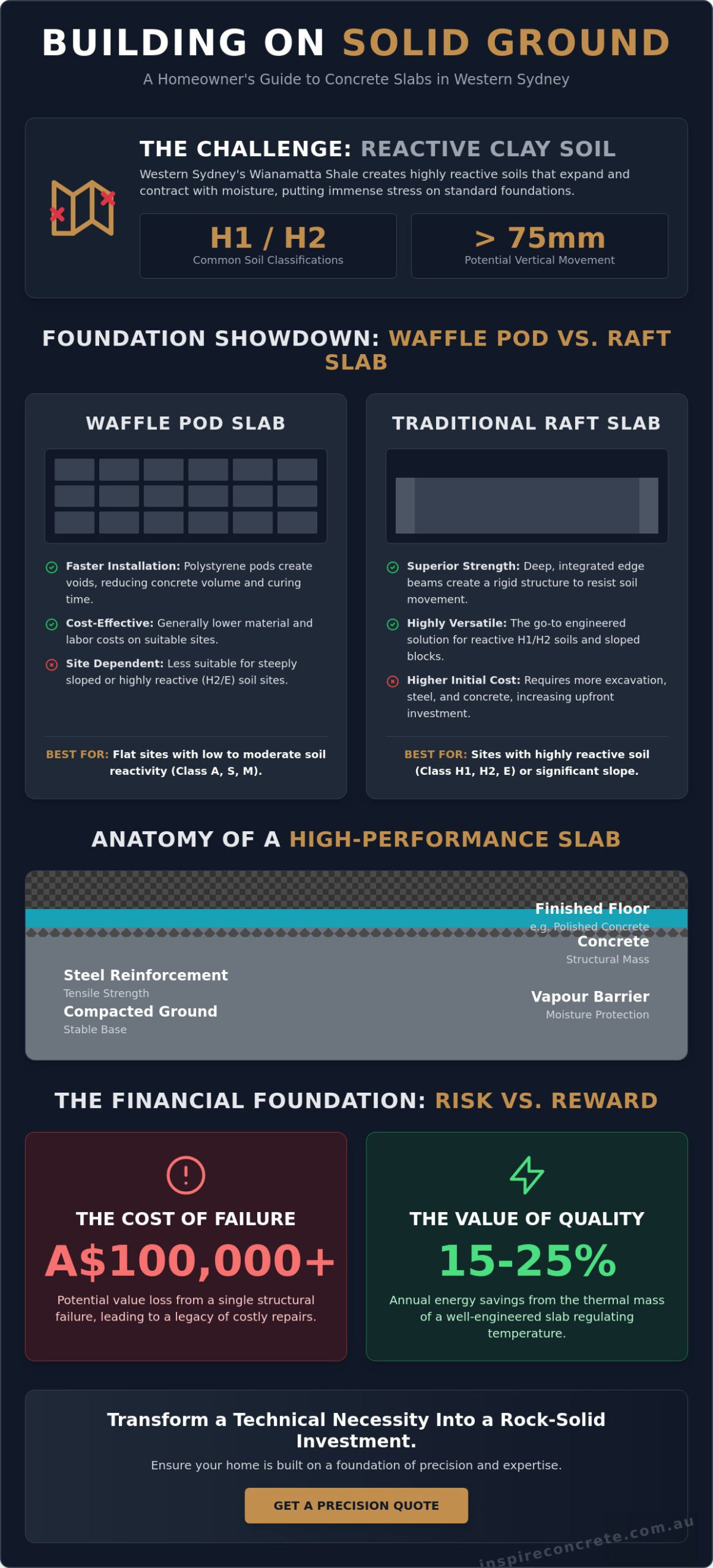
High-performance foundations require more than just pouring wet mix into a frame. The process starts with a high-quality vapor barrier. This heavy-duty plastic prevents ground moisture from seeping into your floor, which is vital during Western Sydney’s humid summer months. We integrate steel reinforcement, including mesh and trench mesh, to provide the tensile strength concrete lacks on its own. Most modern residential projects utilize Slab-on-grade or floating slab foundations to distribute the building’s load across the surface. Edge beams and internal ribs act as the skeleton of this system, providing the stiffness needed to resist soil movement.
Why Foundation Choice Matters in 2026
Building in 2026 requires a focus on efficiency and longevity. With material costs rising, doing the job right the first time saves thousands in potential repairs. Your foundation choice also impacts your interior design. If you’re envisioning the elegant, seamless look of polished concrete, the initial pour requires a level of precision that standard slabs don’t always meet. Beyond aesthetics, the thermal mass of a well-engineered slab is a secret weapon against rising energy costs. It absorbs heat during the day and releases it at night. This natural regulation can reduce annual heating and cooling bills by 15% to 25%, a crucial benefit for families facing Western Sydney’s extreme temperature swings.
The Impact of Western Sydney’s Reactive Clay Soils on Slab Design
Western Sydney’s landscape is defined by the Wianamatta Shale group, a geological formation that produces some of Australia’s most challenging reactive clay soils. These clays act like a sponge; they expand significantly when absorbing moisture and contract as they dry out. For house slab builders western sydney, this constant movement represents a primary engineering hurdle. Building a durable foundation in growth corridors like Oran Park or Marsden Park requires more than just pouring concrete; it demands a bespoke approach to structural integrity that accounts for these shifting subterranean forces.
Soil reactivity is measured through specific classifications outlined in Australian Standard AS 2870. While Class M (Moderately reactive) sites are common, many new estates in Western Sydney fall into H1, H2 (Highly reactive), or even E (Extremely reactive) categories. In these zones, the ground can move more than 75mm vertically between seasons. If a builder provides a “standard” quote without first reviewing a site-specific geotechnical report, they’re likely overlooking the thousands of dollars in extra steel and concrete required to stiffen the slab against these movements. Reviewing the Consumer Building Guide from NSW Fair Trading can help you understand your rights when builders present these necessary site-related costs.
Soil Testing and Geotechnical Reports
A Borehole test is the non-negotiable first step for any reputable project. Engineers drill deep into the lot to extract samples, determining the “Characteristic Surface Movement,” labeled as ys in your report. This numerical value dictates the entire skeleton of your foundation. Higher ys values require deeper edge beams and wider internal ribs to prevent the slab from cracking under pressure. Experienced house slab builders western sydney use this data to calculate the exact volume of concrete needed to ensure the home remains level for decades, regardless of the clay’s temperament.
Managing Moisture and Drainage
The long-term performance of a Western Sydney slab depends heavily on how moisture is managed around the perimeter. Our region’s climate, characterized by 40-degree summer days and sudden winter deluges, creates a volatile environment for clay. This volatility often leads to soil heave. Soil heave refers to the upward movement of the ground caused by the expansion of clay as it absorbs moisture, potentially lifting the slab and causing structural cracking if not managed through precise engineering. To mitigate this risk, we focus on integrated drainage solutions and apron slabs that direct water away from the foundation. You can consult with our experts to see how we transform these technical challenges into a stable, elegant foundation for your lifestyle.
- Class M: 20mm to 40mm of expected movement.
- Class H1/H2: 40mm to 75mm of expected movement.
- Class E: Upwards of 75mm, requiring specialized piering or heavy-duty waffle pods.
Comparing Slab Types: Waffle Pod vs. Traditional Raft Foundations
Choosing the right foundation is the most critical decision in your build. Expert house slab builders western sydney prioritize the site soil classification above all else. In the Greater Western Sydney region, where reactive clay is the norm, the choice usually sits between a modern waffle pod system or a traditional raft slab. Both options offer distinct engineering advantages; however, the local terrain often dictates which method will ensure your home remains level for the next fifty years.
Waffle Pod Slabs: The Modern Standard
Waffle pod slabs have become the dominant choice for new estates in suburbs like Marsden Park and Oran Park. These systems sit directly on the ground rather than being trenched into it. This method utilizes a grid of high-density polystyrene blocks to create internal concrete beams. This design offers a significant thermal benefit; the pods provide an insulation layer that helps homes meet the 7-star energy ratings required by the National Construction Code (NCC) 2022 and 2025 updates. Most waffle systems achieve an added R-value of approximately 1.0, keeping floors warmer in winter.
The ground moves. Your foundation shouldn’t. Waffle pods are ideal for level sites with controlled drainage. On highly reactive clay (Class H1 or H2), they provide excellent stiffness. They’re also faster to install. A skilled crew can often lay the pods and reinforcement for a standard 200-square-meter home in a single day. This efficiency translates to lower labor costs for the homeowner. You must ensure your builder manages surface water correctly, as waffle slabs are sensitive to “edge heave” if the surrounding soil becomes saturated.
Traditional Raft Slabs: The Heavy-Duty Alternative
Traditional raft slabs, or “in-ground” slabs, remain the gold standard for challenging Western Sydney blocks. These foundations involve digging deep trenches into the earth for the perimeter and internal beams. This creates a solid “raft” that anchors the home. We recommend this approach for sloping sites or “E” class (extremely reactive) soils often found near the foothills of the Blue Mountains. The process is more labor-intensive and requires more concrete, but the structural integrity is unmatched for custom, high-end builds. The same engineering principles that govern residential foundations also apply when planning shed slabs in Sydney, where reactive clay and drainage management are equally critical considerations for a durable outcome.
- Longevity: Raft slabs offer superior resistance to ground movement on sites with mature trees or varying moisture levels.
- Site Versatility: They’re the preferred choice when the building footprint requires significant excavation or “cut and fill” work.
- Solid Feel: Many homeowners prefer the dense, grounded feel of a raft slab, which provides a permanent sense of security.
When you work with professional house slab builders western sydney, the goal is to balance your budget with the long-term stability of the structure. While a raft slab might cost 15% to 25% more than a waffle pod system depending on the site, the investment prevents costly cracking in the future. We view the foundation as a bespoke piece of engineering. It’s the silent partner in your home’s design that ensures every tile stays flat and every door swings true for decades to come. For a broader understanding of how concrete slab engineering in Sydney responds to NCC regulations and AS 2870:2011 standards, our essential guide provides the technical depth to inform your decision.
How to Vet House Slab Builders in Western Sydney: A Buyer’s Checklist
Your foundation is the silent partner of your home. It holds every brick and beam in place. When you evaluate house slab builders western sydney, you aren’t just buying concrete; you’re investing in the engineering that prevents your walls from cracking five years down the line. The current market demands a level of scrutiny that goes beyond a basic price comparison. You need a partner who understands the reactive clay soils common in the Greater West and the rigorous standards of the Home Building Act 1989.
Verifying credentials is your first line of defense. Every contractor must hold a valid NSW Fair Trading license. For any residential project exceeding A$20,000, they must provide proof of Home Building Compensation Fund (HBCF) insurance. This isn’t optional. It’s a legal safeguard that protects your investment against major structural defects or business insolvency. A reputable builder will present these documents with pride, showing a commitment to transparency and professional integrity.
Experience in the local landscape is equally vital. A builder with 20 years of experience in Sydney has seen how different soil classifications, from Class M to H2, respond to the region’s erratic weather cycles. They don’t just pour; they manage the entire “Formwork to Finish” lifecycle. This integrated approach ensures that the excavation, steel reinforcement, and final trowel work are handled by a single, accountable team. It eliminates the risk of communication breakdowns between sub-contractors that often lead to costly delays.
Critical Questions for Your Concreter
- Do you handle the architectural drafting and engineering liaison? A master craftsman works closely with your engineer to ensure the slab design meets the specific load-bearing requirements of your home.
- What is your process for managing site access and concrete pump logistics? Western Sydney blocks can be tight. Your builder needs a clear plan for pump placement and traffic management to avoid damaging neighboring properties.
- How do you ensure the slab remains level for my specific floor finishes? Whether you’re installing bespoke timber flooring or large-format tiles, the surface tolerance must be exact. Ask about their use of laser leveling technology.
Red Flags in Foundation Quotes
Precision begins with the quote. Beware of “lump sum” figures that lack technical detail. A professional quote should specify the concrete strength in MPa, the total steel tonnage, and the thickness of the vapor barrier. If a builder hasn’t performed a site inspection before quoting, they’re guessing. This often leads to expensive variations once the first shovel hits the dirt. Using unlicensed “cowboy” builders for structural work is a gamble that risks the long-term value of your property. Cheap foundations often result in expensive repairs that far exceed the initial savings. The same scrutiny applies whether you’re commissioning a full residential foundation or evaluating quotes for durable shed slabs engineered for Sydney’s reactive soil conditions.
Secure your project’s future by partnering with a team that values precision and structural excellence. Request a detailed site assessment from the experts at Inspire Concrete today.
Building Your Future with Inspire Concrete’s Foundation Expertise
Inspire Concrete doesn’t just pour foundations; we engineer the structural heart of your home. We’ve built a reputation as the premier house slab builders western sydney residents rely on by merging rigorous technical engineering with a refined aesthetic touch. Every project begins with a deep dive into the specific topography of your site. We don’t believe in a one-size-fits-all approach because the ground beneath your feet demands better.
Our “Sydney-First” methodology acknowledges that Western Sydney’s soil is unique. From the highly reactive Wianamatta Shale clays found in Blacktown to the varied terrains of the Hills District, we design slabs that exceed the AS 2870-2011 residential slab and footing standards. By 2026, council requirements for thermal performance and drainage have become more stringent. Our designs anticipate these shifts to ensure your home remains compliant and stable for decades. It’s about creating a legacy of durability.
Whether you’re adding a 60-square-metre granny flat to a Penrith backyard or constructing a sprawling 500-square-metre luxury residence in Oran Park, our solutions scale to match your ambition. We maintain a 98% on-time completion rate across our residential projects, driven by a commitment to precision and sophisticated project management. We don’t just meet expectations; we define the standard for house slab builders western sydney through transparency and technical mastery.
Integrated Solutions: Beyond the Slab
Your foundation shouldn’t exist in isolation. We plan your slab with the foresight to integrate seamlessly with your future outdoor living spaces. This includes pre-calculating levels for Exposed Aggregate Driveways Sydney, ensuring a flush, trip-free finish between your internal living areas and external alfrescos. Many homeowners also choose to extend their project scope by investing in a concrete patio in Sydney that complements their new foundation, creating a seamless transition between indoor comfort and outdoor entertaining. Our crews maintain a clean, professional worksite throughout the build. We treat every Western Sydney street with the respect it deserves, keeping dust and debris to a minimum to ensure your neighbours are as happy with the process as you are.
Start Your Project with a Professional Quote
Precision begins long before the first concrete truck arrives on site. Our detailed architectural drafting and project management service removes the guesswork from the equation, providing a clear roadmap for your build. This clarity is why 85% of our new business in Western Sydney comes from word-of-mouth referrals and repeat builder partnerships. We provide a transparent breakdown of structural requirements so you know exactly where your investment is going. Don’t leave your home’s integrity to chance.
Request a comprehensive foundation quote from Inspire Concrete and secure the structural integrity of your next Western Sydney build with the experts who care about the details.
Lay the Groundwork for a Lasting Legacy
A home is only as resilient as the ground it stands on. Navigating Western Sydney’s unique construction landscape requires more than just pouring concrete; it demands a deep understanding of the region’s reactive clay soils and precise structural engineering. By prioritizing fully licensed and HBCF insured professionals, you ensure your 2026 project maintains its structural integrity for decades to come. Whether you opt for a waffle pod or a traditional raft foundation, the technical execution must be flawless to mitigate the risks of shifting soil.
Partnering with the most reliable house slab builders western sydney has to offer transforms a complex engineering challenge into a seamless start for your build. With over 20 years of Sydney concreting experience, Inspire Concrete brings a blend of rugged trade expertise and refined craftsmanship to every site. We are specialists in reactive soil engineering, focusing on the long-term value and durability your property requires. It’s time to move from planning to reality with a team that treats your foundation as the masterpiece it is.
Get a Professional House Slab Quote for Your Western Sydney Build
Your vision deserves a foundation that’s built to endure, so let us inspire the confidence you need to start building something remarkable today.
Frequently Asked Questions
How much does a house slab cost in Western Sydney?
Expect to pay between A$85 and A$125 per square metre for a standard residential slab in 2026, depending on site access and soil reactivity. These figures align with current NSW construction benchmarks for residential foundations. Factors like the slope of your land or the need for additional piering can increase these costs. We provide detailed quotes that reflect the precise engineering required for your specific Western Sydney block.
Do I need a separate builder for excavation and concreting?
You don’t need to hire separate contractors because Inspire Concrete provides a seamless, end-to-end service. We manage the entire process from the initial site scrape and excavation to the final pour and finish. This integrated approach ensures structural integrity isn’t compromised between stages. As leading house slab builders Western Sydney, we streamline your project timeline and eliminate the communication gaps often found when juggling multiple trades.
What is the difference between an H1 and H2 soil classification?
The primary difference lies in the expected surface movement, with H1 soil moving 40mm to 60mm and H2 soil experiencing 60mm to 75mm of movement. These classifications come from the AS 2870 standard for residential slabs. H2 sites require more robust engineering, often involving thicker slabs or increased steel reinforcement. Understanding your soil’s reactive nature is the first step to a foundation that lasts a lifetime.
How long does it take to pour and cure a standard house slab?
A standard house slab typically takes 5 to 10 days to prepare and pour, followed by a 28-day chemical curing period. While the concrete reaches about 75% of its strength within the first 7 days, we follow strict industry protocols to ensure the slab achieves its full design strength. Weather conditions in Western Sydney can influence these timelines, but our team manages the schedule to keep your build on track.
Can I build a granny flat slab on reactive clay soil?
You can definitely build a granny flat on reactive clay by using a waffle pod system or deep-edge beams designed for high reactivity. Western Sydney is known for its clay-heavy soil, which expands and contracts significantly with moisture changes. As experienced house slab builders Western Sydney, we use engineered solutions that allow the structure to resist movement. This protects your investment from unsightly wall cracks and door jams.
Does Inspire Concrete handle council approvals and engineering?
We partner with qualified structural engineers and private certifiers to ensure your foundation meets all NSW Building Code requirements. While the homeowner usually holds the primary DA or CDC approval, we handle the technical documentation and onsite inspections required for the slab pour. This collaboration ensures every project is backed by professional certification. We take the guesswork out of compliance so you can focus on the design.
What happens if my house slab cracks?
Most minor hairline cracks are a natural result of drying shrinkage and don’t affect the structural integrity of the home. However, if a crack exceeds 2mm in width, it may require professional assessment according to Australian Standard AS 2870. We design our slabs with strategic expansion joints and high-grade reinforcement to minimize this risk. Our commitment to excellence means we’re here to inspect and advise if you notice any unexpected movement.
Why is steel reinforcement so important in Sydney foundations?
Steel reinforcement is vital because concrete has high compressive strength but lacks the tensile strength to resist pulling forces. In the shifting soils of Sydney, steel mesh like SL82 or SL92 acts as the skeleton of your foundation. It holds the concrete together under stress and prevents minor movements from becoming major structural failures. We use premium Australian steel to ensure your home stands on a foundation of absolute certainty.
